
STEADI: intervene
How Permanent DST Affects Senior Sleep and Fall Risk
Learn how permanent daylight saving time disrupts seniors' already fragile sleep cycles and increases fall risk, then follow three actionable home modifications — lighting upgrades, morning light therapy, and medication timing adjustments — to protect your parent starting tonight.
The hard part of how permanent daylight saving time affects seniors’ sleep is not the one lost hour in spring. It is the older parent who wakes at 3:40 a.m. because their body thinks the night is over, then has to cross a dark bedroom, hallway, or bathroom path while the clock still says everyone else should be asleep.
That timing problem starts before any law or clock change enters the room. Around age 60 to 65, many people’s circadian rhythms shift earlier, with sleepiness arriving closer to 7–8 p.m. and waking closer to 3–4 a.m.; Sleep Foundation describes this age-related shift as a normal circadian phase advance, not a character flaw or a simple matter of “bad sleep habits.” [1]
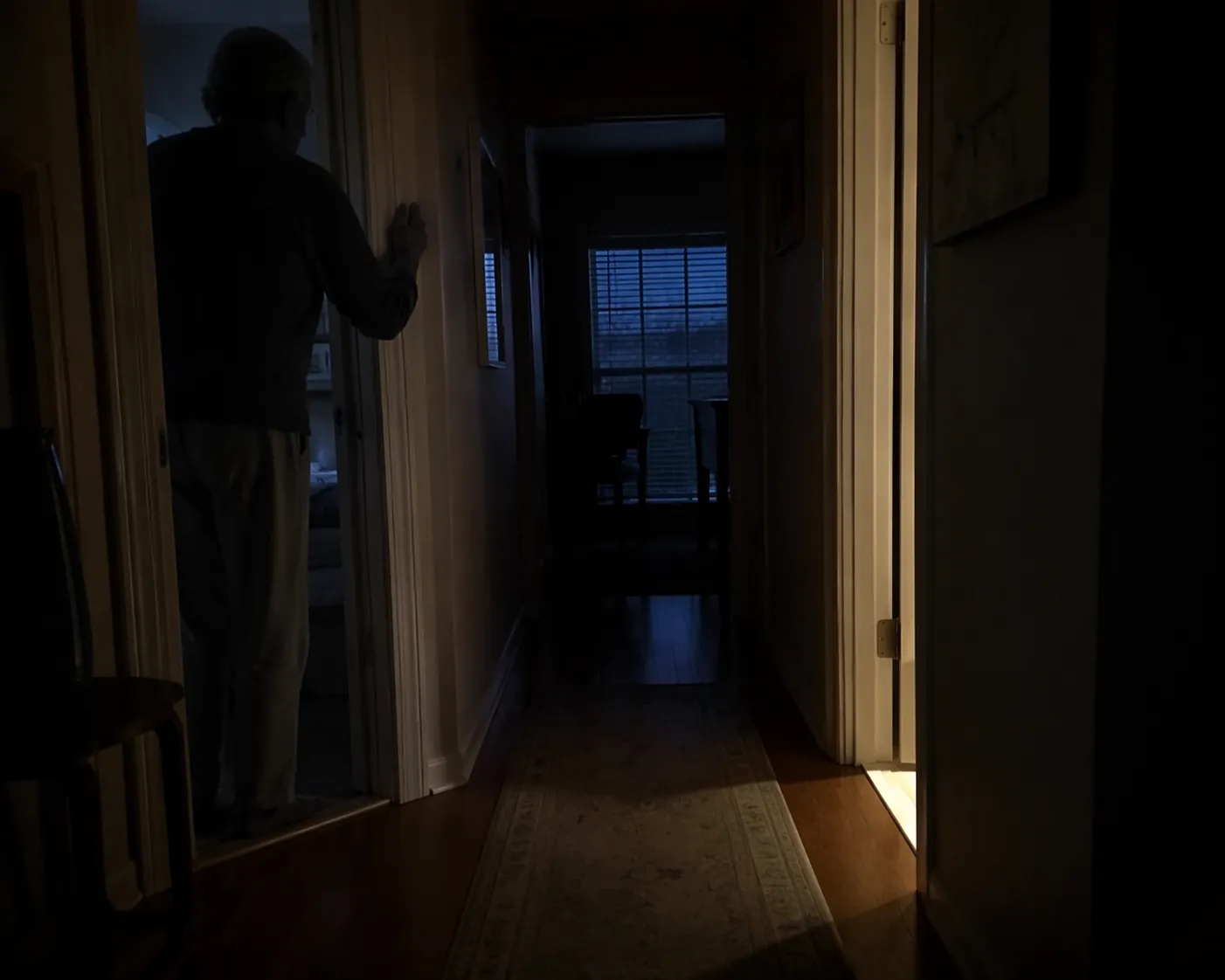
Permanent daylight saving time would push the social clock later against that already-early body clock. Morning light arrives later by the clock, while the senior’s internal wake signal may still come early. The American Academy of Sleep Medicine’s position statement is blunt about the chronic part: “The body clock does not fully adjust to DST even after several months,” with chronic sleep debt and circadian misalignment persisting beyond the first adjustment period. [2]
That is why telling an older adult to “just adjust” misses the point. A younger adult may complain about dark mornings and still move through the house quickly. A frailer adult may wake into darkness, feel chilled, need the bathroom, and stand up before vision, balance, and blood pressure have caught up.
Why the sleep problem becomes a fall problem
The sleep-to-fall connection does not require a dramatic theory. Reduced sleep can affect balance, gait stability, attention, and reaction time in older adults; senior-care guidance on daylight saving time repeatedly flags these effects as practical fall-risk concerns, especially during disrupted sleep periods. [3][4]
There is an important evidence line here. The support is strongest for the chain: daylight saving time can disrupt circadian timing; poor or shortened sleep can impair balance and reaction time; impaired balance and reaction time make a dark walk to the bathroom more dangerous. There is not a clean DST-specific clinical trial proving that one exact hallway light prevents one exact fall under permanent daylight saving time. I would not wait for that trial before lighting the route from bed to toilet.
The practical target is the predictable danger window: very early morning, before sunrise, when the senior is awake but the house is not ready for them.
Start with the route they actually walk in the dark
Lighting is the first home modification because it does not ask the older adult to sleep differently tonight. It changes what happens if they wake up anyway.
The Fall Prevention Foundation’s senior lighting guide is a practical nonprofit resource, not a peer-reviewed DST intervention trial. Still, its recommendations are concrete enough to inspect a home with a shopping list instead of a vague promise to “make it brighter.” It recommends general room lighting of at least 800 lumens, color rendering index of 80 or higher, and warm white bulbs in the 2700K–3000K range. [5]
| Home area | What to change | Why it matters during dark DST mornings |
|---|---|---|
| Bedroom | Add floor-level LED strips from bed to door; keep the switch or motion sensor reachable before standing. | The first few steps happen before the person is fully awake and oriented. |
| Hallway | Place lights every 6–8 feet, with warm, even illumination rather than one harsh overhead glare point. | A long dark stretch invites wall-touching, shuffling, and missed obstacles. |
| Bathroom path | Use motion-activated nightlights near the toilet and along the sink path. | Bathroom urgency is one of the few reasons a sleepy person will walk even when they should pause. |
| Stairs | Install step lights so each tread edge is visible. | Depth perception is worse when the stair edge disappears into shadow. |
| Main rooms used before sunrise | Use bulbs rated at least 800 lumens, CRI 80+, and warm white 2700K–3000K. | The room should be bright enough to navigate without feeling like a cold examination room. |
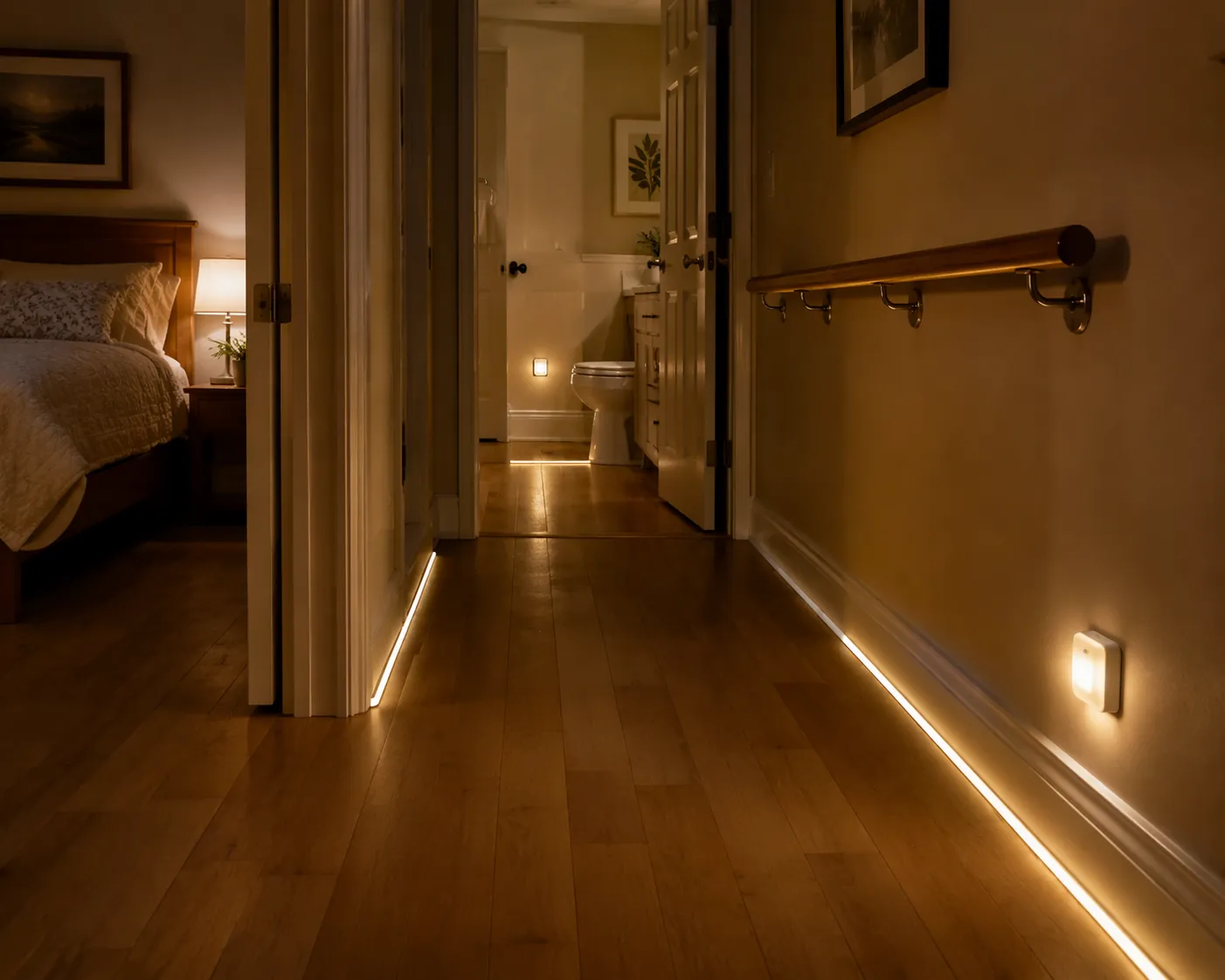
Do the bed-to-bathroom route first. Not the guest room. Not the pretty lamp in the living room. Stand where your parent’s feet hit the floor, turn off the overhead lights, and walk the route they take at 3 or 4 a.m. If you have to reach for the wall, step around laundry, guess where the threshold is, or turn on a blinding bathroom light, the route is not ready.
A useful lighting upgrade is boring on purpose
Avoid making the home look like an airport runway. Older eyes need enough contrast and even illumination, but a sudden blast of bright light can be disorienting and may make it harder to return to sleep. Warm, low-positioned, motion-triggered lighting is usually more useful for the overnight path than one powerful ceiling fixture that switches the whole room from black to white.
- Put a motion nightlight inside or just outside the bathroom, aimed toward the toilet and sink route rather than into the person’s eyes.
- Use floor-level lighting from the bed toward the door so the first direction cue is visible before standing.
- Check for shadows at thresholds, rugs, walkers, oxygen tubing, pet beds, and laundry baskets.
- If there are stairs between bedroom and bathroom, treat that as an urgent layout problem, not a lighting-only problem.
This is also where caregivers should be honest about habit. If your parent refuses to use a bedside lamp because it feels like too much fuss, the lamp is decorative. A motion light that turns on before they decide anything has a better chance of working.
Use morning light as a clock cue, not as a lecture
Lighting the floor protects the body when the senior is already awake. Morning light works on the sleep side of the problem. Light is one of the main signals the circadian system uses to set timing, and daylight saving time changes the relationship between clock time and natural morning light. [6]
A reasonable caregiver routine is simple: aim for 10–30 minutes of outdoor light before 10 a.m. when weather and mobility allow. This does not have to mean a brisk walk. It can be coffee near a bright window with a short step outside afterward, sitting on a porch, or walking to the mailbox with supervision if needed.
The timing matters. Bright light late in the evening can push sleep later, which may worsen the problem for an older adult whose sleep is already fragile. Morning light gives the body a clear daytime cue without trying to force bedtime through willpower.
On cloudy days, in winter, or when getting outside is not safe, a light therapy lamp can be an alternative. Treat it like a tool, not a casual gadget: use it in the morning, keep it positioned according to the manufacturer’s instructions, and ask the clinician before use if the senior has an eye condition, bipolar disorder, or medications that increase light sensitivity.
What morning light can and cannot do
Morning light may help reinforce a steadier sleep-wake rhythm. It does not erase the fact that permanent daylight saving time delays morning light by the clock. It also does not make a 3:30 a.m. bathroom trip safe by itself. That is why the light routine belongs beside the hallway fix, not instead of it.
Medication timing needs a pharmacist, not guesswork
Some caregivers can move dinner or bedtime in small increments without much risk. Medication schedules are different. Guidance for seniors navigating daylight saving time flags several time-sensitive categories, including insulin, Parkinson’s medications, and blood pressure medications; schedule changes should be gradual over 3–4 days and checked with a pharmacist or prescribing clinician. [3][4]
This matters because a sleepy, dark morning is already a balance problem. Add mistimed blood pressure medication, a missed Parkinson’s dose, or a diabetes routine that was shifted casually, and the caregiver may have created a second risk on top of the clock change.
- Before changing insulin timing, ask the pharmacist or diabetes clinician how to shift meals, glucose checks, and doses together.
- Before changing Parkinson’s medications, ask how much timing flexibility exists and what symptoms to watch for during the shift.
- Before changing blood pressure medications, ask whether morning dizziness, nighttime bathroom trips, or standing blood pressure should affect the plan.
- If pills are managed in a weekly organizer, update the written schedule before refilling the box.
The safest question is not “Can we move everything by an hour?” It is “Which of these medications are time-sensitive, and if the household schedule shifts, how should we adjust over several days?”
A brief word on the policy debate
Sleep medicine groups have not treated permanent daylight saving time and permanent standard time as equal. The AASM position statement favors permanent standard time for health and safety and argues that daylight saving time produces chronic circadian misalignment. [2]
That policy argument is worth knowing, but it does not help much at 3:40 a.m. Caregivers still have to make the home safer under the clock system they are given. The useful question is where the mismatch shows up in daily life: dark waking, unsafe walking routes, weak morning light cues, and medication routines that were never reviewed for a shifted schedule.
Tonight, then this week
Tonight, light the route before bedtime. Put temporary plug-in motion nightlights where the permanent fixtures should eventually go: bed edge, doorway, hallway turn, bathroom entrance, toilet path, and sink path. Remove anything that makes the person step over, around, or through an obstacle while half-awake.
This week, replace weak bulbs in the main rooms your parent uses before sunrise, add floor-level lighting where overhead light is either absent or too harsh, and check hallway spacing. Use the practical lighting targets as a guide: at least 800 lumens for general room lighting, CRI 80+, warm white 2700K–3000K, hallway lights every 6–8 feet, step lights on stairs, and motion nightlights in the bathroom path. [5]
Also this week, plan a morning light routine before 10 a.m. and message the pharmacist before shifting insulin, Parkinson’s medications, blood pressure medications, or any drug you have been told to take at a specific time. Permanent DST may be outside your control. Darkness, light timing, and medication timing are not.
References
- Circadian Rhythms and Aging — Sleep Foundation.
- Permanent standard time is the optimal choice for health and safety: an American Academy of Sleep Medicine position statement — Journal of Clinical Sleep Medicine, 2024.
- A Guide for Seniors Navigating Daylight Savings — Northbridge Communities.
- Fall Back Safely: Understanding Daylight Saving Time's Impact on Seniors and How Home Care Can Help — Amy's Helping Hands.
- Senior-Friendly Home Lighting for Fall Safety: Creating a Safer Living Environment for Aging Adults — Fall Prevention Foundation, May 31, 2025.
- Daylight Saving Time and Sleep — Sleep Foundation.
Related reading
Noticed something outdated or inaccurate on this page? Flag a correction. We review every report against CDC, NIA, and AARP HomeFit guidance before updating a page.
Part of the Fall Prevention section.