
STEADI: intervene
Post-Earthquake Fall Prevention Checklist for Senior Travelers
This crisis checklist helps senior travelers and their caregivers avoid falls in the immediate aftermath of an earthquake while away from home. It covers the unique hazards—broken glass, debris, wet floors, unfamiliar layouts—that standard earthquake guides and senior travel checklists miss.
The shaking has stopped. If you are an older adult in a hotel room, vacation rental, cruise cabin, airport lounge, or unfamiliar apartment, the next danger may not be the earthquake itself. It may be the first hurried step onto glass, wet flooring, a shifted rug, a fallen lamp cord, or a bathroom threshold you forgot was there.
This travel safety checklist for seniors after an earthquake is built around that first minute. The American Red Cross tells people to wait a minute before getting up, expect broken glass and debris on the ground, and put on sturdy shoes as soon as possible.[1] The CDC also notes that many earthquake-related injuries and deaths are caused by falling or flying objects, or by people being knocked to the ground.[2] For older adults, that matters because falls are already the leading cause of injury in this age group.[3]
There is not good evidence measuring exactly how often senior travelers fall in hotels after earthquakes. The risk here is a careful synthesis: earthquakes create debris, darkness, water, panic, and displaced furniture; older adults are more vulnerable to serious injury from falls; and travelers are moving through rooms they did not set up themselves.
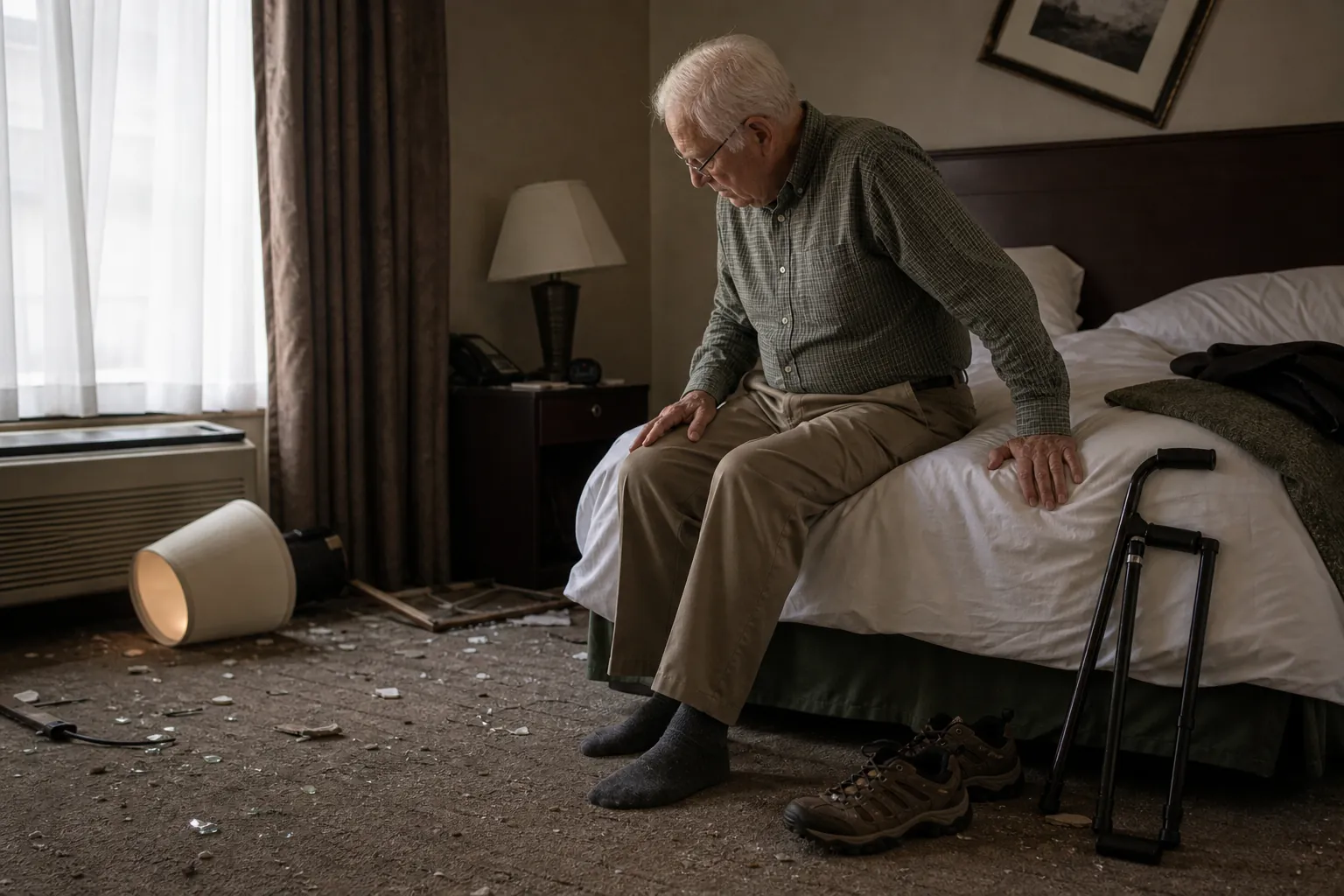
The first 60 seconds: do not stand up yet
If you are in bed, on a chair, or on the floor and the shaking has just stopped, stay where you are for a moment unless there is immediate danger from fire, collapse, or another clear threat. The purpose of this pause is not passivity. It is to stop your body from making the most dangerous move before your eyes, feet, hands, and balance aids are ready.
| What to do | Why it matters for fall prevention |
|---|---|
| Wait about 60 seconds before getting up. | Aftershocks, falling items, darkness, and disorientation can make the first movement unsafe. |
| Keep sitting or stay in bed if you cannot clearly see the floor. | You cannot avoid glass, water, cords, or debris you cannot see. |
| Find glasses, hearing aids, phone, and flashlight before walking if they are within reach. | Poor vision, poor hearing, and no way to call help all increase risk once you stand. |
| Put on sturdy shoes before taking steps, but only if reaching them does not require an unsafe lean. | Bare feet on glass or wet flooring can start a fall or cut off a safe evacuation route. |
| Bring the walker, cane, or wheelchair into position before standing. | The mobility aid needs to be reachable before weight shifts onto unsteady feet. |
| Scan the path before moving toward the door, bathroom, or hallway. | Unfamiliar layouts hide thresholds, corners, furniture legs, luggage straps, and wet spots. |
Start with your feet. Do not make a barefoot bathroom trip. Do not step over a broken picture frame to reach slippers with smooth soles. If sturdy shoes are beside the bed, put them on while seated. If they are across the room and the floor is not visible, call the front desk, a travel companion, or emergency services before trying to reach them.
Then check what your hands need to do. A phone in one hand and a cane in the other may leave no hand free for balance. If you use a walker, make sure it has not rolled away, tipped, or become tangled with bedding or luggage. If it has wheels, check that it is stable before using it to stand. If you use a wheelchair, lock the wheels before shifting weight; the Earthquake Country Alliance includes “Lock, Cover, and Hold On” as an alternative for people who have difficulty getting to the ground during shaking.[4]
Now look low, not high. The ceiling may be frightening, but the next injury may be at ankle level: broken glass from a framed print, sprinkler water, a tipped trash can, a fallen lamp, a suitcase that slid into the walking path, or a drawer that opened during shaking. Hotel rooms can look simple in daylight and become confusing at night after furniture has shifted.
Stay put, call, or move: make the next step earn its keep
Some guidance for older adults says that if you are in bed or sitting down, you should not get up immediately after an earthquake. Other earthquake guidance tells people to put on sturdy shoes and move to a safe area. Those instructions are not really opposites if they are put in the right order.
- Pause first. Let falling items settle and notice whether you are dizzy, injured, or disoriented.
- Stay seated or in bed if standing would put you onto unseen glass, water, or debris.
- Reach only for essentials that are close enough to get without leaning dangerously: glasses, hearing aids, phone, flashlight, shoes, cane, walker, or medical alert device.
- Move only if the path is visible, footwear is protective, and the mobility aid is ready.
- If the path is not safe, call for help instead of testing it with your body.
A hallway is not automatically safer than a room. It may have fallen ceiling tiles, crowding, fire doors, sprinkler water, or people rushing toward stairs. A lobby is not automatically safer either, especially if elevators are out and stairwells are crowded. The better question is narrower: can you get from here to there without being knocked down, cut, separated from your walking aid, or forced to move faster than your balance allows?
If you smell gas, see fire, hear instructions to evacuate, or are told by hotel staff or local officials to leave, evacuation may be necessary. But for a senior traveler, evacuation still needs fall-prevention steps: shoes on, glasses on, medication and phone if they are reachable, mobility aid in hand, and no rushing into stairs without seeing the first few steps.
If you are the caregiver on the phone
A frightened parent may start with “I’m fine” or “I’m getting out.” Slow the call down before giving instructions. The safest caregiver voice is plain, short, and specific. You are not trying to diagnose the building. You are trying to keep one person from standing into a fall hazard while help and information catch up.
- “Are you still in bed or sitting down?”
- “Can you see the floor from where you are?”
- “Do you have your glasses on?”
- “Are your hearing aids in, or can you hear me clearly enough?”
- “Where are your shoes? Can you reach them without standing?”
- “Where is your cane, walker, or wheelchair?”
- “Do you see glass, water, cords, fallen lamps, open drawers, or anything blocking the path?”
- “Is hotel staff giving instructions, or do you hear an alarm?”
Do not ask a shaken older adult to inspect the whole room. Ask about the next six feet. Bed to shoes. Chair to walker. Walker to door. Door to hallway. If the answer is uncertain, treat the path as unsafe until someone in the building can help.
If your parent says the room is dark, ask whether a phone flashlight, bedside lamp, or travel flashlight is within reach. If the light source is across the room, do not make that the first mission. A dark walk to get a flashlight defeats the point of having one.
If they say they are going to the bathroom, stop there. Bathrooms after earthquakes can have water, tile, glass, loose toiletries, and tight turns. Ask whether the need can wait until the floor is checked or help arrives. This is an uncomfortable sentence to say to a parent, but it is better than a wet-floor fall behind a hotel bathroom door.
If they are injured, dizzy, confused, short of breath, bleeding, trapped, or unable to stand safely, call local emergency services or ask hotel staff to do it immediately. Stay on the line if possible. If phone service is poor, send a short text with their name, hotel, room number, condition, and mobility needs.
Controlled movement after the room is scanned
Once the floor is visible and protective shoes are on, stand up slowly. Sit back down if you feel lightheaded. After an earthquake, adrenaline can hide pain for a few minutes, and a person who insists they are steady may still be moving too fast.
Use furniture carefully. A hotel dresser, rolling chair, minibar cabinet, or lightweight desk may have shifted or may not support weight. A mounted grab bar is different from a towel rack. A walker or cane is usually a better support than an unknown piece of furniture, if the aid is intact and positioned correctly.
If you must leave the room, take the simplest stable route. Keep one hand available when possible. Avoid carrying loose items in both hands. Do not drag rolling luggage through debris while also managing a cane or walker. If medication, ID, glasses, phone, and room key are reachable, take them; if reaching them creates a fall risk, call for help and wait.
Stairs deserve special caution. Elevators may be unavailable or unsafe after an earthquake, but stairwells can be crowded, poorly lit, wet, or damaged. If you use a walker, have poor vision, are dizzy, or cannot manage stairs without a rail and assistance, tell hotel staff exactly that. “I cannot evacuate stairs safely without help” is more useful than “I’m old” or “I’m slow.”
The next few hours: protect mobility, medication, and communication
After the first movement decisions, the fall risk does not disappear. It changes shape. Floors may stay wet. Power may fail. Crowds may gather in lobbies. Transportation may be disrupted. A senior traveler may be separated from luggage, chargers, medication, glasses, or mobility equipment just when routines have broken down.
The Illinois Emergency Management Agency and Office of Homeland Security advises seniors to keep walking aids nearby at all times and notes that falling objects can pose a special hazard because older adults may not be agile enough to reach cover quickly.[5] That advice matters after the shaking too: a cane left by the sofa, a walker folded in a closet, or a wheelchair parked across the room may as well be in another building if the floor between is unsafe.
- Tell hotel staff your room number, mobility limits, and whether you need help with stairs.
- Keep shoes on until broken glass, debris, and wet flooring are no longer a concern.
- Keep your phone, glasses, hearing aids, room key, ID, and medication together in one reachable place.
- Avoid wandering to inspect damage; let staff or local officials assess building conditions.
- Use travel assistance, hotel staff, tour staff, or local emergency services for medical care, evacuation coordination, or accessible transportation.
Travel assistance can be practical rather than abstract here. Travelex describes a travel earthquake protocol that includes contacting 24/7 travel assistance for medical care and evacuation coordination.[6] Insurance and assistance services vary by policy, but the useful point is the same: if a senior traveler cannot safely move through a damaged or disrupted setting, the plan should include a person or service that can help arrange the next safe move.
Pack the first minute before the trip begins
Preparation for this scenario is not a large emergency kit buried at the bottom of a suitcase. It is the placement of ordinary items so they can be reached from bed or a chair in a dark, unfamiliar room.
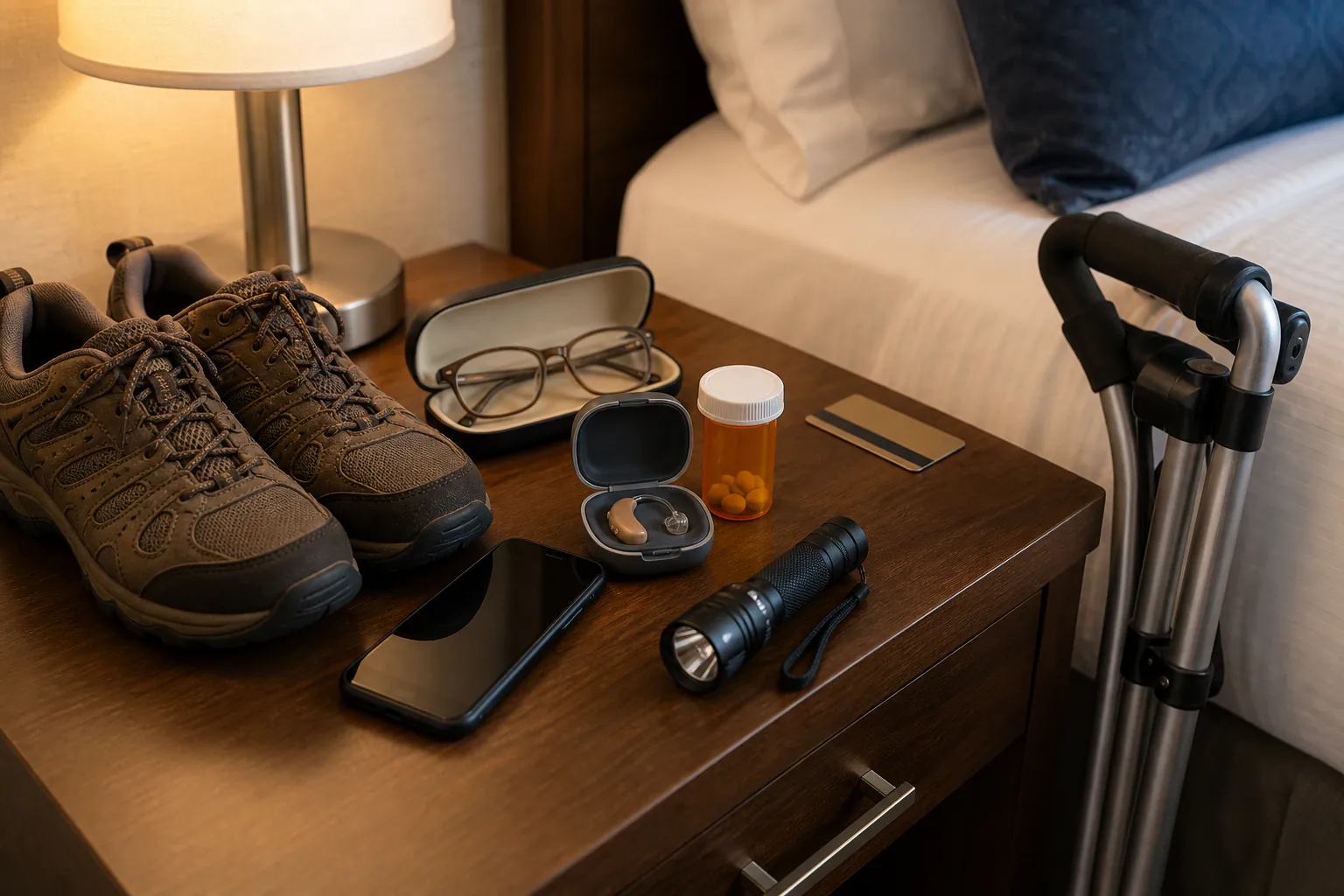
- Place sturdy closed-toe shoes beside the bed, not across the room.
- Keep the cane, walker, or wheelchair in the same reachable position every night.
- Put glasses, hearing aids, hearing aid batteries, phone, charger, flashlight, and room key together on the nightstand.
- Carry essential medications and medical equipment in carry-on luggage rather than checked bags.
- Wear or carry medical ID and keep an ICE contact visible in the phone or wallet.
- Write a short visual checklist in large print: wait, glasses, shoes, walker, scan floor, call, move slowly.
California Department of Aging preparedness materials emphasize practical communication and sensory supports for older adults, including extra hearing aid batteries, spare glasses, and written or visual checklists with short steps.[7] Those are not minor conveniences during travel. They are what let an older adult understand instructions, see hazards, and avoid improvising under stress.
HealthinAging.org, from the American Geriatrics Society’s Health in Aging Foundation, recommends carrying essential medications and medical equipment in carry-on luggage, along with medical identification and emergency contact information.[8] For earthquake travel planning, that advice has a fall-prevention angle: if a traveler is relocated, delayed, or moved to a lobby or shelter area, losing medication, glasses, or a mobility device can make every later transfer more dangerous.
Disaster planning for older adults also has to account for the fact that mobility limitations can delay or prevent urgent evacuation. The American Association for Geriatric Psychiatry disaster preparedness guide makes that point for older adults with physical disabilities and mobility limits.[9] A traveler who cannot descend stairs quickly, hear announcements clearly, or walk without a device needs that information named before a crisis, not discovered in a stairwell.
A hotel-room setup that makes the checklist possible
On arrival, take two minutes to arrange the room as if you might have to move through it half-awake. This is not anxious overplanning. It is the same kind of habit as checking where the bathroom is before turning out the light.
- Move loose luggage, shopping bags, and shoes out of the path from bed to bathroom and bed to door.
- Keep the walking aid on the side of the bed where you actually get up.
- Place sturdy shoes where they can be reached while seated.
- Keep a small flashlight or phone within arm’s reach, not charging across the room.
- Put glasses and hearing aids in a consistent container so they are not knocked loose on the nightstand.
- Ask the front desk about accessible evacuation procedures if stairs, distance, or crowds would be a problem.
Caregivers can do this without taking over the trip. A text before bedtime is enough: “Shoes by bed? Walker reachable? Glasses and phone on nightstand?” The point is not to make an independent traveler feel watched. It is to make sure independence still works if the room changes in the dark.
What this checklist does not replace
This is a fall-prevention checklist, not a full earthquake response plan. It does not replace local evacuation orders, emergency medical care, hotel staff instructions, or official public safety alerts. If authorities tell guests to evacuate, evacuate with the safest mobility support available. If there is fire, gas odor, structural collapse, severe injury, or immediate threat, call emergency services or get help from staff.
The checklist changes the first decision. It keeps “get out” from becoming “stand up barefoot in the dark,” and it keeps “stay put” from becoming “ignore a safer move when shoes, vision, and support are ready.” For senior travelers, the safest earthquake response is to pause, protect feet and mobility, scan the unfamiliar path, and move only when the next step is safer than staying still.
References
- “Earthquake Safety,” American Red Cross.
- “Safety Guidelines: After an Earthquake,” Centers for Disease Control and Prevention.
- “Falls and Fractures in Older Adults: Causes and Prevention,” National Institute on Aging.
- “Step 5: Drop, Cover, and Hold On,” Earthquake Country Alliance.
- “Earthquake Preparedness for Seniors,” Illinois Emergency Management Agency and Office of Homeland Security.
- “What to Do Before, During and After an Earthquake While Traveling,” Travelex Insurance.
- “Emergency Preparedness for Older Adults,” California Department of Aging.
- “Travel Tips for Older Adults,” HealthinAging.org, June 2019.
- “Disaster Preparedness for Older Adults,” American Association for Geriatric Psychiatry.
Related reading
Noticed something outdated or inaccurate on this page? Flag a correction. We review every report against CDC, NIA, and AARP HomeFit guidance before updating a page.
Part of the Fall Prevention section.