
STEADI: Intervene
Earthquake Preparedness Checklist for Seniors
A step-by-step earthquake preparedness checklist for older adults and their caregivers: what to secure in the home, what to pack for medications and mobility aids, and how to adapt Drop, Cover, and Hold On to a cane, walker, or wheelchair. It also explains why the old “stand in the doorway” advice is outdated and what to practice instead.
Most earthquake emergency preparedness checklists make one quiet assumption: the person reading can get to the floor, crawl under a table, find a flashlight without glasses, walk around broken glass, and manage several days of supplies without a medication gap. That is a poor fit for many older adults aging in place. A useful earthquake emergency preparedness checklist for seniors has to start with the body that will actually be in the room when the shaking starts: stiff knees, a cane by the bed, hearing aids on the charger, a walker parked in the hall, oxygen tubing, pill bottles, bifocals, and a very real risk of falling while trying to do the “right” thing too quickly.
The first correction is the most important one: do not stand in a doorway. The current instruction from ShakeOut is Drop, Cover, and Hold On, adapted for people who use a cane, walker, wheelchair, or cannot safely get to the floor [1]. Ready.gov also tells people not to run outside and not to stand in a doorway during an earthquake [2]. For an older adult, this is not a small etiquette update. Moving toward a doorway while the ground is shaking can turn a survivable event into a fall.
Practice the move before the earthquake: Drop, Cover, and Hold On, adapted
During shaking, the job is to get low if possible, protect the head and neck, and stay put until the shaking stops. ShakeOut’s guidance is plain: drop to hands and knees, take cover under a sturdy table or desk if one is nearby, and hold on until the shaking stops [1]. Ready.gov gives the same core advice and adds that if there is no nearby shelter, a person should get down near an interior wall or low furniture that will not fall, cover the head and neck, and stay away from windows [2].
That instruction needs rehearsal, not admiration. Many older adults cannot safely “drop” on command. Some can lower themselves to a chair but not the floor. Some can lock a rollator faster than they can turn around. Some need to protect glasses, hearing aids, or oxygen tubing while keeping both feet planted. The goal is not to perform a perfect emergency-drill posture. The goal is to avoid walking, running, transferring, or improvising while the floor is moving. The Red Cross warns that earthquake deaths and injuries can happen when people fall while trying to walk or run during shaking [3].
| If the older adult is... | Safer action to practice | What to avoid |
|---|---|---|
| Standing and able to get down safely | Drop to hands and knees, cover under a sturdy table or desk if close, protect the head and neck, and hold on until shaking stops [1][2]. | Do not run outside, cross the room, or try to reach a doorway [1][2]. |
| Standing with a cane | If getting to the floor is not safe, sit on a nearby sturdy chair or bed, bend forward as able, cover the head and neck, and hold on. Keep the cane where it will not slide away. | Do not take extra steps to retrieve a better cane, shoes, bag, or doorway position while the shaking continues. |
| Using a walker or rollator | Lock the wheels if the walker has brakes, get as low as safely possible, bend forward as able, cover the head and neck, and hold on to the walker or a stable surface [1]. | Do not try to walk across the room with the walker during shaking. |
| Using a wheelchair | Lock the wheels, stay seated, bend forward as able, cover the head and neck, and hold on until shaking stops [1]. | Do not transfer out of the chair unless there is an immediate danger that makes staying put impossible. |
| In bed | Stay there if it is safer than trying to stand. Protect the head and neck with a pillow, blanket, or arms until shaking stops. | Do not rush to the hallway or doorway in the dark. |
| Unable to get low | Stay seated or braced where they are, cover the head and neck, and keep the airway, oxygen tubing, and mobility aid from becoming tangled. | Do not treat “drop” as a command to fall. |
The doorway myth hangs on because it sounds simple. It also sounds like the kind of advice people remember from school drills or older relatives. The problem is that modern guidance does not treat ordinary residential doorways as the safest shelter. ShakeOut explains that doorways in modern buildings are generally not stronger than other parts of the structure and do not protect against flying or falling objects [1]. Ready.gov’s earthquake guidance says not to stand in a doorway [2]. For a person with balance trouble, the trip to the doorway is its own hazard.
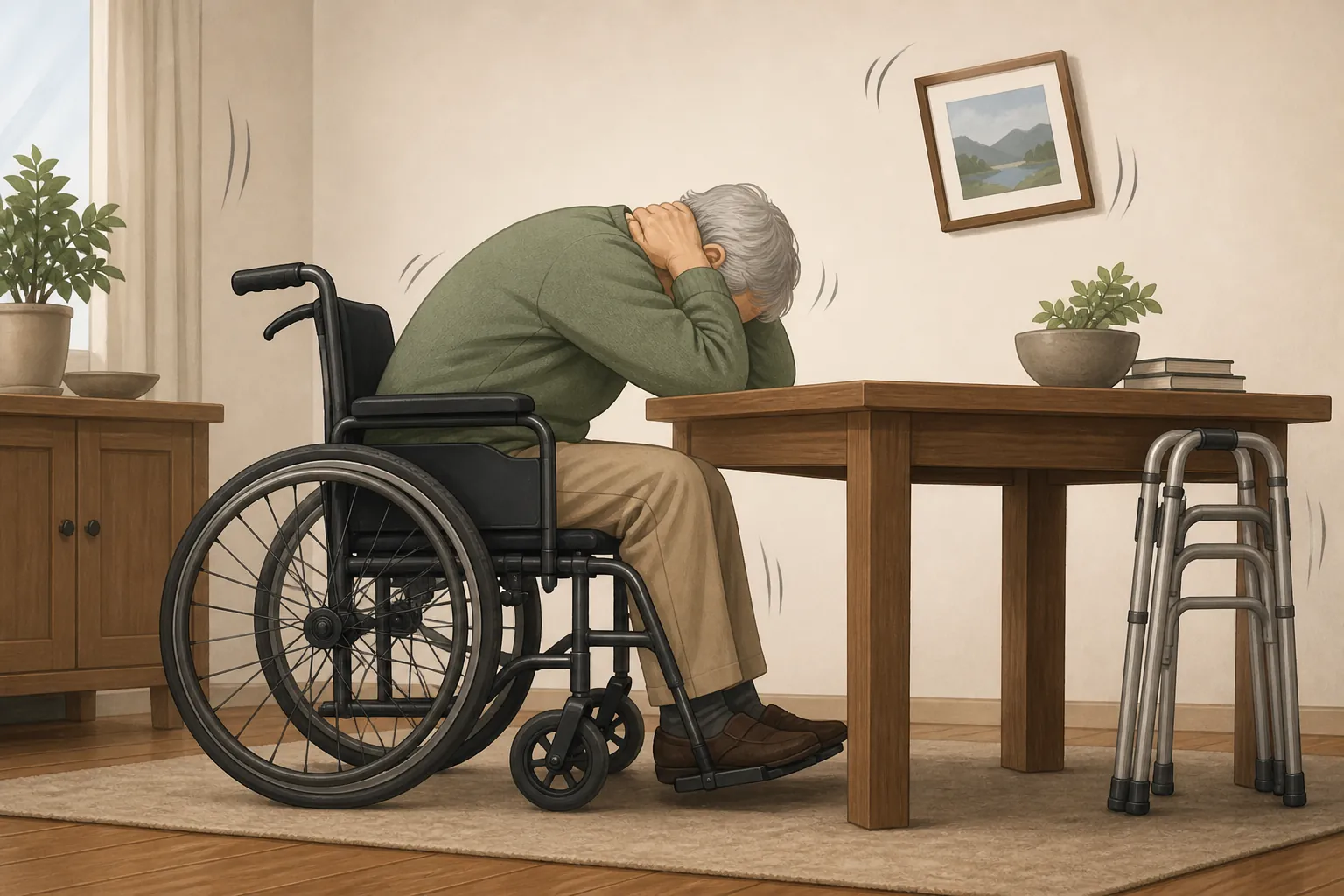
A good drill is short and specific. Pick the places where the person spends the most time: bed, favorite chair, kitchen table, bathroom, and the spot where the walker is usually parked. In each place, decide what “cover” means there. It may be a sturdy table. It may be a pillow over the head in bed. It may be locking wheelchair brakes and leaning forward. It may be sitting immediately instead of trying to lower to the floor.
This belongs with fall prevention as much as disaster planning. The same practical thinking used in severe-weather safety for older adults applies here: if the plan requires fast movement under stress, it is probably not a plan for someone at fall risk.
Secure the home around the path the person actually uses
The weekend version of earthquake preparation should begin with the rooms the older adult uses every day, not with a shopping cart. Start at the bed. Then walk the route to the bathroom, kitchen, favorite chair, exit, and phone charger. If a walker cannot pass through that route now, it will not pass through easily after books, cabinet contents, lamps, or glass have fallen.
Illinois emergency management guidance for seniors emphasizes securing heavy furniture and appliances, anchoring oxygen tanks and medical equipment, keeping walking aids close, clearing doorways and halls, and placing supplies where they can be reached [4]. California aging-preparedness materials also stress bedside supplies, walking aids in reach, cabinet safety, and room-by-room planning for older adults and people with access and functional needs [5].
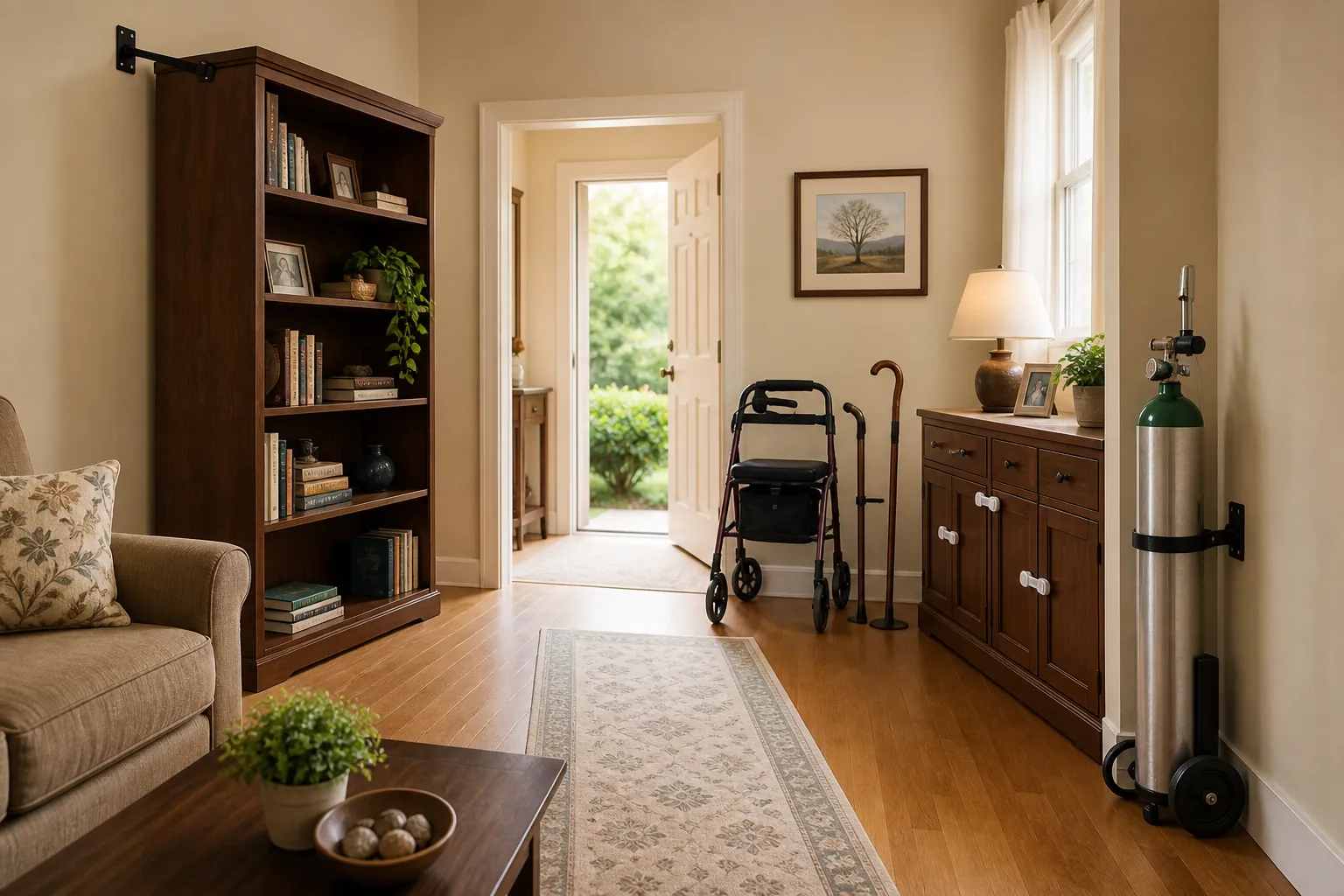
- Anchor tall bookshelves, dressers, televisions, and heavy furniture that could fall into a walking path or onto a bed or chair.
- Secure or strap oxygen tanks and essential medical equipment so they do not roll, tip, or block an exit [4].
- Latch cabinets that hold dishes, glassware, chemicals, or heavy pans.
- Move heavy objects to lower shelves, especially near the bed, recliner, and kitchen seating area.
- Keep the cane, walker, rollator, wheelchair, or transfer device in its normal reachable position. Do not “tidy” it into another room.
- Clear halls, doorways, and exits wide enough for the mobility aid the person actually uses.
- Move the bed away from windows where appropriate, and avoid placing glass, framed pictures, or heavy items above the head of the bed.
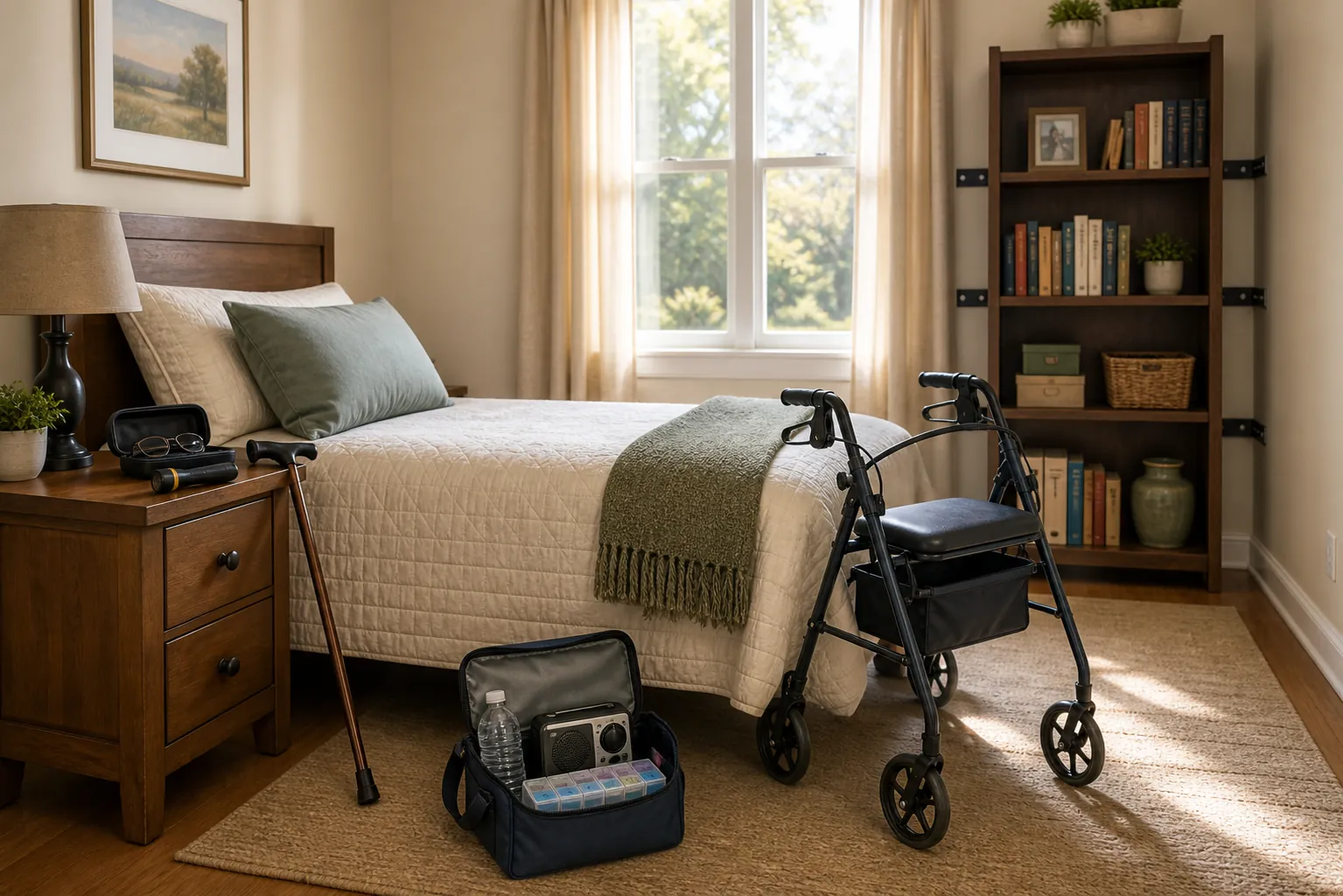
- Place shoes with firm soles near the bed, along with a flashlight, glasses in a hard case, and a whistle.
This is also where aging-in-place home modifications and earthquake preparation overlap. A grab bar, a clearer route, a lower shelf, or a better bedside setup is not dramatic, but it may decide whether the person can wait safely for help instead of stepping into debris. For broader planning, see why seniors are choosing home modifications over downsizing.
Build the kit around medications, devices, and senses
Ready.gov’s baseline emergency kit includes water, nonperishable food, a battery-powered or hand-crank radio, flashlight, extra batteries, first-aid kit, whistle, dust mask, plastic sheeting and duct tape, sanitation supplies, wrench or pliers, manual can opener, local maps, a cell phone with chargers and backup battery, cash, and important family documents [6]. Ready.gov specifies one gallon of water per person per day for several days, for drinking and sanitation [6].
For an older adult, those items are only the base layer. The senior-specific kit is where many well-meaning caregivers miss the things that make the kit usable: the right medication list, spare hearing-aid batteries, eyeglasses, a copy of the oxygen prescription or device instructions, a backup cane tip, a written phone list, and a way to open food with arthritic hands.

Medication supply: do not turn different guidance into one fake rule
Medication advice varies by source and context. That is not a nuisance to smooth over. It matters because insurance refills, controlled substances, refrigeration, oxygen, and pharmacy access do not behave the same way for every household. Treat the tiers below as planning targets to discuss with the prescriber or pharmacist, not as a single universal rule.
| Source | Medication or supply target stated in the source | How to use it in a senior checklist |
|---|---|---|
| Illinois IEMA senior earthquake planning | A 72-hour emergency supply is included in its senior planning guidance [4]. | Use this as the minimum “can I get through the first several days?” layer. |
| Red Cross survival kit supplies | A 7-day supply of medications and medical items is listed in its survival kit supplies guidance [7]. | Use this for the go-bag or portable kit when a full month of medication is not feasible. |
| NCOA emergency preparedness guidance | NCOA advises older adults to have a two-week supply of medications, medical supplies, and items such as oxygen, insulin, dialysis equipment, hearing aids, and mobility aids [8]. | Use this as a stronger continuity target for people with daily medication or device dependence. |
| Red Cross older-adult preparedness | Red Cross older-adult guidance advises at least a 30-day supply of medications and medical supplies [9]. | Use this for advance refill planning when prescribers, insurance, storage, and medication safety allow it. |
| Red Cross earthquake guidance | The Red Cross earthquake page advises having a one-month supply of medication in a child-proof container [3]. | Use this as earthquake-specific reinforcement for longer medication continuity planning. |
A practical medication packet should include an up-to-date medication list, doses, prescribing clinicians, pharmacy phone number, allergies, medical conditions, copies of insurance cards, and instructions for refrigerated or time-sensitive medications. If a medication cannot be stored in the kit, put a written reminder on the kit and in the caregiver’s phone: “Add insulin,” “Add inhaler,” “Add eye drops,” or “Add weekly pill organizer.”
The senior-specific kit items that deserve their own check
- Glasses in a hard case, plus a spare pair if available.
- Hearing aids, spare batteries or charger, and written instructions for caregivers who may not know the device.
- Dentures, denture supplies, and a labeled container.
- Cane, walker, rollator, wheelchair, or transfer equipment, with spare tips, brake parts, charger, or cushion where feasible.
- Oxygen, CPAP, nebulizer, glucose meter, blood pressure cuff, or other medical equipment instructions, including power needs.
- Written communication cards for hearing loss, speech difficulty, dementia, medication needs, or mobility limits.
- A flashlight that can be operated with stiff fingers, plus extra batteries.
- A whistle or other signal device reachable from bed and favorite chair.
- Cash in small bills, copies of important documents, emergency contacts, and a local map.
- Water, food, manual can opener, hygiene supplies, first-aid supplies, radio, phone charger, and backup battery from the baseline kit [6].
If the person depends on power for medication storage, oxygen, CPAP, lift chairs, or communication devices, earthquake planning should borrow from power-outage planning. The same questions apply: what can run on battery, how long the backup lasts, who knows when the backup is failing, and when leaving becomes safer than staying. For a deeper continuation, see how to keep seniors safe in a heat wave power outage.
Put supplies where they can be reached, not where they look organized
One beautiful emergency bin in the garage is not enough for someone who may be barefoot in a dark bedroom after shaking stops. Keep the main kit, but also place small, reachable supplies in the rooms where a person could be stuck waiting.
| Location | What belongs there | Why it matters |
|---|---|---|
| Bedside | Shoes, flashlight, glasses in a hard case, whistle, cane or walker within reach, phone charger, medication reminder. | Night earthquakes punish distance. The person should not have to cross broken glass to see, stand, or call. |
| Favorite chair or living room | Flashlight, whistle, phone charger, written contact list, nearby mobility aid. | Many older adults spend long periods seated here and may shelter in place in that spot. |
| Bathroom route | Clear path, night lighting if available, no loose rugs, no stored boxes or laundry baskets. | The bathroom trip is already a common fall-risk moment; debris makes it worse. |
| Kitchen | Latched cabinets, lower storage for heavy items, manual can opener, water and easy-open food. | The kitchen is full of glass, heavy pans, and doors that can swing open. |
| Exit area | Walker, cane, shoes, coat, copies of documents or go-bag if safe to store there. | Evacuation should not depend on searching for equipment. |
A caregiver doing this in one weekend should resist the urge to reorganize everything at once. Familiar placement matters. If the cane has lived on the right side of the bed for ten years, earthquake preparation usually means making that spot safer and more reliable, not moving the cane to a “better” emergency corner the person will not reach in the dark.
Make the communication plan boring enough to work
The communication plan should fit on paper and survive a dead phone. Write down local contacts, out-of-area contacts, doctors, pharmacy, oxygen or medical equipment supplier, building manager, utility contacts, and neighbors who have agreed to check in. Put copies in the emergency kit, wallet, bedside drawer, and caregiver’s home.
- Choose one out-of-area contact who can collect updates if local calls are difficult.
- Write down how the older adult prefers to communicate: voice call, text, captioned phone, relay service, large-print notes, or caregiver check-in.
- Label medical equipment with the person’s name, emergency contact, and basic operating instructions.
- Keep a paper medication list with the kit and update it whenever prescriptions change.
- Decide who checks on the person if elevators are out, roads are blocked, or the caregiver cannot arrive immediately.
For apartment buildings or senior communities, ask management how residents with mobility limitations will be checked after shaking, what happens if elevators stop, and where residents should wait if they cannot use stairs. Get the answer in writing if possible. A vague “we’ll help everyone” is not a plan.
Plan evacuation around equipment, not optimism
Not every earthquake requires evacuation. In fact, during shaking, running outside is specifically discouraged by Ready.gov [2]. But after shaking stops, there may be a fire, gas leak, structural damage, broken glass, or another hazard that makes staying unsafe. That is when the person’s mobility equipment becomes part of the evacuation plan, not an accessory to grab if there is time.
- Identify two exits if the home allows it, and walk them with the actual cane, walker, rollator, or wheelchair.
- Check whether the walker fits through the exit route after doors are fully open.
- Keep the go-bag light enough for the older adult or caregiver who will realistically carry it.
- If oxygen is used, decide in advance which tank or portable unit is used for evacuation and how it is secured.
- If a wheelchair or powered device is used, plan for manual movement, charging, and a backup if available.
- Choose a meeting place close to the home and another outside the neighborhood.
The equipment check is the same kind of thinking needed after any sudden home damage. The crisis-path guide on what to do when a tree falls on an elderly parent’s home is useful here because it keeps the focus on locating the walker, cane, wheelchair, glasses, oxygen, documents, and medications before moving someone through a damaged space.
A one-weekend checklist for an older adult’s earthquake plan
If the whole subject feels too large, do the work in this order. It follows the way a person will actually experience the earthquake: first the shaking, then the room, then the supplies, then the calls, then the decision to stay or leave.
- Practice Drop, Cover, and Hold On in the bed area, favorite chair, kitchen, bathroom route, and any wheelchair or walker position. Retire the doorway instruction.
- Clear the walking routes used every day, especially bedroom to bathroom, chair to kitchen, and chair or bed to exit.
- Anchor or secure tall furniture, heavy objects, medical equipment, and oxygen tanks.
- Move heavy objects low, latch cabinets, and reduce glass or falling items near bed and seating areas.
- Build the baseline kit with water, food, flashlight, batteries, radio, first aid, whistle, sanitation supplies, manual can opener, documents, cash, phone charger, and backup battery [6].
- Add senior-specific items: medication list, medication supply plan, glasses, hearing-aid supplies, dentures, mobility-aid parts, medical device instructions, oxygen details, and written communication cards.
- Place small duplicate supplies where they may be needed: bedside, favorite chair, exit area, and kit.
- Write the communication plan on paper and give copies to the older adult, caregiver, and at least one trusted contact.
- Walk the evacuation route with the actual mobility aid and go-bag.
- Set a reminder to update medications, batteries, food, water, documents, and contact names.
After the shaking stops, slow the next move down
This is not a full post-earthquake response guide, but the first minute after shaking matters. Before walking, check for injury. Find glasses. Find the cane, walker, rollator, wheelchair, oxygen, medications, phone, and flashlight. Look for broken glass, fallen furniture, spilled liquids, cords, and blocked routes. If there is no immediate danger, unnecessary movement through debris can create the injury the earthquake itself did not cause.
Earthquake preparedness for seniors is not separate from official guidance. It is official guidance rebuilt around the person who has to use it: how they stand, how they transfer, how they hear, how they see, how they take medication, how they breathe, and what they can reach when the floor will not hold still.
References
- Drop, Cover, and Hold On, Great ShakeOut
- Earthquakes, Ready.gov
- Earthquake, American Red Cross
- Planning Guide for Seniors, Illinois Emergency Management Agency and Office of Homeland Security
- Disaster Preparedness Tip Sheets, California Department of Aging
- Build A Kit, Ready.gov
- Survival Kit Supplies, American Red Cross
- Emergency Preparedness 101: What to Do Before, During, and After Disaster, National Council on Aging
- Older Adults, American Red Cross
Related reading
Noticed something outdated or inaccurate on this page? Flag a correction. We review every report against CDC, NIA, and AARP HomeFit guidance before updating a page.
Part of the Fall Prevention section.