
STEADI: Intervene
What a Power Grid Emergency Order Means for Older Adults
A power grid emergency order warns that blackouts are possible; it is not a blackout itself. The real risks to an older adult come from the extreme heat behind the order — heat illness, darkness-related falls, medical-device failure, and CO/medication hazards — and a caregiver can act on them with an under-an-hour prep checklist now and the CDC outage rules if the power goes out.
Medical review: Reviewed by Maya Patel, RN, BSN. This article is for general caregiver education and is not medical advice. If an older adult may be overheating, cannot safely use required medical equipment, has fallen, or seems acutely unwell, call 911 or local emergency services.
If you just saw the words “power grid emergency order,” start here: it does not mean your parent’s lights are already about to go out. It means the grid is under enough stress that emergency steps are being used to keep supply and demand balanced. The caregiver question is not “Should I panic?” It is “What can I do in the next hour so heat, darkness, medication, and medical-device problems do not catch us flat-footed?”
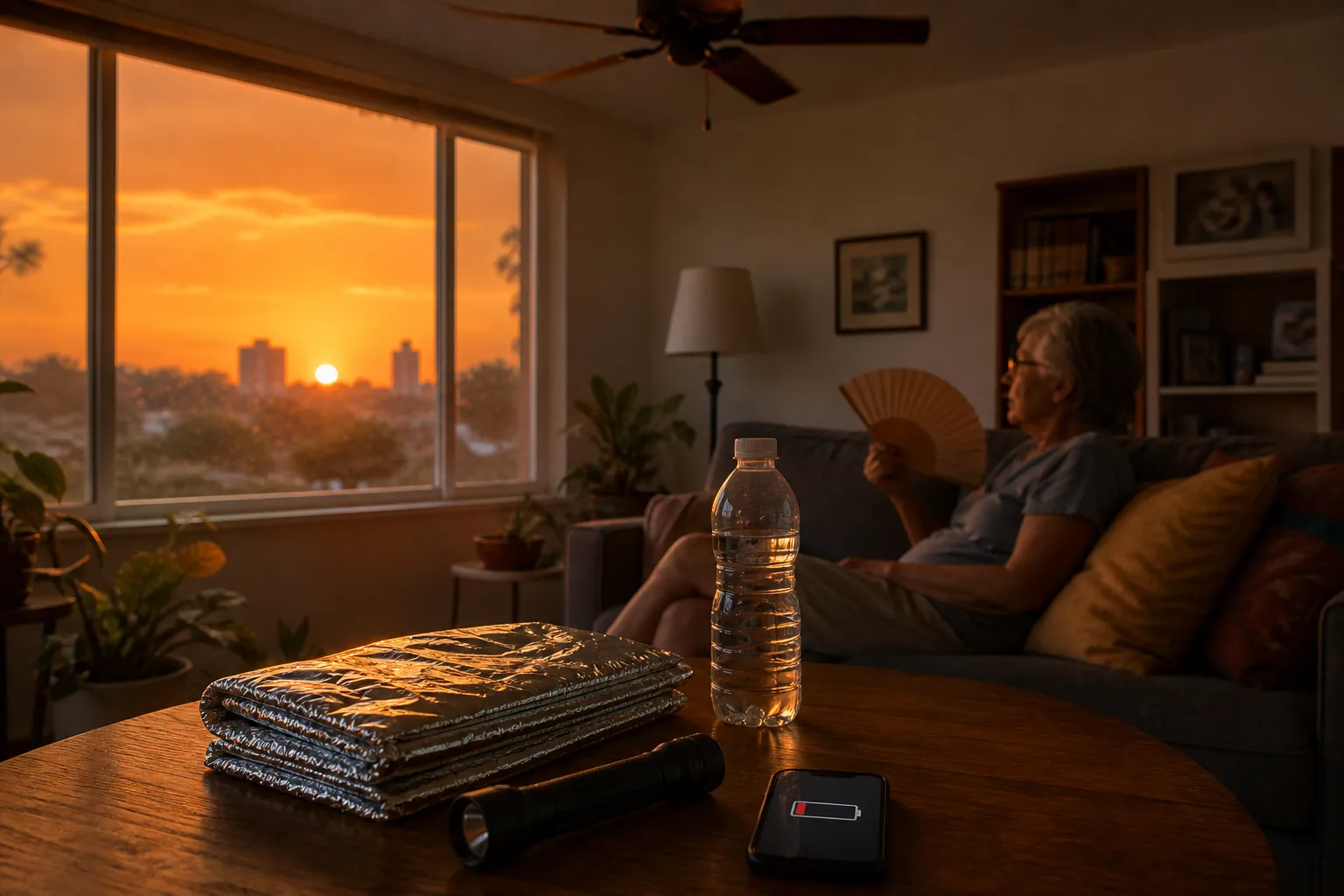
A power grid emergency order is a warning, not the blackout itself
Section 202(c) of the Federal Power Act lets the U.S. Department of Energy issue emergency orders affecting electricity generation or delivery when reliability is at risk. In June 2025, DOE issued a Southeast power-grid emergency order during a heat wave. On June 30–July 3, 2026, emergency orders tied to PJM covered 13 states plus Washington, D.C., and roughly 67 million people. Those are examples of the kind of announcement that can make a caregiver’s phone light up before anything has actually gone dark at home. [1][2]
The practical meaning is narrower than the headline usually sounds: the system is trying to avoid forced outages. Your parent may keep power the whole time. They may also be asked to conserve during a peak window, and if conditions worsen, controlled outages can become possible.
| Alert language you may see | What it means for a caregiver |
|---|---|
| EEA 1 | Operating reserves are low. Start checking the house and phones now; do not wait for a stronger alert. [3] |
| EEA 2 | Emergency resources are being used. Treat this as a real preparation window, especially if the older adult lives alone or uses powered medical equipment. [3] |
| EEA 3 | Controlled rolling blackouts become possible. Confirm where the older adult will go, who can physically check on them, and how you will communicate if service is poor. [2][3] |
Avoid getting stuck on grid jargon. The alert level matters only because it changes what you do next. If the utility asks customers to reduce use during a peak conservation window, help your parent do that safely: reduce nonessential loads, delay laundry or dishwashing, charge devices before the window, and keep cooling focused on the room where they will actually sit or sleep.
The health impact comes from heat and outages, not from the order itself
There is an important line here. The health evidence does not show that a Section 202(c) announcement, by itself, harms older adults. The evidence comes from extreme heat and power-outage research, applied to the situation that caused the emergency order in the first place.
Older adults are a high-risk group in hot conditions. The World Health Organization reports that heat-related mortality among people over 65 increased by about 85% between 2000–2004 and 2017–2021. [4]
Power outages add another layer. A Columbia narrative review lists older adults among medically high-risk groups during outages. The same review reports that after Hurricane Sandy, Beth Israel Medical Center saw a 114% increase in emergency department use among patients age 80 and older, and it cites New York City mortality increases during the 2003 Northeast Blackout: 25% for non-accidental mortality and 122% for accidental mortality. [5]
Those numbers should not be stapled onto every grid alert as if they predict what will happen in one household. They do explain why a caregiver should treat heat-wave grid warnings as preparation time, not background noise.
Four risks to check before the peak window
Heat illness: the room matters more than the headline
When the grid is stressed by heat, the first question is where your parent will actually spend the next several hours. A cool living room does not help much if they nap in a west-facing bedroom that has been warming all afternoon. A working air conditioner does not help if they avoid turning it on because they are trying to “be good” during a conservation request.
For a deeper caregiver guide to the heat-and-fall connection, see Why Extreme Heat Raises Fall Risk in Older Adults. If you are worried about heat stroke specifically, use How to Spot Heat Stroke in Seniors — and When to Call 911 rather than trying to diagnose over the phone.
Darkness-related falls: the risk people miss while thinking about air conditioning
The easiest preventable failure is a dark route to the bathroom. During a heat-wave outage, an older adult may be tired, warm, thirsty, rushing, or trying not to bother anyone. Add a dark hallway, a misplaced cane, a loose rug, or a phone flashlight with a dying battery, and the emergency is no longer abstract.
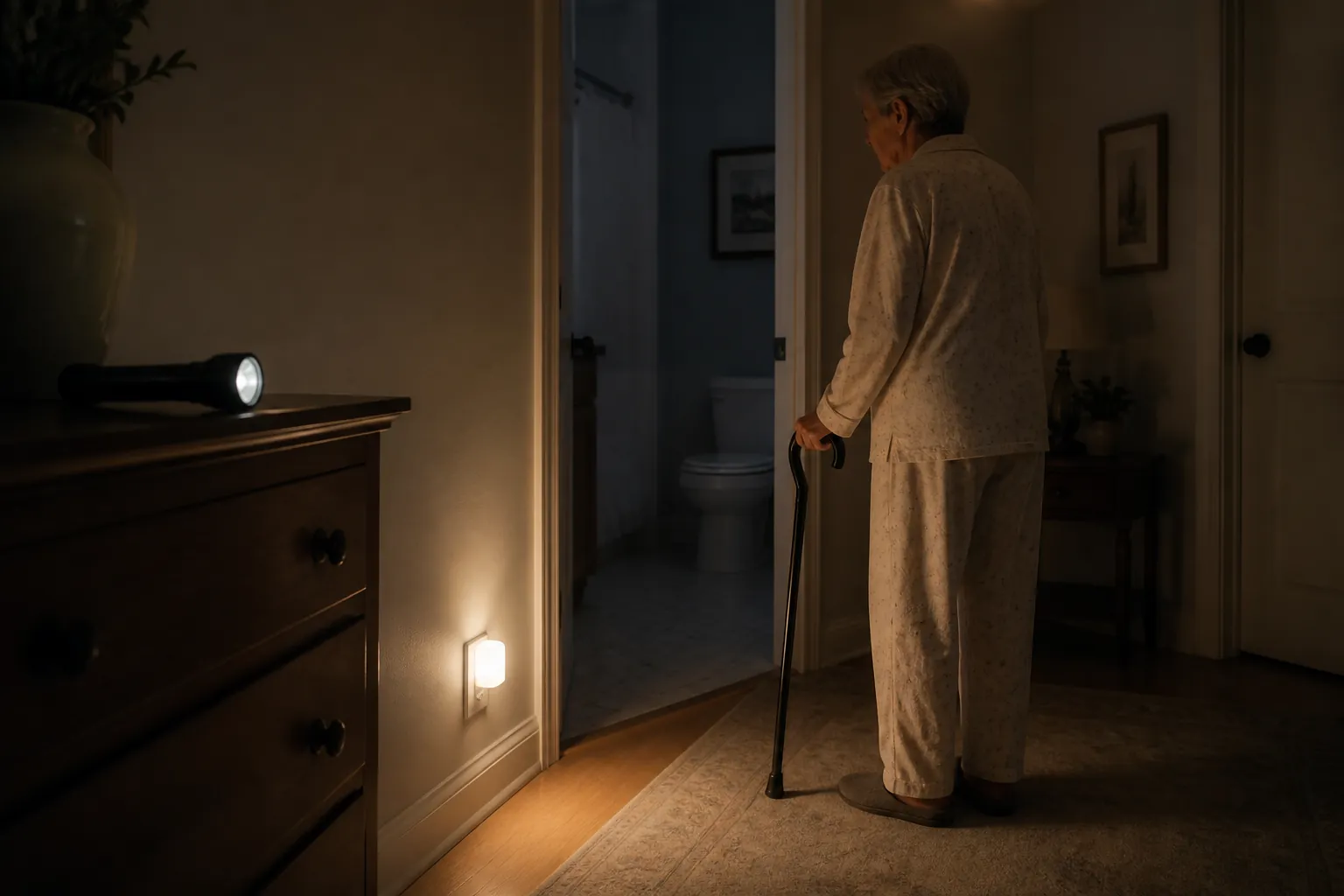
Before the peak window, light the path from bed to bathroom, bed to phone, and favorite chair to kitchen. Put a flashlight where a hand naturally lands, not in a drawer everyone forgets. If there is a walker or cane, place it where the first step happens. For a room-by-room outage setup, use the Senior Fall Prevention Checklist for Power Outages.
Electricity-dependent medical devices: check the backup before the lights flicker
If your parent uses an oxygen concentrator, powered mobility equipment, a home dialysis-related setup, a powered bed, a lift chair they cannot safely exit without help, or another electricity-dependent device, do not wait for an outage to discover the backup plan is only half a plan.
Check whether the backup battery is charged, who knows how to connect it, and how long the older adult can safely remain at home if power is out. If the answer is uncertain, call the device supplier, clinician, utility medical-baseline or critical-care program if available, or local emergency management. For a broader severe-weather planning guide, see Severe Weather Safety Tips for Elderly With Medical Needs.
Carbon monoxide, food, and refrigerated medications
A generator pulled “just into the garage” is not a small compromise. It is the kind of decision people make when they are hot, worried, and trying to fix things fast. The CDC’s outage guidance is plain: do not use generators or gasoline-powered engines indoors, never use a gas range or oven to heat the home, and use flashlights instead of candles. [6]
Medication deserves a separate check from food. If a medication needs refrigeration, look at the label now and call the pharmacy if you do not know what temperature exposure would make it unsafe. Do not use the refrigerator-food rule as a medication rule.
The under-an-hour caregiver checklist
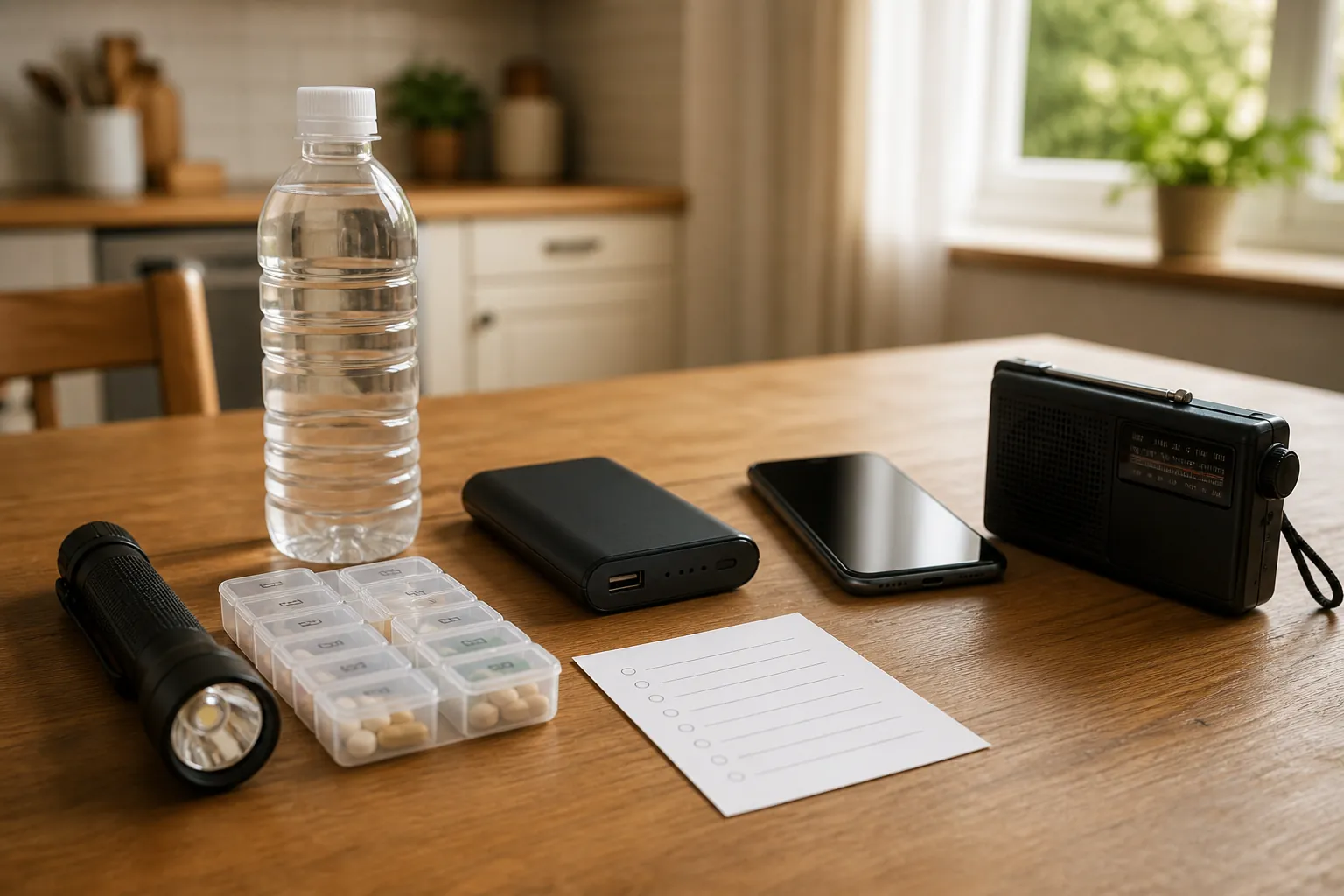
This is the part to do while the power is still on. It is not a full emergency plan. It is the kitchen-table version for the hour before a heat-wave peak window, when the phone battery is already too low and everyone is tempted to either overreact or wait.
| Do this now | What to confirm |
|---|---|
| Call or text the older adult | Ask whether the air conditioning works, where they are sitting, whether the phone is charging, and whether they can reach a flashlight without standing on anything. |
| Charge the communication chain | Plug in the older adult’s phone, your phone, power banks, medical-device batteries, and any battery-powered radio or alert device. |
| Light the fall paths | Put flashlights or battery lights at the bed, bathroom route, favorite chair, kitchen path, and entry door. Move cords, shoes, and loose items out of those paths. |
| Set one safe cooling room | Choose the coolest usable room. Put water, phone, charger, glasses, hearing aids if used, medications, walking aid, and a flashlight there. |
| Check medical-device backup | Confirm the battery is charged, the older adult knows what to do, and there is a person or service to call if the backup will not cover the outage. |
| Protect food and medication decisions | Avoid repeated refrigerator opening. Identify refrigerated medications and call the pharmacy now if storage instructions are unclear. |
| Choose relocation triggers | Decide in advance what would mean leaving: no safe cooling, no working medical-device backup, inability to reach the caregiver, worsening heat concern, or an outage expected to last through the night. |
| Assign the physical check | Name the person who can knock on the door if calls fail. Do not assume the nearest relative is the one who can safely get there. |
If cell service is unreliable or already down, switch from “keep trying” to a simple contact plan: one person calls, one person texts, one person checks utility outage maps if available, and one person is responsible for an in-person welfare check if it becomes necessary. For that situation, use Cell Service Down? 5 Steps Caregivers Must Take Right Now.
Do not make the older adult feel like the house has become a command center. The goal is smaller: fewer dark steps, fewer dead batteries, fewer unanswered calls, and a clear decision about when staying home is no longer the safer choice.
If the power actually goes out, switch to CDC outage rules
Once the outage is real, stop improvising around the hazards that injure people every year. Follow the CDC’s power-outage rules: keep generators and gasoline-powered engines out of the home, do not use a gas oven or range for heat, and use flashlights instead of candles. [6]
- Keep refrigerator and freezer doors closed as much as possible.
- A full freezer can keep food safe for about 48 hours if the door stays closed; a half-full freezer is about 24 hours. [6]
- Refrigerated food is safe for about 4 hours if the door stays closed. [6]
- Do not taste food to decide whether it is safe.
- For refrigerated medications, contact a pharmacist, prescriber, or the medication’s emergency instructions rather than guessing.
For the older adult at home, the first pass is simple: flashlight in hand, walking aid in place, phone conserved, cooling plan active, device backup checked, refrigerator closed, and no generator or fuel-burning engine indoors. If any of those cannot be maintained, the plan should shift from “ride it out” to “get help or relocate.”
The right response is calm, fast preparation
A power grid emergency order is not the same thing as a blackout at your parent’s address. It is a warning that the system is under strain and that the heat behind the warning deserves attention. The best caregiver response is not alarm and not reassurance. It is a short, practical sweep of the risks most likely to hurt an older adult at home: heat illness, dark hallways, electricity-dependent equipment, carbon monoxide hazards, and refrigerated food or medication decisions.
References
- Secretary Wright Issues Emergency Order to Secure Southeast Power Grid Amid Heat Wave, U.S. Department of Energy, June 2025
- PJM Emergency Order Heat Wave 2026, Electric Choice, 2026
- Energy Emergency Alerts, ERCOT
- Climate change: heat and health, World Health Organization
- Power Outages and Community Health: a Narrative Review, PMC
- What to Do to Protect Yourself During a Power Outage, Centers for Disease Control and Prevention
Related reading
Noticed something outdated or inaccurate on this page? Flag a correction. We review every report against CDC, NIA, and AARP HomeFit guidance before updating a page.
Part of the Fall Prevention section.