
STEADI: intervene
How Older Adults Can Avoid Falls During a Power Outage
A power outage makes every room a fall hazard for older adults. This article provides concrete, pre-planned steps to stay safe in the dark — from strategic flashlight placement to using mobility aids indoors.
When the lights go out, the floor changes first
The room you know by heart becomes a different room the second the power fails. The edge of the rug disappears. The hallway turns flat and black. The bathroom, which was ordinary ten minutes ago, is now the place where you may be sleepy, hurried, barefoot, and reaching for a wall that is not exactly where you remembered it.
For older adults living alone, power outage safety tips have to start there: not with the freezer, not with the radio, not with the emergency drawer across the house, but with the first decision after the lights go out. Do you have to stand up in darkness to find light? Do you have to cross the room to get a flashlight? Do you have to choose between carrying something and keeping a hand free?
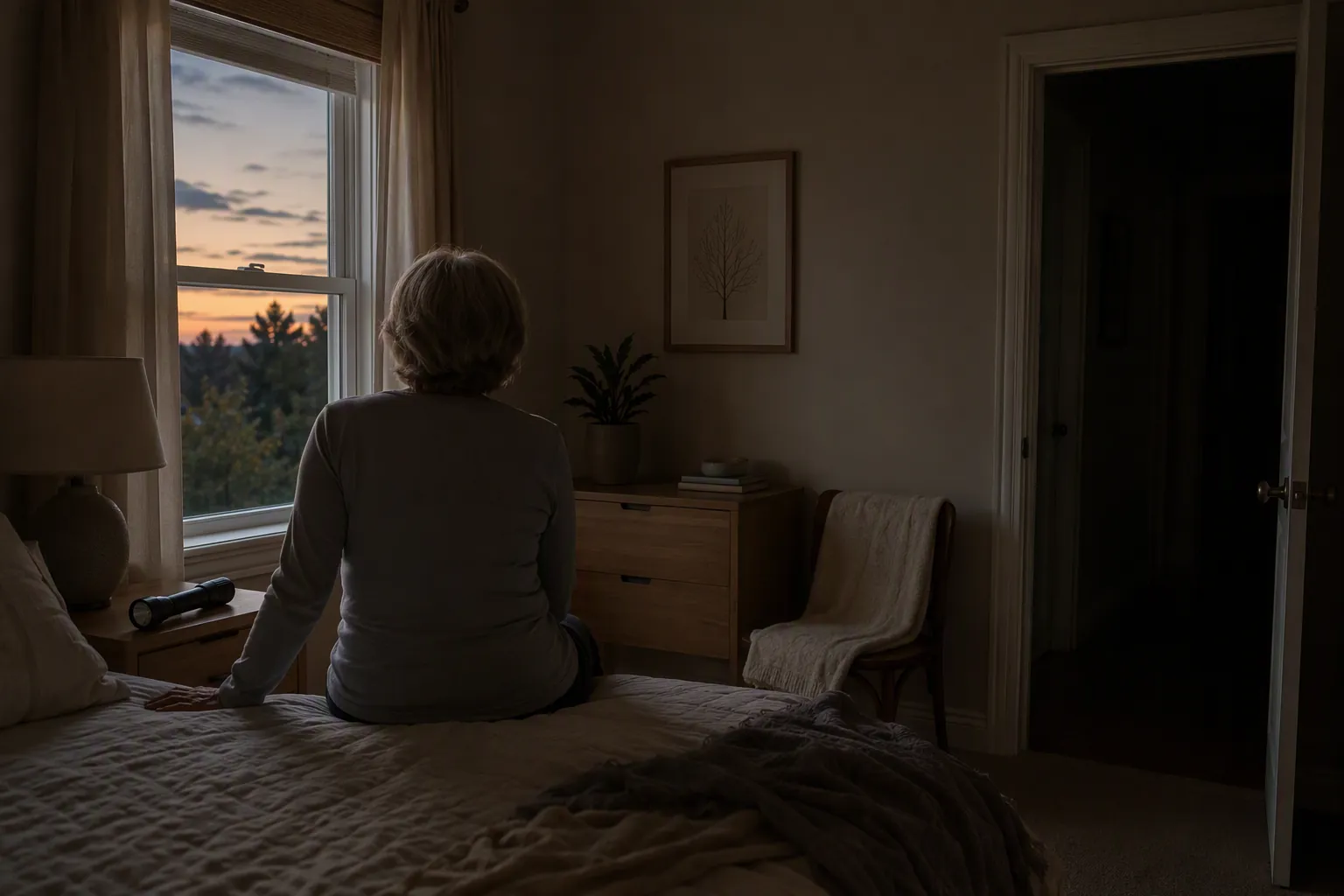
Falls are already common enough without adding total darkness. The CDC reports that about 1 in 4 older adults falls each year, leading to about 3 million emergency department visits and about $50 billion in annual medical costs in the United States.[1] Those numbers are large, but the useful lesson is small: the risky moment often happens before anyone can help.
Lighting matters because older eyes do not adjust to darkness as quickly, depth perception is less forgiving, and reaction time gives you less room to recover from a misstep. A 2024 study by Emad and colleagues found that lower lighting was correlated with higher fall rates in New Zealand long-term care facilities; in the same study, each 100 lux increase in lighting was associated with a 9–10% reduction in fall rate, and 68.5% of care-facility bathrooms were below recommended lighting levels.[2] That is not a private-home study, and it does not prove that a single nightlight prevents a specific fall. Still, it points to the same practical problem: low light and older bodies are a poor pairing, especially near bathrooms.
Do not make one flashlight serve the whole house
The classic “emergency flashlight” in a kitchen drawer is better than nothing, but it has one obvious flaw: it asks you to walk through the dark to reach it. That is exactly the trip you are trying to avoid.
Put light where you will be, not where emergency supplies happen to live. The National Institute on Aging includes keeping a flashlight by the bed in its disaster-preparedness guidance for older adults.[3] The same idea should be repeated through the home: bedroom, bathroom entrance, living room chair, kitchen counter, and anywhere else you routinely spend time after sunset.
| Place | What to keep there | What it prevents |
|---|---|---|
| Bedside table | Flashlight within arm’s reach, not inside a drawer | Standing up before you have light |
| Bathroom entrance | Battery-operated nightlight or motion light | Stepping onto tile without seeing the floor |
| Hallway | Battery-operated nightlight or low portable lantern | Walking by memory alone |
| Favorite chair | Small flashlight or lantern beside the chair | Crossing the room after dozing off |
| Kitchen counter | Flashlight kept in the open | Searching through drawers in darkness |
| Near cane or walker | Light and mobility aid stored together | Choosing between balance support and visibility |
The rule is simple enough to test: if the power went out while you were in that spot, could you turn on a light without standing? If the answer is no, that room is not ready.
Check batteries on a schedule you will actually remember. The first day of each month works. So does the day you change the furnace filter, refill a pill organizer, or pay a regular bill. A flashlight with dead batteries is clutter wearing a useful costume.
Treat the bathroom as the priority zone
The bathroom deserves more attention than the pantry during a short outage. Food safety matters, and phone charging matters, but the bathroom combines the things that make falls ugly: hard surfaces, possible water on the floor, towels or bathmats that shift, urgency, and the habit of making the trip at night without fully waking up.
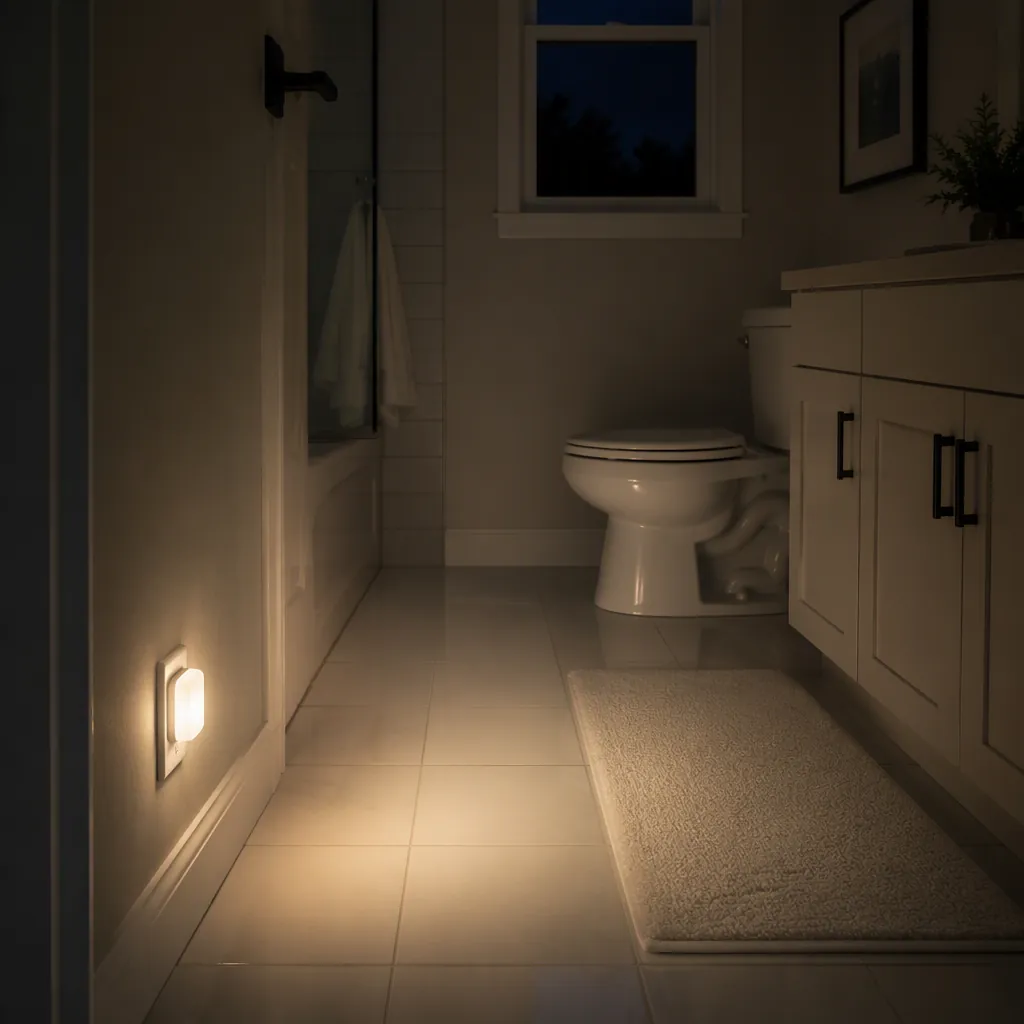
A small battery-operated nightlight in the bathroom and another in the hallway can do more for outage safety than a large flashlight stored somewhere else. Plug-in nightlights are helpful on ordinary nights, but for outages, use battery-operated or rechargeable models that come on when the power fails. The point is not brightness for reading. The point is to make the floor, toilet, sink edge, and doorway visible enough that your feet do not have to guess.
Before storm season, look at the bathroom as if you were walking into it half awake. Remove loose throw rugs or use non-slip backing. Keep the route from door to toilet clear. Do not let a laundry basket, scale, trash can, or package of toilet paper sit in the walking path. If you use grab bars, make sure you can reach one from the usual route, not only once you are already at the toilet or tub.
The National Institute on Aging’s fall-prevention guidance also approaches home safety room by room, which is the right way to think about hazards that become easy to stop seeing.[4] If you want a broader hazard check beyond outages, a Parkinson’s Home Safety Checklist can be useful even if Parkinson’s is not your situation, because many of the same room-by-room questions apply to balance, clutter, and nighttime movement.
Clear the route before dark, not after the first flicker
When a storm is expected, do not wait for the first flicker. Walk the route you would take from bed to bathroom, from chair to kitchen, and from bedroom to phone. Move what your feet can catch: shoes, pet toys, oxygen tubing, extension cords, laundry, delivery boxes, curled rug corners, and the small stool that has been “just there” for months.
This is not housekeeping. It is route planning. A home can be clean and still unsafe in the dark if the walking line bends around furniture, cords, or low objects.
- Open interior doors before the outage if you expect to use those rooms. A closed door is one more reach, twist, and balance shift in the dark.
- Place sturdy slippers or shoes beside the bed with the toes facing out. Bare feet slide more easily and find every dropped object.
- Keep the cane or walker where your hand naturally goes, not across the room.
- Put a charged phone beside the bed and another light beside the favorite chair if you spend evenings there.
- If you have pets, decide where they will be during a storm. A small dog or cat underfoot is hard enough to avoid with the lights on.
Broader outage preparation still has its place. The CDC gives power-outage guidance on protecting health and safety during an outage, including practical concerns such as food, water, and temperature.[5] Ready.gov also advises older adults to plan around individual needs and support systems before disasters happen.[6] Those things matter. They just should not push fall prevention to the bottom of the list.
The first minute after the power fails
If you are sitting or lying down when the lights go out, stay there for a moment. That pause is not helplessness. It is control. Let your eyes adjust, notice whether you are dizzy, and reach for the light you already placed within arm’s reach.
Do not stand first and search second. That order is backwards. Turn on the flashlight, lantern, or battery nightlight first. Then put on shoes or non-slip slippers. Then stand slowly, using the bed, chair arm, wall, cane, or walker for support.
- Stay seated or still.
- Reach for light without getting up.
- Turn the light on and point it toward the floor, not into your eyes.
- Put on secure footwear if you are barefoot.
- Take the cane or walker before you move, even for a short trip.
- Move only if the path is visible and one hand can remain free.
If your flashlight is not within reach, do not make the heroic trip across the room to find it. Call someone if you need help. Wait if the need is not urgent. Use the phone light only if you can do it without walking while looking down at the screen. A phone in one hand can also steal the hand you need for balance, so it is a backup, not the plan.
Use the cane or walker indoors, even if you usually do not
This is the advice people resist, so let’s be plain about it. Using a cane or walker during an outage does not mean you have “started needing it” in the house. It means the house changed. The light is gone, the visual information is poorer, and your balance has to work harder. A mobility aid gives you another point of contact until the power returns.
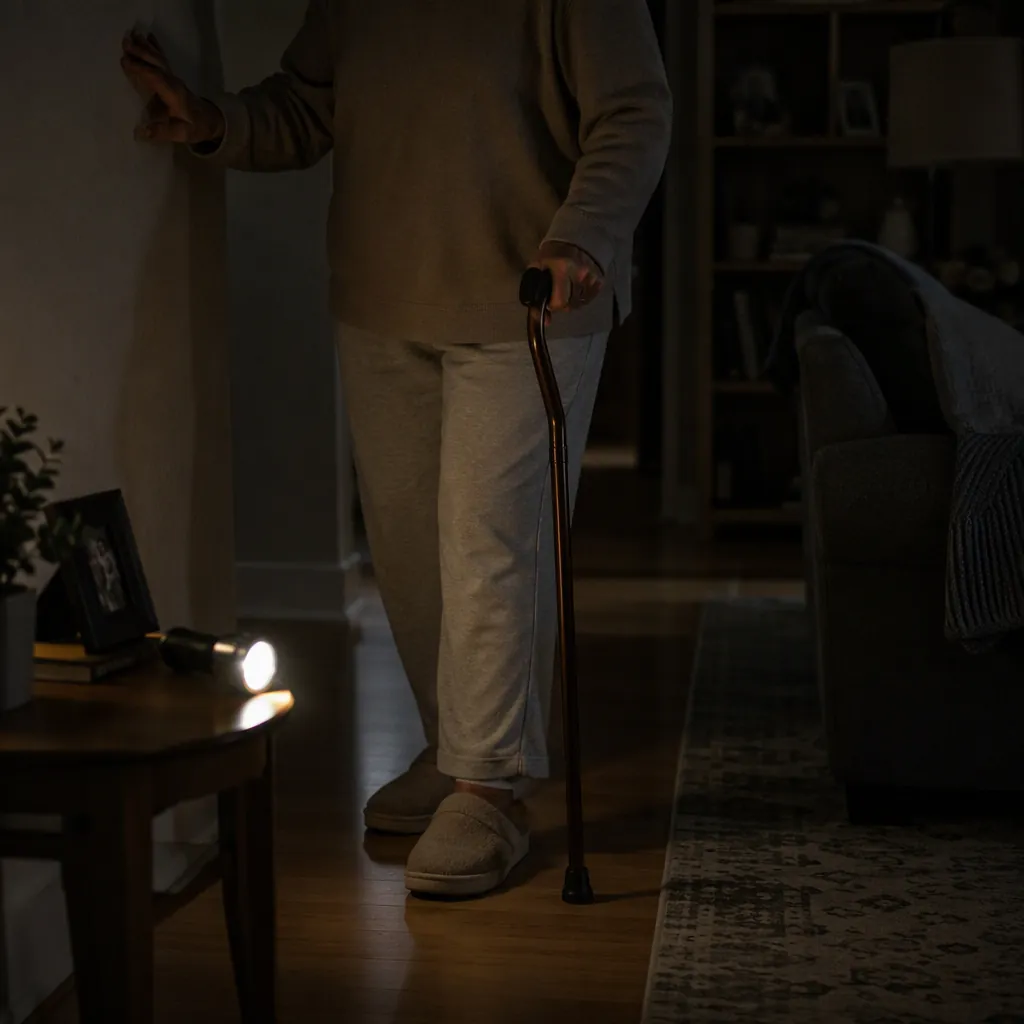
If pride starts arguing with you, make the rule temporary: cane or walker after dark, during outages, during storms, or any time the floor is not clearly visible. That keeps the decision practical instead of personal.
Keep the device where you will use it. A walker folded in the hallway closet will not help from the bed. A cane leaning by the front door will not help with a 2 a.m. bathroom trip. If the home has more than one common sitting or sleeping area, consider whether the mobility aid needs to live closer to the nighttime route, not the daytime exit.
How to move when you have to move
Once you have light and support, slow the trip down. The goal is not to move normally. The goal is to arrive without a fall.
- Keep one hand free. Do not carry a laundry basket, trash bag, or stack of supplies during the outage walk.
- Aim light at the floor several steps ahead so you can see obstacles before your foot reaches them.
- Use the wall, railing, cane, or walker as a steady contact point.
- Avoid stairs unless there is a true need. If you must use them, use a railing and keep both feet on one step before moving to the next.
- Do not rush toward sounds, appliances, or windows. A beep, branch, or flicker can wait longer than your hip can.
For a bathroom trip, turn on the closest light first, then stand. If a hallway nightlight is working, let it guide the route. If the bathroom is still dark, stop at the doorway and light the floor before stepping onto tile. Sit if you feel unsteady. There is no award for staying on your feet while half awake in a blackout.
Make help easy to reach without making every outage an emergency
Living alone does not mean handling every situation alone. Keep a charged phone within reach at night. If you use a medical alert device, wear it during storms and overnight, not just when you leave the house. If a neighbor, adult child, or friend checks in during outages, agree on the plan before the weather turns bad: text first, call if no answer, come by only if needed.
The useful plan is specific. “Check on me if the power goes out” is vague. “If the power is out after 9 p.m., call me; if I do not answer, call again in five minutes; if I still do not answer, contact the building manager or come over” gives everyone less guessing to do.
A five-minute readiness test tonight
You do not have to turn the whole house into a shelter. Start with the route that matters most: bed to bathroom. Sit on the bed and ask whether you can reach light without standing. Look at the floor and remove what your feet could catch. Put the cane or walker where it can be reached before the first step. Check that the bathroom and hallway have battery-operated light, not just plug-in light that dies with the power.
Then test the favorite chair, the kitchen, and the phone location the same way. If the power went out tonight, could you reach light, see the path, keep one hand free, use support, and get to the bathroom without rushing through darkness?
References
- Facts About Falls, CDC.
- Emad et al. 2024 lighting study, PMC, 2024.
- Disaster Preparedness and Recovery for Older Adults, National Institute on Aging.
- Preventing Falls at Home: Room by Room, National Institute on Aging.
- What to Do to Protect Yourself During a Power Outage, CDC.
- Older Adults, Ready.gov.
Related reading
Noticed something outdated or inaccurate on this page? Flag a correction. We review every report against CDC, NIA, and AARP HomeFit guidance before updating a page.
Part of the Fall Prevention section.