
STEADI: intervene
Create a Flood Evacuation Plan for Older Adults in 4 Phases
Older adults face disproportionate risks in floods—this four-phase checklist covers pre-season special-needs registration, medication and equipment consolidation, mobility-aid readiness, and post-flood health monitoring to help caregivers and seniors build a complete evacuation plan before the next flood season.
A flood plan for an older adult starts before the water rises
A useful evacuation checklist for an older adult during a flood has to do more than name a meeting place and pack a bag. It has to answer the practical questions that decide whether an older adult can actually leave: who can get there, who can drive, where the walker goes, how the oxygen or CPAP is powered, whether prescriptions are ready, and who keeps watching for health problems after the immediate danger has passed.
The risk is not theoretical. AARP, citing National Weather Service data, reported that adults 50 and older accounted for 59% of U.S. flash and river flood deaths in 2024 [1]. Floodwater also changes the math for people who use canes, walkers, rollators, or have slower balance recovery: CDC flood safety guidance warns that six inches of moving water can knock a person down, and California aging disaster materials call out the same danger for older adults using mobility aids [2][3].
Leaving the house is only the first safety threshold. A Columbia Mailman School study published in July 2025 analyzed 72 flood events and 4.5 million hospitalizations and found relative increases in hospitalization rates among adults 65 and older within four weeks of flood exposure: 3.1% for skin diseases, 2.5% for nervous system diseases, and 1.1% for injuries [4]. Those figures are relative rate increases, not a prediction that any one person has that absolute chance of being hospitalized. They still matter because they move the plan beyond “arrive somewhere dry” to “keep monitoring the person after the water is gone.”
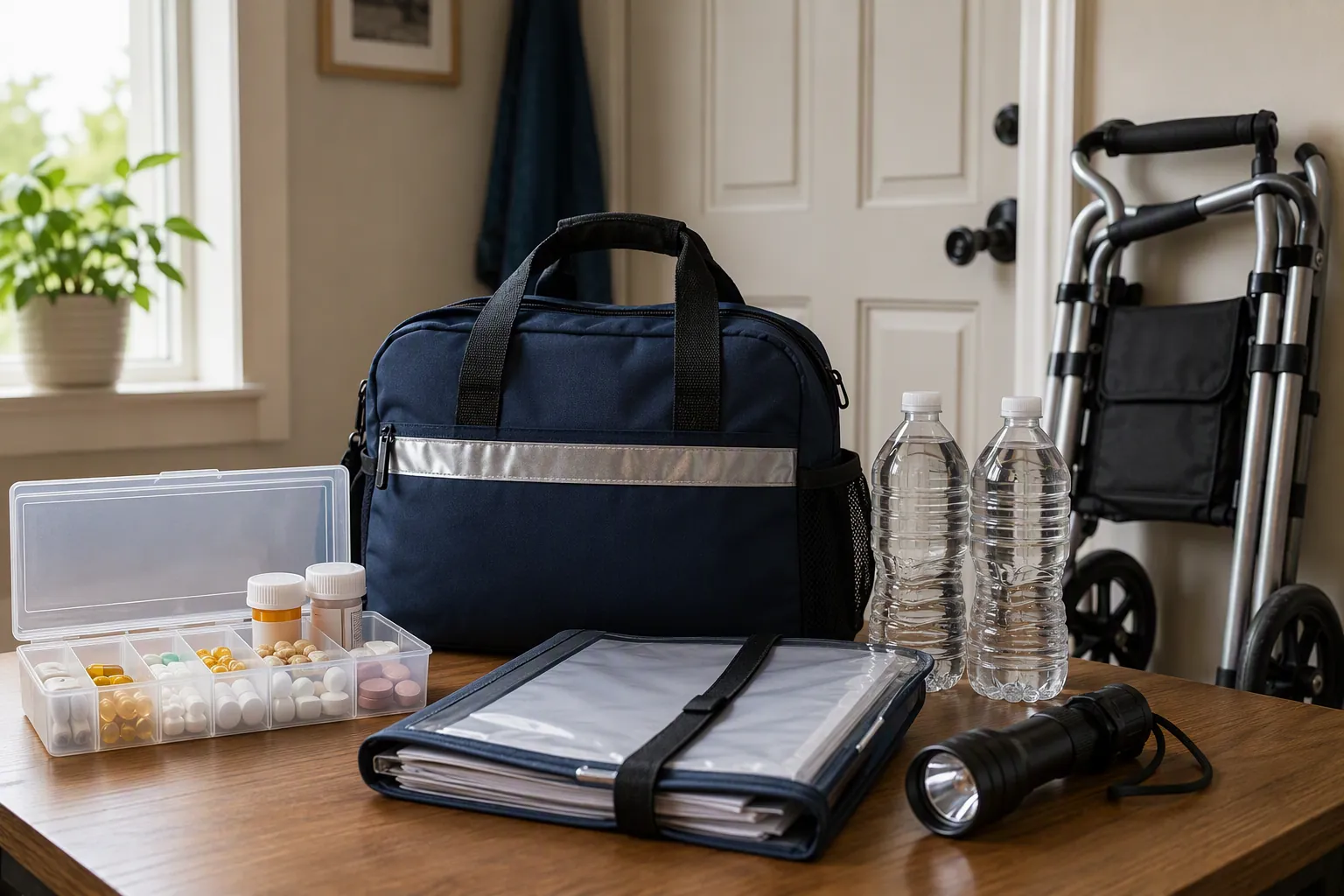
The four-phase flood evacuation checklist
Print this as a working checklist, not a one-time reading assignment. Add a name and backup name beside each task. A plan that says “family will handle it” usually means the nearest person gets the blame when a charger, medication, or transport form is missing.
| Phase | Trigger | What must be ready |
|---|---|---|
| 1. Pre-season | Before flood season or before hurricane season starts locally | Local emergency alerts; county special-needs or access-and-functional-needs registration; support network; evacuation transportation; document binder and digital copies; medication and equipment list; backup mobility plan; shelter and pet/service-animal rules |
| 2. Flood watch | Flooding is possible in the area | Medication consolidation; medical-device charging; backup batteries and power supplies; vehicle fuel/charge; go-bag placed by exit; mobility aids staged; caregiver check-in schedule activated |
| 3. Flood warning or evacuation order | Flooding is occurring, imminent, or local officials tell residents to leave | Leave before water blocks the route; load mobility aids and medical equipment; use assigned driver or transport service; shut off utilities only if instructed and safe; execute communication plan |
| 4. Post-evacuation and return | After reaching shelter, family, hotel, or returning home | Medication continuity; device power; fall prevention in unfamiliar spaces; wound and skin checks; tracking new neurological, respiratory, cardiovascular, or injury symptoms; follow-up calls for four weeks after flood exposure |
Phase 1: Do the work that cannot be improvised during a flood
The pre-season phase carries the most weight because it covers the tasks that become slow, bureaucratic, or physically impossible once rain is already falling. Ready.gov’s older adult guidance emphasizes making a support network and planning around transportation, medical needs, and daily living assistance before an emergency [5]. Red Cross guidance for older adults gives similar priority to planning with helpers, medications, mobility, and communication needs [6].
Confirm local registration and shelter rules
Start with the county emergency management office, not a national webpage. Ask whether your county or state has a special-needs, medical-needs, transportation-assistance, or access-and-functional-needs registry. The name changes by location. The deadline, renewal schedule, eligibility rules, and required medical forms also change by location.
Registration should be treated as a planning aid, not a rescue contract. It may help emergency managers understand who may need transportation, power-dependent equipment support, or a medically appropriate shelter. It does not guarantee an ambulance, a particular shelter bed, one-on-one medical care, or rescue through floodwater. That distinction is uncomfortable, but it keeps families from making the registry their only plan.
- Call county emergency management and ask which registry applies to older adults with mobility, oxygen, dialysis, cognitive, or transportation needs.
- Ask whether a doctor’s signature, medication list, equipment list, or caregiver contact is required.
- Ask how often the registration must be updated and who receives the confirmation.
- Ask which shelters can support oxygen, refrigerated medications, mobility devices, caregivers, service animals, and pets.
- Write down the office name, phone number, date called, and the exact answer. Do not rely on memory.
Ready.gov’s evacuation guidance is useful for the national baseline—routes, alerts, family communication, and leaving when told—but local evacuation transportation and shelter operations are local decisions [7]. The practical move is to use national guidance for the framework and county guidance for the actual procedure.
Build a support network with assigned jobs
A support network is not just a list of relatives. It is a small operating team with jobs that do not overlap unless there is a backup. AARP’s caregiver emergency planning guidance emphasizes identifying helpers, making plans accessible, and preparing for disruptions before a crisis [8].
| Job | Primary person | Backup person | What they must know |
|---|---|---|---|
| Evacuation decision caller | Name and phone | Name and phone | When the family leaves voluntarily, who can override delay, and which local alerts trigger action |
| Nearby physical helper | Name and phone | Name and phone | How to enter the home, where mobility aids are stored, and whether the person needs help transferring |
| Driver or transport coordinator | Name and phone | Name and phone | Vehicle type, wheelchair or rollator fit, fuel plan, pickup point, and alternate route |
| Medication and device lead | Name and phone | Name and phone | Current medication list, pharmacy, prescribers, oxygen/CPAP settings, chargers, batteries, and refrigerated medication needs |
| Out-of-area contact | Name and phone | Name and phone | Receives status updates and tells the rest of the family where the older adult went |
Long-distance caregivers need one extra rule: the person who lives far away should not be the only person expected to act first. Use a nearby neighbor, friend, building manager, faith-community contact, or paid aide as the local check-in person, and give the long-distance caregiver a clear call tree. If your family needs that structure, use a first-hour emergency response plan for long-distance caregivers alongside this flood checklist.
Make documents usable when the house is not
A waterproof binder and a digital copy solve different problems. The binder helps at a shelter desk, pharmacy, urgent care clinic, or family member’s kitchen table. The digital copy helps when the binder is in the wrong car. Keep both updated, and put the update date on the front page.
- Photo ID, insurance cards, Medicare or Medicaid information, and emergency contacts
- Medication list with drug name, dose, schedule, prescriber, pharmacy, and what the medication is for
- Medical conditions, allergies, implanted devices, oxygen or CPAP settings, dialysis schedule, and equipment vendors
- Advance directive, health care proxy, power of attorney, or physician orders if these exist and the older adult wants them available
- Shelter registration confirmation, transportation-assistance confirmation, apartment manager contact, and utility account numbers
- Recent photo of the older adult, especially if there are memory concerns
If this is the first time organizing those papers, start with an emergency contact binder for aging parents. The binder should not live in a drawer under unpaid bills. Put it where the assigned helper can find it in the dark.
Test transportation and mobility before anyone is tired
The transportation plan needs a dry-weather rehearsal. Can the older adult get into the actual vehicle? Does the rollator fold and fit with the oxygen tank, go-bag, and caregiver? Is the driveway steep? Does the route flood early? Does the person need a transfer board, gait belt, portable ramp, or two-person assist?
Do not wait for a flood warning to learn that the wheelchair cannot clear the doorway, the sedan trunk cannot hold the walker, or the assigned driver cannot lift the scooter battery. If ramps, grab bars, wider pathways, or threshold changes are needed for daily safety as well as evacuation, compare them with other aging-in-place home modification costs before storm season rather than during it.
Plan around cognition, not just mobility
For an older adult with memory loss, mild cognitive impairment, dementia, delirium risk, or anxiety in unfamiliar settings, the plan should reduce decisions. Write a short script: “There is a flood warning. We are going to Maria’s house. Your blue bag and walker are ready. I will call Daniel when we arrive.” Put identification in the wallet, go-bag, and on the mobility device if the older adult will tolerate it.
Also decide who is allowed to share medical information, who can consent if the older adult cannot, and which comfort items calm the person without taking up the space needed for equipment. In a flood, a familiar blanket or labeled photo card may do more good than another generic item from a preparedness list.
Phase 2: When a flood watch is issued, move from planning to staging
A watch is the moment to reduce the number of things that must be found later. This is where families often lose time: medications are in three rooms, the phone battery is low, the oxygen backup was never charged, the walker is in the garage, and the person who promised to drive is at work across town.
Do the watch-phase tasks while roads are still open and the older adult can move at a normal pace.
- Call the older adult and the nearby helper. Confirm who is physically going to the home if conditions worsen.
- Move the go-bag, document binder, medications, chargers, and mobility aids to the exit that will be used.
- Charge phones, hearing aids, power banks, wheelchair batteries, scooter batteries, oxygen concentrator batteries, CPAP batteries, and any backup lighting.
- Refill fuel or charge the vehicle. Park facing out if safe and legal.
- Check whether refrigerated medications have a cooler, cold packs, labels, and a way to stay with the person.
- Place shoes with good traction, dry socks, glasses, hearing aids, dentures, cane, walker, rollator, or wheelchair where they cannot be missed.
- Confirm the destination: family home, hotel, public shelter, medical-needs shelter, or other county-designated location.
Consolidate medications without creating a medication error
Medication readiness is a known weak spot. In AARP’s 2023 disaster-preparedness survey of adults 50 and older, about one-third reported having no extra prescription medication, and nearly half lacked an emergency phone charger [1]. The point is not to shame anyone; it is to treat refills and charging as watch-phase safety tasks, not errands that can wait until after evacuation.
Put current medications in one clearly labeled container, but keep enough original labeling to avoid confusion at a pharmacy, shelter, or clinic. Include eye drops, inhalers, insulin supplies, pain medicines, anticoagulants, heart medicines, Parkinson’s medicines, seizure medicines, and over-the-counter drugs the older adult actually uses. If the medication list is long or has recent changes, review it against a polypharmacy risk guide for older adults before storm season, not during the warning.
- Bring the current medication list and the actual medications.
- Keep time-sensitive doses on the same schedule unless a clinician says otherwise.
- Do not combine pills into unmarked bags or bottles.
- Photograph prescription labels as a backup.
- Call the pharmacy early if refills, insulin supplies, inhalers, test strips, or oxygen supplies are low.
Charge and label medical equipment
Power-dependent equipment deserves its own check, separate from the general go-bag. A phone charger is not the same problem as a powered wheelchair, oxygen concentrator, CPAP machine, nebulizer, home dialysis supply, or refrigerated medication. Label each cord and battery with the device name, the older adult’s name, and the caregiver’s phone number.
For oxygen, CPAP, mobility batteries, and refrigerated medications, pair this flood plan with a power outage plan for older adults with medical equipment. Floods and outages travel together often enough that the backup-power question should be settled before the watch becomes a warning.
Reduce fall risks before the evacuation starts
The watch phase is also when the home starts to become less familiar: porch steps get wet, rugs shift, lights flicker, and people rush. Put shoes on early. Clear the route from bed or chair to the exit. Move extension cords, loose rugs, pet bowls, and boxes. If the older adult uses a walker at night but a cane during the day, stage the walker anyway.
For a broader storm-season setup, use a storm and fall-prevention checklist for elderly adults. In this flood plan, the immediate goal is simpler: no unnecessary walking, no searching in the dark, no last-minute trip to the garage for the rollator.
Phase 3: When a flood warning or evacuation order arrives, leave in the order you already wrote down
The warning phase is not the time to renegotiate the plan with every sibling, neighbor, and group text. If local officials issue an evacuation order, follow it. If the family’s pre-set trigger says to leave earlier because the older adult needs more time, use that trigger.
Do not walk through moving floodwater to save time, retrieve one more item, or reach a car parked in a flooded area. The six-inch warning is enough for a healthy adult; for someone using a cane, walker, or rollator, it is even less forgiving [2][3]. Do not drive through floodwater either; Ready.gov’s evacuation guidance tells residents to follow recommended routes and avoid shortcuts that may be blocked or dangerous [7].
- Call the assigned driver or transport service. If they do not answer, call the backup immediately.
- Put the older adult in safe shoes and outerwear before loading bags.
- Load the mobility aid that will be needed at the destination, not only the one that fits easily.
- Load medications, medical equipment, chargers, batteries, document binder, ID, glasses, hearing aids, dentures, and communication devices.
- Shut off gas, electricity, or water only if local officials instruct it and only if it can be done without entering floodwater or delaying evacuation.
- Send one message to the out-of-area contact: who left, with whom, at what time, and where they are going.
- After arrival, send one update with the location, room number or shelter area if available, medication status, and device-power status.
If the older adult refuses to leave, keep the conversation narrow and concrete. Avoid a debate about whether the forecast will be “that bad.” Use the agreed trigger: “The county has issued the order,” or “The creek level reached our leave point,” or “Your oxygen backup is ready now, and the road is still open.” If the person has impaired decision-making capacity, use the legal and care plan already documented in the pre-season phase.
Phase 4: After evacuation, keep the health watch going
Once the older adult is out of immediate flood danger, the plan shifts to continuity: medication, device power, safe walking, hydration, sleep, wound care, and follow-up. This is the phase generic evacuation advice often underplays, even though the Columbia findings point to elevated hospitalization rates among older adults in the four weeks after flood exposure [4].
Another 2025 study summarized by NIEHS reported that flooding was associated with increased death rates from cardiovascular and respiratory diseases among older adults, based on more than 35 million deaths during the 2001–2018 study period [9]. That does not mean every cough or blood pressure change is flood-caused. It does mean a caregiver should not treat the return home as the end of the health risk window.
Use a four-week post-flood check-in schedule
Set four weekly check-ins after flood exposure, even if the older adult seems fine at first. The person doing the check-in should ask specific questions and, when possible, look at the feet, lower legs, hands, and any skin folds or small wounds. Flood cleanup, damp shoes, missed medications, poor sleep, and unfamiliar shelter layouts can turn into problems after the family group chat has gone quiet.
| What to check | What to write down | Who to contact |
|---|---|---|
| Skin and wounds | New redness, swelling, drainage, rash, pain, blisters, or wounds that are not improving | Primary care clinician, urgent care, or emergency services depending on severity |
| Falls and injuries | Any fall, near-fall, new bruise, new pain, head hit, or change in walking | Clinician promptly; emergency services for serious injury or head injury concerns |
| Nervous system changes | New confusion, weakness, dizziness, numbness, severe headache, or trouble speaking or walking | Emergency services for sudden or severe symptoms |
| Heart and breathing | Chest pain, worsening shortness of breath, swelling, unusual fatigue, or oxygen problems | Emergency services for chest pain or severe breathing trouble; clinician for milder changes |
| Medication continuity | Missed doses, lost medicines, pharmacy access problems, side effects, or duplicate dosing | Pharmacist or prescriber |
| Device power and supplies | Battery problems, missing cords, oxygen supply concerns, CPAP problems, refrigerated medication temperature concerns | Equipment vendor, clinician, pharmacy, or shelter medical support |
Returning home adds another layer. Do not send an older adult with balance problems into a damp house to “look around.” Wet flooring, poor lighting, debris, displaced rugs, and damaged steps make the first walkthrough a fall-risk job for someone steadier, wearing protective footwear, and following local safety instructions. If there is any doubt about structural safety, utilities, mold, sewage, or electrical hazards, wait for the appropriate local authority or qualified professional.
Before the plan is considered complete, confirm local registry and shelter rules with county emergency management, update the medication and equipment list, and choose the person who will do the four weekly health check-ins after flood exposure. This guide is preparedness support. It is not emergency medical advice, legal advice, a substitute for local evacuation orders, or a guarantee of rescue or safety.
References
- Adults 50+ Need to Be Better Prepared — AARP, updated October 2024
- Preparing for Floods — CDC
- Disaster Preparedness Tip Sheets — Flood — California Department of Aging
- Large Study Uncovers Specific Impacts of Flooding on Older Adult Health — Columbia Mailman School of Public Health, July 30, 2025
- Older Adults — Ready.gov
- Older Adults Emergency Preparedness — American Red Cross
- Evacuation — Ready.gov
- How Caregivers Can Build Emergency Plans — AARP
- Hidden Effects of Floods — Higher Death Rates — NIEHS, February 2025
Related reading
Noticed something outdated or inaccurate on this page? Flag a correction. We review every report against CDC, NIA, and AARP HomeFit guidance before updating a page.
Part of the Fall Prevention section.