
STEADI: assess
How to Fall-Proof Your Parent's Home Before a Power Outage
A blackout simulation walkthrough using tactile checks and flash photography helps caregivers find fall hazards standard daytime checklists miss. Fix them room by room with cost-ranked solutions before emergency delays make injury more dangerous.
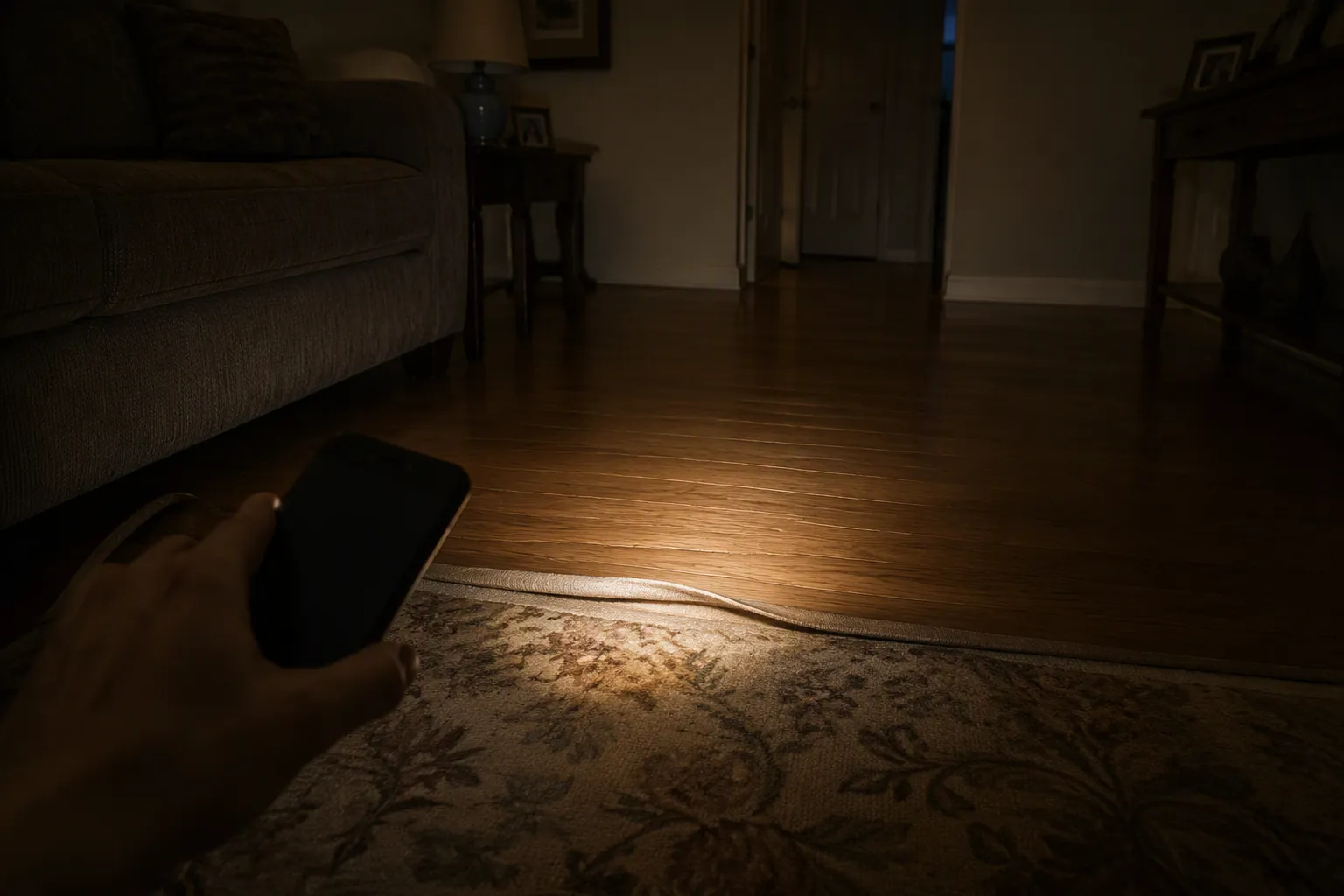
Do the walkthrough before the forecast gets serious. Go to your parent's home on an ordinary visit, wait until dusk or close the blinds, then turn off the lights in one room at a time. Stand where your parent would actually stand: beside the bed, at the bathroom doorway, at the top of the stairs, in front of the favorite chair. Take one photo with the room dark and one photo with your phone flash. Then move slowly enough to feel what daylight usually lets everyone ignore.
This is not a clinical protocol, and it should not be treated like one. It is a practical caregiver method built around known fall risks: poor lighting, throw rugs, clutter, uneven steps, and unstable supports. The point is simple: find the fall that is waiting in the dark while there is still time to remove it.
The baseline is already high. More than 1 in 4 older adults falls each year, falls cause 95% of hip fractures, and falls lead to about 3 million emergency department visits annually among older adults in the United States.[1] A power outage does not invent those risks. It strips away light, routine, working phones, open roads, and fast help.
Why Daylight Misses the Fall Risk
A daytime checklist sees the house at its best. Curtains are open. The hallway has ambient light. A rug edge looks flat because the pattern hides the curl. A cord along the baseboard looks obvious because you are standing still, fully awake, with two hands free.
That is not the blackout version of the house. The blackout version is the bedroom at 2 a.m., one hand on the wall, one foot searching for a slipper, a parent trying to decide whether the dark shape ahead is the doorway or the dresser. The object that matters is rarely dramatic. It is the rug lip you can feel through a sock, the ottoman that migrated six inches, the grab bar that gives a little when weight shifts onto it.
Long outages make the margin thinner. During Winter Storm Fern in January 2026, more than 1 million customers lost power, and parts of northern Mississippi were without power for two weeks.[2] That is an extreme case, not the expected length of every outage. It does show why a plan that depends only on batteries, optimism, and someone checking in later can fail.
Hospital strain matters, too. A March 2026 PLOS Medicine study of 2018 Medicare Fee-For-Service beneficiaries linked power outages lasting at least 8 hours with about 4,246 excess hospitalizations among adults 65 and older; cardiovascular risk was highest the day after an outage, while respiratory risk was highest the same day.[3] That figure is not a prediction for every storm or every insurance population. It is useful because it reminds families that an injury during a prolonged outage lands in a system already under pressure.
Set Up the Blackout Walkthrough Without Creating a New Hazard
Start with the safe version of pretending. Do not ask your parent to walk in the dark while you test the house. You do the first pass. Keep one steady flashlight or phone light available, tell your parent what you are doing, and leave one clear exit path lit enough for both of you. If the home has stairs, oxygen tubing, pets, or medical equipment, slow down and keep the simulation partial rather than theatrical.
- Use your phone camera in two ways: a no-flash photo to show what disappears, and a flash photo to reveal edges, cords, clutter, and furniture legs.
- Walk the route your parent actually uses, not the route that looks neatest when company visits.
- Wear socks for part of the check so you can feel rug lips, floor transitions, and uneven thresholds.
- Use one hand as your parent's balance hand: wall, bed rail, dresser edge, door frame, counter, chair arm.
- Keep a short fix list as you go. Do not try to repair everything while the room is dark.
The tone matters. This should feel like, “Let's see what the house looks like if the power goes out,” not “I am here to inspect everything you own.” If a change touches something personal, such as a favorite rug or bedside table, mark the hazard first and negotiate the fix later.
Start With the Bed-to-Bathroom Route
The most important route is the one your parent takes half-awake. Stand beside the bed on the side they use. Turn off the room lights. Take a dark photo toward the bathroom or hallway. Then take a flash photo from the same spot. Look for the difference between what the eye assumes and what the camera catches.
Now feel the first three steps. Is there a slipper where a foot will land? Does the bedspread hang low enough to catch a toe? Is there a charging cord between the mattress and the outlet? Does a rug sit where a turning foot will twist on it? Put your hand on whatever your parent would use for balance. If it is a nightstand, does it slide? If it is a dresser, are the drawers closed? If it is the wall, is the path to the wall clear?
The bathroom doorway deserves its own pause. Doorways vanish in the dark because they are vertical, familiar, and usually safe. Run your hand along both sides of the frame. Feel for robe hooks, towel loops, laundry baskets, scale edges, raised thresholds, and bath mats that buckle when pushed by a foot.
Bathroom Checks That Need Touch, Not Just Sight
In the bathroom, test the surfaces in the order a tired person reaches for them: door frame, vanity, towel bar, grab bar, toilet seat, tub edge. Do not yank. Apply steady pressure in the direction a falling body would pull. A towel bar that wiggles is not a support. A grab bar that shifts under pressure needs attention before storm season.
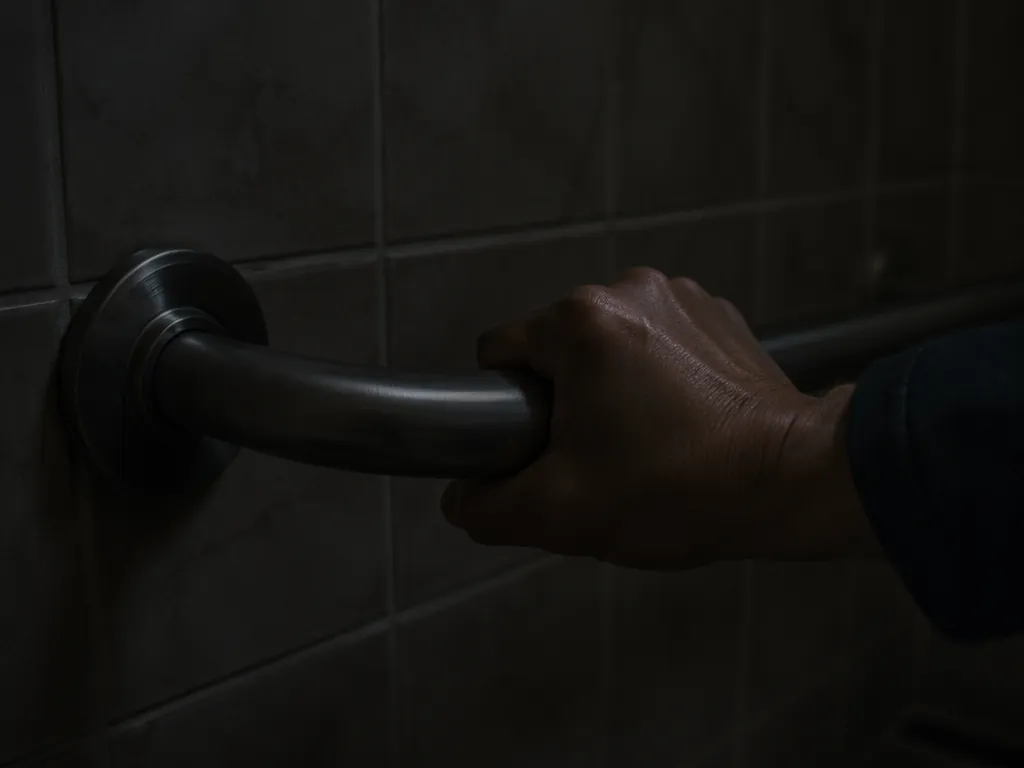
Then put a socked foot on the bath mat and push forward gently. If the mat travels, folds, or catches, it will not behave better during an outage. Check whether the toilet paper holder, trash can, scale, and laundry hamper narrow the turning space. The fall risk here is often not the shower itself. It is the turn, the reach, and the instinctive grab for something that was never installed to hold body weight.
Walk the Rooms in the Order Your Parent Uses Them
After the bed-to-bath route, move through the home in lived order. Favorite chair. Kitchen. Medication spot. Entry door. Laundry area if your parent uses it. Stairs only if they are part of normal movement during an outage; otherwise, the safer plan may be to keep the outage routine on one level.
| Area | What to Photograph in the Dark | What to Feel or Test |
|---|---|---|
| Bedroom | Bed edge, route to door, nightstand, cords | Rug edges, bedding overhang, sliding furniture, reachable light source |
| Hallway | Doorways, floor transitions, furniture silhouettes | Wall contact path, loose runners, uneven thresholds, protruding frames |
| Bathroom | Doorway, toilet path, tub or shower edge | Grab bar stability, bath mat movement, towel bar temptation, turning space |
| Living room | Favorite chair to hallway route, side tables, ottoman | Furniture corners at hip height, rug curl, lamp cords, pet items |
| Kitchen | Path to water, medication, phone, exit | Mats, cabinet handles, appliance edges, rolling carts, chair legs |
| Entryway | Door lock area, steps, shoes, umbrella stand | Handrail stability, threshold height, loose mats, wet-floor traction |
| Stairs | Top step, bottom step, landing, rail shadows | Handrail continuity, stair-edge visibility, loose carpet, objects on steps |
In the living room, sit in the chair your parent uses most. Stand up from that chair in the dark. What does a knee hit? What does a hand reach for? Side tables, ottomans, magazine baskets, and footstools often create a narrow little obstacle course around the one place a parent spends the most time.
In the kitchen, do not inspect every cabinet. Trace the outage route: water, food that does not need cooking, medication, phone, flashlight, exit. Floor mats near the sink are worth touching because they curl, slide, and blend into flooring. Rolling carts and lightweight chairs should be tested gently; if they move when used for balance, they are part of the hazard map.
At the entryway, look at the first step inside and outside the door. This is where wet shoes, packages, pets, and urgency meet. If your parent might open the door for a neighbor, caregiver, utility worker, or EMS, the threshold and handhold need to make sense in the dark.
For stairs, photograph from the top looking down and from the bottom looking up. In a dark photo, stair edges can flatten into one block. Feel whether the handrail runs continuously from before the first step to after the last step. If the rail stops early, the most dangerous moment may be the first or final step, when the body thinks the route is finished.
Sort the Fixes by Cost, Not by Anxiety
A blackout walkthrough can produce a discouraging list if every finding turns into a purchase. Do the opposite. Separate the fixes into free, under-$20, and under-$100 changes. The first pass should remove hazards before adding gadgets.
Free Fixes
- Move cords out of walking paths and keep chargers off the floor beside the bed.
- Remove or relocate throw rugs that curl, slide, or sit in turning zones.
- Clear the route from bed to bathroom, favorite chair to kitchen, and chair to exit.
- Move lightweight furniture that your parent might grab but that cannot hold weight.
- Place shoes, cane, walker, flashlight, and phone in the same reachable location every night.
- Close drawers and cabinet doors before evening so they do not become shin-height obstacles.
Taping a rug edge can be a temporary improvement, but it should not become a way to keep a bad rug in a critical route. If the rug still rises under a socked foot, remove it for outage season.
Under-$20 Fixes
- Add simple battery-powered nightlights or puck lights along the bed-to-bath path.
- Use high-contrast or glow-in-the-dark tape on stair edges, thresholds, and sharp route changes.
- Replace slippery bath mats with low-profile, non-slip options that do not bunch underfoot.
- Add tactile markers to the flashlight, walker handle, or bedside table so they can be found by touch.
- Keep a small flashlight attached near the bed, bathroom, and favorite chair rather than stored in a drawer.
Visibility aids should mark decisions, not decorate the whole house. A bright edge at the top stair, a light at the bathroom threshold, or contrast at a floor transition is more useful than a drawer full of unopened emergency lights.
Under-$100 Fixes
- Install motion-activated lighting where the route changes direction, especially hallways, bathrooms, and entryways.
- Add a properly mounted grab bar where your parent already reaches for an unsafe towel bar, vanity, or door frame.
- Improve stair and entry lighting with battery backup or motion activation if those areas remain dark in the photo test.
- Replace unstable small tables with sturdier surfaces only if your parent truly uses that spot for balance.
- Add non-slip stair treads or threshold improvements when contrast tape alone does not solve the footing problem.
Do not install a grab bar where it merely looks helpful. Install support where your parent actually reaches, and make sure it is mounted into a structure that can hold body weight. A loose bar is worse than no bar because it invites trust.
Do One Daylight Checklist, Then Return to the Dark Photos
A standard fall-prevention checklist still matters. Medications, footwear, vision care, mobility aids, exercise, and routine home hazards all belong in the larger fall conversation. The blackout walkthrough does not replace that baseline; it exposes what the baseline often misses when the lights are on.
After the first repairs, repeat only the key dark photos: bed to bathroom, favorite chair to hallway, kitchen route, entryway, and stairs if used. Compare the new photos with the old ones. The improvement should be visible. Doorways should read as doorways. Stair edges should separate. The floor should look boring.
Then do the touch test again. A route is not fixed because it photographs well. It is fixed when a foot does not catch, a hand finds stable support, and the path still makes sense when the person walking it is tired.
When the Outage Plan Cannot Depend on the House
Some homes do not pass the practical test, at least not for a prolonged outage. The question is not whether the house is perfect. It is whether your parent can move between essential places in darkness or backup lighting: bed, bathroom, medication, water, phone, and exit. If those routes still depend on unstable furniture, stairs without dependable handholds, or lighting that will not last, the plan needs more than supplies.
This is where the family conversation should shift from “What else should we buy?” to “Where should you stay if the outage is expected to last?” That might mean another relative's home, a neighbor's home with safer access, a hotel outside the outage area, or a community option if available. It should be discussed with your parent before a warning, not announced over the phone after the lights are already out.
For parents who use electrically powered medical equipment, Ready.gov advises contacting the power company about medical-device needs and asking whether the person can be listed for priority power restoration.[4] That step does not guarantee continuous power, and it does not remove fall hazards. It belongs beside the room-by-room route check, not in place of it.
The go/no-go threshold is plain: after the fixes, can your parent get from essential room to essential room in realistic darkness with backup lighting and stable handholds? If the honest answer is no, emergency preparedness for an older adult during a power outage has moved beyond a kit. It has become a stay-or-go plan.
References
- CDC STEADI — Older Adult Fall Prevention, CDC, https://www.cdc.gov/falls/data-research/facts-stats/index.html
- Power Outage Preparedness for Seniors & Elderly, PowerOutage.us, https://poweroutage.us/storm-prep/power-outage-preparedness-seniors-elderly
- McBrien et al., PLOS Medicine, March 2026, https://journals.plos.org/plosmedicine/article?id=10.1371/journal.pmed.1004923
- Power Outages, Ready.gov, https://www.ready.gov/power-outages
Related reading
Noticed something outdated or inaccurate on this page? Flag a correction. We review every report against CDC, NIA, and AARP HomeFit guidance before updating a page.
Part of the Fall Prevention section.