
STEADI: Intervene
How to Prevent Falls When a Heat Wave Knocks Out Power
When a heat wave knocks out power, older adults face a sudden triple risk of darkness, heat, and dehydration that can lead to a fall. This guide walks caregivers through the first critical steps — from securing safe lighting and knowing when to abandon fans above 90°F to protecting medications and deciding when to relocate to a cooling center.
When the power goes out during a heat wave, the first fall-prevention job is not finding every supply in the house. It is keeping the older adult from making one hot, dark, unsteady trip before you have lighting, water, and a cooler room under control.
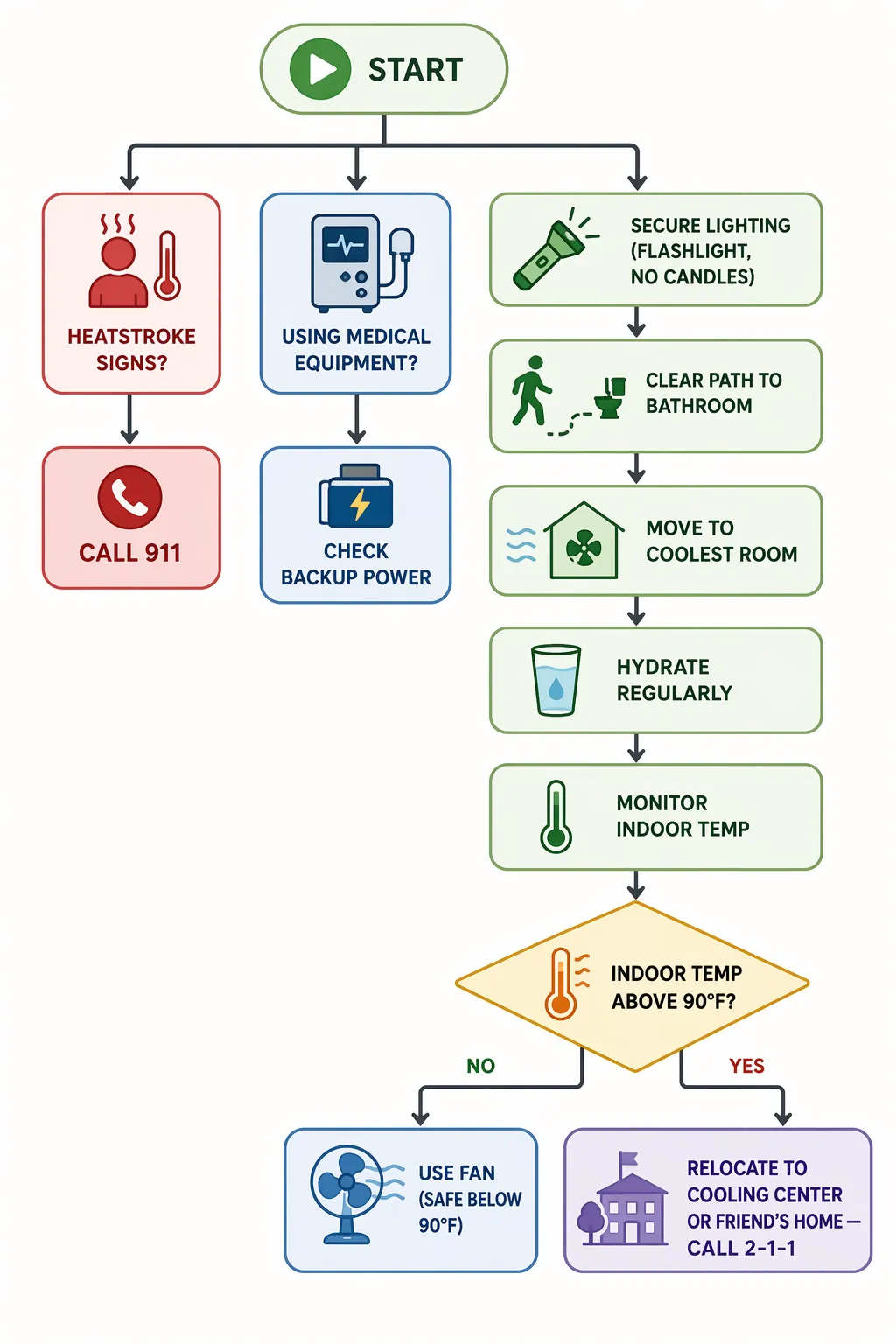
Start with the condition that cannot wait: if the person has a body temperature of 104°F or higher, confusion, altered behavior, fainting, or unconsciousness, call 911. Heatstroke is an emergency, and trying to “watch it for a while” can leave you moving someone only after they are weaker, more confused, and harder to help safely. [1]
The first 10 minutes: stop the dark-room fall
If there are no heatstroke signs, make the house safer before asking the person to move. A sudden blackout turns ordinary furniture, thresholds, pet bowls, oxygen tubing, and throw rugs into trip points. Heat makes that worse because dizziness and weakness can arrive before anyone says, “I feel dehydrated.”
- Use flashlights or battery lanterns, not candles. A candle adds fire risk exactly when people may already be moving awkwardly in the dark. [2]
- Put one light within arm’s reach of the older adult, one along the route to the bathroom, and one near the water or kitchen area.
- Clear only the routes that matter now: bed or chair to bathroom, bed or chair to water, and the path to the coolest room.
- Ask the person to sit while you set up the room. Do not turn the first few minutes into a supply hunt that sends them walking from room to room.
- Bring water to them. Small, regular drinks are safer than waiting until they are thirsty and then asking them to stand.
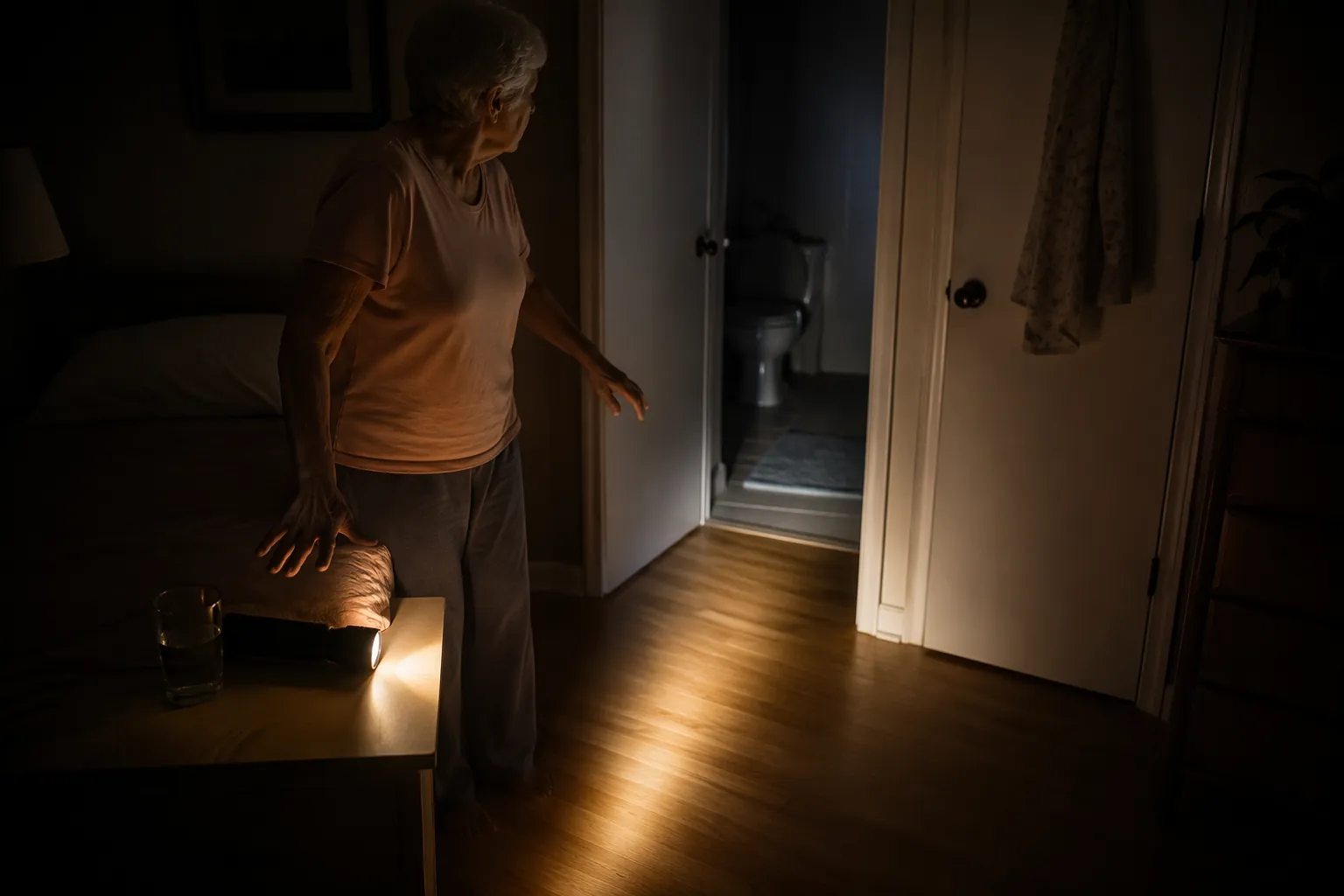
The bathroom route deserves special attention. People often try to make that trip quickly, half-awake, without asking for help. During a heat outage, that is where dehydration, darkness, urgency, and pride meet. Put light on the path before it is needed, move clutter out of the way, and agree on a simple plan: call, knock, or wait for help before walking if they feel weak.
If medical equipment depends on power, check that next
If the older adult uses electricity-dependent medical equipment, do not spend the next half hour rearranging the house before checking backup power. About 4.5 million Medicare recipients use electricity-dependent durable medical equipment, and outages lasting 8 hours or more can become medically relevant as batteries deplete. [3]
- Check whether the device is running on battery and how much time remains.
- Call the equipment supplier, clinician, utility medical baseline contact, or local nonemergency resource if backup time is short.
- If the device is essential and power is not expected back soon, treat relocation as a medical safety decision, not a comfort choice.
- For longer planning around devices, backup batteries, and documentation, use a dedicated 72-hour power outage plan for medically dependent seniors after the immediate danger is controlled.
A portable generator does not belong in a doorway, garage, porch, or near an open window. If one is used, keep it at least 20 feet from windows, doors, and vents, and use a carbon monoxide detector. Carbon monoxide risk is not a tradeoff for cooler air. [2]
Move to the coolest safe room, then keep movement boring
Choose the room with the least heat gain: often a lower floor, a shaded room, or a room away from west-facing windows. Keep the person seated or lying down there, with water, phone, medications list, flashlight, mobility aid, and bathroom route all accounted for. The goal is to make the next necessary action short and predictable.
| Control point | What to do now | Why it matters for falls |
|---|---|---|
| Lighting | Place battery light at the person, bathroom route, and water source | Prevents blind walking and rushed searching |
| Hydration | Offer regular small drinks unless a clinician has restricted fluids | Heat-related dehydration can bring dizziness, weakness, and confusion |
| Room choice | Use the coolest room and reduce unnecessary trips | Less movement means fewer chances to stumble as heat stress builds |
| Bathroom plan | Clear the route and agree on help before standing if weak | Urgent nighttime trips are high-friction moments |
| Temperature | Track indoor temperature, not just how the air feels | The fan decision changes at 90°F |
Heat illness in older adults is not only a temperature problem. It becomes a mobility problem. The CDC identifies adults 65 and older as a higher-risk group during heat, and more than 700 people die from extreme heat in the United States each year. [4]
The 90°F fan rule is a decision point, not trivia
An electric fan can feel like the obvious answer when the air conditioner stops. That instinct has a hard boundary: the CDC warns that electric fans do not prevent heat-related illness when indoor temperatures are in the high 90s, and above 90°F fan use can actually increase body temperature. [5]
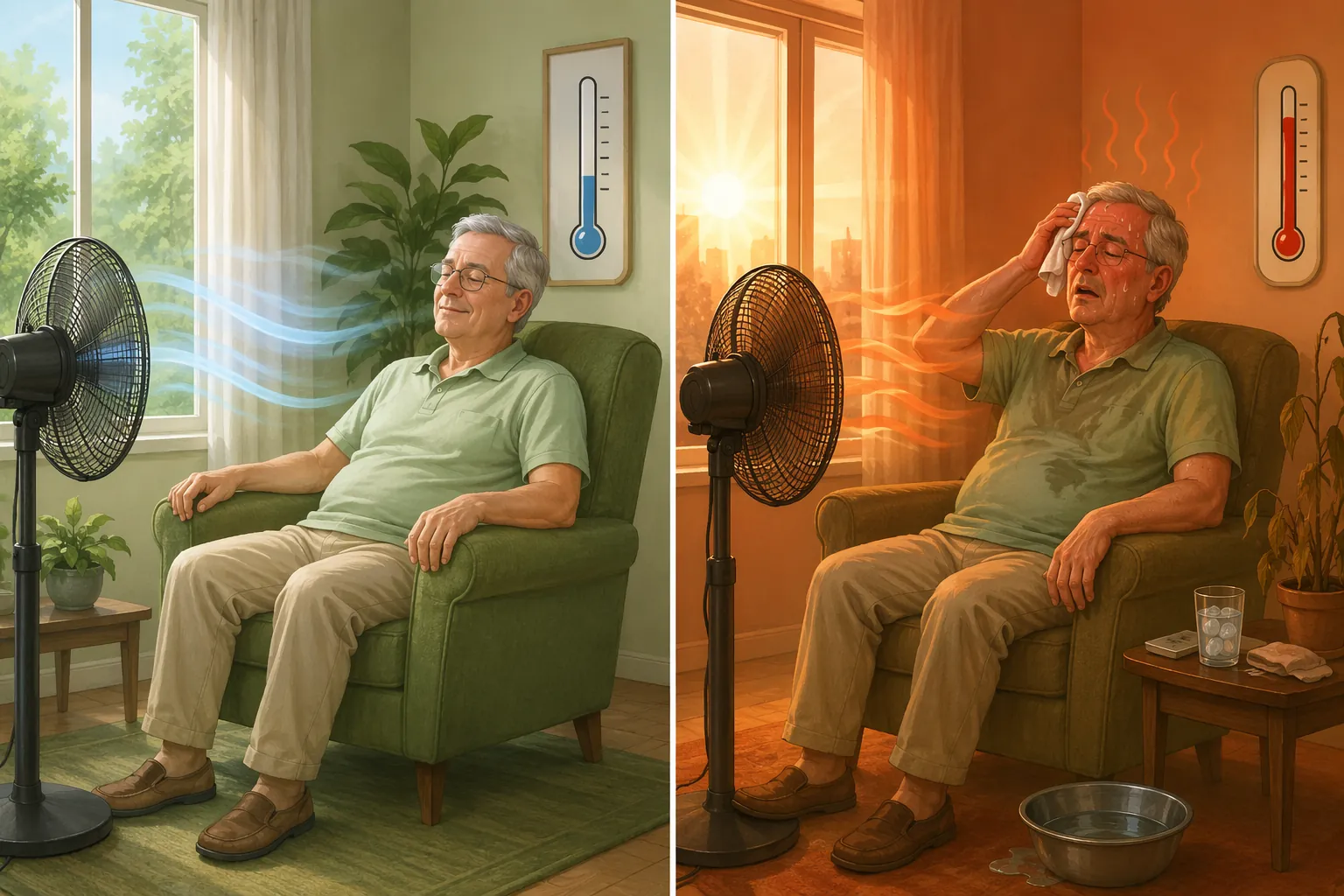
Below that line, a fan may help comfort if the person is drinking fluids and the room is not dangerously hot. Once the indoor temperature is above 90°F, do not treat a fan as protection. At that point the question changes from “Can we make this room feel better?” to “Where can this person cool down safely before standing, walking, and thinking all become harder?”
Use a thermometer if you have one. If you do not, watch the person rather than arguing with the room: new confusion, unusual sleepiness, weakness, flushed skin, dizziness, or trouble following a simple instruction should push you toward escalation.
When to leave the house
Relocation is easier before the person is weak. Waiting until they are dizzy can turn a short walk to the car into the most dangerous part of the outage. If indoor cooling is failing, make the stay-or-go decision while the person can still transfer safely, use a walker correctly, and answer questions clearly.
- Leave now or call 911 if there are heatstroke signs: 104°F or higher body temperature, confusion, fainting, or unconsciousness. [1]
- Relocate if the home is above 90°F and not cooling, especially if the person is already weak, dizzy, confused, or unable to drink reliably. [5]
- Relocate earlier if electricity-dependent medical equipment has limited backup time and no safe power source is available. [3]
- Call 2-1-1 to ask about local cooling centers, transportation options, and heat emergency resources. Availability can vary during widespread outages. [6]
- If a cooling center is not practical, call nearby family, friends, neighbors, faith communities, or a building with reliable air conditioning.
Do not make relocation a debate about independence. Make it a narrow safety choice: the room is too hot, the fan is no longer protective, the person is getting weaker, or the medical equipment cannot wait. A calm sentence helps: “We are going somewhere cooler while walking is still easy.”
If hearing loss is part of the picture, do not rely only on shouted updates, phone alerts, or a neighbor knocking. Hearing loss is common among older adults, and power outages can remove visual cues, television alerts, doorbells, and other familiar signals at the same time. [7]
Medications: protect them, but do not improvise treatment
Keep the refrigerator closed as much as possible. During a power outage, food and medication storage decisions get worse every time the door opens for another look. Some refrigerated medications may remain stable for a limited period in a closed refrigerator, and a 12–24 hour window is often used as a rough planning range, but medication stability depends on the drug, temperature, packaging, and time exposed. [8]
Insulin deserves special caution because heat can reduce potency; Banner Health notes that insulin degrades above 86°F. [8] That is a reason to protect it from heat and call a pharmacist or prescribing clinician, not a reason to change doses on your own. Do not stop, skip, double, or alter medications based on this article.
Some medications can also affect how the body handles heat or fluids. The CDC advises clinicians to consider medication-related heat risk, and AARP has highlighted common prescription categories that may not mix well with heat. [9][10] In the moment, your job is simpler: keep the person cool, keep the medicine from getting hotter than necessary, and get professional guidance before changing treatment.
The first few hours: repeat checks before fatigue takes over
After the first setup, do not let the house drift. Heat outages become dangerous because everyone gets tired and the next decision gets delayed. Set a simple rhythm: person, room, water, medications, power.
- Person: check for confusion, dizziness, weakness, faintness, flushed skin, or unusual sleepiness.
- Room: check whether the indoor temperature is approaching or above 90°F.
- Water: offer regular small drinks unless fluid intake is medically restricted.
- Path: keep the bathroom route lit and clear as objects get moved around.
- Medications: keep the fridge closed and write down when the outage began.
- Power: check backup battery time for any essential device.
If you need a broader room-by-room fall-proofing plan after this immediate heat risk passes, use a room-by-room guide to power outage safety for seniors. In the active outage, keep the focus narrower: light the path, cool the person, reduce trips, and decide early if the house is no longer safe.
The next 24 hours: stay only if the home can stay safely cool
A home can be familiar and still unsafe during a heat outage. Stay only if the person remains alert, can drink, can move safely with help or a mobility aid, has protected medications, has enough backup power for essential devices, and the indoor temperature is not crossing the 90°F fan boundary without another cooling option.
If any of those conditions stop being true, call 2-1-1 for local cooling information, call family or friends with air conditioning, and keep medical-device battery time and medication storage in the decision. Leave while the person can still transfer and walk safely.
References
- Heatstroke - Symptoms and Causes — Mayo Clinic
- What to Do to Protect Yourself During a Power Outage — CDC
- How to prepare for power outages if your health depends on home medical devices — NPR
- Heat and Older Adults (Aged 65+) — CDC
- About Heat and Your Health — CDC
- Extreme Heat — Ready.gov
- Power Outage Preparedness for Seniors & Elderly — PowerOutage.us
- Can Extreme Heat or Cold Damage Your Medications? — Banner Health
- Heat and Medications – Guidance for Clinicians — CDC
- 8 Prescription Medications That Don't Mix With Heat — AARP
Related reading
Noticed something outdated or inaccurate on this page? Flag a correction. We review every report against CDC, NIA, and AARP HomeFit guidance before updating a page.
Part of the Fall Prevention section.