
STEADI: intervene
How Seniors Can Avoid Falls During Tornado Cleanup
After a tornado, seniors face unique fall hazards from debris, wet surfaces, darkness, fatigue, disrupted mobility aids, and improper footwear. This guide maps those risks to the CDC STEADI framework and provides concrete steps to stay safe during cleanup.
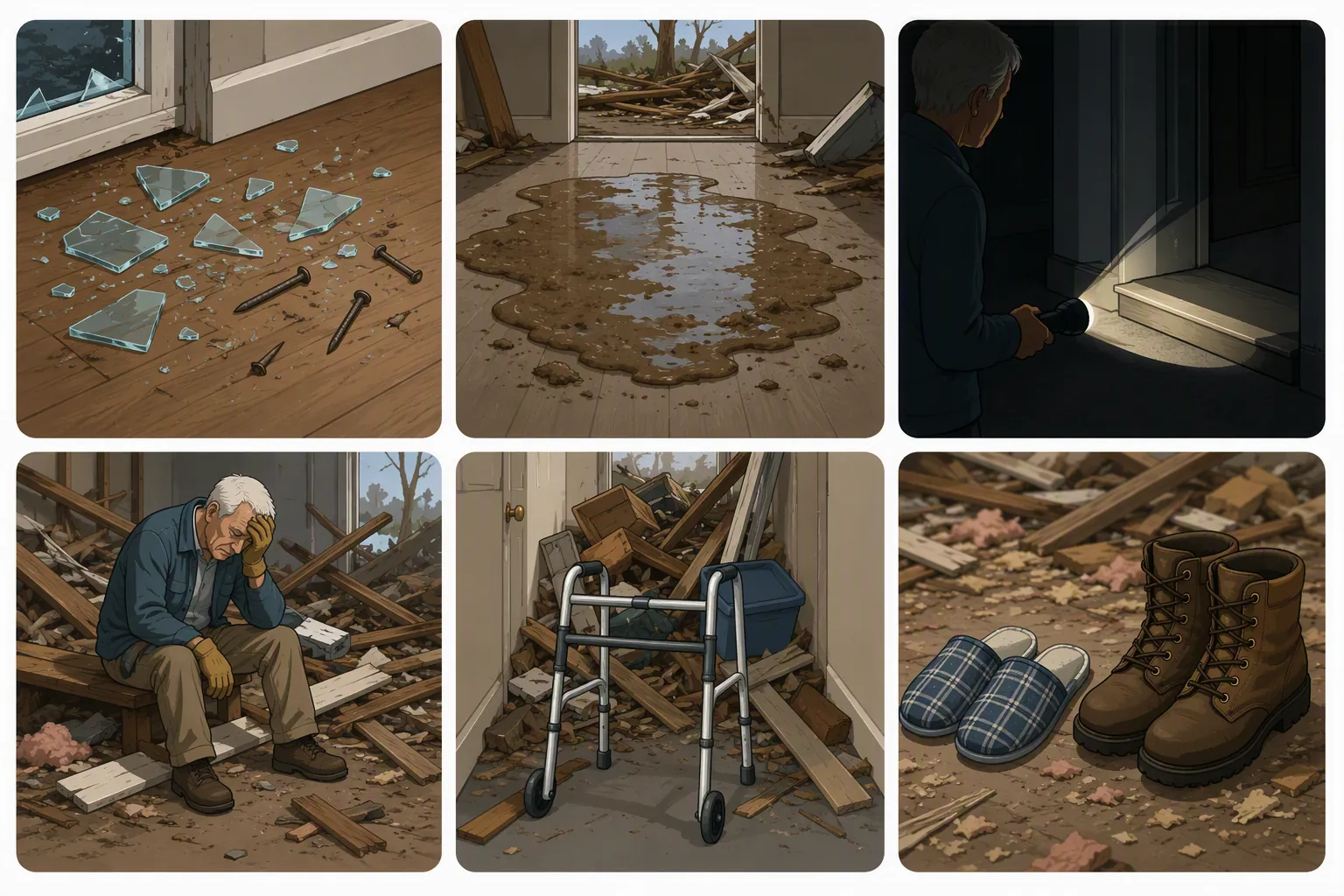
At the doorway, do a six-hazard scan
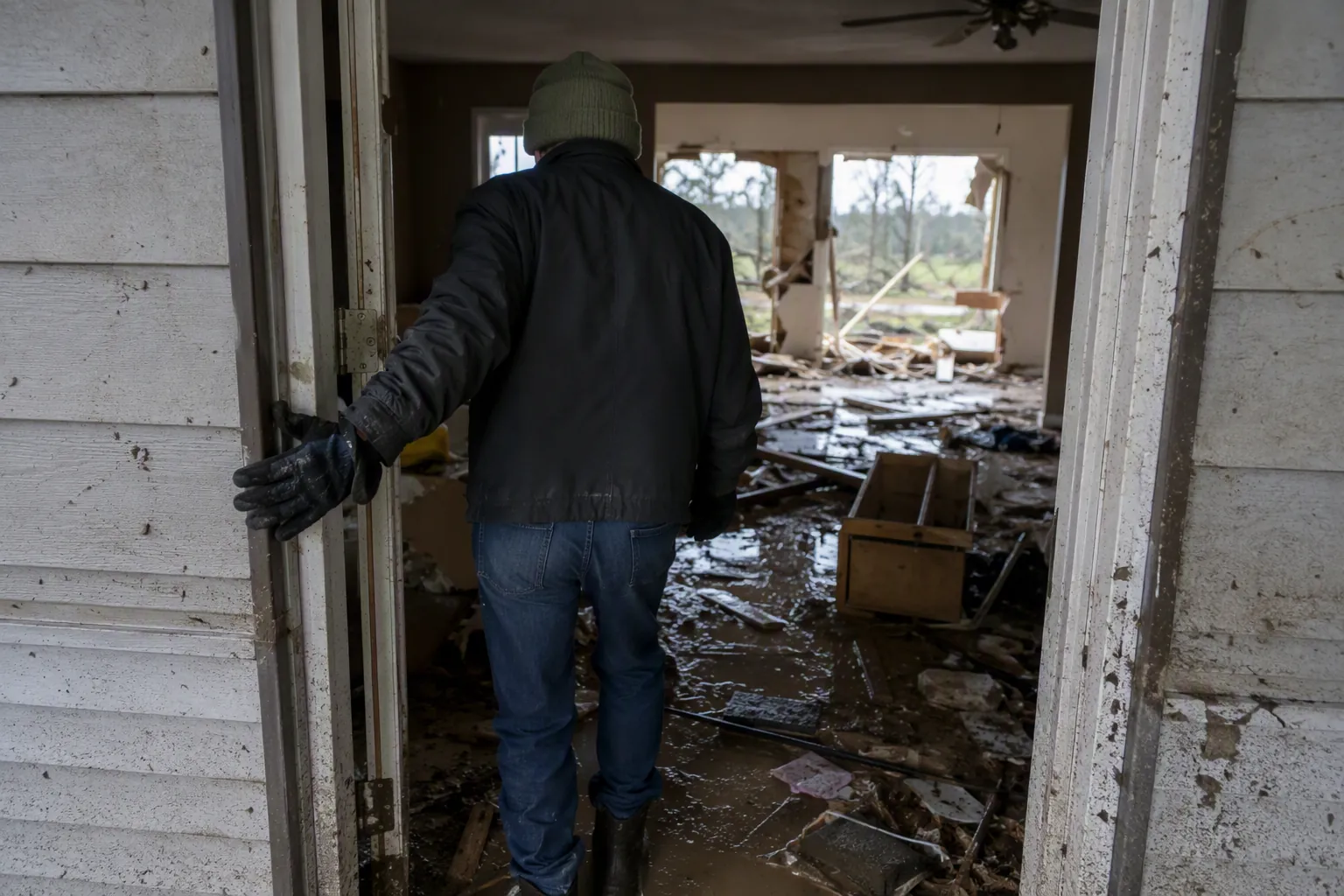
The first step back into a tornado-damaged home should not be a cleanup step. It should be a stop at the threshold. The floor inside may look like the same hallway, kitchen, or living room you knew yesterday, but it is now a temporary fall-risk zone: debris underfoot, wet surfaces, low light, fatigue, blocked walking paths, and footwear that was fine for the driveway but unsafe for wreckage.
The most useful tornado cleanup safety tips for seniors begin with that scan, because cleanup often asks an older adult to walk, turn, bend, carry, and make quick decisions in a damaged space. CDC disaster cleanup guidance says to pace yourself, decide priority tasks first, get help lifting anything over 50 pounds per person, and wear sturdy boots and protective equipment before cleanup begins.[1]
The fall risk is not theoretical. The CDC reports that 1 in 4 older adults falls each year and that falls are the leading cause of injury-related death among adults 65 and older.[2] The National Safety Council reports 43,020 older adult fall deaths in 2024, a 51% increase over the past decade.[3] Those figures are not tornado-cleanup figures; they are the baseline risk that follows an older adult into a house made harder to walk through.
There is an important evidence boundary here. Available sources do not include a peer-reviewed study that directly measures fall rates among older adults specifically during tornado cleanup. This guide applies established older-adult fall-risk factors from CDC STEADI—balance or mobility impairment, lower-body weakness, vision loss, medication side effects, foot problems, and environmental hazards—to the conditions commonly present during disaster cleanup.[4]
This article is educational, not medical advice. An older adult who has dizziness, recent falls, fainting, new weakness, severe pain, medication side effects, shortness of breath, or a condition that affects walking should speak with a clinician before taking part in cleanup.
| Hazard to scan for | What it looks like after a tornado | What to do before continuing |
|---|---|---|
| Debris underfoot | Nails, glass, splintered wood, insulation, broken furniture, displaced household objects | Clear a walking path first; do not step over debris to start another task. |
| Wet or slippery surfaces | Rainwater, mud, floodwater, soaked carpet, slick tile, warped flooring | Treat wet flooring as unsafe until it is lit, tested, and cleared by someone steady on their feet. |
| Darkness | Power outage, blocked windows, dim rooms, unseen stairs, raised thresholds, clutter in shadows | Use hands-free lighting when possible and postpone walking through dark rooms. |
| Fatigue | Shaky legs, rushed decisions, emotional overwhelm, long periods standing or bending | Work in short intervals; stop before balance and judgment fade. |
| Mobility aid disruption | A cane tip slipping, a walker blocked by debris, narrow paths, cords, broken thresholds | If the usual cane or walker cannot move safely, the senior should not walk that route. |
| Improper footwear | Slippers, sandals, smooth-soled shoes, wet shoes, shoes without ankle or sole support | Put on sturdy boots before entering the cleanup area. |
Debris underfoot is the first cleanup hazard
Tornado debris does not sit politely in piles. It spreads into walking paths: nails angled up from trim boards, broken glass mixed with leaves and mud, splintered wood beside furniture legs, roof material dragged into a hallway, picture frames and kitchen items scattered where a cane or walker would normally land.
For an older adult, that debris field collides with several CDC STEADI risk factors at once. Balance impairment makes an unexpected shift underfoot harder to correct. Lower-body weakness makes stepping over boards or boxes more dangerous. Vision loss makes low-contrast hazards—clear glass, dark nails, brown mud on brown flooring—easy to miss.[4]
The safe first task is not “start cleaning.” It is “make one stable route.” A caregiver or stronger helper should clear a short path from the entrance to one necessary area, such as a chair, medication location, or bathroom, before the older adult walks farther in. That route should be wide enough for the person’s normal walking pattern and any mobility aid they use. If each step requires testing, twisting, or stepping over objects, the route is not ready.
Do not ask the senior to hold a trash bag in one hand while “just picking up small things” with the other. That removes a hand that may be needed for balance and turns small debris into a walking task, a bending task, and a carrying task all at once.
Wet surfaces change the floor before you can judge it
After a tornado, water may come from broken windows, roof damage, rain driven under doors, floodwater, leaking pipes, or saturated carpet. A floor can be slick even when it does not look flooded. Mud on tile, wet leaves on a porch, soaked rugs, and damp sawdust can all change how a foot lands.
Wet surfaces are especially unforgiving for seniors with foot problems, neuropathy, lower-body weakness, balance changes, or medication side effects that slow reaction time. CDC STEADI lists these as fall-risk factors; the wet floor simply gives those risks less room for recovery.[4]
Before an older adult walks on a wet area, someone should identify why it is wet, whether the surface is stable, and whether there is a dry alternative route. Soaked carpet can hide uneven flooring. A rug that used to prevent slipping can become a sliding mat. Mud on a familiar porch step can turn a normal entry into the most dangerous step of the day.
If water, mud, and debris overlap, treat the area as a no-walk zone for the senior until it is cleared. The person who is most worried about the house may want to go in and “see how bad it is.” That is understandable. It is also exactly when someone else should take photos, retrieve essentials, or describe the damage from a safer spot.
Darkness turns a familiar room into guesswork
A power outage does more than make cleanup inconvenient. It hides raised thresholds, stair edges, cords, broken boards, shifted rugs, glass, and furniture that has moved from its usual place. A senior who could safely cross the room in daylight may be guessing in the dark, especially if vision changes are already part of daily life.
The common fix—a handheld flashlight—has its own problem. If an older adult needs one hand for a cane, walker, railing, or door frame, putting a flashlight in that hand can take away support. If the flashlight is in the other hand, there may be no free hand for balance or carrying. The room is brighter, but the walking task may still be unsafe.
Use the brightest stable lighting available before anyone starts moving through damaged rooms. A headlamp, lantern placed on a stable surface, or helper-directed light is safer than asking the senior to walk one-handed through debris. If stairs, thresholds, or clutter are involved, the lighting should show the floor ahead and the next foot placement, not just the wall or the object being inspected.
For a room-by-room lighting plan, use the power outage fall prevention checklist for seniors before entering hallways, bathrooms, basements, or stair areas after dark.
Fatigue is a cleanup hazard, not just a feeling
Tornado cleanup is heavy work even before lifting starts. There is shock, decision-making, phone calls, insurance documentation, heat or cold, noise, neighbors coming and going, and the pressure to prove that something is being done. An older adult may not say, “I am too tired to walk safely.” They may say, “Let me just get that,” and step into the worst part of the room.
Fatigue matters because it slows reactions and weakens judgment. It can make a person less likely to use a cane, more likely to hurry, and more willing to step over debris instead of waiting. If medication side effects, lower-body weakness, or balance impairment are already present, fatigue compounds the same fall-risk factors identified in CDC STEADI.[4]
Set cleanup work into short, specific intervals. “Sit here and sort these documents” is safer than “help however you can.” “Call the utility company from this chair” is safer than “watch your step while we move things.” A seated task still gives the older adult control and usefulness without making unstable walking the price of participation.
If cleanup is happening in hot conditions, fatigue can arrive faster than expected. Use the guidance on how to cool seniors without AC and prevent falls during heat waves when air conditioning is out, the house is humid, or cleanup requires repeated trips outdoors.
A blocked walker path is a stop sign
A cane or walker is not optional just because cleanup is urgent. If the device cannot move through the area, the area is not safe for the person who relies on it.
This is where families can accidentally create risk while trying to be efficient. A walker gets left at the doorway because debris narrows the hall. A cane tip slips on wet tile. A rollator wheel catches on a raised threshold or cord. Someone says, “I’ll hold your arm,” and the senior agrees because they do not want to slow everyone down.
That workaround may remove the very support the person uses to stay upright. CDC STEADI includes balance and mobility impairment among fall-risk factors; abandoning the usual device during cleanup does not make the person more capable, it makes the walking surface more demanding.[4]
Before the senior enters, test the route with the actual device. Can the walker sit flat on the floor? Can all legs or wheels move without catching? Is the path wide enough to turn around? Can the cane land on dry, stable spots? If the answer is no, the senior should wait outside the route while someone else clears it.
Footwear is the protection chosen before the first step
Shoes are not a small detail during tornado cleanup. They are the contact point between an older adult and every nail, slick board, muddy threshold, and uneven patch of flooring. Slippers, sandals, smooth-soled shoes, backless shoes, and wet shoes should stay out of the cleanup area.
CDC cleanup guidance calls for sturdy boots, long sleeves, gloves, a hard hat, goggles, and an N95 mask during disaster cleanup.[1] For fall prevention, the sturdy boots deserve special attention: they protect the sole, improve grip, and make it less likely that a small shard, nail, or wet patch changes the way the person steps.
Boots should be dry, secure, and easy for the older adult to walk in. A heavy boot that changes gait can create its own problem, especially for someone with lower-body weakness or foot pain. If the only available footwear is flimsy or unfamiliar, the safer answer may be for the senior to stay out of the damaged area while another person enters with proper protection.
The N95 mask belongs in the protection plan, too, but it is mainly a respiratory safeguard rather than a fall-prevention tool. If dust, smoke, mold, or air-quality alerts are part of the cleanup conditions, use the separate guidance on how to protect seniors from falls when air quality alerts arrive so breathing protection does not distract from safe walking.
Choose the senior’s role before cleanup begins
Older adults often want to help because the home is theirs, the loss is theirs, and waiting can feel like being pushed aside. That deserves respect. It does not mean the first job should be walking through broken rooms.
Disasters also hit older adults harder. AARP notes that people age 75 and older accounted for 50% of Hurricane Katrina deaths despite being only 6% of the population, and identifies advanced age as the single strongest demographic predictor of disaster mortality.[5] That does not mean every older adult is fragile. It means cleanup decisions should not treat age-related mobility, vision, stamina, medication, and health concerns as afterthoughts.
The Red Cross advises older adults to have a support network that can help with cleanup.[6] After a tornado, that network may be adult children, neighbors, faith-community members, local volunteers, or professional cleanup crews. The important part is assigning the unstable walking, lifting, and carrying to people who can do it safely.
- Have the older adult stay outside the damaged area until one safe route has been cleared, lit, and checked for wet spots.
- Give seated or stable tasks first: making calls, listing damaged items from photos, sorting documents, identifying medications, contacting relatives, or directing helpers to important locations.
- Keep lifting and carrying off the senior’s task list, especially when objects are wet, awkward, sharp, or heavier than they look.
- Follow the CDC cleanup limit: get help lifting anything over 50 pounds per person.[1]
- Recheck the route after each major cleanup move. A path that was safe ten minutes ago may be blocked again by bags, cords, fans, tools, or furniture.
When cleanup should wait
There are moments when the safest tornado cleanup plan is to stop. If the home is dark, wet, debris-covered, or impossible to navigate with the older adult’s usual cane, walker, or other mobility aid, the senior should not enter that area for cleanup. Someone else can take photos, retrieve essentials, open a path, or arrange help.
The same answer applies if the older adult is dizzy, exhausted, overheated, short of breath, newly unsteady, or trying to help without safe footwear. Those are not minor inconveniences during disaster recovery. They are signs that the walking conditions and the person’s current capacity do not match.
A fall during cleanup can add an injury crisis to a housing crisis. Preventing that fall is part of tornado recovery, not a delay from it.
References
- Guidelines for Cleaning Safely After a Disaster — CDC
- Facts About Falls | Older Adult Fall Prevention — CDC
- Older Adult Falls — Injury Facts — National Safety Council
- STEADI — Older Adult Fall Prevention | CDC — CDC
- The Impact of Disasters on Older Adults — AARP
- Older Adults Emergency Preparedness — American Red Cross
Related reading
Noticed something outdated or inaccurate on this page? Flag a correction. We review every report against CDC, NIA, and AARP HomeFit guidance before updating a page.
Part of the Fall Prevention section.