
STEADI: Intervene
Prevent Falls and Protect Medical Devices During a Power Outage
Learn how to prevent falls in the dark, keep medical devices running, and recognize temperature danger signs during a power outage. This guide covers low-cost pre-outage modifications and step-by-step actions for seniors who rely on powered equipment.
The first dangerous moment in a power outage is not the food in the refrigerator. It is the older adult waking up in a black room and trying to get from the bed to the bathroom, the recliner to the hallway, or the chair to the oxygen tubing without enough light to judge the floor.
For power outage safety for seniors with medical needs, the plan has to treat three problems as one chain: darkness raises fall risk, interrupted power can stop or limit medical equipment, and heat or cold can make judgment and balance worse. A fall can separate someone from a phone, oxygen backup, walker, CPAP setup, or caregiver. That is how a manageable outage becomes a second emergency.
The chain is especially unforgiving because aging changes how the home is experienced in the dark. PowerOutage.us cites NIH data that 22% of adults ages 65 to 74 and 55% of adults 75 and older have disabling hearing loss, and it notes that aging can reduce depth perception and peripheral vision, making familiar obstacles harder to detect at night.[1] The rug that was “fine yesterday” is different when the hallway has no shadows, the bathroom edge disappears, and the person is half-awake.
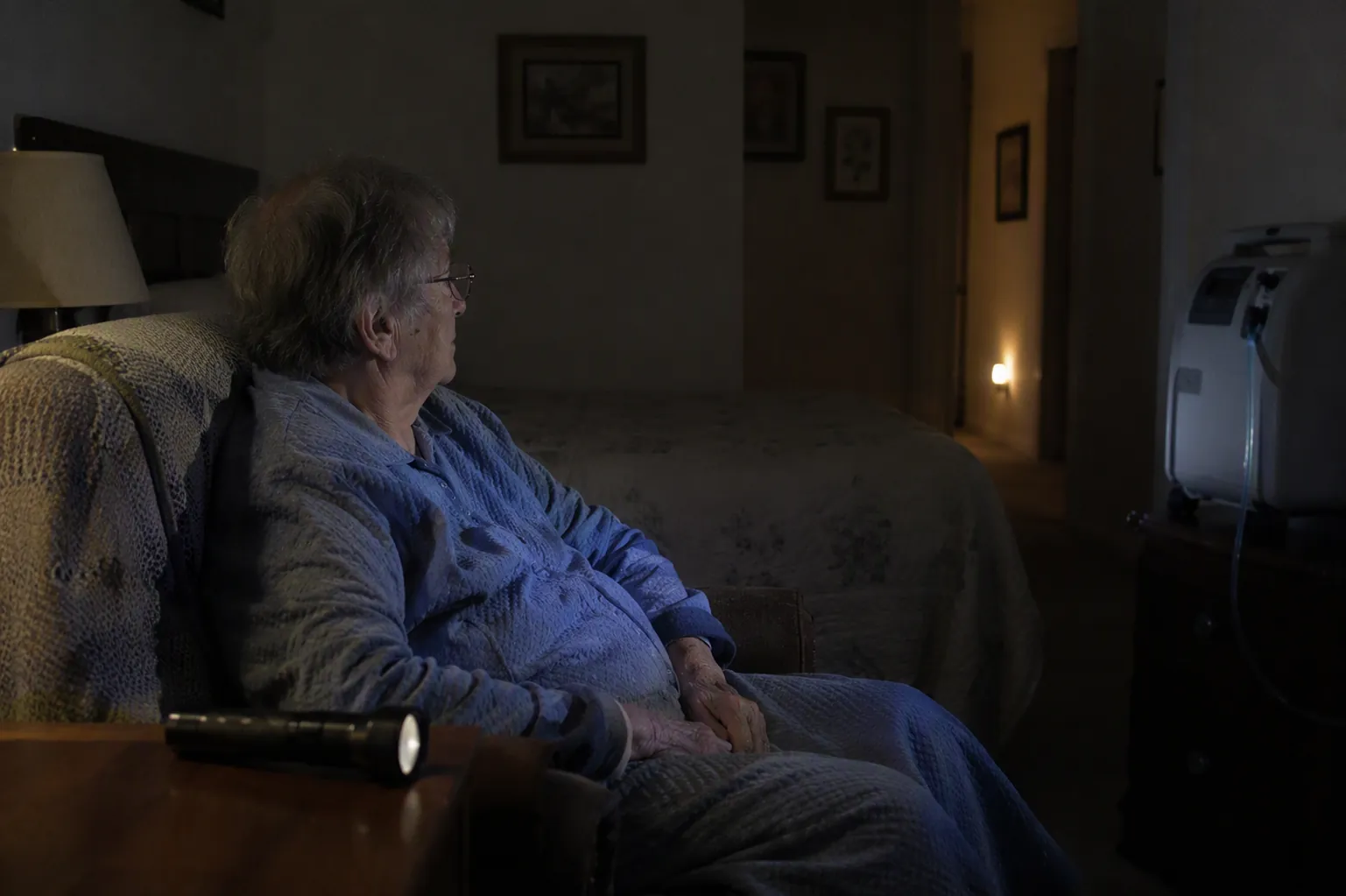
Start with the paths the person actually uses
Before buying anything, walk the routes that matter after dark. Not the whole house. The real routes: bed to bathroom, bed to phone, recliner to walker, recliner to oxygen backup, bathroom to bedroom, bedroom to exit. If the person uses a rollator, cane, wheelchair, oxygen tubing, or bedside commode, include that equipment in the walk-through instead of imagining a clear, healthy stride.
Then ask a harsher question: if the lights went out at 2 a.m., what would the person have to decide before taking the first step? Every decision you can remove before the outage is one less chance for a frightened or sleepy person to improvise.
| Route or reach zone | Pre-outage setup | What it prevents |
|---|---|---|
| Bedside | Flashlight within arm's reach, phone charged nearby, walker or cane parked in the same place every night | Standing up before there is light or support |
| Bed-to-bathroom path | Battery nightlights or motion-sensor lights, taped-down rug edges, clear tubing route, non-slip bathroom mat | Trips, slips, and tubing snags |
| Favorite chair or recliner | Flashlight, phone, device instructions, and backup power or oxygen information within reach | Crossing the room to solve a device problem |
| Steps, thresholds, and doorways | Glow tape or high-contrast marking on key edges | Missing a change in floor height |
| Medical-device area | Backup battery, backup oxygen, cords, and written steps stored beside the device location | Searching in the dark while equipment is alarming or off |
This is the part of outage planning that looks too small until it is needed. A flashlight in a kitchen drawer is not a safety feature for someone who wakes up in a dark bedroom. The American Red Cross advises keeping flashlights handy and avoiding candles because of fire risk; for an older adult with medical needs, “handy” should mean within arm’s reach of every bed, favorite chair, and mobility device location.[2]
Make light reachable before movement starts
Put a flashlight where the hand naturally goes: on the nightstand, clipped to the walker basket, on the table beside the recliner, and near the bathroom entrance if that is where the person steadies themselves. Test the location with the person sitting or lying down. If they have to stand, bend, open a drawer, or remember which cabinet holds the flashlight, the placement is not good enough.
Battery-operated nightlights and motion-sensor lights belong low along the route, not just in the middle of the room. The useful question is whether the person can see the floor edge, rug edge, threshold, toilet base, and walker wheels. Home fall-prevention guidance commonly emphasizes removing tripping hazards, securing rugs, improving lighting, and using non-slip mats in areas such as bathrooms and hallways.[3]
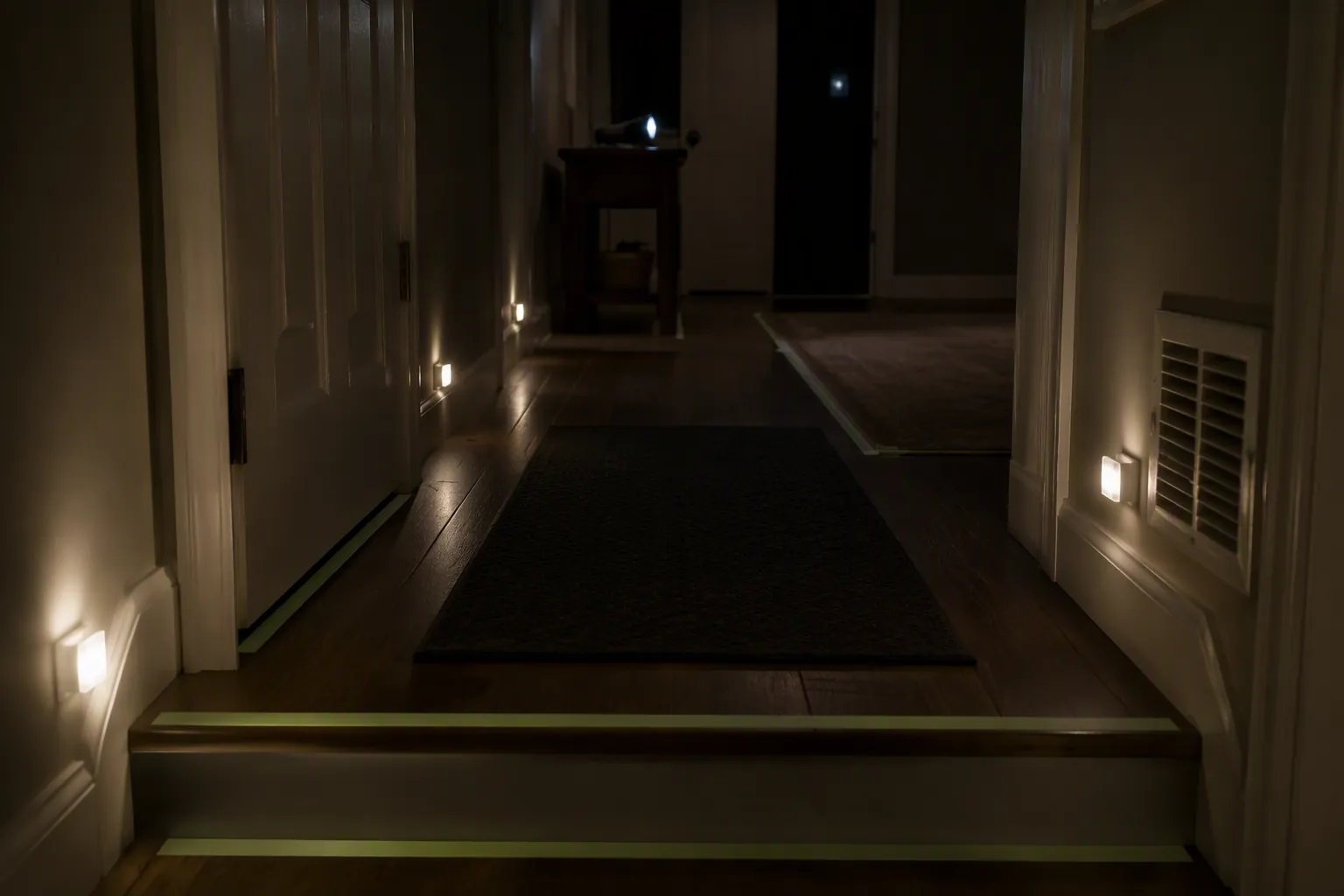
Glow-in-the-dark tape or high-contrast tape is most useful where the floor changes: a step down into a den, a raised threshold, the edge of a shower, the lip of a ramp, or the corner of furniture that narrows the route. Do not decorate the house with it. Mark the places where a foot, walker, or oxygen tube is most likely to catch.
Treat the bathroom route as the main route
The bed-to-bathroom path deserves more attention than the front door in many homes, because it is used when the person is sleepy, urgent, barefoot, and least likely to pause. Tape down or remove area rugs along that path. Use a non-slip mat that lies flat. Make sure the walker can pass without clipping a laundry basket, trash can, magazine rack, oxygen concentrator, or cord.
Grab bars are not only for the shower. If the person uses the wall, sink, towel bar, or door frame to steady themselves, that is information. A real grab bar in the right place is better than pretending the towel bar is harmless. The goal is not to turn the home into a facility; it is to stop a predictable reach from becoming a fall.
- Keep the walker, cane, or wheelchair in the same position every night, with the path to it clear.
- Route oxygen tubing away from the main walking line when possible, and remove loops near the bed or bathroom door.
- Use a bedside commode during high-risk outages if the bathroom route is long, uneven, or hard to light.
- Place a whistle, phone, or medical alert button where the person can reach it from the floor as well as from the chair or bed.
Keep medical-device decisions close to the person
Backup power is often discussed as if the only question is battery life. Battery life matters, but the movement question comes first: can the senior stay seated or lying safely while someone switches to backup power, backup oxygen, or a safer location?
If the backup battery is in a closet, the oxygen cylinder is in the garage, and the instructions are in an email, the plan depends on a calm, mobile caregiver being present at the exact right time. That may happen. It may not. Store the items needed for the first safe transition near where the person sleeps and sits.
Oxygen concentrators: plan for the switch, not just the supply
For someone using an oxygen concentrator, the outage plan should be written with the oxygen supplier or clinician, not guessed during a storm. Banner Health advises oxygen users to have backup tanks or cylinders available for power outages.[4] The practical home question is where those tanks are stored and whether the person can remain safely seated while they are connected.
Keep the supplier’s emergency number, the prescribed flow rate, and basic switch-over instructions in large print near the concentrator and near the person’s main chair or bed. If more than one family member helps, do not rely on one person being the only one who knows how the backup works. A calm five-minute practice on an ordinary day is kinder than a shouted phone call in the dark.
Utility medical lists can be worth asking about, but they are not a private rescue contract. Programs vary by state and utility, and being listed may not mean immediate restoration. Call the specific utility before an outage season, ask what documentation is required, and ask what the list does and does not provide.
CPAP and BiPAP: protect the sleep setup
For CPAP or BiPAP users, the safest outage setup is boring and visible: the machine, battery option, mask, hose, distilled water if used, and written steps all in the same reach zone. The American Lung Association notes that CPAP users may use battery packs and car adapters as part of power-outage planning.[5] Those options should be checked against the specific device model and the clinician’s advice, especially if oxygen is also connected.
A car adapter may help in some situations, but it changes the safety problem. Moving an older adult outside to sit in a vehicle during severe weather, heat, ice, or darkness may create more risk than it solves. If a car is part of the backup plan, decide ahead of time who helps the person get there, what path is lit, and when it is safer to leave for a powered location instead.
Powered mobility and positioning equipment
Power recliners, lift chairs, hospital-style beds, stair lifts, and powered wheelchairs can become traps or transfer hazards if nobody has thought through the manual option. Keep manuals, release instructions, and charger locations together. If the person cannot safely transfer without the powered feature, the outage plan needs a caregiver response plan, not just a spare battery.
Do not wait for the outage to discover that the lift chair is stuck reclined, the bed is too high, or the wheelchair charger is behind furniture. Test the manual or backup process in daylight with the person present, and stop if the test itself feels unsafe. That is a sign to ask the equipment supplier, therapist, or clinician for a safer plan.
During the outage: slow the first five minutes down
When the power fails, the first instruction should be simple: stay seated or stay in bed until there is light. The caregiver’s job is to bring light and information to the person, not to have the person walk toward the problem.
- Tell the person to stay where they are unless there is immediate danger such as fire, smoke, or flooding.
- Turn on the nearest flashlight, lantern, battery nightlight, or phone light before anyone stands.
- Check breathing equipment, mobility equipment, and the phone before checking food, appliances, or the rest of the house.
- Move cords, tubing loops, pets, and loose rugs out of the next needed path.
- If equipment has failed and there is no safe backup, call the supplier, clinician line, utility emergency number, local non-emergency services, or 911 depending on the severity.
This is also when family arguments become dangerous. If one person says “Dad can walk fine,” bring the conversation back to the actual situation: no lights, possible tubing, possible urgency, possible device alarm, and a person who may have just been startled awake. The standard is not whether he walks well on a normal afternoon. The standard is whether this walk is necessary right now.
Use generators carefully, or do not use them at all
A generator can keep essential equipment running, but it can also add carbon monoxide danger to an already difficult night. Ready.gov says generators should be used outdoors and kept more than 20 feet away from windows, doors, and attached garages; it also advises installing carbon monoxide detectors on every level of the home.[6] The Red Cross gives similar generator safety guidance.[2]
Never run a generator in a garage, on a porch, near an open window, or in a partially enclosed space. If the only way to power the device involves an unsafe generator setup, that is not a backup plan. That is the point to move to a safer powered location or call for help.
Temperature can turn a careful person unsteady
Cold and heat are not separate from fall prevention. They change alertness, strength, and decision-making. A person who is too cold, overheated, dehydrated, or confused is less able to judge the bathroom step, manage tubing, or wait for help.
During a cold-weather outage, watch for hypothermia signs that can be mistaken for ordinary tiredness. Medical Guardian, citing Mayo Clinic, lists drowsiness, slurred speech, and disorientation among warning signs of hypothermia.[7] Those signs should change the plan. A sleepy, slurring, confused person should not be asked to “just get up carefully” and walk through a dark house.
Warm layers, blankets, closed interior doors, and staying in one safer room may be enough for a short outage if the person is alert, breathing equipment is handled, and the route to the bathroom is safe. If the person becomes confused, very drowsy, hard to understand, or physically unstable, leaving for a warming center, powered relative’s home, emergency shelter, or medical care may be safer than waiting.
Heat creates a different kind of urgency, especially for medication storage. PowerOutage.us states that insulin degrades above 77°F and advises moving it to the coolest room or leaving if safe storage is no longer possible.[1] That is not a small housekeeping detail for someone who depends on insulin. It is a trigger to call the pharmacist, clinician, or local emergency-management resources and decide whether the home is still safe.
When staying home stops being the safer choice
Leaving the home is not automatically safer. A dark stairwell, icy ramp, hot car, dead phone, or poorly timed transfer can make evacuation dangerous. But staying is not automatically safer either, especially when medical equipment, temperature, or cognition is slipping.
The decision should be made earlier than most families want to make it. If oxygen backup is running down, CPAP or BiPAP cannot be used safely, powered mobility equipment cannot support transfers, insulin cannot be kept in a safe temperature range, or the person is becoming confused, weak, or unsteady, the plan should shift from “ride it out” to “get help or get to power.”
- Call the medical-device supplier if oxygen, CPAP/BiPAP, or mobility equipment backup is uncertain.
- Call the clinician, pharmacist, or nurse line for medication storage questions, especially insulin.
- Call the utility for outage estimates and any medical-account procedures, while remembering restoration programs vary.
- Call local emergency management, 211 where available, or local non-emergency services for warming centers, cooling centers, transportation, or shelter information.
- Call 911 if breathing, consciousness, chest pain, severe confusion, injury, or immediate safety is in question.
A 2026 author manuscript by Comellas and colleagues found that, in a survey of 222 Iowa adults ages 45 to 80, 58% reported having no plan to continue medical care during an outage, and only 8% had discussed medication management with their provider.[8] That study is limited: it is an Iowa sample, not a national rule, and the manuscript status matters. Still, the gap it points to is familiar. Families often own supplies without having rehearsed the handoff from darkness to light, from wall power to backup, from home to help.
A safer outage setup is physical, visible, and close
The most useful preparations are the ones that still work when nobody is thinking clearly. A flashlight the hand can find. A bathroom path that does not catch a toe. A backup oxygen cylinder stored where it can be reached without a dark trip through the garage. A CPAP battery kept with the machine instead of in a mystery box. A phone charger and written numbers beside the chair where the person actually sits.
The safest outage plan is not the biggest kit. It is the one that keeps the older adult seated, lit, connected to essential equipment, and warm or cool enough to make safe decisions until power returns or help arrives.
References
- Power Outage Safety for Seniors and People with Disabilities — PowerOutage.us
- Power Outage Safety — American Red Cross
- Fall-Proofing Your Home — National Institute on Aging
- What to Know About Oxygen Therapy and Safety — Banner Health
- CPAP and Power Outages — American Lung Association
- Power Outages — Ready.gov
- How to Prevent Hypothermia in Seniors During Winter Power Outages — Medical Guardian
- Older Adults’ Preparedness for Power Outages and Continuity of Medical Care — PubMed Central, 2026
Related reading
Noticed something outdated or inaccurate on this page? Flag a correction. We review every report against CDC, NIA, and AARP HomeFit guidance before updating a page.
Part of the Fall Prevention section.