
STEADI: Intervene
How Older Adults Can Stay Safe During a Mall Earthquake
Shopping malls create unique hazards for older adults during an earthquake. This guide shows how seniors using mobility aids can adapt Drop-Cover-Hold-On techniques and find safe shelter in a mall setting.
The floor starts to roll while you are halfway between a shoe store and the food court. There is no sturdy table within reach. The storefront beside you is mostly glass. A display of boxed appliances is tall enough to hurt someone if it tips. If you use a cane, walker, or wheelchair, the first good decision is not to aim for the exit. It is to stop a fall before it starts.
For older adults during mall earthquake shaking, the working rule is simple: protect yourself where you are, using the closest safe cover you can actually reach. Earthquake Country Alliance tells people in a store to Drop, Cover, and Hold On when possible, and if a table is not available, to use alternatives such as a shopping cart, clothing rack, bottom shelf, or an interior wall away from windows and tall furniture. [1]
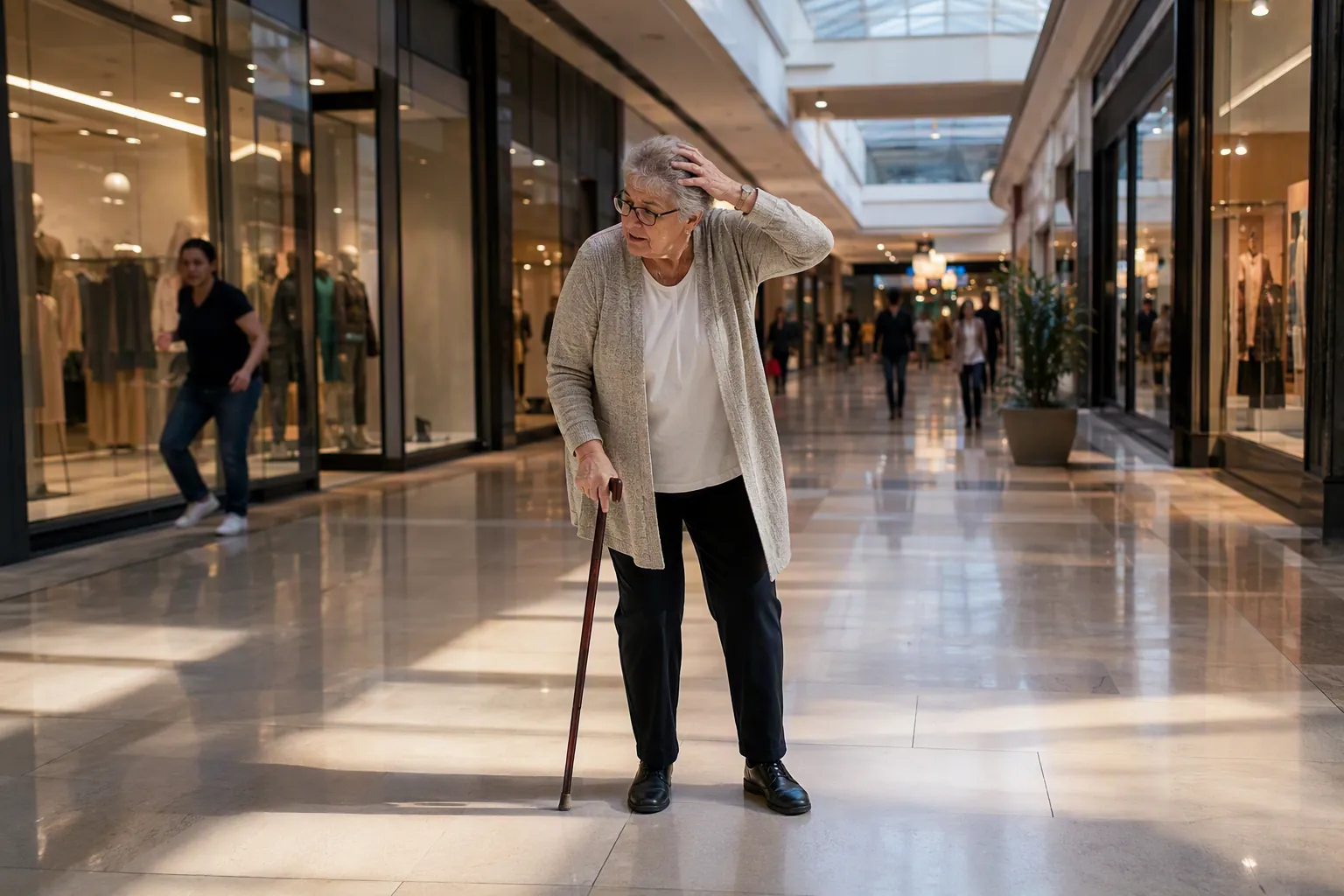
That advice matters more for older adults because shaking does not have to be dramatic to become dangerous. The CDC reports that about 1 in 4 older adults falls each year, and falls are the leading cause of fatal and nonfatal injuries among adults 65 and older. [2] A mall earthquake adds noise, crowds, slick floors, moving carts, escalators, and merchandise to a body that may already be guarding a hip, relying on a cane, or turning slowly because balance is not what it used to be.
The First Ten Seconds Are About Not Falling
In a mall, the exit is usually farther away than it looks. It may also require crossing open tile, passing glass, moving with a crowd, or stepping near an escalator. During shaking, those are not small details. They are the route by which an older adult gets pulled off balance.
So the sequence is short: stop, get lower if you can do it safely, cover your head and neck, and hold on to something stable enough to keep you from being thrown sideways. If you cannot get down, stay seated or braced and protect your head and neck. Earthquake Country Alliance gives adapted instructions for cane, walker, and wheelchair users rather than assuming everyone can drop to hands and knees. [1][3]
| If you are using | During shaking, prioritize |
|---|---|
| Cane | Sit or get low if possible; keep the cane close; cover head and neck; avoid stepping toward glass or exits. |
| Walker | Lock the wheels if the walker has them; bend low over the frame if you can; cover head and neck; hold the walker steady. |
| Wheelchair | Lock the wheels; bend forward if able; cover head and neck; stay away from windows, displays, and shelves that may fall. |
| No mobility aid nearby | Get low beside nearby cover if safe; use a shopping cart, clothing rack, bottom shelf, or interior wall away from glass. |
This is not a promise that a shopping cart or clothing rack is perfect protection. It is a mall-specific compromise: when there is no desk or table, partial cover that can shield the head and break the path of falling items is better than standing exposed in a corridor.
If You Use a Cane
A cane helps only if it remains in your control. Do not toss it aside to crawl under something unless you have already reached a safe place and know you can get back up. If a bench, sturdy chair, or low seat is immediately beside you, sit. If not, widen your stance as much as you safely can, bend your knees slightly, and use your free arm to cover the back of your head and neck.
Move away from glass only if you can do it in one or two controlled steps before the shaking becomes stronger. That means sliding or stepping toward an interior wall, a solid column, or the side of a store fixture that is not tall and top-heavy. It does not mean crossing the corridor because an exit sign is visible.
If you are already holding a shopping bag, let the bag go if it interferes with balance. A purchase can be replaced. A broken wrist, hip, or head injury is the kind of consequence mall advice too often politely skips.
If You Use a Walker

With a walker, the first action is to make the walker stop moving. Lock the wheels if it has brakes. If it does not, press down evenly through the handles and keep your feet planted. Earthquake Country Alliance’s adapted guidance for walker users is to lock the wheels, bend over, and cover the head and neck. [1][3]
In a mall corridor, bending low over the walker may be safer than trying to crouch to the floor. Getting down is only useful if you can do it without pitching forward, losing the walker, or being unable to rise after the shaking stops. If your walker has a basket full of purchases, do not lean so far that the weight pulls the frame forward. Keep your center of gravity over your feet and the walker close enough that it still supports you.
Look for cover that does not require abandoning the walker: the side of a clothing rack, a low shelf, an interior wall, or a shopping cart close enough to turn toward without crossing the flow of people. Stay away from glass storefronts, tall stacks of merchandise, kiosks with loose items, and escalator landings.
If You Use a Wheelchair
For wheelchair users, the chair is the shelter base. Lock the wheels. Bend forward if you can do so without sliding or losing airway comfort. Cover your head and neck with your arms, a bag, a folded jacket, or anything soft enough to cushion falling debris. Earthquake Country Alliance gives this adapted wheelchair sequence directly: lock, cover, and hold on. [1][3]
If you are being pushed by someone else, that person should not try to keep rolling toward the exit. A moving wheelchair during shaking can become a runaway object or tip hazard. The companion’s first useful job is to stop the chair, lock it, and help shield the head and neck if doing so does not put their own body under falling glass or merchandise.
If the chair is near glass, move only if there is a nearby safer spot and the chair can be turned there immediately. A short pivot toward an interior wall is different from a long push through a panicking crowd.
If You Are Caught in Open Mall Space

The wide central corridor is where ordinary earthquake advice starts to feel thin. There may be no table, no doorway worth trusting, and no clear wall nearby. In that case, use what the mall gives you: a shopping cart, a low merchandise shelf, a clothing rack, the side of a sturdy counter, or a solid interior column away from glass.
A shopping cart can serve as partial cover if it is close. Pull it near, get as low as your body allows, and angle your head and shoulders beside or under the cart rather than standing behind it like a shield. If the cart rolls, hold it only if doing so helps your balance. Do not fight a cart that is pulling you off your feet.
Food court furniture needs judgment. A heavy table that is within arm’s reach may help. Lightweight chairs and small tables can skid, flip, or clutter the floor. If using them means stepping through a scatter of chair legs while the floor is moving, stay braced where you are and cover your head and neck.
What a Companion Should Do
The companion’s instinct is often to grab an arm and move. That can be the wrong kind of help. Pulling an older adult away from a cane, walker, or wheelchair during shaking may remove the very thing keeping that person upright.
- Do not drag the older adult toward an exit while shaking continues.
- Do not separate the person from a cane, walker, wheelchair, glasses, hearing aids, or essential bag unless there is an immediate life threat.
- Help lock walker or wheelchair brakes if you can reach them safely.
- Use your body only where it helps: steady the mobility aid, guide the person lower, or shield the head and neck from small falling objects.
- Speak in short instructions: “Lock the wheels,” “Cover your head,” “Stay here,” “I’m beside you.”
If you are with a parent who has hearing loss, low vision, dementia, or slow reaction time, your voice and hands matter more than a perfect plan. Stand where they can see or feel you. Point to the nearest cover. Put a hand on the walker frame rather than yanking an elbow. If they freeze, protect the head and neck first; movement can wait until the floor stops.
The American Red Cross recommends that older adults build a personal support network and plan for help during emergencies. [4] In a mall, that network may be just one daughter, spouse, neighbor, or hired caregiver for the afternoon. The useful question before the outing is not “What if there is an earthquake?” It is “If the shaking starts, who touches the brakes, who watches for glass, and who keeps the mobility aid with the person?”
Why Malls Change the Usual Advice
A home has familiar furniture, known exits, and usually fewer strangers moving at once. A mall has long corridors, glass storefronts, decorative fixtures, unsecured merchandise, escalators, elevators, kiosks, and food court furniture that may shift. Those features do not make every mall unsafe in the same way, and there is no mall-specific senior earthquake injury study that proves a single injury pattern. The safer claim is narrower: known fall risk in older adults meets a public space where cover may be farther away and crowd movement can add another hazard.
That is why generic “get under a table” advice is not enough in this setting. If there is a sturdy table right next to you, use it. If there is not, the better question is which nearby object reduces the chance of being knocked down or struck without forcing you to travel through the shaking.
After the Shaking Stops
Do not treat silence as the all-clear. First, check your own body: head, hip, wrist, ankle, breathing, dizziness. Then check the mobility aid. A bent walker leg, jammed brake, loose cane tip, or wheelchair wheel problem can turn the evacuation into the injury.
- Stay where you are if moving would put you under glass, loose displays, or a crowd surge.
- Follow mall staff or emergency responder directions when they are present and credible.
- Avoid elevators after shaking; use accessible evacuation routes or wait for assistance if stairs are not safe for you.
- Move slowly around broken glass, spilled liquids, fallen signs, and shifted merchandise.
- Expect aftershocks and keep the cane, walker, or wheelchair within reach.
For the fuller decision after the shaking—when to evacuate, when to shelter, and how an adult child can help without making the situation worse—use CareWise Guide’s earthquake evacuation guide for an elderly parent. This mall guide is mainly about surviving the shaking without adding a preventable fall.
Plan Before the Next Mall Trip
Preparedness for a mall visit should be small enough that people will actually do it. The California Department of Aging advises older adults to keep walking aids nearby and consider practical emergency items such as spare hearing aid batteries and a whistle. [5] Ready.gov also emphasizes planning around medical, mobility, communication, and support needs for older adults. [6]
- Keep the cane, walker, or wheelchair with the person, not in the car “just in case it gets crowded.”
- Carry a charged phone, emergency contact information, essential medication details, and any communication aid needed to hear or be understood.
- Choose meeting places that do not require crossing glass-heavy corridors or using elevators.
- Agree that during shaking, nobody runs for the exit and nobody abandons the mobility aid.
- Review adapted Drop-Cover-Hold-On positions at home first, especially if the older adult uses a cane, walker, or wheelchair.
CareWise Guide’s earthquake safety guide for seniors with limited mobility covers the home version of these adapted positions. The mall version asks the same question in a less forgiving place: what can this person do, with this mobility aid, beside this glass, display, cart, bench, or wall, before the next jolt knocks balance away?
References
- Step 5: Drop, Cover, and Hold On, Earthquake Country Alliance, https://www.earthquakecountry.org/step5/
- Facts About Falls, Centers for Disease Control and Prevention, https://www.cdc.gov/falls/data-research/facts-stats/index.html
- Accessibility Resources, Earthquake Country Alliance, https://www.earthquakecountry.org/accessibility/
- Older Adults Emergency Preparedness, American Red Cross, https://www.redcross.org/get-help/how-to-prepare-for-emergencies/older-adults.html
- Disaster Tip Sheets, California Department of Aging, https://www.aging.ca.gov/Providers_and_Partners/Area_Agencies_on_Aging/Disaster_Preparedness/Disaster_Tip_Sheets/
- Older Adults, Ready.gov, https://www.ready.gov/older-adults
Related reading
Noticed something outdated or inaccurate on this page? Flag a correction. We review every report against CDC, NIA, and AARP HomeFit guidance before updating a page.
Part of the Fall Prevention section.