
STEADI: intervene
How to Prevent Falls in Heat Without Air Conditioning
High heat without air conditioning can trigger a dangerous cascade of dehydration, dizziness, and impaired balance that increases fall risk for older adults. This guide explains why that happens and provides practical cooling strategies that double as fall prevention measures.
The dangerous moment in a hot home is often ordinary: an older adult pushes up from a chair, pauses because the room tilts for a second, then reaches for the nearest table or door frame. At night, the same thing can happen on the way to the bathroom, when the body is warm, fluids are low, and there is no time to think through balance.
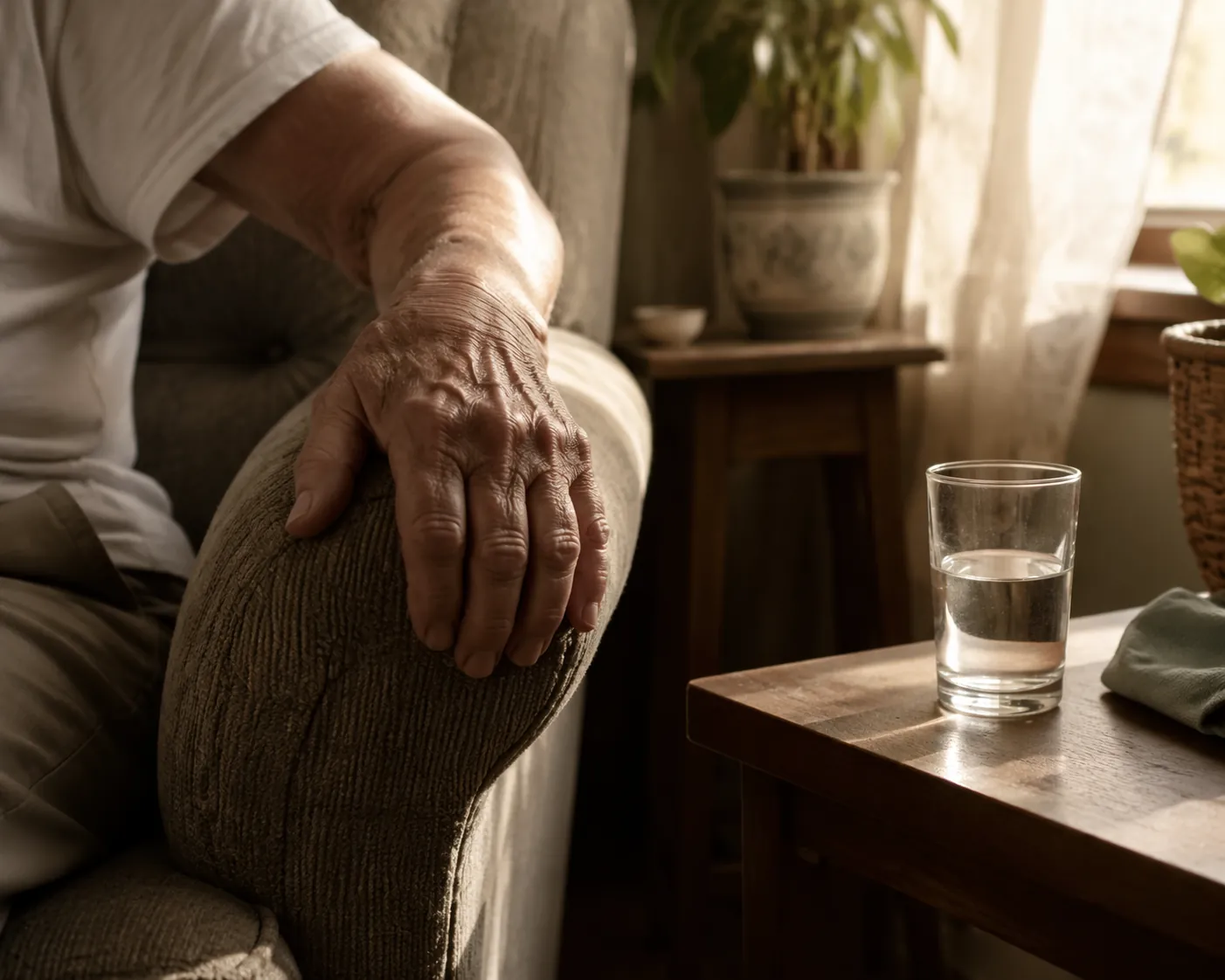
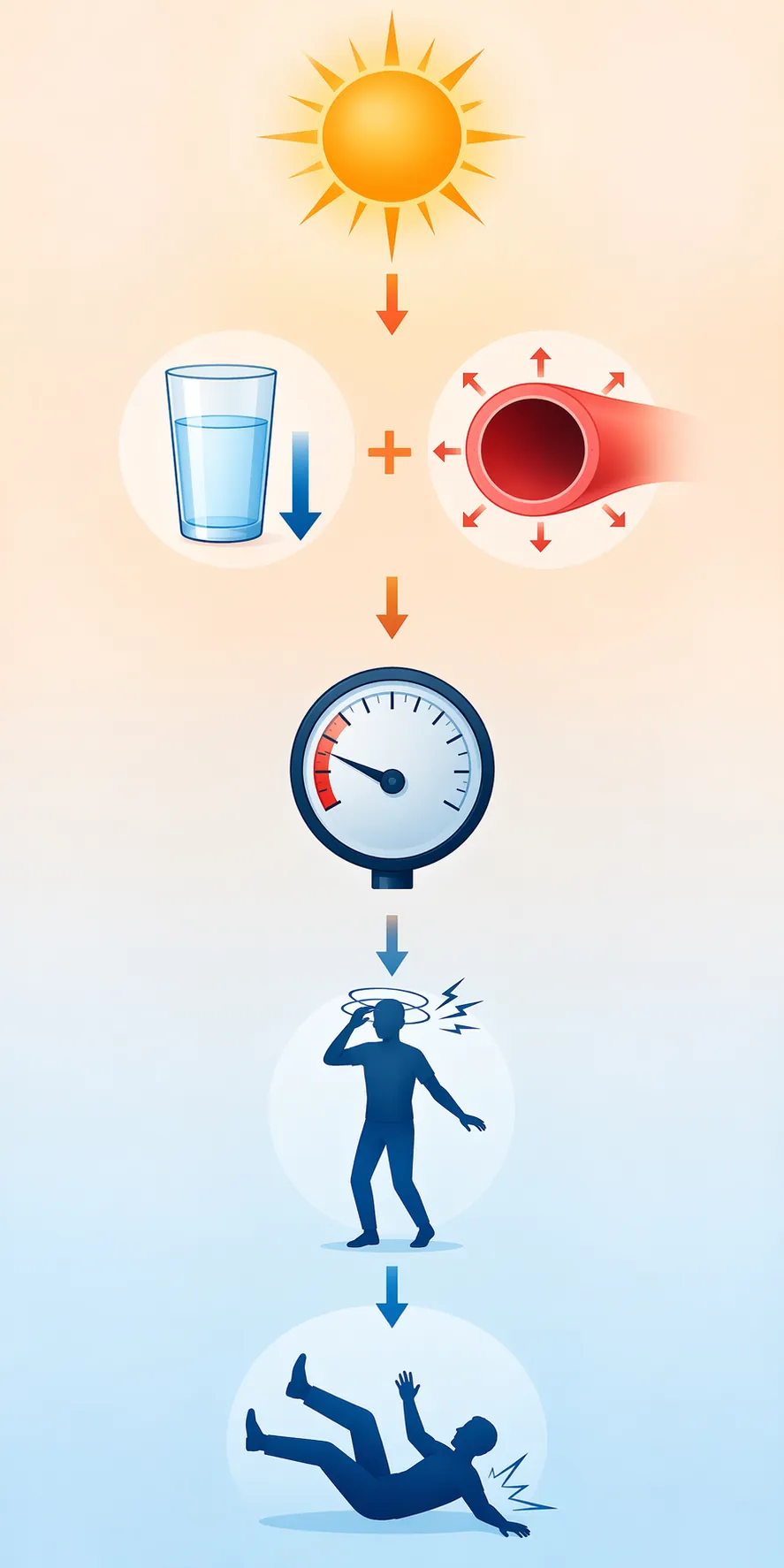
That is why keeping an older adult cool during a heat wave without AC belongs inside fall prevention. Heat can reduce fluid volume through sweating and lower intake. It can also widen blood vessels as the body tries to release heat. Together, those changes can contribute to a drop in blood pressure when standing, dizziness, slower reactions, and poorer balance. The fall may look sudden. The chain leading to it usually is not.
The strongest fall-related data point comes from a large study of 30,634 older adults in Mayo Clinic Proceedings. Dehydration was present in 37.9% of the cohort, and dehydration was associated with 13% higher odds of falling within 30 days after adjustment for measured factors.[1] That does not prove that every hot day causes a fall, and the cohort was 94.6% white non-Hispanic and Midwestern, which limits how confidently the findings apply to every community.[1] But for a household decision, the signal is still hard to ignore: hydration status is not a side issue when someone is already at fall risk.
Why thirst is a poor safety alarm in older adults
A younger person may feel thirsty, refill a bottle, and correct course before dizziness shows up. Many older adults do not get that clear warning. Aging can blunt thirst signals, so “they’ll drink when they need to” is a weak plan for a hot room. By the time thirst feels urgent, the person may already be closer to the point where standing up becomes unsteady.
This changes the household task. Hydration cannot depend only on reminders shouted from another room or a caregiver asking, “Did you drink enough?” The safer setup is visible, scheduled, and tied to routines that already happen: a glass next to the morning chair, another with lunch, another in the evening before the house heats up again. If fluid restrictions, kidney disease, heart failure, or other medical limits are involved, the schedule should be cleared with a clinician rather than improvised.
The point is not to make drinking water a moral test. It is to remove a decision that heat makes easier to miss. A person who does not feel thirsty, does not want hovering, and is trying to stay independent needs a setup that works without constant negotiation.
The standing-up problem: where heat becomes a fall
Orthostatic hypotension is the practical hinge in this chain: blood pressure drops when a person moves from lying or sitting to standing. Heat can make that transition harder by lowering effective circulating volume and widening blood vessels. The result may be a few seconds of lightheadedness, blurred vision, weakness, or the need to grab furniture.
Those few seconds deserve attention. They are not just “getting up too fast” in a harmless sense. In a cooler, well-hydrated body, the person may compensate. In a hot bedroom after a night of poor recovery, the same movement can be enough to turn a normal bathroom trip into a fall.
- Before standing, sit upright for a moment with both feet on the floor.
- After standing, pause before walking, especially at night or after a nap.
- Treat dizziness, new weakness, or unusual unsteadiness as a warning sign, not as a personality quirk.
- Keep the route to the bathroom clear, lit, and free of loose rugs, because heat reduces the margin for error.
For more on the broader heat-and-balance connection, see why extreme heat makes falls more likely. This article stays focused on homes without air conditioning, where the controls have to be simple enough to repeat.
Medication can turn heat from stressful to unstable
Medication review is one of the most useful caregiver actions because it turns a vague heat warning into a list of bottles on a table. In the Hamrick study, loop diuretics were associated with higher fall odds, antidepressants with higher fall odds, and anticholinergics with higher fall odds in the cohort analysis.[1] These medications are not “bad” because it is hot outside. Many are necessary. The risk is that heat, dehydration, blood pressure changes, sedation, urinary urgency, or cognitive slowing can overlap with the reasons a person is already vulnerable to falling.
| Medication category | Why it matters during heat | What to do at home |
|---|---|---|
| Loop diuretics | Can increase fluid loss and may contribute to low volume in a hot environment. | Do not stop the medication on your own; ask the prescribing clinician what heat-day monitoring should look like. |
| Antidepressants | Some can affect alertness, blood pressure, or steadiness, depending on the drug and person. | Note new dizziness, sleepiness, or unsteadiness and bring the full medication list to review. |
| Anticholinergics | Can affect sweating, cognition, vision, urinary function, or balance in ways that matter more during heat. | Check prescription and over-the-counter products, including sleep aids and bladder medications, with a clinician or pharmacist. |
The useful question is not, “Which pill caused the fall?” It is, “Which medications make heat-day standing, walking, toileting, and nighttime decisions less safe?” A clinician or pharmacist can help sort that out. A caregiver can make the review easier by bringing the actual bottles, including over-the-counter sleep aids, allergy medicines, bladder products, and supplements.
A heat-day note can be brief: room temperature, fluid intake pattern, dizziness on standing, bathroom urgency, confusion, and any near-fall. That information is more useful than a general complaint that “summer is hard.”
Build a cool corner before the hottest hours arrive
Without air conditioning, the goal is not to pretend the whole home can be made comfortable. It is to choose one place where the body gets a better chance to recover and ordinary movements become safer. A “cool corner” is a home-safety setup: the coolest room, the most shaded window, a stable chair, water within reach, a thermometer, and a fan placed with intention rather than just pointed somewhere in the room.
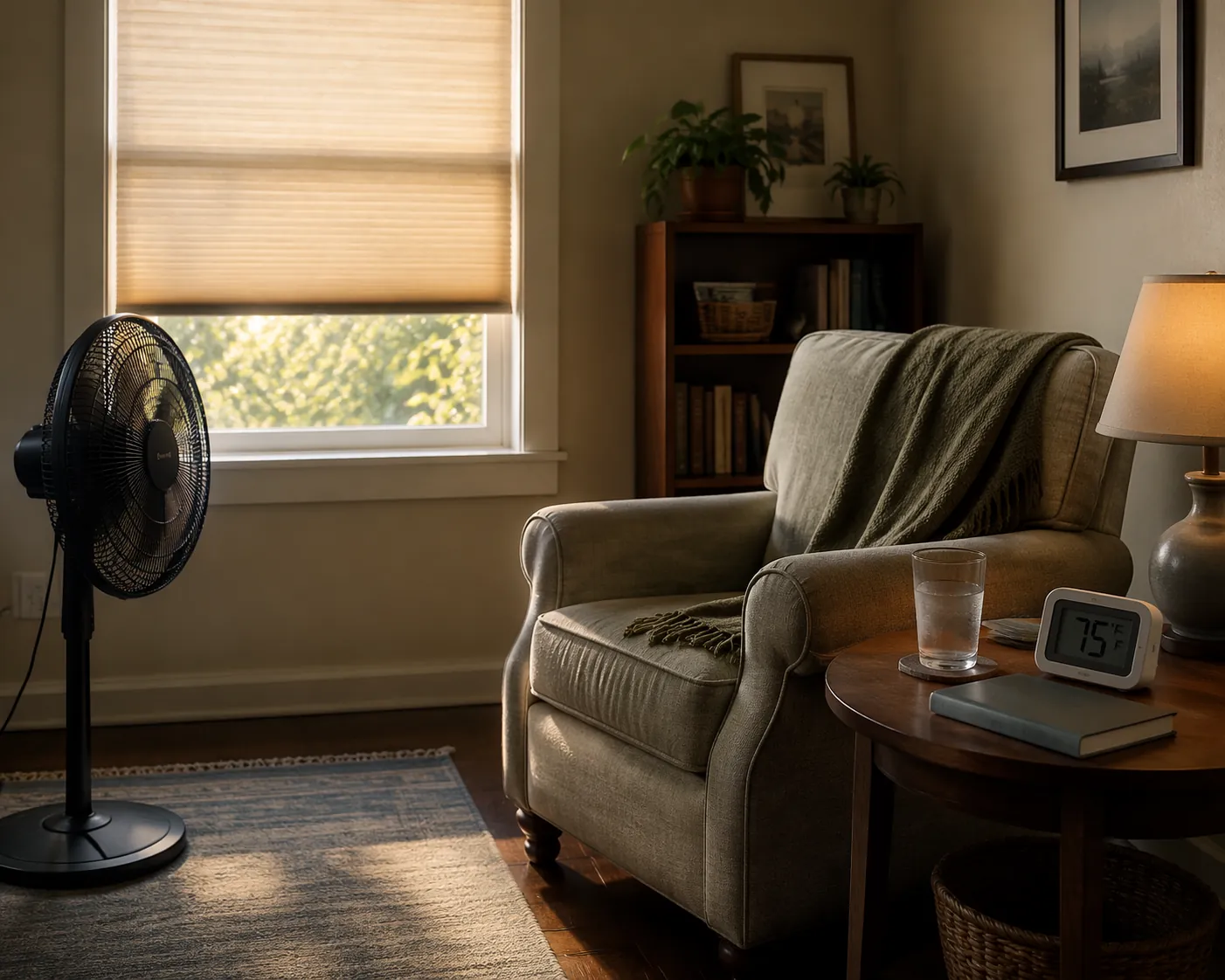
Ashley Ward of the Duke Heat Policy Innovation Hub has described overnight temperatures above 75°F, or 24°C, as a concern because they limit the body’s ability to recover from daytime heat; PBS reported this in June 2026 in coverage of heat safety.[2] That threshold is useful at home because it gives families something concrete to check at bedtime. It should not be treated as a clinical diagnostic line, but it can help decide when the sleeping plan needs to change.
- Shade the window before direct sun hits it, not after the room is already hot.
- Use the coolest room in the home, often a lower-level or north-facing room when available.
- Place the fan to move cooler air across the sitting or sleeping area, while keeping cords out of walking paths.
- Keep water, a phone, glasses, walking aid, and needed nighttime items within reach.
- Consider sleeping in the cool corner when nighttime indoor temperatures stay above 75°F/24°C.
The chair matters. A low, soft chair may feel comfortable but make standing harder. A safer heat-day chair has arms, a firm seat, and enough height that standing does not require a deep forward lunge. If the person uses a walker or cane, it belongs at the chair, not across the room.
A fan is helpful only within limits
A fan can improve comfort and airflow, but it is not a complete heat-safety device. CDC guidance warns that electric fans alone do not prevent heat-related illness when indoor temperatures reach extreme levels; cooling the body with water or moving to an air-conditioned place is more effective in those conditions.[3] That warning matters for fall prevention because an overheated person may be dizzy, weak, or confused before anyone calls the situation an emergency.
If the home stays dangerously hot, the safer plan may be temporary relocation: a cooling center, library, senior center, faith community space, relative’s home, or other air-conditioned place. That is not always easy. Transportation, mobility, pets, language, cost, neighborhood safety, and pride can all become barriers. The practical question is still worth asking early, before the person is too weak to leave safely.
A no-AC fall-prevention workflow for hot days
The safest routine is not a long lecture about heat. It is a sequence that interrupts different points in the same cascade: fluid loss, low blood pressure, dizziness, unsafe walking, and poor overnight recovery.
| When | Action | Fall-prevention purpose |
|---|---|---|
| Morning | Check the forecast and indoor temperature; set up shade before the room heats. | Reduces heat load before the body starts losing ground. |
| With meals and regular sitting times | Use planned fluids rather than waiting for thirst. | Supports blood volume and reduces reliance on a blunted thirst cue. |
| Before standing | Sit, stand, pause, then walk. | Gives the body time to adjust blood pressure before movement. |
| Afternoon | Move activity to the cool corner; avoid unnecessary trips through hotter rooms. | Cuts the number of risky transitions when heat stress is highest. |
| Evening | Check indoor temperature near the sleeping area. | Identifies nights when recovery may be poor and the sleeping setup should change. |
| During medication review | Ask about diuretics, antidepressants, anticholinergics, and heat-day symptoms. | Connects dizziness or unsteadiness with possible medication-related risk. |
For older adults living alone, the routine needs one more layer: a check-in that asks about function, not just temperature. “Are you dizzy when you stand?” and “Have you been able to get to the bathroom safely?” are more useful than “Are you hot?” More guidance for that situation is available in how heat waves increase fall risk when you live alone.
Phone alerts can also reduce the burden on memory. If an older adult or caregiver uses a smartphone, heat alerts can prompt earlier shade, fluid, and cooling decisions. See how to set up heat alerts on an elderly parent’s phone for that narrower task.
When the plan needs outside help
A home without AC may need more than household rearranging. Local programs sometimes offer utility assistance, weatherization help, cooling centers, fan programs, or transportation during heat events. Availability changes by state, county, income rules, season, and funding, so this is a local call rather than a universal promise.
Some cooling practices are also climate-dependent. Evaporative cooling methods that help in dry heat may work poorly in humid regions. Heavy curtains that block sun in one home may trap heat in another if windows cannot be opened safely at night. The test is not whether a tip sounds clever; it is whether the room temperature, the person’s symptoms, and the walking route actually become safer.
Medical help is needed promptly if an older adult has fainting, confusion, chest pain, severe weakness, inability to keep fluids down, very hot skin, or repeated near-falls. A fall prevented by sitting down in time is still a warning. It means the current heat plan is too close to failure.
For a broader companion guide, see how to protect elderly during a heatwave and prevent falls.
Families do not have to turn summer into surveillance to take this seriously. The better approach is to make fewer risky decisions necessary: planned drinks, slower standing, medication awareness, a shaded cool corner, a nighttime thermometer check, and a clear threshold for leaving the home when the indoor heat is too much. In a home without air conditioning, those are not comfort upgrades. They are fall-prevention controls.
References
- Dehydration and Falls in Older Adults: A Population-Based Cohort Study, Mayo Clinic Proceedings, 2020.
- PBS News heat safety coverage quoting Ashley Ward of the Duke Heat Policy Innovation Hub, PBS News, June 2026.
- Heat and Older Adults, Centers for Disease Control and Prevention.
Related reading
Noticed something outdated or inaccurate on this page? Flag a correction. We review every report against CDC, NIA, and AARP HomeFit guidance before updating a page.
Part of the Fall Prevention section.