
STEADI: intervene
7 Things Seniors Should Do Immediately When the Power Goes Out
When the power goes out, an older adult's highest risk is falling in the dark. This article provides a numbered crisis sequence starting with staying still and lighting the path, then securing medications, food, and communication — with fall prevention as the top priority.
The lights go out. Do not stand up yet. Do not walk to the kitchen, the breaker box, or the refrigerator. Stay where you are until you have light on the floor in front of your feet.
For a senior, the first emergency in a power outage is often not the outage itself. It is the first dark step. The CDC reports that about 1 in 4 older adults falls each year, and falls are the leading cause of injury death for adults 65 and older in the United States.[1] That is why the first few minutes should be handled like fall prevention, not like appliance management.
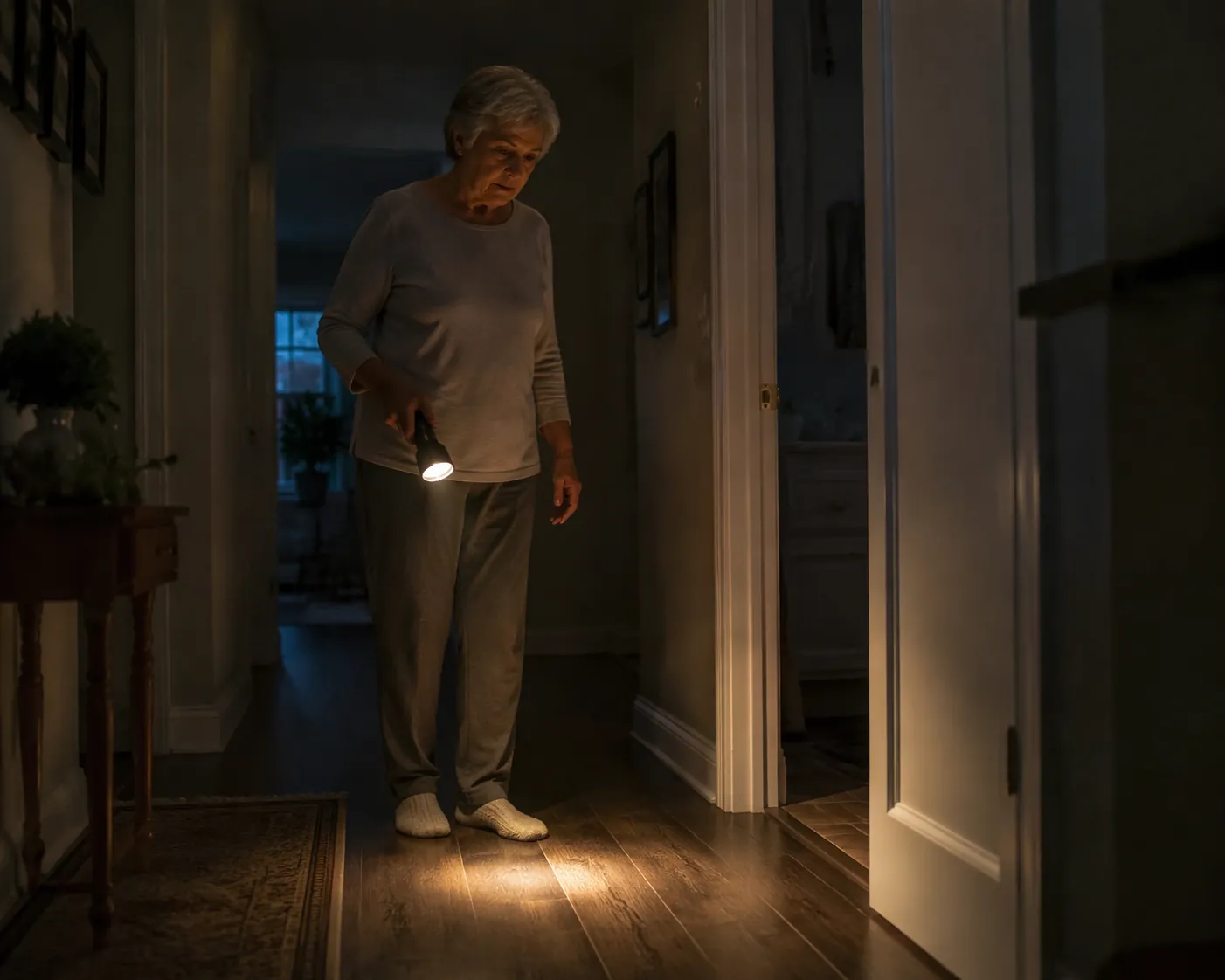
1. Do not stand up or walk until you have light
If you are sitting, stay seated. If you are standing, stop and put one hand on a stable surface if one is already within reach. Do not reach far, twist quickly, or hurry toward a window. First, find the closest light source without changing position.
- Use a flashlight if it is beside you, on a nightstand, in a walker pouch, or on the table within arm’s reach.
- Use your phone screen or phone flashlight if the phone is closer.
- If someone is on the phone with you, ask them to stay on the line while you get oriented.
- If there is no safe light source nearby, wait a moment and call someone instead of crossing the room in the dark.
This is the moment when people make the expensive mistake: “I’ll just go check.” The hallway rug has not moved. The slippers are where they always are. The step into the kitchen is the same height. But without light, those ordinary things become harder to judge.
2. Put on shoes or non-slip socks before moving
Before taking even a short walk through the house, put something safer on your feet. Bare feet can slide. Loose slippers can catch or twist. Socks without grip can be worse on smooth flooring than shoes.
Choose the most stable option you can reach without wandering: well-fitting shoes, slippers with backs and tread, or non-slip socks. If your cane or walker is normally used at night, use it now. A power outage is not the time to prove you can manage without it.
For families planning ahead after this outage, a bedside flashlight and safer footwear belong together. A broader preparation list can wait until the immediate situation is handled; later, use a power outage preparedness guide for older adults or a storm outage fall-prevention checklist to fix the setup before the next outage.
3. Aim the flashlight at the floor and clear one direct path
Do not shine the flashlight across the room like a searchlight. Point the beam down where your next few steps will land. Look for shoes, pet bowls, cords, throw rugs, laundry, oxygen tubing, uneven flooring, and anything that would be easy to miss in partial light.
Clear only the path you actually need. In the first minutes, that usually means the route from your chair or bed to the bathroom, bedroom door, phone, medication storage area, or a safer seat. Do not tour the whole house. Do not check every appliance. Make one usable path and move slowly through it.
| If you need to move | Do this first |
|---|---|
| From bed to bathroom | Put on stable footwear, turn on a light source, and scan the floor before standing |
| From chair to kitchen | Ask whether the trip is necessary now; medication may be, food usually is not |
| To the front door | Check for rugs, shoes, thresholds, pets, and wet flooring before walking |
| To reach a phone | Use the closest safe phone first, even if it is not the one you prefer |
4. Secure refrigerated medications before worrying about food
Once you are lit, steady, and wearing safer footwear, think about medication. This is where the refrigerator may matter quickly, but not because of leftovers.
If you use refrigerated medication such as insulin, follow the storage instructions from your pharmacist, prescriber, or medication label. Ready.gov notes that insulin can degrade above 77°F, so temperature-sensitive medication deserves attention early in the outage.[2] If you have a cooler and ice packs available, move the medication carefully, avoid direct freezing contact if your medication instructions warn against it, and keep a thermometer with it if you have one.
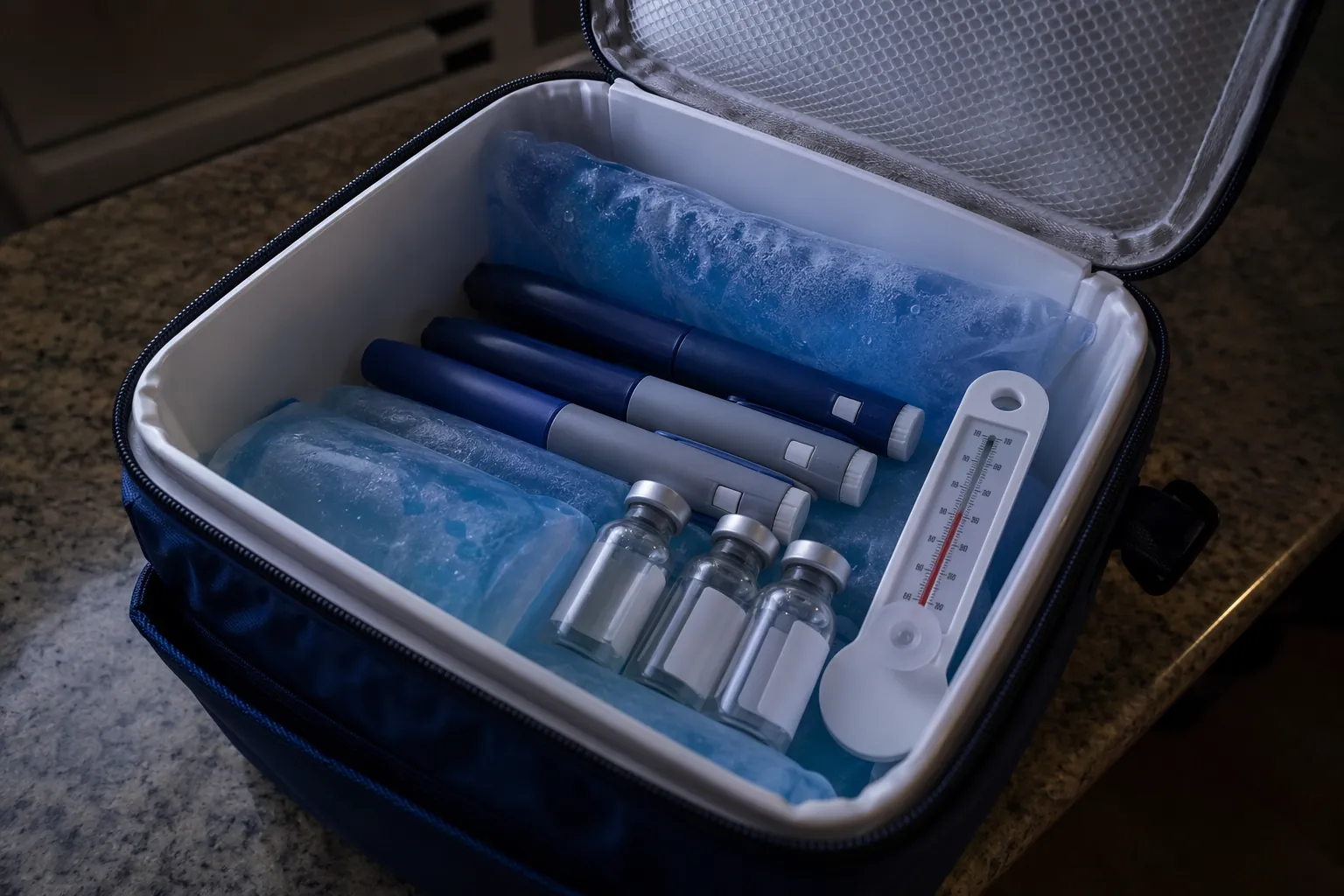
If an adult child or caregiver is on the phone, this is a good point to ask three plain questions: What medication needs refrigeration? Where is it? Can it be reached without crossing an unsafe room? If the answer to the third question is no, pause and arrange help rather than having the senior walk through darkness or clutter.
Home medical equipment changes the urgency. If you rely on a CPAP machine, oxygen concentrator, home dialysis equipment, powered mobility device, or another device with backup instructions, follow the device-specific plan from your equipment provider or clinician. If the device is medically necessary and backup power is limited, call your support contact, medical provider, or emergency services as appropriate instead of trying to improvise.
5. Keep the refrigerator and freezer closed
Food can usually wait longer than people think, as long as the doors stay closed. Ready.gov says an unopened refrigerator keeps food cold for about 4 hours, and a full freezer keeps its temperature for about 48 hours if the door remains closed.[3] That buys time. It does not buy safety if someone falls trying to inspect the milk.
Do not open the refrigerator to “check if it is still cold.” Opening the door spends the cold air you are trying to preserve. If you have already handled urgent medication needs, leave the food alone for now.
A simple priority order helps: people first, medications next, food later. That order is especially important when an older adult is alone and the kitchen is several dark steps away.
6. Call the power company and ask about medical or senior household registration
Report the outage to the utility company once you can do it safely. Use the phone number on the bill, the utility’s outage map, or the utility app if you already use it. If you are calling for a parent, ask whether the outage has been reported for that address and whether there is an estimated restoration time.
Also ask whether the household can be registered as a senior, disabled, or medically dependent household. Ready.gov advises people who use battery-dependent assistive technology or medical devices to contact their power and water companies about their needs.[2] Registration does not guarantee faster restoration, and it should not be treated as a substitute for backup power or evacuation planning. It does help the utility know that the address has a person with added risk.
If hearing loss makes phone alerts, weather radios, or spoken instructions unreliable, bring that into the plan now. Keep hearing-aid batteries or charging options in the same safety category as flashlights and medication, not as an afterthought.
7. Call one support-network person and set the next check-in
After the immediate fall risks and medication needs are handled, make sure one real person knows your status. Call a family member, neighbor, caregiver, building manager, faith-community contact, or nearby friend. Texting is fine if that is what works, but a live call is better when there are medication, mobility, hearing, or medical-device concerns.
The call should cover facts, not reassurance alone: where you are sitting, whether you have light, whether you have shoes or non-slip socks on, whether medication is secure, whether you have water nearby, and whether you need help before walking anywhere else.
- If you are the senior: ask the person to check back at a specific time.
- If you are the adult child: stay on the phone while your parent gets seated safely.
- If a neighbor is nearby: ask for help with unsafe walking tasks, not just a general “check-in.”
- If medical equipment is involved: tell the support person what device is affected and how much backup time is available, if known.
Once this outage is over, use the same experience to improve the home setup. A hurricane kit built around fall prevention is more useful for many older adults than a box of supplies stored where they cannot reach it.
Do not create a second emergency
The last part is simple because it needs to be remembered in the dark. Avoid the shortcuts that turn a power outage into a fire or carbon-monoxide emergency.
- Do not use candles for light if you can use flashlights, lanterns, or battery-powered lights instead.
- Do not run a generator indoors, in a garage, on a porch, or near windows.
- Do not use a gas stove or oven to heat the home.
- Do not use unvented or unsafe heat sources inside the home.
The American Red Cross warns against candles during outages and says generators, grills, camp stoves, and similar fuel-burning devices should not be used inside homes, garages, basements, crawl spaces, or enclosed areas; it also warns not to use a gas stove or oven to heat a home.[4]
When the senior is seated or moving only on a lit path, wearing stable footwear, protected around medications, connected to another person, and not using unsafe heat or flame, the immediate response has done its job. The rest can be handled more slowly.
References
- About Older Adult Fall Prevention, Centers for Disease Control and Prevention.
- Power Outages, Ready.gov.
- Food, Ready.gov.
- Power Outage Safety, American Red Cross.
Related reading
Noticed something outdated or inaccurate on this page? Flag a correction. We review every report against CDC, NIA, and AARP HomeFit guidance before updating a page.
Part of the Fall Prevention section.