
STEADI: Intervene
Senior Tornado Shelter Safety When the Power Goes Out
This article helps you choose the safest tornado shelter location for a senior with fall risk, then shows how to fall-proof that spot so it is safe to reach and occupy during a power outage — with room-by-room guidance tailored to mobility limitations.
When a tornado warning comes through and the power fails, the first safety question is not whether the basement is theoretically best. It is whether the older adult can get from the recliner, bed, bathroom, or kitchen to the shelter spot without falling in the dark.
That changes the meaning of “safest.” For a senior with a walker, poor balance, low vision, hearing loss, oxygen equipment, temperature-sensitive medication, or a history of freezing when the lights go out, the safest tornado shelter is the best protected place they can actually reach and occupy until the warning passes.
This is not a small adjustment. The CDC data republished by the National Council on Aging says 1 in 4 older adults falls each year, and falls are the leading cause of injury-related deaths among adults 65 and older.[1] People with disabilities are also 2 to 4 times more likely to die or be injured in a disaster than people without disabilities.[2] Those two facts belong in the same shelter conversation as wind, windows, and walls.
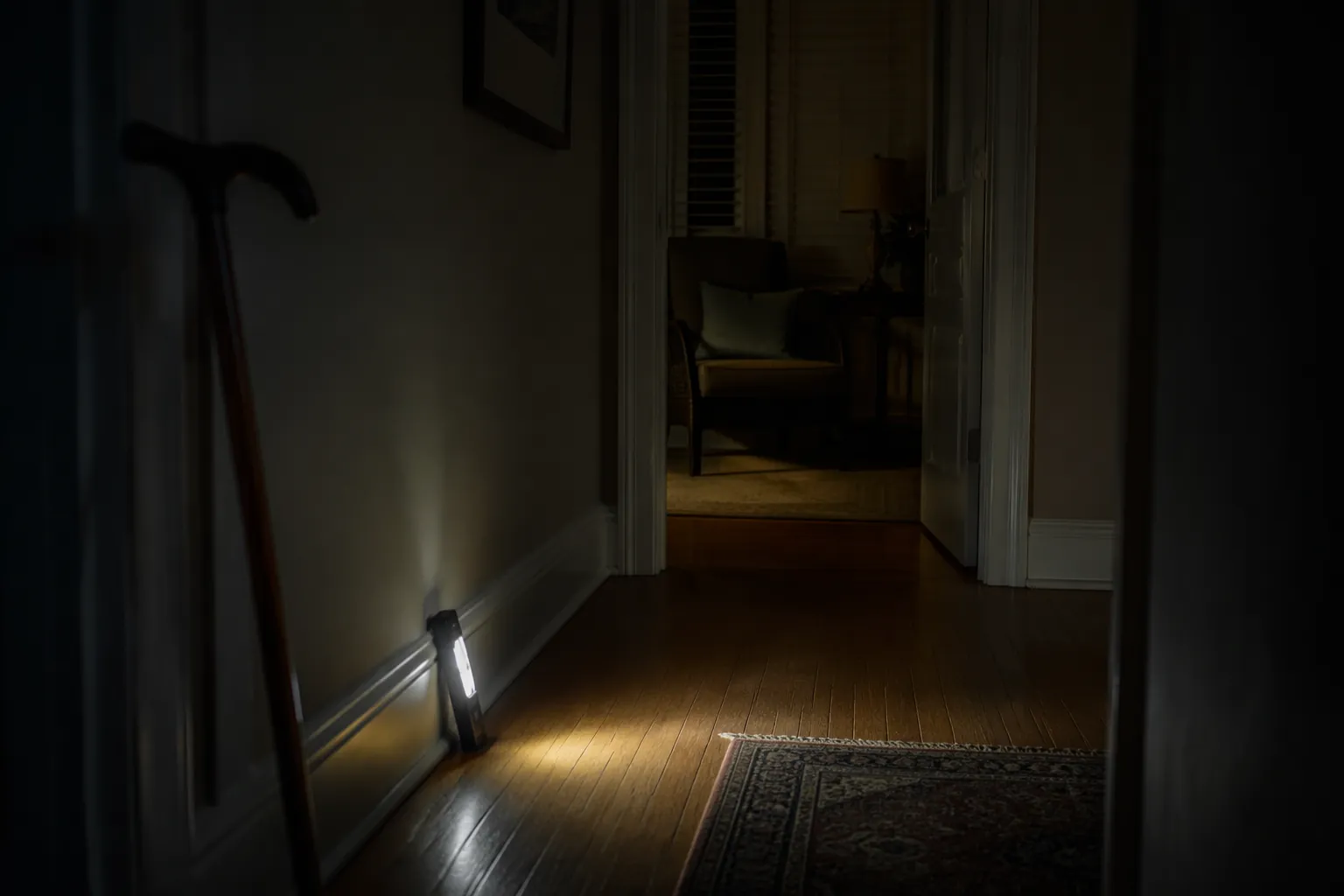
Start With the Route, Not the Room
NOAA and the National Weather Service tell people to move to a basement or an interior room on the lowest floor, away from windows.[3] The Red Cross gives the same basic direction: go to a safe room, basement, storm cellar, or small interior room on the lowest level of a sturdy building.[4] That guidance is sound. It is also incomplete if the person taking cover cannot manage stairs, cannot hear the alert, or cannot cross a dark hallway safely.
Walk the route in ordinary daylight first. Start where the senior actually spends time: the bed, favorite chair, bathroom, kitchen table, porch door, or laundry area. Then time and observe the trip to each possible shelter location without rushing. The point is not to beat a stopwatch. The point is to find the first place the plan breaks.
- Count stairs, thresholds, tight turns, and doorways that catch a walker or wheelchair.
- Look for loose rugs, cords, floor vents, clutter baskets, pet bowls, and low furniture.
- Check whether the route still works if one hand is holding a cane or walker.
- Notice where the person reaches for balance: wall, towel bar, door trim, furniture, or nothing at all.
- Ask whether the door can be opened from inside and outside, especially if the person may sit or fall against it.
- Repeat the route in low light with supervision, because a sudden blackout increases fall risk throughout the home.[5]
If the route depends on a flashlight stored in a drawer, a caregiver answering the phone, or the senior remembering which closet was chosen, it is not ready. Safety has to be built into the hallway, doorway, and shelter zone before the warning.
How Common Shelter Spots Hold Up for a Senior
The best shelter choice is usually a compromise. A basement may give strong tornado protection but create a stair hazard. A bathroom may be reachable but too cramped for a walker. A hallway may be close but offer nowhere stable to sit. The right question is not “Which room is perfect?” It is “Which option gives the most protection without adding a fall, entrapment, or medical risk?”
| Shelter candidate | What it does well | Where it can fail for a senior | Use it when |
|---|---|---|---|
| Basement | Often provides strong protection because it is below ground and away from windows | Stairs, handrail gaps, poor lighting, damp flooring, storage clutter, and no easy place to sit | The senior can manage the stairs safely every time, including in low light, and the path is cleared and lit |
| Interior closet | Small, enclosed, often away from windows and easy to reinforce with stored supplies | Door may be narrow, floor may be crowded, and there may be no room for a walker, wheelchair, or chair | It is on the lowest accessible level and can be emptied enough for entry, seating, and mobility aids |
| Interior bathroom | Often has plumbing walls and may have a tub or enclosed space away from windows | Wet floors, bathmats, hard edges, towel bars mistaken for grab bars, and tight turning space | The floor can be kept dry and clear, and the senior can enter, sit, and exit without stepping over a tub wall |
| Interior hallway | May be close to the main living area and away from windows | No supportive seating, doors swinging into the space, clutter, and exposure if the hallway is long or open | It is short, interior, windowless, on the lowest accessible level, and has a sturdy chair or protected sitting position |
| Above-ground safe room | Can combine tornado protection with step-free access when properly designed | Cost, installation, door clearance, and whether the senior can open and occupy it independently | It is accessible by walker or wheelchair and is located where the senior can reach it quickly |
| Other interior room | May be the only reachable option in some homes | Windows, exterior walls, heavy furniture, glass, and poor protection compared with smaller interior spaces | No better accessible option exists inside the home, and the room can be made more protective and less hazardous |
Basements deserve the most honest look. They are often named first in tornado guidance, and in many homes they are the strongest shelter option. But stairs are not a detail. If an older adult climbs them slowly in daylight, grips laundry shelving for balance, or cannot bring a walker down without help, the basement may be structurally safer and personally more dangerous at the same time.
An interior closet can work well only after it stops being storage. A coat closet packed with vacuum attachments, gift wrap, boots, and a laundry basket is not a shelter. The floor needs enough open space for the senior’s feet and mobility aid. If the person uses a wheelchair, the doorway and turning space must be checked with the chair, not guessed by eye.
Bathrooms are tempting because they are small and familiar. They are also full of fall hazards. A wet tile floor, a loose bathmat, and a tub wall can turn a warning into a hip-fracture situation. If the bathroom is chosen, the safest position may be sitting on a sturdy chair or closed toilet away from glass, with the floor kept dry and the route clear. Do not count a towel bar as a grab bar unless it was installed for that purpose.
Above-ground safe rooms and accessible storm shelters matter because not every older adult can use stairs. Accessibility-focused shelter providers note that above-ground options can be easier for seniors and people with mobility limitations than underground shelters when they are designed with features such as wider access and easier entry.[6] That does not make every above-ground shelter suitable. The door, latch, threshold, lighting, seating, and space for mobility equipment still have to match the person who will use it.
Match the Shelter to the Person’s Mobility
A shelter plan should be tested with the same body, device, and habits the senior will have during a real warning. If they use a walker at night but walk unaided during the day, test with the walker. If they sleep without hearing aids, test the alert plan as if hearing aids are not in. If they need glasses to judge the floor, the glasses belong in the warning route.
If the Senior Uses a Walker
The walker should travel the full route without being lifted over rugs, cords, thresholds, or storage bins. Park it where the senior naturally stands up, but not where it blocks the bedroom door or bathroom door. In the shelter area, leave enough space to turn and sit. A walker folded in the closet may look tidy, but it is useless if the senior has to balance without it while opening the door.
If the Senior Uses a Cane
A cane user still needs a free hand for doors, rails, and balance. Avoid shelter choices that require carrying a heavy emergency kit, pulling open a stuck door, or stepping down into a space without a rail. If the route includes a handrail, make sure the rail is on the side the person actually uses and continues through the whole stair run.
If the Senior Uses a Wheelchair
The shelter must be chosen by rolling into it. Measure only after the real chair, footrests, doorway, door swing, and turning space have been tried. A narrow interior closet may be strong against wind but unusable for a wheelchair user. A step-free interior room or accessible safe room may be the better plan if it keeps the person away from windows without requiring transfer under pressure.
If the Senior Is Unsteady but Does Not Use a Device
This is the group families often overestimate. Someone who “gets around fine” in daylight may not do fine when the siren, phone alert, wind noise, and blackout arrive together. Give that person the same clear path, mounted lighting, stable seating, and reachable shoes that you would give a walker user. Pride does not light a hallway.
Prepare the Shelter Zone Before Storm Season
A tornado shelter zone is more than the final room. It includes the place where the senior receives the alert, the route they travel, the doorway they pass through, the place they sit, and the supplies they can reach without standing again.
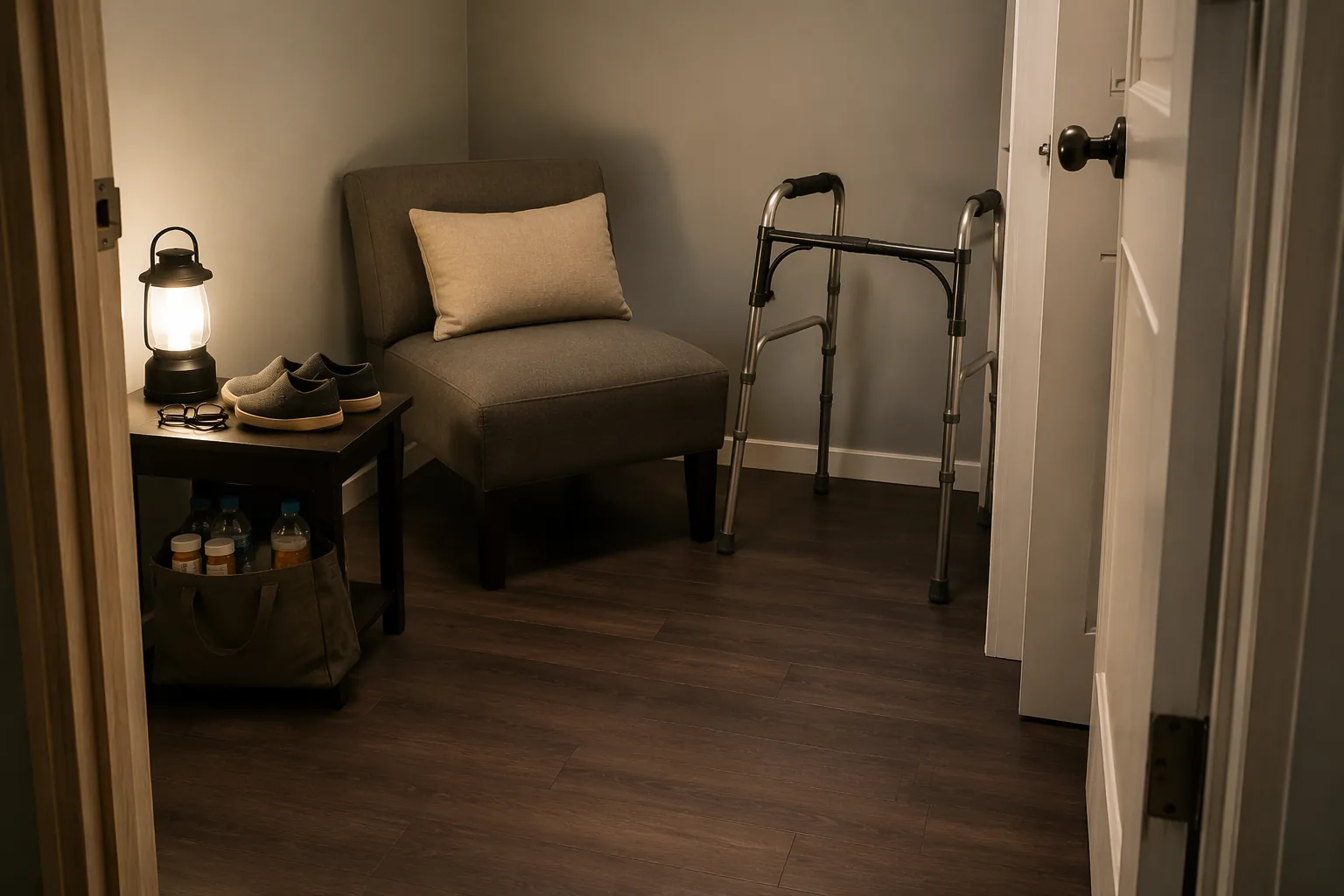
- Clear the path from the bed, chair, bathroom, and kitchen to the shelter; remove rugs, cords, boxes, plant stands, and anything stored along the wall.
- Install battery-powered or rechargeable lights along the route and inside the shelter; do not rely on one handheld flashlight.
- Keep sturdy shoes, glasses, hearing aids if used, and a charged phone where the senior can reach them before standing.
- Place a sturdy chair in or next to the shelter position if the senior cannot sit safely on the floor.
- Store the walker, cane, wheelchair, or transfer aid so it helps entry and does not block the door.
- Put water, essential medications, a small first-aid kit, and a written contact list within reach, not on a high shelf or across the room.
Lighting deserves more attention than it usually gets. Ready.gov advises having flashlights and extra batteries for power outages, and warns against using candles because of fire risk.[7] For an older adult with fall risk, one flashlight in a kitchen drawer is not enough. Use lights that are already mounted or already standing in place: a battery lantern on the shelter table, motion-activated lights near the bed and hallway, and a light inside the shelter itself.
The chair matters too. Many tornado instructions tell people to crouch or get low. Some seniors cannot get down to the floor and back up without help. A sturdy armless chair, positioned away from windows and heavy objects, may be safer than asking someone with bad knees or poor balance to kneel on a closet floor. If a helmet, blanket, or pillow is part of the family’s plan for added protection from debris, it should be reachable from the seated position.
Do not let the emergency kit become another obstacle. A large bin in the hallway can block a walker. A heavy backpack can throw off balance. Keep shelter supplies compact, low, and reachable. If the senior needs help opening packaging, reading labels, or handling small batteries, choose containers and lights they can operate with their actual grip strength.
Alerts Cannot Depend Only on Hearing
Outdoor sirens are not a complete alert plan, especially inside a house with wind, rain, television noise, sleep, or hearing loss. NIH data cited by the American Association for Geriatric Psychiatry says about 22% of adults ages 65 to 74 and 55% of adults 75 and older have disabling hearing loss.[8] A senior who does not hear a warning cannot start the route, no matter how carefully the closet is prepared.
Build redundancy into the warning system. Use a NOAA weather radio with battery backup if the senior can hear and understand it. Add phone alerts with vibration and visual notifications. Consider a bed shaker, flashing alert device, or caregiver call routine for someone who sleeps without hearing aids. Ready.gov’s older-adult preparedness guidance also emphasizes planning around communication, support networks, and medical needs before an emergency.[9]
The backup alert should be tested from the places the senior actually occupies. A flashing device in the kitchen does not help if the warning comes at midnight. A phone set to vibrate does not help if it charges across the room. A weather radio does not help if the volume is too low or the message is too fast for the person to process.
Power Needs Belong in the Shelter Decision
Some older adults can wait out a short warning with a chair, light, phone, and medication list. Others cannot. If the senior depends on powered medical equipment, refrigeration for medication, a lift chair, an adjustable bed, oxygen equipment, or a communication device, the power outage plan has to be part of the tornado shelter plan, not a separate checklist.
Ready.gov recommends keeping mobile phones and other electric equipment charged, having backup batteries or charging methods, and planning for medical devices that require power.[7] Temperature-sensitive medication needs special attention. PowerOutage.us notes that insulin can degrade above 77°F, and portable coolers with ice packs can help protect medications during a short outage when used properly.[5] The caregiver’s job is to know which medicines or devices cannot simply wait until morning.
Keep backup power where it can be used safely. A portable power bank for a phone or small medical device is different from a generator. Generators must never be used indoors, in garages, or near windows because of carbon monoxide risk; Ready.gov says to keep generators outside and at least 20 feet away from windows, doors, and attached garages.[7] AAGP also flags carbon monoxide poisoning as a disaster-related danger for older adults.[8]
When the Home Does Not Contain a Good Shelter
Some homes cannot be made safe enough by clearing a hallway and adding lights. NOAA warns that mobile homes are not safe during tornadoes and advises people to leave for a sturdy building or shelter when possible.[3] That instruction is hard, but it is not optional planning material for a senior in a mobile home. The safe room may be somewhere else.
The same may be true in a multi-story building if the older adult cannot reach a lower interior area without stairs or an elevator that may fail. If the only interior option requires a risky descent, the plan should involve the building manager, neighbors, local emergency management, or a nearby accessible shelter before storm season. Do not wait for the warning to discover that the elevator is out, the stairwell is dark, or the shelter room is locked.
For a senior who needs powered equipment without reliable backup, the plan may also need to extend beyond the home. That could mean registering with a local emergency management program if available, arranging a neighbor check-in, identifying an accessible public shelter, or planning to relocate earlier on high-risk weather days. NCOA’s older-adult emergency preparedness guidance encourages planning ahead for transportation, support networks, medications, documents, and communication needs before a disaster.[10]
Practice Once While Nothing Is Happening
A shelter plan does not have to be dramatic, but it does have to be practiced. Pick a calm day. Start from the bed, then from the favorite chair, then from the bathroom. Turn on the battery lights. Use the walker, cane, wheelchair, glasses, and shoes exactly as the senior would use them. Sit in the shelter position long enough to notice what is missing.
- If the senior cannot reach the shelter without grabbing unstable furniture, change the route or add proper support.
- If the walker blocks the doorway, change where it is parked.
- If the light creates glare or shadows, move it before the next storm.
- If the chair is too low to rise from, replace it with a sturdier, higher seat.
- If the senior cannot hear or feel the alert, add a visual, vibrating, or human backup.
This article is general home-safety and emergency-preparedness information, not medical, legal, or structural-engineering advice. A clinician, occupational therapist, local emergency manager, building official, or qualified shelter professional may need to review the plan when medical equipment, major mobility limits, home modifications, or shelter installation are involved.
If the senior lives in a mobile home, cannot reach any interior shelter without stairs or major fall risk, or depends on powered medical equipment without reliable backup, room preparation is not enough. The plan has to include an accessible nearby shelter, a neighbor or caregiver arrangement, or contact with local emergency management. The standard is simple: the senior can practice the route, reach the shelter in the dark, and remain there safely until the warning passes.
References
- Get the Facts on Falls Prevention, National Council on Aging.
- Tornado Preparedness for the Disability Community, United Spinal Association.
- Tornado Safety Tips, NOAA National Weather Service.
- Tornado Safety, American Red Cross.
- Power Outage Preparedness for Seniors & Elderly, PowerOutage.us.
- Storm Shelter Accessibility Features for Seniors and People with Disabilities, OKC Shelters.
- Power Outages, Ready.gov.
- Older Adults and Disaster Preparedness and Response, American Association for Geriatric Psychiatry.
- Older Adults, Ready.gov.
- Emergency Preparedness 101: What to Do Before, During, and After a Disaster, National Council on Aging.
Related reading
Noticed something outdated or inaccurate on this page? Flag a correction. We review every report against CDC, NIA, and AARP HomeFit guidance before updating a page.
Part of the Fall Prevention section.