
STEADI: intervene
Prevent Falls During a PG&E Power Shutoff
When PG&E cuts power for wildfire safety, darkness turns ordinary fall hazards into traps. This guide walks seniors and their caregivers through pre-shutoff home fall-proofing, safe mobility during the outage, and a backup plan if a fall does happen — so a long blackout doesn't lead to a broken bone.
The first dangerous moment in a PG&E power shutoff is often ordinary: getting out of bed, turning toward the bathroom, and taking the same route the body knows by habit. The hallway is darker than expected. The throw rug edge is no longer visible. The walker is across the room because it was not needed for the last trip. A person reaches for the wall, not the light switch, because that is faster.
That is why PG&E power shutoff safety tips for seniors need to be more specific than “keep a flashlight handy.” During a Public Safety Power Shutoff, the house loses the quiet protections that normal fall-prevention advice depends on: ambient light, charged phones, powered stair lifts, electric wheelchair charging, and sometimes the alert sounds a person was supposed to hear. PG&E describes outage safety around preparation and staying informed, and its PSPS notification pattern gives households a practical sequence: about 48 hours ahead when possible, about 24 hours ahead when possible, and again just before power is shut off.[1]
Those windows matter because fall prevention is physical work. Someone has to move the shoes, tape down the cord, put the flashlight where a hand lands before feet hit the floor, and decide whether the stair lift can be trusted once the lights go out.
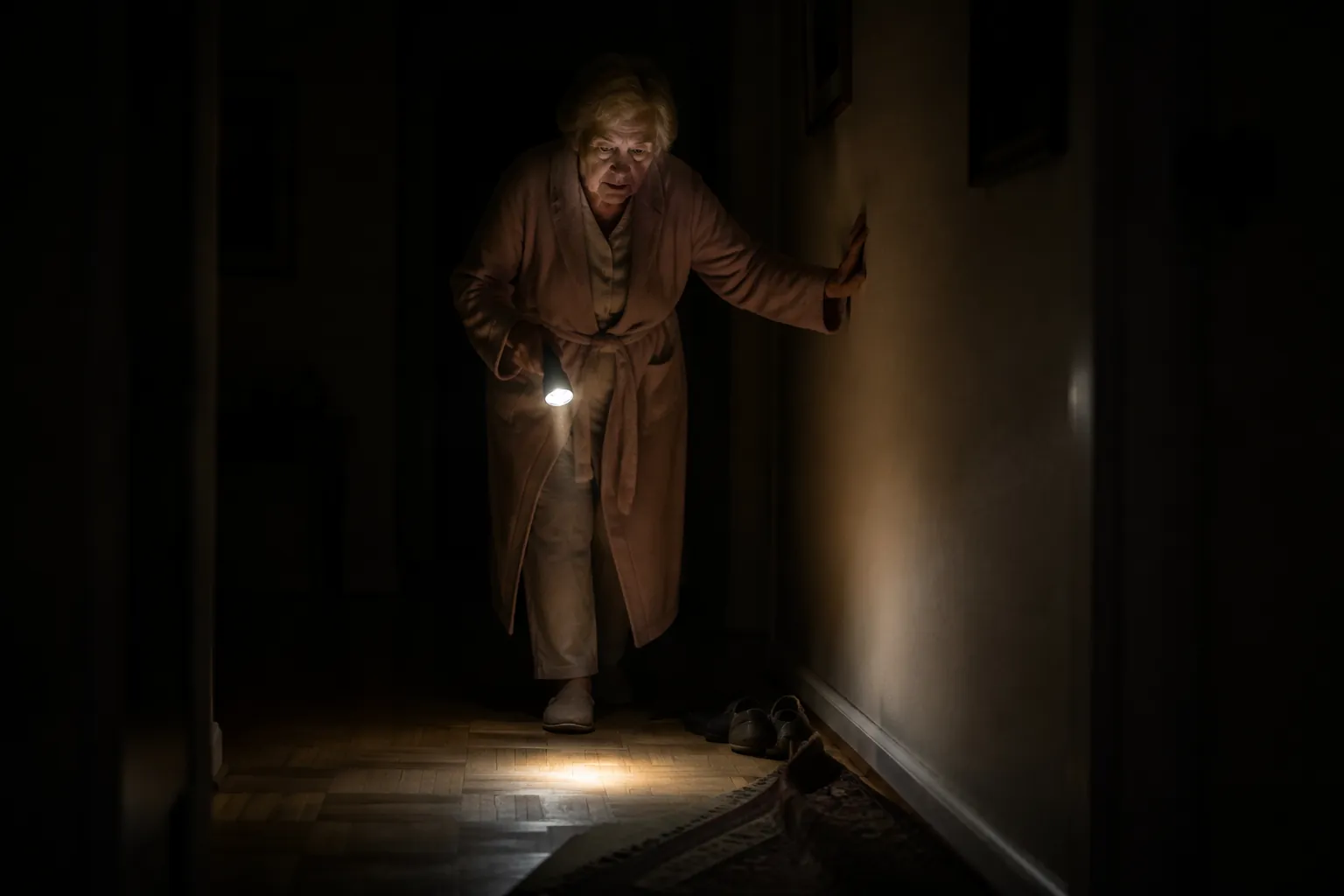
Ordinary Fall Prevention Is Still Necessary, But It Is Not Enough
CDC STEADI is still the right foundation for identifying fall risk: medications, prior falls, gait, balance, vision, footwear, and home hazards all matter before wildfire season starts.[2] A household that has not done that baseline work should do it, preferably before the first red-flag warning appears. A Fall Prevention Action Plan gives caregivers and older adults a common checklist instead of a yearly argument about “being careful.”
But STEADI-style home safety has to be adapted for a PSPS. A lamp that normally makes the bedroom safe will not help when the outlet is dead. A medical alert pendant may not help if its base station has no battery backup. A phone on the kitchen counter may as well be in another county if the fall happens between the bed and the bathroom.
Audio-only warnings also deserve less trust than many families give them. NIH hearing data report disabling hearing loss in 22% of adults ages 65 to 74 and 55% of adults ages 75 and older.[3] That does not mean every older adult will miss every alert. It does mean a plan that depends on a beep, a recorded call, or someone hearing a phone ring from another room is weaker than it looks.
Use PG&E’s Alert Windows as a Fall-Prevention Schedule
A shutoff notice is not just information. It is a work order. The best use of the alert timeline is to divide preparation into what needs a body in the house, what can be checked by phone, and what must be in reach before the lights go out.
| Timing | Fall-prevention job | What remote caregivers should confirm |
|---|---|---|
| About 48 hours before shutoff, when notice is possible | Clear routes, remove trip hazards, verify backup power needs, decide whether staying home is safe | Which rooms will be used, whether mobility equipment needs power, who can physically check the home |
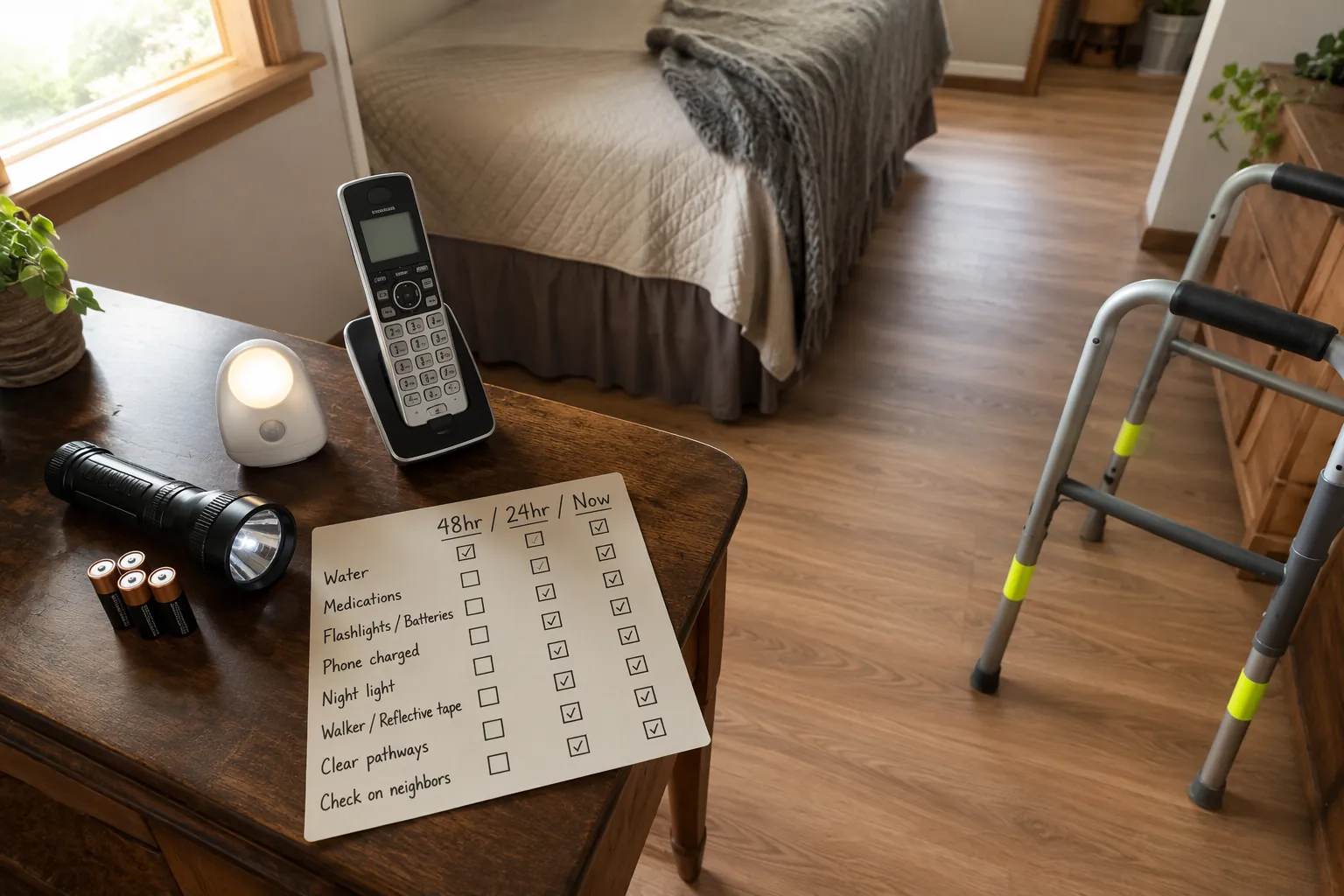
| About 24 hours before shutoff, when notice is possible | Stage flashlights, motion lights, mobility aids, phones, medications, and bathroom supplies | Exact placement of lights and devices, not just that they exist |
| Just before shutoff | Stop avoidable stair use, charge devices, put shoes on, keep assistive devices within reach | Final check-in completed; no one is planning one last unsafe trip |
| During outage | Move differently: slower, hands free, no loads in dark rooms, stairs avoided when possible | Scheduled check-ins continue by the most reliable available method |
At 48 Hours: Clear the Paths People Actually Use
Start with the night route, not the neatest room. Bed to bathroom. Bed to hallway. Recliner to kitchen. Bedroom to front door. Those are the paths that matter when someone is half awake, worried about the freezer, or trying to answer a knock.
- Remove loose rugs from the route, or secure them so an edge cannot catch a slipper or walker leg.
- Move shoes, pet bowls, laundry baskets, oxygen tubing, and charging cords out of walking lines.
- Clear both sides of the bed so the person does not have to twist around furniture in the dark.
- Make the bathroom route wide enough for the walker or cane the person should use at night, not the path they prefer in daylight.
- Check that railings, grab bars, and toilet supports are firmly mounted, because a dark room makes people grab harder and less accurately.
For caregivers who live hours away, this is the time to involve the neighbor, building manager, home aide, or nearby relative who can see the floor. A video call helps, but it misses height changes and shadows. If a parent has been tripping, furniture-walking, refusing grab bars, or using stairs unsafely, those are not personality quirks during a shutoff; they are reasons to get help identifying hazards before the next event. A room-by-room fall-prevention review or the warning signs in this CAPS specialist guide can turn a vague concern into a practical punch list.
The bathroom deserves special attention because it combines urgency, hard surfaces, water, and usually the poorest nighttime judgment. If the toilet path requires stepping around a scale, hamper, trash can, or bath mat, move those before the outage. If the person already needs help transferring, a blackout is not the time to discover that the grab bar is decorative or the shower chair blocks the walker. Bathroom modifications should be chosen for transfer safety and nighttime use, not only for how the room looks in daylight; evidence-based bathroom safety features are worth reviewing before fire season, not during it.
At 48 Hours: Decide Whether Powered Mobility Can Safely Stay in the Plan
A powered stair lift, electric wheelchair, adjustable bed, oxygen concentrator, or device charger changes the PSPS plan. Backup power is not a comfort item when the person cannot move safely without it.
PG&E’s Portable Battery Program is aimed at eligible Medical Baseline customers who rely on qualifying medical devices, and households should verify current eligibility and program details directly with PG&E before depending on it.[4] PG&E also describes a Generator and Battery Rebate Program with rebate amounts listed up to $300 or $500 depending on eligibility, again requiring the household to check current rules and availability.[5]
If the equipment cannot be backed up, the decision is not “hope the outage is short.” The decision is whether the person should avoid that equipment during the outage, move to one level of the home, stay with someone else, or use a PG&E Community Resource Center if one is open and reachable. PG&E says its Community Resource Centers may provide services such as device charging and ADA-accessible restrooms during qualifying events.[6]
Do not assume Medicare or Medicaid will solve the backup-power problem. Disability Rights California has warned that Medicare and Medi-Cal coverage for generators or backup power has been limited and program-specific, so families need to check the person’s actual plan and utility options rather than wait until shutoff week.[7]
At 24 Hours: Put Light Where the Hand Reaches First
The National Institute on Aging’s fall-prevention guidance includes a simple line that becomes much more important during a PG&E shutoff: keep a flashlight by the bed in case of a power outage.[8] For an older adult with balance problems, “by the bed” needs a stricter definition.
- Place the flashlight on the side where the person actually gets up, within reach before sitting or standing.
- Use a flashlight with a large switch that can be found by touch, not a tiny button at the end.
- Keep a second light at the bathroom entrance, because one dropped flashlight should not end the plan.
- Use battery-powered motion-sensor lights low along the route so the floor, rug edges, thresholds, and walker legs are visible.
- Do not place lights where the person has to cross the room in the dark to reach them.
This is also when the mobility aid gets staged, even if the person dislikes needing it. A walker parked in the living room does not protect a nighttime bathroom trip. A cane leaning behind a door may fall before it helps. If reflective tape on walker legs helps the person see the frame in low light, add it before the shutoff. If tennis balls or glides catch on a threshold in daylight, they will be worse in darkness.
For hearing loss, use confirmation instead of hope. A caregiver can ask the older adult to read back the plan: which light is by the bed, where the walker is, what time the next call will happen, and whether stairs are off limits. That is not treating the person like a child. It is checking that the plan survived the alert system.
Just Before Shutoff: End the “One Last Trip” Habit
The last hour is when people try to finish tasks quickly: carry laundry downstairs, check the garage freezer, bring in patio items, take trash out, look for batteries. Those are reasonable chores in normal light. During a pending PSPS, they become fall exposures.
- Charge phones, medical alert devices, hearing aids, flashlights with rechargeable batteries, and mobility equipment.
- Put on stable shoes before the house goes dark; do not depend on socks or loose slippers.
- Move medications, water, glasses, and the phone to the room where the person will spend the outage.
- Stop avoidable stair use before shutoff, not after the lights fail.
- Make the final caregiver or neighbor check-in while devices are still charged.
Stairs need an early decision because people underestimate them when the flight is familiar. A few steps to a bedroom, garage, basement, or laundry area may be manageable in daylight and unreasonable in outage darkness. If the person resists changing stair routines, the conversation usually goes better when it is tied to the shutoff window, not to a permanent loss of independence. The issue is not whether they can use stairs on a good day; it is whether the rail, foot placement, depth perception, and lighting will all be there at the same time. Families dealing with that resistance may find it useful to separate dignity from risk in this stair-safety discussion.
During the Outage, Movement Rules Change
Once the power is off, the safest home is the one that asks less of the person. Fewer trips. Shorter routes. No carrying loads through dark rooms. No testing whether the stair lift still has enough charge. No walking to a window just to see whether the neighbor has power.
Ready.gov advises using flashlights instead of candles during power outages because of fire risk.[9] For fall prevention, flashlights also need to be used in a way that does not steal a hand from balance. A handheld light is helpful only if the other hand is free for the rail, walker, cane, or grab bar. If someone needs two hands on a walker, the better choice is usually a headlamp, clip-on light, lantern placed ahead of time, or motion lighting along the route.
Walking in Low Light
- Stand fully before stepping; do not rise and turn in one motion.
- Keep one hand free unless both hands are on a walker.
- Do not carry laundry, trash, groceries, water jugs, or battery packs while walking through a dark room.
- Use the planned route even if a shorter route exists.
- Pause at thresholds, rug edges, and bathroom entrances where the floor surface changes.
A cane in the dark is not the same tool as a cane in daylight. It may help with balance, but it does not find a dark shoe underfoot or a cord across the path unless the user is moving slowly enough to feel before committing weight. A walker gives more support, but only if the path is wide and clear. If the walker bumps furniture at night, the person may abandon it and furniture-walk instead, which is exactly the habit the outage plan should prevent.
Bathroom Trips at Night
Nighttime risk deserves its own plan because urgency makes people skip steps. If the person commonly gets up more than once, set the bathroom path before bedtime: light on the route, walker at the bedside, shoes placed heel-out for easy entry, eyeglasses in the same spot, and the bathroom door open enough to avoid fumbling with the knob.
If the trip cannot be made safely without another person, that is not solved by telling someone to be careful. Some households need overnight help during outage conditions, especially when confusion, rushing, incontinence, recent hospitalization, or poor balance is already present. An overnight care decision framework can help families decide whether a PSPS changes a usual nighttime routine into an unsafe one.
Stair Lifts, Electric Wheelchairs, and Mid-Transit Risk
Powered mobility creates a different kind of fall risk: the person may begin a movement that cannot be safely finished if the equipment stops, the battery drains, or the landing is dark. A stair lift stuck between floors is not merely inconvenient. An electric wheelchair with low battery can leave someone stranded away from the bathroom, charger, phone, or bed.
- Do not start a stair-lift trip during the outage unless its battery status and destination lighting are known.
- Do not park an electric wheelchair where it blocks the walking route if the user may transfer to a walker.
- Keep charging cords out of the path before plugging equipment into backup power.
- If only one floor can be used safely, move essential items to that floor before shutoff.
- If backup power is uncertain, choose relocation early rather than improvising after dark.
This is where distant caregivers sometimes have to be firmer than they want to be. Independence does not require pretending equipment will work the same way without power. It requires choosing the safest workable routine before the outage decides for everyone.
The Check-In Plan Has to Work When Sound, Batteries, or Networks Fail
A fall plan that depends on one charged phone is thin. A plan that depends on a person hearing that phone from the floor is thinner. The check-in system needs a primary route, a backup route, and a trigger for sending help.
- Set scheduled check-ins instead of “call if you need anything.”
- Agree on what happens after one missed check-in and after two missed check-ins.
- Give a nearby person permission to knock or enter according to the older adult’s wishes and local rules.
- Keep written emergency contacts near the bed and the main sitting area in large print.
- If a medical alert device is used, verify its battery backup, cellular connection, and charging routine before outage season.
The neighbor check matters because many distant caregivers cannot turn a missed call into a welfare check quickly enough. The neighbor does not need to provide medical care. They need to know the plan: when to knock, who to call, where the spare key or lockbox is if one is used, and whether the older adult has agreed to that arrangement.
Caregivers also need to plan for the emotional part. Some older adults refuse preparations because the setup feels like an admission that they are declining. A PSPS script can be narrower and less threatening: “This is for the shutoff window, not a judgment about every day.” Families who are already arguing about fall prevention after an illness or hospital stay may need a different approach; post-hospital fall-prevention strategies can help separate safety planning from a power struggle.
If a Fall Happens During a Shutoff
The backup plan should be written before anyone is on the floor. If the person falls and cannot get up safely, the goal is not bravery. The goal is contact, warmth, and avoiding a second injury.
- Do not crawl across a dark room unless staying in place creates a greater danger.
- Use the nearest phone, pendant, whistle, smart speaker with backup power, or prearranged neighbor signal if available.
- If unable to reach help, move only enough to stay warm, protect the head, and avoid pressure on an injured hip, shoulder, or wrist.
- Caregivers should treat a missed outage check-in as actionable, not as “maybe they are resting.”
- After any fall, arrange medical evaluation according to symptoms and the person’s care plan, even if they insist they are fine.
The usual fall response may be disrupted during a PSPS because phones, base stations, hearing aids, and networks all have limits. A household that already knows who calls 911, who checks the door, who contacts the adult child, and where medical information is kept is in a better position than one trying to invent that chain in the dark. For the health-services steps after the person is found, use an after-a-fall response guide rather than relying on memory during a crisis.
A PG&E shutoff does not make every home unsafe. It does change the fall-prevention system. The safe path is built before the power is cut, movement slows and narrows while the lights are out, and the fall backup plan does not depend on one battery, one ringtone, or one person being able to get up alone.
References
- General Power Outage Safety, PG&E
- STEADI — Older Adult Fall Prevention, Centers for Disease Control and Prevention
- Quick Statistics About Hearing, National Institute on Deafness and Other Communication Disorders
- Portable Battery Program, PG&E
- Generator and Battery Rebate Program, PG&E
- Community Resource Centers, PG&E
- Electric Utility Power Shutoffs, Disability Rights California
- Prevent Falls and Fractures, National Institute on Aging
- Power Outages, Ready.gov
Related reading
Noticed something outdated or inaccurate on this page? Flag a correction. We review every report against CDC, NIA, and AARP HomeFit guidance before updating a page.
Part of the Fall Prevention section.