
Professional Home Safety Assessments for Older Adults: What Medicare Now Covers
Learn why a professional home safety assessment is the most effective first step after a fall or hospitalization, and how the new Medicare coverage (effective January 2026) helps families get a documented, prioritized action plan without paying out of pocket.
The first useful step after a fall or hospital discharge is usually not buying a shower chair, arguing about throw rugs, or printing another home-safety checklist for older adults. It is asking the physician or care team whether a professional home safety evaluation can be ordered for the parent who is about to resume daily life at home.
That question matters more in 2026 than it did a year ago. Effective January 1, 2026, physician-ordered home safety evaluations are described as a covered Medicare service when the evaluation is documented in the patient’s medical record; the coverage is for the assessment, not the modifications that may follow, and families still need to confirm details with the specific Medicare plan and provider as implementation settles.[1]
This is the point where responsibility often shifts quietly. The hospital has treated the fracture, dehydration, infection, medication problem, or dizziness. The parent wants to go home. The family is left staring at stairs, a bathtub edge, a bedroom path, and a front step that suddenly looks higher than it did last month. A professional assessment gives that family something better than confidence: a documented, prioritized list tied to the person’s actual risks.
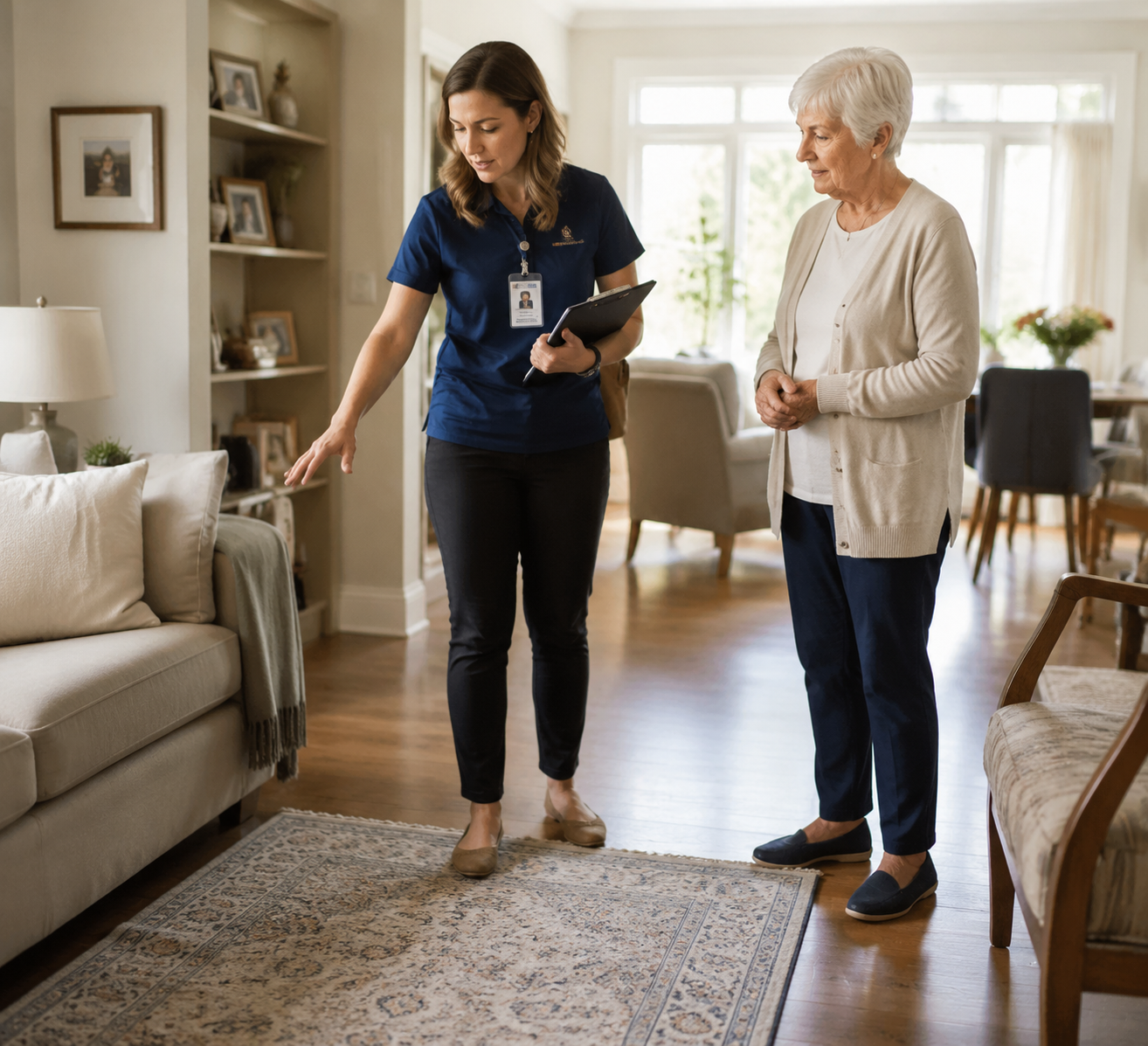
Start With an Ordered Assessment, Not Scattered Equipment
Families often move fast after a scare. Someone orders suction grab bars. Someone else removes every rug. A sibling suggests a stairlift before anyone has watched how Mom actually climbs the stairs at 7 p.m. when the hallway is dim and she is tired. Some of those fixes may help. Some may be unnecessary. A few may create a new problem because they were installed in the wrong place or chosen for the wrong limitation.
The reason to begin with a professional home safety assessment is not that relatives are careless. It is that a house after a fall is a clinical environment for a moment, whether anyone calls it that or not. The evaluator is looking at the parent’s mobility, balance, vision, strength, cognition, medications, habits, and the physical home at the same time. That combined view is hard to recreate with a generic checklist.
The broader fall burden explains why the healthcare system is paying attention: about one in four older adults falls each year, and falls among older adults lead to about 3 million emergency department visits and 1 million hospitalizations annually.[2] But the family’s immediate problem is smaller and more concrete: which hazards in this specific home could make the next ordinary routine—getting to the bathroom, answering the door, carrying coffee, stepping into the shower—unsafe?
Who Can Perform a Professional Home Safety Assessment?
The most clinically useful route after a fall or hospitalization is often an occupational therapist, especially when the assessment is connected to a physician’s order and the parent’s medical record. Occupational therapists are trained to look at how a person performs daily activities in a real environment: bathing, toileting, dressing, cooking, transferring in and out of bed, managing steps, and moving through the home with or without a device.
Other professionals may also be involved. Senior Home Safety Specialists focus on hazards and prevention strategies in the home. CAPS-certified professionals are commonly used when the next step is design or construction for aging-in-place modifications. These roles are related, but they are not interchangeable. The family needs to know whether it is asking for clinical evaluation, safety inspection, design advice, or construction work.
| Professional | Best used for | What to confirm |
|---|---|---|
| Occupational therapist | Assessing how the older adult actually moves, transfers, bathes, cooks, and uses the home in relation to health conditions | Whether the evaluation can be physician-ordered, documented, and covered under the applicable Medicare pathway |
| Senior Home Safety Specialist | Identifying household hazards and practical safety changes across rooms and routines | Training, scope, fee, and whether the report is detailed enough to guide later work |
| CAPS-certified contractor or remodeler | Planning and completing aging-in-place modifications such as ramps, bathroom changes, or structural updates | Licensing, insurance, estimate details, and whether recommendations align with the assessment report |
If the parent is coming home from a hospital, rehab facility, or emergency department visit, the practical question is simple: ask the discharge planner, primary care physician, or treating clinician who can order the evaluation and which providers in the area are accepting referrals. If the parent is in a Medicare Advantage plan, call the plan before scheduling and ask what documentation, referral, or network rules apply.
What the Evaluator Looks At Inside the Home
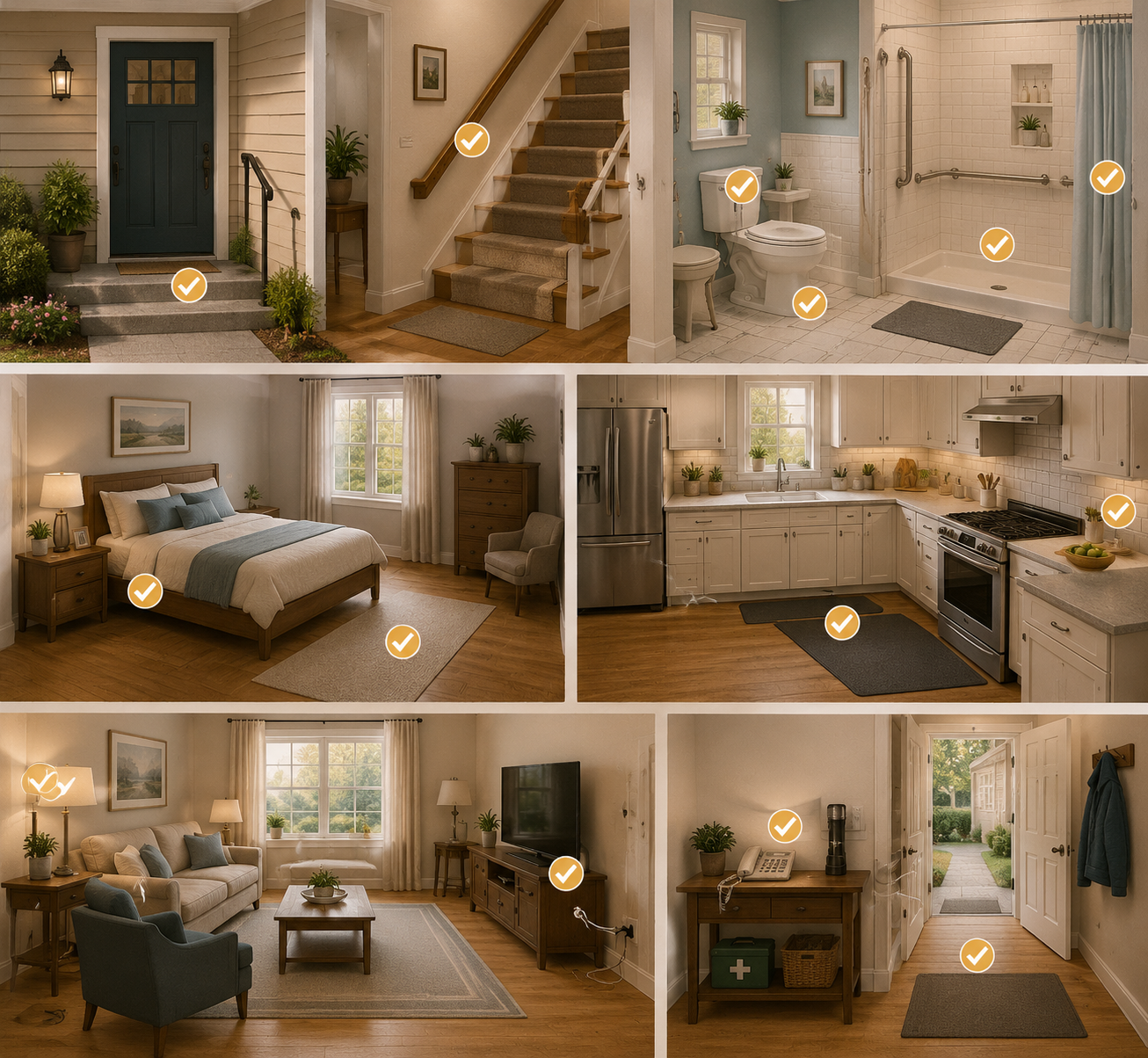
A professional visit is not a polite walk-through where everyone agrees the bathroom is “the main issue.” A comprehensive home safety assessment commonly covers entryways, staircases, bathrooms, bedrooms, kitchens, lighting throughout the home, and emergency preparedness.[3] The value comes from seeing how those areas connect to the person’s routines.
Entryways and Exits
The front door is often the first overlooked hazard. The evaluator may look at step height, railings, threshold edges, door width, surface changes, porch lighting, weather exposure, and whether the older adult can enter while carrying keys, mail, groceries, or a mobility aid. Emergency exit matters too. A path that works on a sunny afternoon may not work during a power outage, fire alarm, or EMS visit.
Stairs and Hallways
Stairs are not just counted; they are observed. The evaluator looks at rail placement, rail graspability, lighting at the top and bottom, contrast on stair edges, clutter, carpet condition, landing space, and whether the person uses the stairs differently when tired. A family may notice “the stairs are hard.” A professional assessment can separate the problems: weak lighting, missing second rail, uneven pacing, poor footwear, or a walker parked in the wrong place.
Bathrooms
Bathrooms deserve close attention because they combine wet surfaces, tight turns, transfers, privacy, urgency, and pride. The evaluator may examine toilet height, tub or shower entry, floor surface, towel bars being used as supports, grab bar placement, shower seating, handheld shower access, storage, lighting, and the route from bedroom to bathroom at night. The key detail is placement. A grab bar that looks sensible to an adult child may not match the direction the parent actually reaches when stepping out of the tub.
Bedrooms
In the bedroom, bed height can matter as much as floor clutter. The evaluator may watch how the older adult gets in and out of bed, where the walker or cane rests overnight, whether there is a clear path to the bathroom, whether lighting can be reached before standing, and whether cords, slippers, bedding, or furniture placement create avoidable risk. A family can use a bedroom checklist as a supplement, but the professional visit shows which items matter first for this parent.
Kitchen and Daily Tasks
Kitchen safety is not only about sharp objects or stove use. The evaluator may look at how often-used items are stored, whether the parent climbs or bends to reach them, whether lighting is adequate for reading labels, whether floor mats shift, and whether carrying food or hot liquids requires a risky path. The goal is not to strip the kitchen of independence. It is to make the ordinary tasks less punishing.
Lighting, Vision, and Nighttime Movement
Lighting is easy for families to underestimate because everyone tours the home at the wrong time of day. A professional assessment considers lighting throughout the home, including transitions between rooms, glare, shadows, switches that cannot be reached soon enough, and the path from bed to bathroom. The National Institute on Aging’s home safety materials also emphasize practical household steps such as keeping walkways clear, improving lighting, and reducing tripping hazards.[4]
Emergency Readiness
Emergency preparedness sounds separate from fall prevention until someone is on the floor and the phone is across the room. The evaluator may ask how the parent would call for help, whether responders can enter, whether medication and medical information are accessible, and whether exits are blocked. This is also where family assumptions often break down. “She always has her phone” is not the same as “she can reach help from the places where she is most likely to fall.”
What You Should Receive After the Visit
The deliverable matters. A useful assessment should leave the family with more than a conversation. Professional home safety assessments may produce a detailed safety checklist, photographic documentation, and a prioritized action plan.[3] That is the difference between “the bathroom is unsafe” and “install a properly anchored grab bar at this location, address the night path to the bathroom before replacing the kitchen flooring, and stop using this towel bar as support.”
For a caregiver coordinating siblings, contractors, clinicians, and the parent, photos and ranking are not administrative extras. They reduce arguments. They show why one fix comes before another. They help the physician understand the home context. They also create a record that can be used when requesting estimates, comparing funding options, or deciding whether a larger aging-in-place plan is realistic.
Many fall-prevention programs and clinical protocols draw from the CDC’s STEADI initiative, which is designed to help healthcare providers screen older adults for fall risk, assess modifiable risk factors, and intervene.[5] A home assessment does not replace medical review of dizziness, medications, vision, strength, or balance. It gives the care team and family a clearer map of the environment where those risks show up.
What Medicare Covers—and What It Does Not
The most important boundary is also the easiest to blur: Medicare coverage applies to the evaluation, not to the home modifications themselves.[1] That means the assessment may be covered when properly ordered and documented, but the grab bars, ramps, stairlifts, bathroom remodeling, flooring changes, electrical work, or construction labor are separate costs unless another program, benefit, grant, or payer applies.
That distinction should not make the assessment feel less valuable. It changes what the family is buying first. Instead of spending money on scattered fixes and hoping the right problem was solved, the family uses the covered evaluation to decide which fixes deserve funding, which can wait, and which require a different professional.
- Ask whether the physician can order a home safety evaluation under the 2026 Medicare coverage pathway.
- Confirm whether the provider accepts the parent’s Medicare coverage and what referral or documentation is required.
- Ask whether the written report will include photos, a ranked action list, and notes that can be shared with the care team.
- Do not assume the recommended modifications are covered just because the evaluation is covered.
Families should be especially careful with phrases like “Medicare covers home safety.” That wording is too broad. The safer working assumption is: Medicare may cover the ordered professional evaluation when the requirements are met; the family still needs a plan for paying for the fixes.
How to Use the Assessment Report Without Turning It Into Another Family Argument
The report should become the roadmap, not another opinion in the group chat. Start with the highest-priority safety items and separate them from cosmetic preferences or long-term remodeling ideas. A loose rug in a nighttime bathroom path and a poorly placed support near the shower may need attention before anyone prices a full kitchen redesign.
When the report recommends equipment or installation, match the next professional to the task. An occupational therapist may identify how and where support is needed. A qualified installer or contractor may be needed to anchor grab bars correctly, modify a threshold, add lighting, or build a ramp. A CAPS-certified professional may be useful when the work becomes a broader aging-in-place remodel rather than a simple safety correction.
The Mayo Clinic Health System’s occupational therapy guidance similarly frames household safety around practical changes in the places where daily activities occur, including bathrooms, bedrooms, kitchens, stairways, and floors.[6] The family does not need to become expert in all of those areas. It needs to preserve the professional reasoning long enough to make the next set of decisions in order.
A sensible sequence after the report is: handle urgent low-complexity hazards first, get quotes for installation or construction items, check local funding options, and decide whether the home needs a staged aging-in-place services plan. If the recommendations point toward larger modifications, compare the roles of occupational therapists, CAPS professionals, and contractors before hiring for the work. If cost becomes the barrier, use the assessment report when searching for grants, loans, assistance programs, or other funding sources.
The First Call to Make
If a parent has recently fallen, been hospitalized, or started showing signs that the home no longer fits their abilities, make the first call to the physician, discharge team, or care manager. Ask directly: “Can you order a professional home safety evaluation, and can it be documented in the medical record under the 2026 Medicare coverage pathway?”
Then confirm coverage with the Medicare plan and the provider before the appointment. Ask what the assessment includes, who will perform it, whether photos and a prioritized written plan are provided, and how the report will be shared. The family will still have decisions to make and fixes to fund. But it will be working from a trained assessment of this parent in this home, not from guesswork in the most stressful week of the year.
References
- Medicare to Cover Home Safety Evaluations Starting in 2026, All About Access, December 2025
- Facts About Falls, Centers for Disease Control and Prevention
- Comprehensive Guide to Home Safety Assessments for Seniors, Age Safe America
- Home Safety Tips for Older Adults, National Institute on Aging
- About Older Adult Fall Prevention, Centers for Disease Control and Prevention
- Household safety checklist for senior citizens, Mayo Clinic Health System
Related reading
Noticed something outdated or inaccurate on this page? Flag a correction. We review every report against CDC, NIA, and AARP HomeFit guidance before updating a page.
Part of the Fall Prevention section.