
How Fall Prevention Services Enable Aging in Place: A Family Caregiver's Roadmap
Falls are the leading threat to aging in place, but a coordinated ecosystem of services — from professional assessment and home modification to in-home care and monitoring technology — can reduce fall risk by up to 60%. This guide helps adult children understand how to layer these services to keep their parent safe at home.
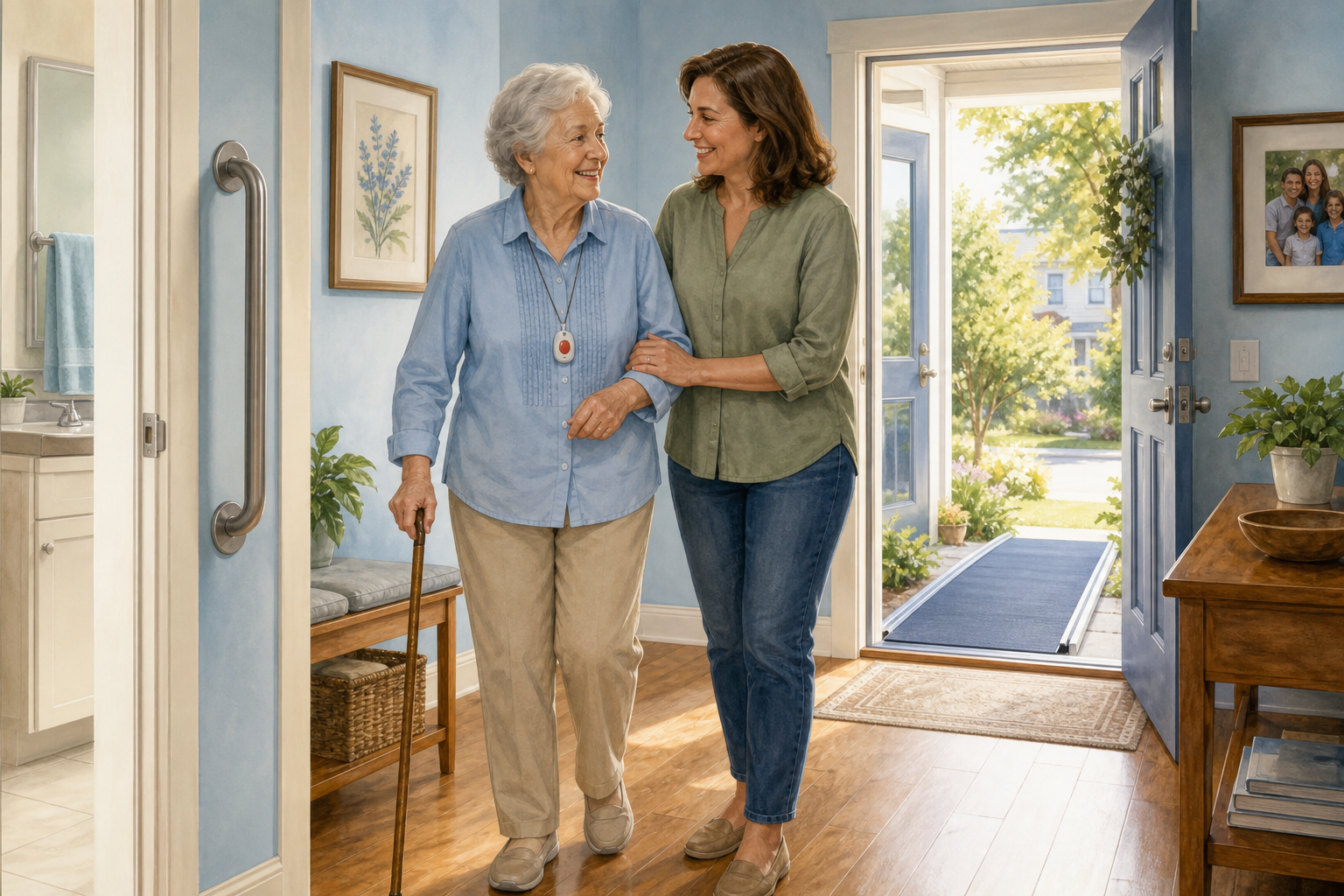
Why Falls Are the Greatest Threat to Aging in Place
Every year, more than one out of four older adults falls. That translates to roughly 3 million emergency department visits and about 1 million hospitalizations annually, according to the CDC. The estimated medical cost of nonfatal older adult falls now sits at approximately $80 billion per year. But the real story behind these numbers is not just about injuries — it is about independence.
When a parent falls, the consequences ripple far beyond the physical injury. About 37% of older adults who fall report an injury that requires medical treatment or restricts their activity for at least one day. A hip fracture, a traumatic brain injury, or even a bad sprain can mark the beginning of a downward spiral: reduced mobility, fear of falling, social withdrawal, and eventually a move to assisted living or a nursing home. Falls cause 83% of hip fracture deaths in older adults, making them the single most lethal home safety threat.
Yet the vast majority of falls are preventable. Over half of all falls happen at home, which means the home environment — and the services that support it — is the single most important battleground for preserving independence. The challenge for family caregivers is that no single intervention is enough. A grab bar alone will not prevent a fall caused by medication side effects. A medical alert system cannot address the muscle weakness that makes walking to the bathroom hazardous. What works is a coordinated, layered approach.
The Four Key Service Layers for Fall Prevention
Aging in place is not about a single home modification or a single device. It is about building a safety ecosystem that addresses the multiple risk factors that contribute to falls: environmental hazards, physical decline, medication effects, and the absence of immediate help when something goes wrong. The most effective approach layers four distinct service categories, each addressing a different dimension of fall risk.
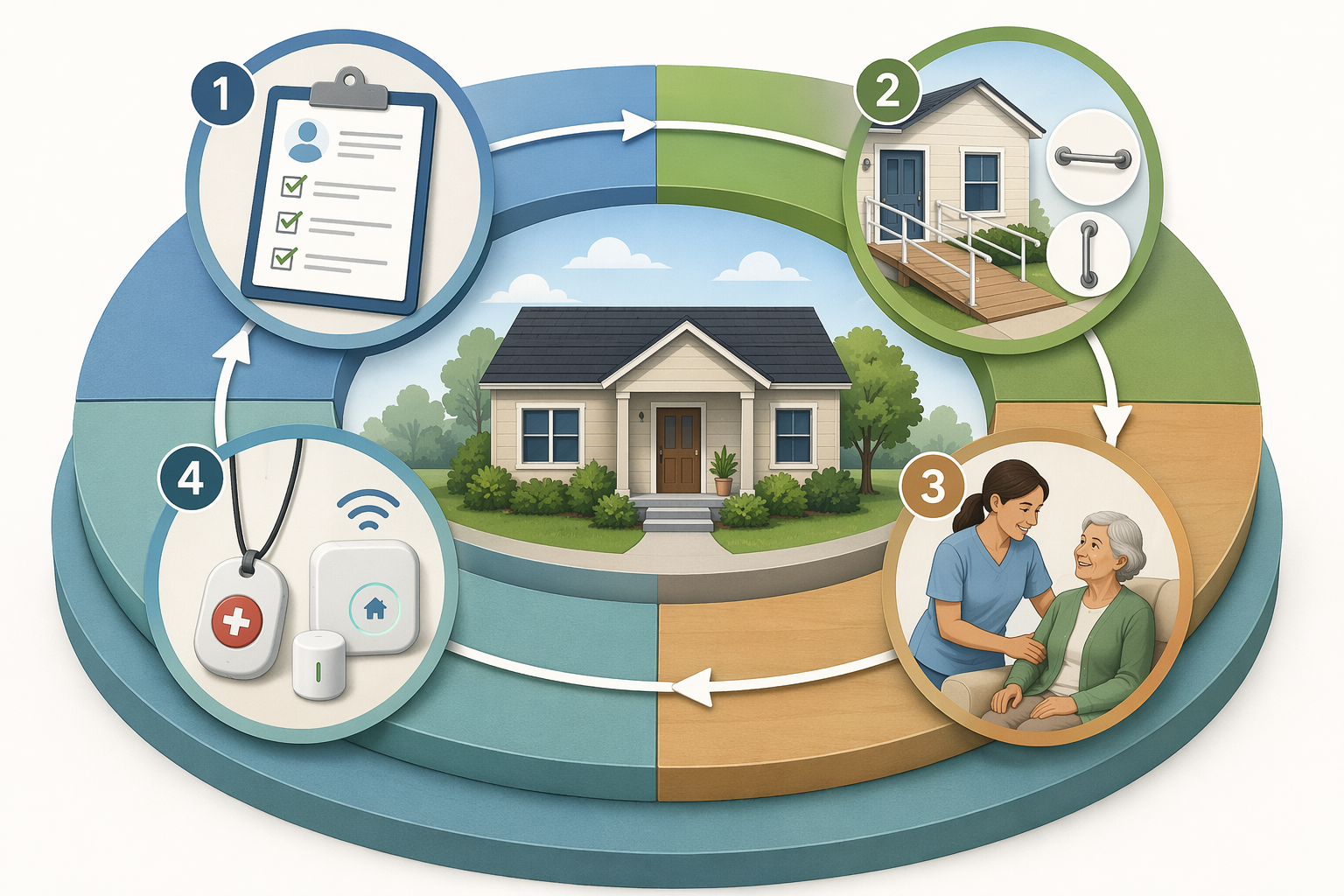
- Professional fall risk assessment: A structured evaluation using the CDC STEADI framework (Screen, Assess, Intervene) identifies specific risk factors — muscle weakness, balance problems, medication side effects, vision issues, and home hazards — before any modifications or care decisions are made.
- Home modification services: Structural changes like grab bars, non-slip flooring, improved lighting, zero-step entries, and widened doorways remove environmental hazards that cause or contribute to falls. These range from simple DIY projects to full professional renovations.
- In-home care with fall prevention training: Personal care aides, home health aides, and companion caregivers provide transfer assistance, mobility support, bathroom help, and medication reminders — all of which directly reduce fall risk. Skilled home health services add physical and occupational therapy.
- Monitoring technology: Medical alert systems with automatic fall detection, passive home sensors, and smart home devices provide a safety net that ensures help arrives quickly when a fall does occur, reducing the severity of outcomes and giving family caregivers peace of mind.
Each layer is necessary, but none is sufficient alone. A home with perfect modifications still leaves a senior vulnerable if they cannot safely transfer from the toilet without assistance. A well-trained caregiver cannot prevent a fall caused by a loose throw rug that was never removed. The power of the layered approach is that each service compensates for the gaps in the others.
Starting with a Professional Fall Risk Assessment
Before buying a single grab bar or hiring a caregiver, start with a professional fall risk assessment. This is the diagnostic step that tells you what you are actually dealing with. Without it, you are guessing — and the stakes are too high for guesswork.
The CDC's STEADI framework — which stands for Stopping Elderly Accidents, Deaths & Injuries — provides the evidence-based structure for this assessment. It has three steps:
- Screen: Identify whether the older adult is at risk for a fall. This can be done by a primary care provider using simple screening questions or by the family using tools like the NCOA Falls Free CheckUp, a free online self-assessment.
- Assess: If the screen indicates risk, a more detailed assessment identifies the specific contributing factors: gait and balance problems, muscle weakness, medication side effects, vision impairment, foot problems, and home hazards.
- Intervene: Develop a personalized plan that may include physical therapy for balance and strength, medication review, vision correction, home modifications, and assistive devices.
As a family caregiver, you can initiate this process by requesting a fall risk screening at your parent's next primary care appointment. You can also contact your local Area Agency on Aging (AAA) to request a home safety assessment. Many AAAs offer free or low-cost in-home evaluations conducted by an occupational therapist or a nurse who can identify hazards and recommend specific modifications.
An occupational therapy home safety evaluation is the gold standard. The therapist observes your parent performing daily activities — walking to the bathroom, getting in and out of the shower, preparing a meal — and identifies exactly where and why they are at risk. This evaluation should happen before any significant home modifications are planned, because the therapist's recommendations will determine which modifications are actually needed.
Home Modification Services: What to Prioritize and Who Does the Work
Once the assessment identifies the specific hazards, the next layer is home modification. The goal is not to make the home look like a hospital — it is to remove the environmental factors that turn a moment of imbalance into a fall.
The most impactful modifications are surprisingly affordable compared to the cost of a single fall-related hospitalization. Here is what the data shows for common modifications:
| Modification | Typical Cost Range | Fall Risk Addressed | Who Installs |
|---|---|---|---|
| Grab bars (bathroom) | $150 – $300 installed | Transferring on/off toilet, in/out of tub or shower | Handyman, CAPS contractor, or occupational therapist-recommended installer |
| Non-slip flooring | $2 – $5 per square foot | Slippery surfaces in bathrooms, kitchens, and entryways | Flooring contractor or handyman |
| Improved lighting | $50 – $200 per room | Poor visibility at night, shadows on stairs, glare | Electrician or handyman |
| Zero-step entry / ramp | $1,000 – $5,000 | Tripping at door thresholds, inability to use steps | CAPS contractor or concrete specialist |
| Widened doorways | $500 – $2,000 per doorway | Difficulty navigating with walker or wheelchair | General contractor or CAPS specialist |
| Handrails (both sides of stairs) | $200 – $500 per set | Loss of balance on stairs, insufficient support | Handyman or carpenter |
The national average cost for an aging-in-place remodel is approximately $9,500, according to NAHB survey data cited by RubyHome. That is a one-time expense — compared to the $5,350 per month median cost of assisted living, it is a fraction of the cost of even a single year of facility care.
For professional installation, look for a Certified Aging-in-Place Specialist (CAPS). CAPS-certified contractors are trained in universal design and aging-in-place remodeling. They understand the specific requirements for grab bar installation (proper blocking in walls, weight-bearing specifications), zero-step entries, and bathroom accessibility. An occupational therapist can also provide a written recommendation that specifies exactly what modifications are needed, which is useful when applying for funding or working with a contractor.
For a deeper dive into which modifications to prioritize and in what order, see our Aging in Place Remodel: A Room-by-Room Priority Guide for Families After a Fall.
In-Home Care with Fall Prevention Training
Home modifications address the environment. In-home care addresses the person. This is the layer that many families overlook, yet it is often the most critical for preventing falls in seniors who already have mobility limitations, balance problems, or cognitive decline.
There are three main types of in-home care that contribute to fall prevention:
- Personal care aides: Trained to assist with bathing, dressing, toileting, and transferring — the activities of daily living (ADLs) where most falls occur. A personal care aide can provide steadying support during transfers, help with showering (a high-risk activity), and ensure your parent uses mobility aids correctly.
- Home health aides: Provide skilled care under the supervision of a nurse or therapist. After a fall, Medicare covers home health services including physical therapy and occupational therapy. A physical therapist can design a personalized exercise program to improve balance and strength, while an occupational therapist can teach safe techniques for daily activities.
- Companion caregivers: Provide supervision, engagement, and light assistance. For seniors with mild cognitive impairment or those who are at risk due to loneliness and inactivity, a companion can reduce fall risk by encouraging movement, ensuring medication is taken on schedule, and keeping the home environment clutter-free.
The key distinction families need to understand is between non-medical home care (personal care and companion services, paid privately or through long-term care insurance) and skilled home health care (PT, OT, nursing, covered by Medicare when medically necessary after a fall or hospitalization). Many families assume Medicare will cover ongoing in-home care, but Medicare only covers skilled services ordered by a physician for a specific condition — not long-term personal care.
For guidance on finding and paying for these services, see our step-by-step guide on how to find and pay for home help for an elderly parent, and our decision-making guide for live-in companions.
Monitoring Technology as a Safety Net
Even with the best assessment, modifications, and in-home care, falls can still happen. The fourth layer — monitoring technology — ensures that when a fall does occur, help arrives quickly. This reduces the severity of outcomes and, equally important, reduces the anxiety that both the older adult and the family caregiver live with.
The core technologies in this layer include:
| Technology | Monthly Cost | Key Feature | Best For |
|---|---|---|---|
| Medical alert system (PERS) with fall detection | $20 – $50/month | Automatic fall detection, two-way voice communication, GPS location | Seniors living alone or who spend time alone during the day |
| Passive home sensors (motion, door, stove) | $15 – $40/month (often bundled) | Monitors activity patterns, alerts family to unusual inactivity or missed meals | Long-distance caregivers; seniors who may not wear a pendant |
| GPS tracker for seniors | $25 – $50/month | Real-time location tracking, geofence alerts | Seniors with dementia who are at risk of wandering |
| Smart home devices (voice assistants, smart lights) | One-time cost $30 – $200 per device | Voice-activated lighting, medication reminders, door lock monitoring | Tech-comfortable seniors; complements other monitoring systems |
Medical alert systems with automatic fall detection are the most widely used monitoring technology for fall prevention. The wearable pendant or wristband detects the impact and orientation change of a fall and automatically alerts a monitoring center — even if the person is unconscious or unable to press the button. This is a critical feature: many older adults who fall alone cannot get to a phone.
For family caregivers, especially those who live out of town, passive home sensors offer a different kind of protection. These sensors monitor movement patterns throughout the home and can alert you if your parent has not gotten out of bed by their usual time, has not opened the refrigerator, or has left the stove on. They do not require the senior to wear or remember anything, which makes them a good option for individuals with cognitive impairment who may not reliably wear a pendant.
How to Layer Services: A Step-by-Step Timeline
Knowing what services exist is one thing. Knowing when to put them in place is another. Here is a practical timeline that moves from immediate crisis response to long-term safety infrastructure.
| Timeframe | Actions | Who Is Involved |
|---|---|---|
| Immediate (this week) | Remove all throw rugs; install night lights in bathroom, bedroom, and hallway; clear clutter from all pathways; move frequently used items to waist-height cabinets; request a fall risk screening at the next doctor's appointment | Family members; no professional services required |
| Short-term (1–4 weeks) | Schedule a home safety assessment through the Area Agency on Aging or an occupational therapist; install grab bars in the bathroom; add non-slip mats or strips in the tub and shower; improve lighting on stairs and entryways; research medical alert systems | Occupational therapist, handyman or CAPS contractor, family members |
| Medium-term (1–3 months) | Complete priority home modifications (zero-step entry, stair handrails, widened doorways if needed); set up medical alert system with fall detection; begin physical therapy for balance and strength if recommended; hire personal care aide for transfer and bathing assistance | CAPS contractor, physical therapist, home care agency, monitoring service provider |
| Ongoing (every 6–12 months) | Re-assess fall risk; review medications with primary care provider; update home modifications as mobility changes; test and maintain monitoring equipment; continue balance exercises and physical activity | Primary care provider, occupational therapist, family members |
For a more detailed breakdown of what to do in the first hours, days, and weeks after a fall, see our Senior Care Assistance Triage: What to Do Now, Next Week, and Next Month.
Service Cost Estimates and Funding Sources
Cost is the most common barrier to implementing a full fall prevention service ecosystem. But the cost of doing nothing — a single fall-related hospitalization — is far higher. Understanding the cost ranges and available funding sources can make the difference between a plan that stays on paper and one that gets implemented.
| Service Layer | Typical Cost Range | Potential Funding Sources |
|---|---|---|
| Professional fall risk assessment | $0 – $250 (often free through AAA or Medicare-covered if part of a medical visit) | Medicare (if ordered by physician), Area Agency on Aging, NCOA Falls Free CheckUp (free online) |
| Home modifications (full remodel) | $3,000 – $15,000 (average $9,500) | Medicaid HCBS waivers (state-dependent), VA Aid and Attendance grants, HUD OAHMP grants, USDA Rural Development, local nonprofit programs |
| In-home personal care | $20 – $35/hour (non-medical) | Private pay, long-term care insurance, Medicaid HCBS waivers, VA Aid and Attendance |
| Home health (PT/OT) | Covered by Medicare Part A or B (after qualifying event) | Medicare, Medicare Advantage, private insurance |
| Medical alert system with fall detection | $20 – $50/month | Private pay (some Medicare Advantage plans offer coverage; check plan details) |
For a comprehensive breakdown of home modification costs and all available funding programs, see The Complete Cost Guide to Aging-in-Place Remodeling and our FAQ on home modification costs.
Room-by-Room Action Guide: Where to Start Today
While professional assessment should guide your overall plan, there are immediate actions you can take in every room of the house starting today. These are the low-cost, high-impact changes that address the most common fall hazards.
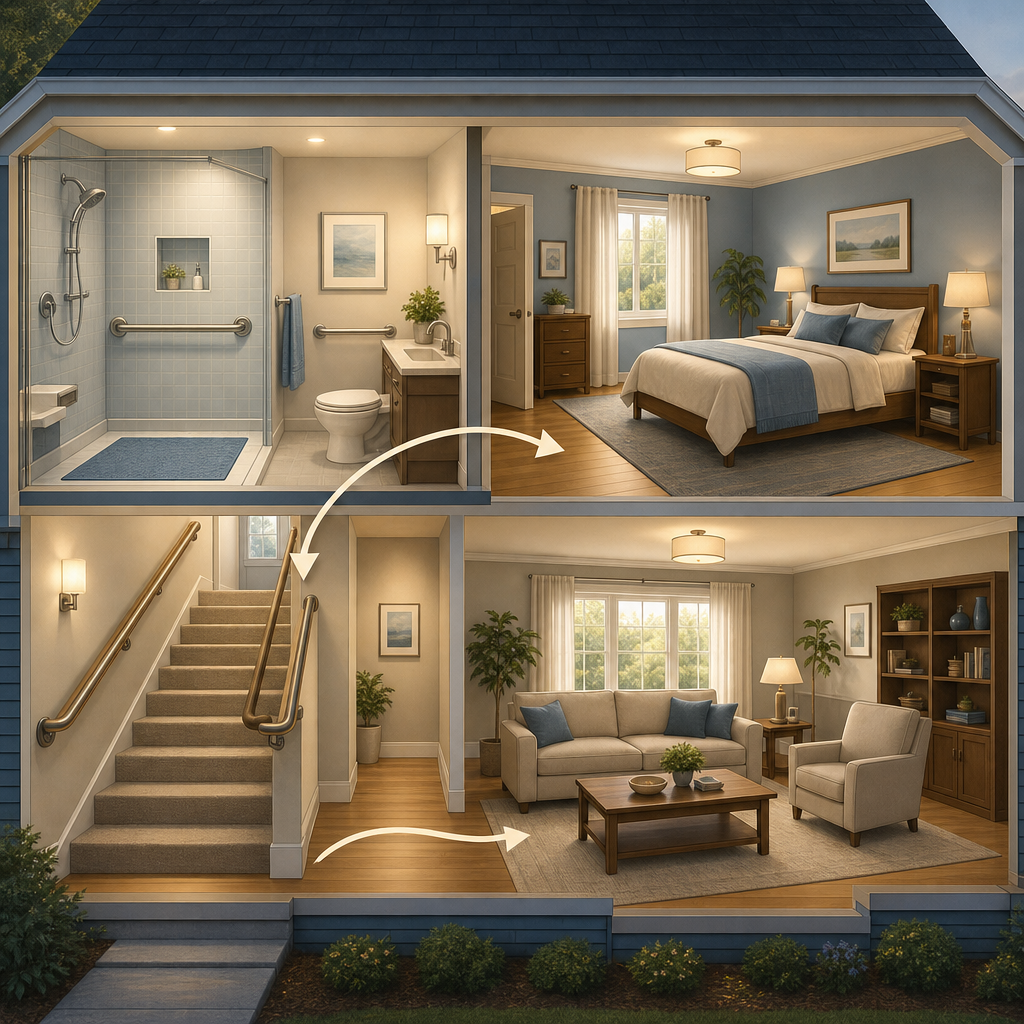
- Bathroom: Install grab bars near the toilet and inside the tub and shower (not suction cup bars — professionally anchored bars only). Add non-slip mats or adhesive strips in the tub and shower. Use a shower chair or transfer bench. Place a night light that stays on all night. Consider a raised toilet seat if your parent has difficulty standing from a low toilet.
- Bedroom: Ensure clear pathways from the bed to the bathroom. Remove clutter, cords, and loose rugs. Place a sturdy chair in the bedroom for sitting while dressing. Install a night light or motion-activated light. Keep a flashlight on the nightstand. Ensure the bed height allows your parent to stand up without strain.
- Stairs: Install handrails on both sides of every staircase. Ensure lighting is bright and has switches at both the top and bottom. Remove any objects stored on stairs. Add non-slip treads to each step. Mark the edge of each step with contrasting tape for visibility.
- Entryways: Eliminate tripping hazards at door thresholds. Add a ramp or zero-step entry if there are steps at any entrance. Install handrails at exterior steps. Ensure outdoor lighting is bright and motion-activated. Keep walkways clear of snow, leaves, and debris.
- Kitchen: Store frequently used items between waist and shoulder height — no reaching overhead or bending low. Use a sturdy step stool with a handrail if reaching is unavoidable. Place non-slip mats in front of the sink and stove. Ensure good task lighting over counters and the stove.
- Living areas: Remove all throw rugs or secure them with double-sided tape. Arrange furniture to create wide, clear walking paths. Keep cords and wires tucked along walls. Ensure seating is sturdy and at a height that allows easy standing. Avoid low, soft furniture that is difficult to get out of.
For a complete, printable room-by-room checklist with detailed instructions for each modification, see our Aging in Place Remodel: A Room-by-Room Priority Guide for Families After a Fall. And for the evidence behind why these modifications work, see The Evidence for Aging-in-Place Home Modifications.
The path to safe aging in place is not a single purchase or a single renovation. It is a process of layering services — assessment, modification, care, and monitoring — that together create a safety net strong enough to catch your parent before they fall. Start with the assessment. Then build the layers, one at a time, in the order that addresses your parent's specific risks. Every layer you add makes the next fall less likely, and every fall you prevent preserves another day of independence.
Related reading
- Fall Prevention at Home: How to Build a Complete Aging-in-Place Safety System Using CDC STEADI, Home Modifications, and Community Services
- Kitchen Fall Prevention Checklist for Older Adults: A Zone-by-Zone Safety Guide for Caregivers
- When a Fall Signals It’s Time: A Decision Guide for Long-Term Care After an Older Adult Falls
Noticed something outdated or inaccurate on this page? Flag a correction. We review every report against CDC, NIA, and AARP HomeFit guidance before updating a page.
Part of the Fall Prevention section.