
STEADI: screen
How to Protect Aging Parents During Rapid Hurricane Intensification
When a hurricane rapidly intensifies, caregivers have hours to decide whether to evacuate or shelter in place with an aging parent. This guide provides a six-question decision framework and a checklist for either path, based on mobility, medical needs, and fall risk.
Rapid intensification is the moment a hurricane stops fitting the family’s usual pace of decision-making. The National Hurricane Center definition used by Climate Central is an increase of at least 35 mph in maximum sustained winds within 24 hours; Climate Central also reports that 80% of major hurricanes undergo rapid intensification, and that storms jumping from Category 1 to major hurricane strength have more than doubled in frequency in the last two decades.[1] For a caregiver several hours away, that does not mean staring harder at the cone. It means the old “we’ll decide tomorrow” plan may have collapsed.

The practical question behind protecting aging parents during rapid hurricane intensification is not whether the storm has reached a certain category. It is whether your parent has already crossed one of the decision lines that makes waiting unsafe: a flood zone, a mobile home, a high-rise elevator, an oxygen concentrator, a walker, a history of falls, or a support network that exists mostly in theory.
A 3-to-5-day preparation rhythm can shrink to a 12-to-24-hour scramble when storms strengthen quickly, and hurricane planning for aging parents has to start before the forecast becomes urgent.[2] That is not because every older adult must evacuate for every storm. It is because delayed decisions create physical work at exactly the wrong time: packing in low light, rushing transfers, moving oxygen equipment, finding documents, calling a neighbor who may already be securing their own home.
Run the Six Questions Before You Debate the Forecast
The cleanest way to keep a family from arguing in circles is to use yes/no criteria. The First Contact framework, based on Pinellas County emergency guidance for older adults and caregivers, asks whether the person is in an evacuation zone, lives in a mobile home, lives in a high-rise, uses electric medical devices, has limited mobility, or lacks a reliable support network.[4] A “yes” does not always mean the same destination, but it does mean the decision has moved from preference to logistics.
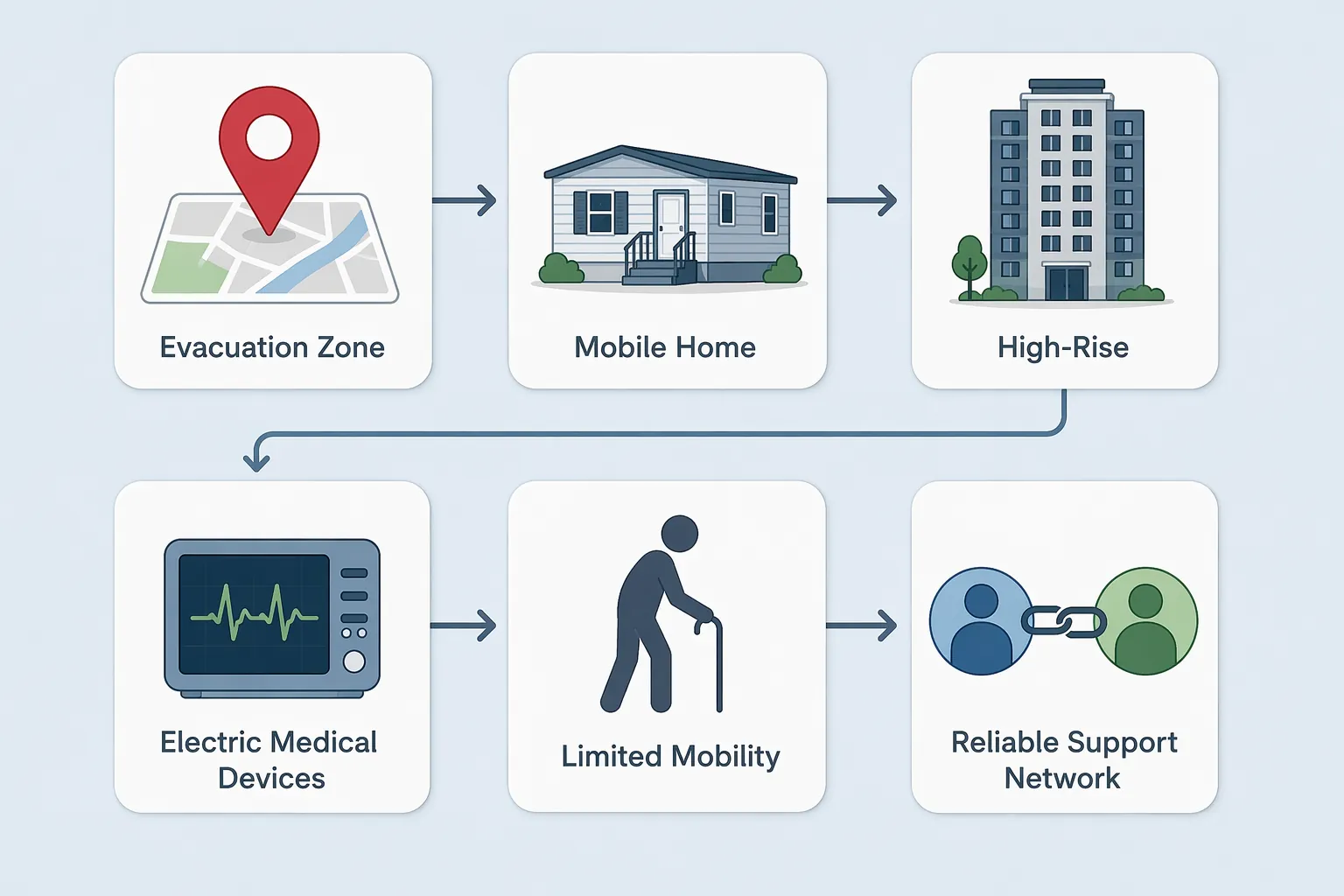
| Question | What a “yes” means in practice |
|---|---|
| Is the parent in an evacuation zone? | Follow the local evacuation order and do not wait for the storm category to feel persuasive. |
| Does the parent live in a mobile or manufactured home? | Treat wind vulnerability as a location trigger, even if the home feels familiar and well kept. |
| Does the parent live in a high-rise? | Plan around elevator failure, stair access, water pressure, and the ability to leave after the storm. |
| Does the parent use electric medical equipment? | Confirm backup power, oxygen arrangements, battery duration, charging access, and destination suitability. |
| Does the parent have limited mobility, vision, balance, or cognition? | Move the decision earlier, because storm preparation itself can become a fall-risk event. |
| Is there a reliable local support network? | Name the people who will physically show up, and name backups if the first person cannot. |
The First Three Are Location Triggers
Evacuation zone, mobile home, and high-rise status should be answered quickly. These are not personality questions. They are location facts. If your parent does not know their evacuation zone, look it up through the county emergency management site and put the result in the shared folder before hurricane season, not during a watch.
High-rise living deserves special attention because it can look safe on a map while becoming functionally unsafe for someone who cannot manage stairs. A parent on an upper floor may be outside a surge zone and still be trapped by elevator shutdown, power loss, heat, or delayed post-storm access. The question is not just “Will the building stand?” It is “Can this person safely use the building when the systems are down?”
Electric Medical Devices Change the Decision
If your parent uses an oxygen concentrator, powered hospital bed, CPAP machine, dialysis-related equipment, nebulizer, refrigerated medication storage, or a mobility device that must be charged, the evacuation question becomes less about wind speed and more about power continuity. PBS News, reporting on University of Michigan work, noted that only 25% of older adults using electric medical equipment had an alternative power source.[3]
That number is the kind of fact that should stop a vague family plan cold. “The power usually comes back” is not a plan for a device that has to work tonight. Before a storm is near, the caregiver file should include the equipment name, vendor, power needs, battery life if known, charger location, backup oxygen instructions if applicable, and the destination where the equipment can actually be used.
Ready.gov advises older adults to plan for medications, medical equipment, assistive devices, and important documents, and it points people with medical or access needs toward local registration options such as special needs shelters where available.[6] Registration is not a same-day errand to assume will work. It should be checked through the county before a storm is named.
Limited Mobility Is Not a Side Issue
Fall risk during storm preparation is a real clinical challenge, not a minor household inconvenience. PBS News and University of Michigan researchers point to mobility, vision, and cognitive factors that can slow evacuation for older adults and make storm preparation harder.[3] Available sources do not support a precise hurricane-related fall-rate statistic, so the safest conclusion is narrower: the danger is credible, clinically recognized, and easy to worsen with rushed decisions.
Think through the actual movements, not the abstract label “limited mobility.” Can your parent get out of the recliner if the power lift feature fails? Can they transfer from bed to walker without the bedside lamp? Can they carry anything while using a cane? Can they step over a shower threshold if they decide to “just rinse off” before leaving? Can they move through a hallway if boxes, bottled water, or patio furniture have been dragged inside?
This is where a Category 2 can be more dangerous than it sounds. A parent who is proud, tired, and trying not to be a burden may move too fast, skip the walker, or pack in the dark because everyone has suddenly agreed to leave. The injury risk is not only during landfall. It starts when the household becomes disorganized.
A Support Network Has to Be Named, Not Assumed
The last question is often the one families answer too optimistically: Is there reliable local support? A neighbor who waves from the driveway is not the same as a person who has agreed to help load a walker, move refrigerated medication, check the breaker panel, or drive to a shelter. A nearby cousin who works at a hospital may be unavailable precisely when the storm arrives.
For a distant caregiver, reliable means three things: the person has agreed in advance, knows what they are being asked to do, and has a backup. If those conditions are not met, the support network question should be treated as a “no” until proven otherwise.
If the Answer Is Evacuate, Use the Next Four Hours Carefully
Once the criteria point toward evacuation, the job is not to build a perfect disaster kit. It is to protect mobility, medication, power-dependent care, documents, and the people or animals your parent will not leave behind. The American Red Cross recommends older adults prepare to be self-sufficient for at least seven days and plan for medical alert systems, pets, and service animals.[5] In an evacuation window, that standard has to be translated into what can be grabbed, charged, labeled, and confirmed quickly.
- Mobility first: walker, cane, wheelchair cushion, transfer belt if used, spare eyeglasses, hearing aid batteries or charger, and shoes that will not slide on wet pavement.
- Medication second: current medication list, prescription bottles, refrigerated medication supplies, cooler plan, glucose supplies if relevant, and the pharmacy phone number.
- Power-dependent care third: oxygen backup, portable batteries, chargers, extension cord, equipment vendor number, and written instructions for anyone helping.
- Documents next: insurance cards, photo ID, Medicare or Medicaid cards, advance directives if available, emergency contacts, and a printed medication list in case phones fail.
- Destination check: confirm the receiving home, hotel, shelter, or special needs shelter can handle the parent’s mobility device, medical equipment, oxygen, refrigerated medication, and pet or service animal.
Ready.gov specifically emphasizes medication planning, document storage, and local special needs shelter registration for older adults.[6] Do not let “we’ll bring everything” become the plan. Bags should be labeled by function: medications, documents, device power, personal care, pet or service animal supplies. The person helping on site should be able to find the right bag without a phone call.
For refrigerated medication, the key question is not only whether there is a cooler. It is who knows which medication needs refrigeration, where the cold packs are, how long the trip is expected to take, and what the pharmacy or clinician says to do if temperature control is uncertain. If that information is not written down, it may not be available when the caregiver most needs it.
If Sheltering in Place, Plan for Seven Days and Remove Fall Hazards Before the Lights Go Out
Sheltering in place is not the easier choice unless the home can function without normal services. The Red Cross advises older adults to prepare to be self-sufficient for at least seven days.[5] For an aging parent, that standard includes the usual supplies, but the deciding details are often smaller: safe walking paths, bathroom access, medication timing, heat, communication, and whether medical alert systems will still work.
| Phase | Fall-prevention and care tasks |
|---|---|
| Before conditions deteriorate | Clear paths from bed to bathroom, recliner to kitchen, and entry door to exit route; move cords, throw rugs, boxes, and stacked supplies. |
| Before power loss | Charge phones, medical alert devices, hearing aids, mobility devices, backup batteries, and any rechargeable lighting. |
| During the storm | Keep the walker or cane within reach, use battery lighting before standing, avoid showers, and do not move heavy objects. |
| After the storm | Wait for a confirmed helper before navigating stairs, wet floors, debris, or a dark garage; treat cleanup as a fall-risk activity. |
Medical alert planning deserves its own check. The Red Cross includes medical alert systems in older-adult preparedness guidance.[5] A pendant that depends on a landline, base station, cellular signal, or charged battery may not behave the same way during an outage. Write down how it works, how long it lasts, and what the backup call procedure is.
The same goes for apartment elevators. If your parent cannot safely manage stairs, sheltering in a high-rise can turn into a delayed evacuation problem after landfall. If they stay, someone local should know the floor number, stairwell access, building contact, and whether the parent can reach water, medication, and a bathroom without using the elevator.
Build the Check-In System Before the Network Fails
A single caregiver contact is a fragile plan. The distant daughter may be the organized one, but she may also be the person with the weakest ability to act if cell towers fail or roads close. The safer plan has one primary contact and two or three backup contacts who know their assignments before the storm.
- Primary contact: tracks official orders, keeps the shared folder current, and makes the go/no-go decision using the six questions.
- Local helper 1: physically checks the parent, confirms mobility aids and medication bags, and reports whether the home is still safe.
- Local helper 2: serves as backup transportation or backup welfare check if the first helper cannot get there.
- Out-of-area relative or friend: receives updates, keeps a written timeline, and becomes the message relay if local calls are inconsistent.
The check-in schedule should be specific enough to prevent guessing: for example, one call when a hurricane watch is issued, one when an evacuation order is announced, one before bedtime, and one after the storm passes if service allows. The exact schedule can be adjusted by county guidance and family circumstances, but the assignments should not be invented during the outage.
This is also where family emotion needs a practical container. A proud parent may say they are fine because they do not want to be managed. The six questions help lower the temperature: the decision is not “Do you feel old?” It is “Are you in the zone?” “Will the elevator work?” “What powers the oxygen?” “Who is coming if I cannot?”
Rapid intensification is a shorter-decision-window problem. For aging parents, safety depends on having the criteria, supplies, and backup people chosen before the storm turns ordinary tasks into rushed transfers, dark hallways, missed medication, and unanswered calls.
References
- Hurricane Rapid Intensification — Climate Central.
- 5 tips for hurricane disaster planning with aging parents, starting now before the storms — The Conversation.
- Why it can be more difficult to evacuate older adults in a disaster — PBS News.
- Disaster Preparedness for Older Adults and Caregivers — First Contact.
- Older Adults Emergency Preparedness — American Red Cross.
- Older Adults — Ready.gov.
Related reading
Noticed something outdated or inaccurate on this page? Flag a correction. We review every report against CDC, NIA, and AARP HomeFit guidance before updating a page.
Part of the Fall Prevention section.