
STEADI: intervene
Protect Your Parent's Whole Home From Wildfire Smoke
Make an older parent's home measurably safer from wildfire smoke with a three-layer plan: seal the house, run a MERV 13 HVAC filter on recirculate, and concentrate activity in a clean room with a correctly sized portable air cleaner. Includes CADR sizing math, the box-fan DIY option and its limits, and the heat-vs-smoke tradeoff for older adults.
The useful answer to how to protect elderly parents from wildfire smoke starts inside the house, not with the smoke plume. Walk the rooms before smoke arrives. Find the HVAC filter slot. Open the thermostat menu. Measure the room where your parent can spend most of the day. The home does not become “smoke-proof,” but it can become measurably safer when three layers are stacked in the right order: seal obvious leak points, filter continuously through the actual HVAC setup where that is safe for the system, and concentrate daily life in a clean room with a correctly sized portable air cleaner.
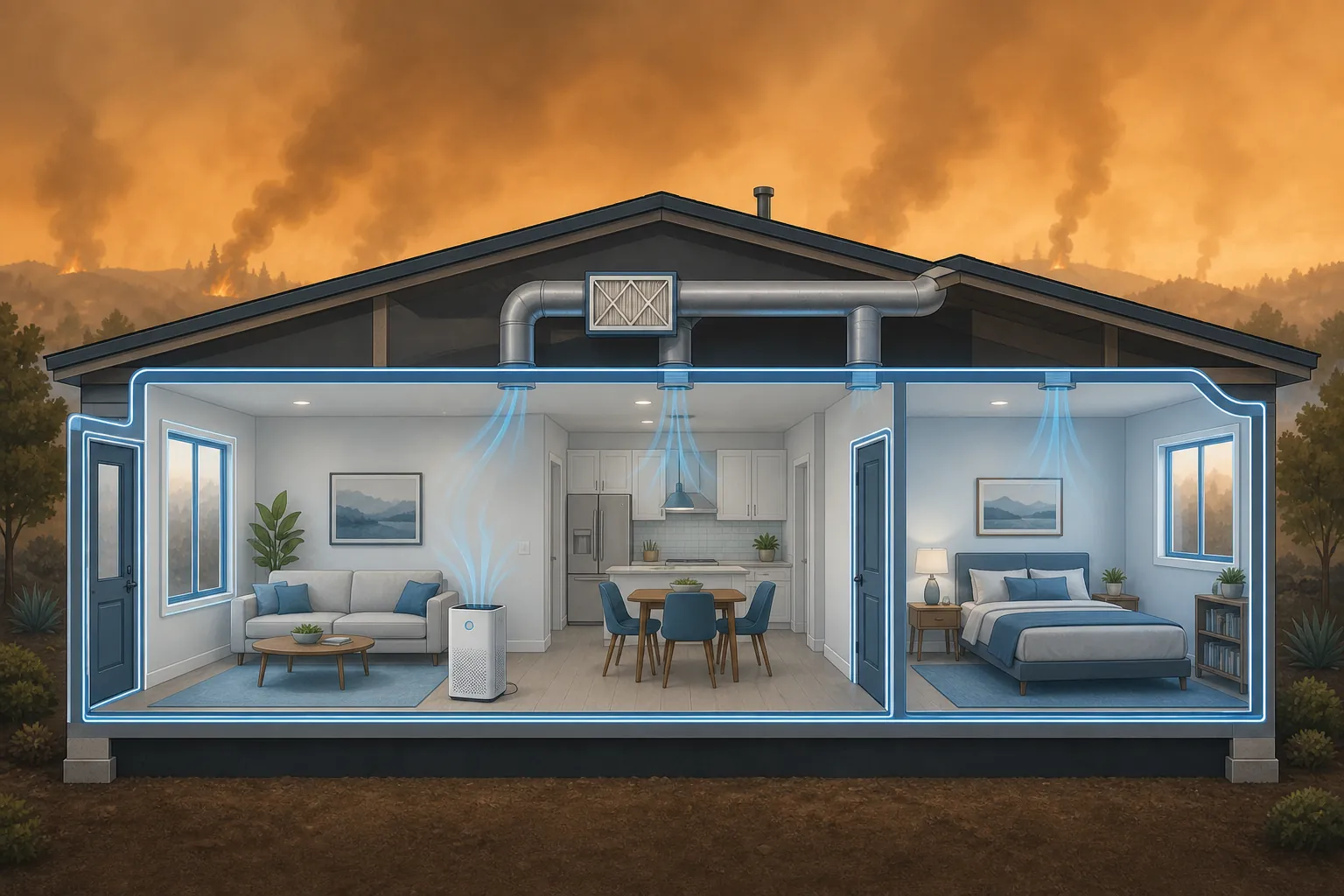
This is a plan-ahead house assessment. It does not replace daily AQI decisions, symptom watching, evacuation planning, or heat-safety checks. If smoke is already in the neighborhood, use your local air-quality alerts and a day-by-day routine like checking air quality during wildfire smoke. If heat becomes the limiting danger, use a daily heat and wildfire smoke safety checklist. The work here is the quieter work that should happen before the alert: making sure the house has a defensible setup.
The whole-home route, in one pass
| Layer | What you check | What a finished decision looks like |
|---|---|---|
| Seal | Windows, doors, visible gaps, the room with the fewest openings | You know which openings will stay closed and which gaps can be temporarily sealed without blocking safe exits or needed ventilation. |
| Filter | HVAC filter size and MERV rating, thermostat fan setting, recirculate or fresh-air intake controls | You know whether the system can take a MERV 13-or-higher filter, whether the fan can run continuously, and whether outdoor-air intake can be reduced during smoke. |
| Concentrate | Clean-room dimensions, ceiling height assumption, portable air cleaner smoke CADR | You know the room’s square footage and the minimum CADR target under the sizing standard you choose. |
| Backstop | Indoor heat, AC availability, power reliability, the parent’s tolerance for a closed-up house | You know when the smoke plan stops being safe because heat has become the more immediate problem. |
Bring a tape measure, a phone camera, and the size printed on the current HVAC filter. Photograph the filter label, the thermostat screen, and the portable cleaner rating plate. If a sibling or neighbor will help from another state, those three photos prevent a lot of guessing.
First, make the house harder for smoke to enter
Start with the envelope: closed windows, closed exterior doors, obvious gaps, and the rooms that are naturally easier to isolate. EPA clean-room guidance points people toward a room that is small enough to manage and has few windows and doors; that same logic helps the whole-house walkthrough because fewer openings mean fewer places for smoke to keep sneaking in while the cleaner is trying to catch up. [1]
Do not make this more dramatic than it needs to be. You are not trying to shrink-wrap the house or make an older homeowner feel trapped. You are looking for practical, reversible fixes: a door sweep that actually touches the threshold, a window that latches fully, a room where the door closes without a half-inch gap at the bottom, and a plan for which doors should not be propped open during smoke.
The best candidate for the clean room is usually the smallest comfortable room where your parent can realistically spend time: often a bedroom, sometimes a den, rarely the largest open-plan living room. “Comfortable” matters. A room that is mathematically easy to clean but has no place to sit, no nearby bathroom access, or no way to keep cool will not hold up for an older adult over a long smoke episode.
Then make the HVAC system filter when it is able to filter
The HVAC layer is where vague advice usually falls apart. “Run the air” can mean several different things, and only some of them help during smoke. You need to know the filter rating, whether the system can handle that filter, whether the fan can run without heating or cooling, and whether the system is bringing outdoor air inside.
Check the filter slot before buying filters
Pull the current filter and write down the printed size. Many homes use a return grille filter; others have a filter cabinet at the furnace or air handler. Some have more than one return. If the filter is bowed, crushed, missing, installed backward, or surrounded by a gap, smoke-season filtration is already compromised before you get to the MERV rating.
For wildfire smoke, the target is a MERV 13 or higher filter where the HVAC system can safely use it. Washington State Department of Health recommends using a MERV 13 filter if the system can handle it, and EPA summit materials identify MERV 13 filtration as effective for the small particle sizes common in wildfire smoke, including the 0.3–1.0 μm range. [2][3]
That “if the system can handle it” clause is not decorative. A tighter filter can restrict airflow in a system that was not designed for it. If the manual, service label, or HVAC technician says the system should not use MERV 13, do not pretend a higher number is automatically safer. Use the best compatible filter and rely more heavily on the clean-room portable cleaner.
Set the fan to run, not just to wait for heating or cooling
On many thermostats, “auto” means the fan runs only when the system is actively heating or cooling. During smoke, that can leave the filter idle for much of the day. EPA summit materials cite the practical problem plainly: HVAC thermostats may filter only about 20% of the time in auto mode, so the fan should be set to “on” during smoke events when the system allows it. [3]
Stand at the thermostat and find the fan setting before the first smoke day. The relevant menu may say “fan,” “auto,” “on,” or “circulate.” For smoke, the useful setting is the one that moves indoor air through the filter continuously or near-continuously without intentionally pulling in outdoor air. If the thermostat is confusing, take a photo of the screen and model number and sort it out before the alert.
Use recirculate, and close fresh-air intake where the system allows
Some systems, especially newer or more complex ones, have outdoor-air or fresh-air intake controls. During smoke, Washington State Department of Health advises setting the system to recirculate and closing the fresh-air intake if the system has one and it can be done safely. [2]
This is where the house’s actual equipment matters. A simple furnace and AC may have no fresh-air control at the thermostat. A ductless mini-split may recirculate room air but not filter the whole house through a central return. A swamp cooler or whole-house fan may be exactly the wrong tool during smoke because its job is to bring outdoor air in. The walkthrough should leave you with a sentence you can say clearly: “This system can run the indoor fan through a MERV 13 filter on recirculate,” or “This system cannot do that, so the clean room carries more of the load.”
Now measure the clean room and size the portable air cleaner
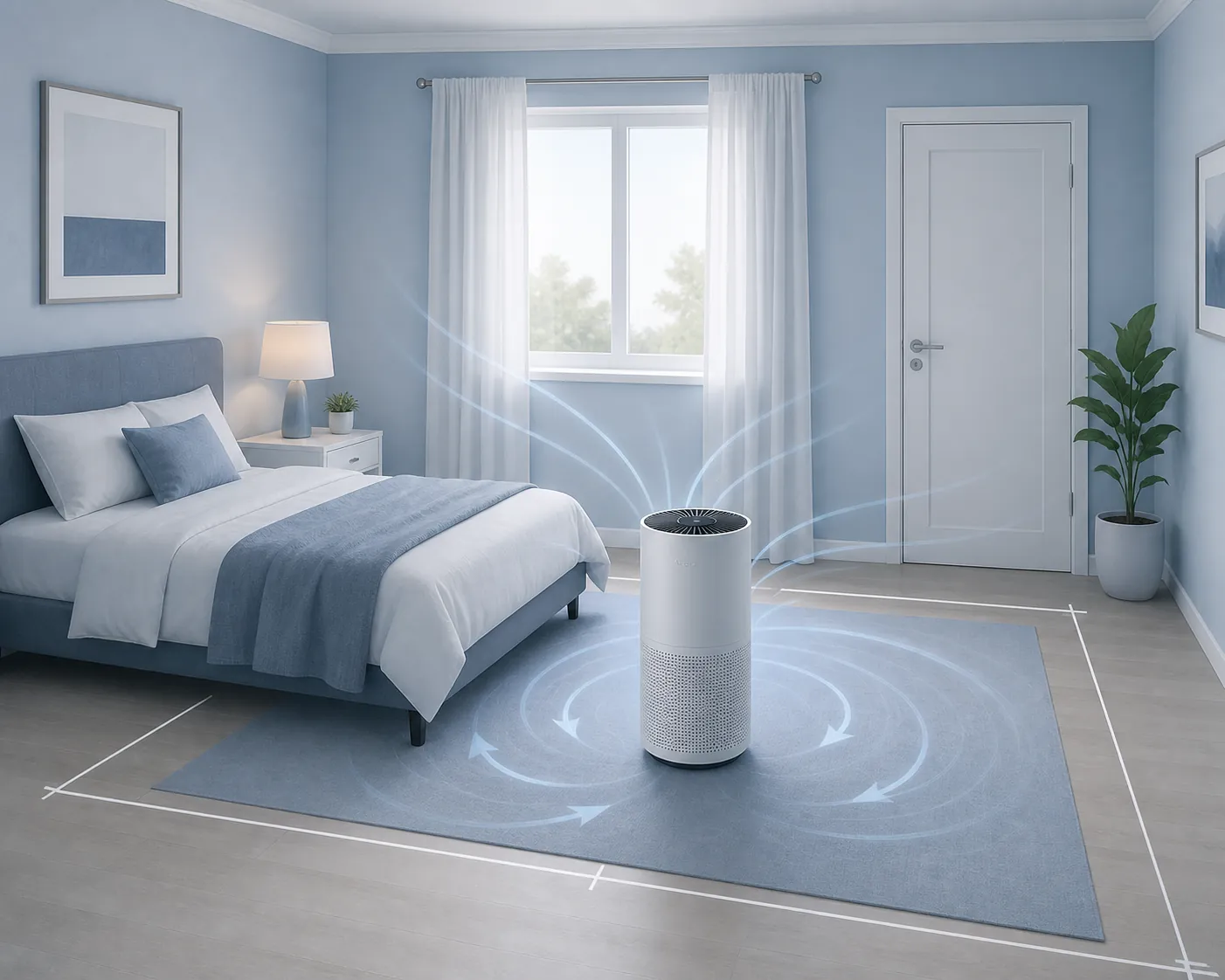
A portable air cleaner is not sized by how anxious everyone feels. It is sized by room area, ceiling height assumptions, and smoke CADR. CADR stands for clean air delivery rate. For this job, look for the smoke or tobacco-smoke CADR on the product label or specification sheet, not only the marketing phrase “covers up to” a certain room size.
Health Canada’s portable air cleaner guidance gives a simple sizing rule: choose a unit with a tobacco-smoke CADR of at least two-thirds of the room’s area in square feet. Its worked example is a 10 ft by 12 ft room, or 120 sq ft, needing a smoke CADR of about 80; the ratings assume an 8 ft ceiling. [4]
| Measured room | Room area | Health Canada minimum smoke CADR: about 2/3 of area | More conservative wildfire-smoke target: smoke CADR about equal to area |
|---|---|---|---|
| 10 ft × 12 ft | 120 sq ft | About 80 | About 120 |
| 12 ft × 12 ft | 144 sq ft | About 96 | About 144 |
| 12 ft × 15 ft | 180 sq ft | About 120 | About 180 |
| 15 ft × 15 ft | 225 sq ft | About 150 | About 225 |
Do not blend those two columns into a fuzzy middle. They are different standards. Health Canada’s general portable-air-cleaner arithmetic uses smoke CADR at least two-thirds of room area, while AHAM’s updated wildfire-smoke recommendation, reported by NAFA, is more conservative: smoke CADR roughly equal to the room’s square footage. [4][5]
The difference changes buying and room-selection decisions. If the “den” is 15 ft by 15 ft, Health Canada arithmetic points to about 150 smoke CADR, while the more conservative wildfire-smoke target points closer to 225. If the bedroom is 10 ft by 12 ft, even the conservative target is around 120. That may be the difference between a unit the family already owns being adequate for one room and being underpowered for the room everyone assumed they would use.
Run the cleaner continuously in the clean room during smoke, with the door and windows closed as much as heat and safety allow. Place it where air can move around it; do not wedge it behind a recliner or under a table. For the single-room setup itself—what to keep in the room, how to make it usable for sleep and medications, and how to help a parent accept spending time there—use a dedicated clean-air room guide for seniors.
Portable cleaners are not always cheap. EPA summit materials describe a broad rough price range, about $100 to $1,000, depending on unit size and features. [3] That range is one reason the room measurement matters. Buying one oversized unit for an open-plan area may be less useful than putting a correctly sized unit in the smaller room where your parent can actually spend smoky hours.
If you use a box-fan filter, keep the safety limits attached to the idea
A DIY box-fan cleaner can be a reasonable low-cost tier, especially when the choice is between some filtration and none. But it is not a magic budget version of a rated HEPA cleaner, and it should not be described without its limits.
- Use a 20 in × 20 in MERV 13 filter attached securely to the fan, following local public-health instructions for airflow direction.
- Use only a UL- or ETL-listed box fan made in 2012 or later.
- Never place the box-fan filter setup in a window.
- Do not leave it unattended with a person who may not notice overheating, odor, instability, or a loose filter.
- Treat it as a temporary smoke tool, not a permanent substitute for a rated portable air cleaner.
Washington State Department of Health gives the same core cautions: use a 2012-or-newer UL- or ETL-listed fan, use a 20 in × 20 in MERV 13 filter, and do not put the setup in a window because of fire risk. The department also cites Puget Sound Clean Air Agency testing that found a box-fan filter setup could clean a 15 ft by 15 ft room in about 10–15 minutes. [2]
That test result is useful, but it is still a room-scale result. A box fan in one bedroom does not fix an unfiltered HVAC system, an open exterior door, or a house that is getting too hot because every window is closed. It is one tool in the clean-room layer.
Do not add ozone to the house
For wildfire smoke, avoid air-cleaning devices that intentionally generate ozone. Health Canada advises against using ozone generators in occupied spaces. [4] This is not the moment to experiment with a machine that promises to “sanitize” the air while introducing another respiratory irritant into an older adult’s home.
If a product description is built around ozone, ionizing, plasma, or “activated oxygen,” slow down and verify what the device emits. A mechanical filter with a clear smoke CADR is easier to judge and easier to explain to the family member who will be asked why it has to run all afternoon.
The heat limit governs the whole plan
Closing a house against smoke can create a different danger for an older adult: heat. This is the part of the plan that should not be hidden in a footnote. If the home has reliable air conditioning, the smoke plan is easier to hold. If it does not, the family needs a heat backup plan before a multi-day smoke episode.
EPA summit materials describe the tradeoff used in Missoula County guidance: people who can tolerate some smoke exposure may open windows at night to cool the home, then close the house again and run true-HEPA filtration; people who cannot tolerate smoke and lack air conditioning may need to consider relocating to a cleaner, cooler place. [3] Washington State Department of Health also notes that during longer smoke episodes, such as those lasting 3–4 days or more, people may need to use brief periods of improved outdoor air—after rain or a wind shift, for example—to air out the home. [2]
Those are considerations, not blanket commands. The safer choice depends on the parent’s health, indoor temperature, outdoor smoke level, access to AC, transportation, and whether a cooler clean-air center or another family home is realistically available. If heat is rising indoors and the parent is not safe, the smoke-filtration plan has reached its limit. Use the heat and wildfire smoke safety checklist for daily decisions, and keep wildfire evacuation planning for seniors separate from the home-filtration project.
What the finished walkthrough should leave you knowing
A good smoke-season house walk ends with specifics, not reassurance. You should be able to name the sealed areas, the HVAC filter size and rating, the thermostat fan setting, the recirculate or fresh-air-intake choice, the clean room, the room’s square footage, the cleaner’s smoke CADR, and the heat backup plan.
- “The return takes a 16 × 25 × 1 filter, and the system can use MERV 13.”
- “During smoke, the fan setting is ON, not AUTO.”
- “The system stays on recirculate, and we are not using the whole-house fan.”
- “The clean room is the 10 × 12 bedroom, so the smoke CADR target is about 80 by Health Canada’s rule or about 120 by the more conservative wildfire-smoke target.”
- “If the room gets too hot, we have a cooling and relocation plan instead of just telling her to keep every window closed.”
That is the practical threshold. The house is not purified against every possible smoke-season risk. It is simply less improvised: fewer leaks ignored, more air moving through real filters, one room sized on purpose, and a heat plan that respects the older person living there.
References
- Create a Clean Room to Protect Indoor Air Quality During a Wildfire, U.S. Environmental Protection Agency
- Protect Yourself and Others - Smoke From Fires, Washington State Department of Health
- EPA Clean Air Spaces Web Summit Summary, Frontiers in Public Health
- Using a portable air cleaner to improve indoor air, Health Canada
- AHAM Wildfire Smoke CADR, National Air Filtration Association
Related reading
Noticed something outdated or inaccurate on this page? Flag a correction. We review every report against CDC, NIA, and AARP HomeFit guidance before updating a page.
Part of the Fall Prevention section.