
STEADI: Intervene
How to Protect Seniors When a Wildfire Smoke Alert Fires
When a wildfire smoke alert fires for an older adult's town, the first 24 hours follow a specific order: read the AQI number, seal and filter the home, verify medications and equipment, and run a symptom watch with clear 911-versus-provider rules. This guide walks caregivers through each step and exactly when to escalate.
When a wildfire smoke alert hits your parent’s town, do not start with the color of the sky. Start with the alert’s AQI number and color, then run the first-day sequence from there. The U.S. Air Quality Index runs from 0 to 500 in six color categories; the action-changing thresholds for this call are 100, 150, 200, and 300.[1] For an older adult, that number decides whether your next instruction is “shorten outside time,” “stay in cleaner indoor air,” or “we need another location.”
Older adults are not just a cautious add-on to the warning. EPA identifies adults 65 and older as a group at increased risk from wildfire smoke, in part because chronic heart and lung disease become more common with age.[2] If the person has COPD, asthma, heart disease, diabetes, uses oxygen, or gets short of breath easily, treat the alert as a household task list, not as background weather.
First, read the AQI number out loud
On the phone, ask for the exact number and color from the alert or from AirNow. “It says orange” is useful. “It says 137” is better. Then give instructions that match the level.
| AQI on the alert | What it changes for an older adult |
|---|---|
| 101–150, Orange: Unhealthy for Sensitive Groups | Adults 65+ and people with heart or lung disease should reduce outdoor exposure and avoid strenuous outdoor activity. This is the level where a senior household starts the smoke protocol, not where it waits to see whether the haze gets worse.[1][2] |
| 151–200, Red: Unhealthy | The air is unhealthy for everyone. The older adult should stay in cleaner indoor air, and errands, walks, yard work, and porch sitting should stop unless there is a more urgent reason to go out.[1] |
| 201–300, Purple: Very Unhealthy | Treat this as a serious exposure-control day. Keep the person in the cleanest indoor room you can create, intensify filtration, and consider a cleaner-air location if the home cannot be kept cool and filtered.[1] |
| 301 and higher, Maroon: Hazardous | Follow local emergency instructions closely. If the home cannot provide cleaner indoor air, cooling, medications, and powered medical equipment, leaving for a safer indoor setting may become the practical choice.[1] |
Local health departments may draw the line differently, so do not turn one county’s chart into a national rule. King County advises adults over 65 to stay indoors when AQI is 100 or higher and advises everyone to stay indoors at 150 or higher.[5] Michigan’s public health table tells adults 60 and older to shorten outdoor activity at 101–150 and seek cleaner indoor air at 151 and above.[6] The safe phone instruction is simple: once the alert is in the orange range for an older adult, begin reducing exposure; once it reaches red, make cleaner indoor air the default.

Close the house, but check heat before you trap someone inside
The next instruction is physical: close exterior doors, windows, fireplace dampers, and any obvious gaps that can be closed safely. Turn bathroom and kitchen exhaust fans off unless they are needed briefly, because they can pull smoky outdoor air into the home. If the older adult can do it safely, have them move to the room where they will spend the next several hours before they get tired.
This is also where a lot of smoke advice becomes unsafe by being too tidy. Closing everything can conflict with heat safety. If the home is already hot, the air conditioner is not working, or the person is at risk of overheating, do not tell them to sit in a sealed, warming room just because smoke is outside. On heat-plus-smoke days, use the site’s Heat and Wildfire Smoke Safety Checklist for Seniors and choose the least bad option: a cooled filtered room, a public cleaner-air space if local officials provide one, or a trusted home with working air conditioning and filtration.
The CDC’s chronic-conditions guidance is concrete on this point: people with chronic conditions should stay inside with windows and doors closed, run HVAC with a filter or use a portable air cleaner, keep a 7–10 day prescription supply, and use a NIOSH-approved N95 if they must go outside.[3] That is the first-day order: close what you can close, then make the indoor air cleaner. Closing without filtration is only half the job.
Start filtration next; “inside” is not automatically clean
Do not reassure a parent with COPD that they are protected just because they are indoors. AirNow warns that fine particles can build up indoors even when smoke is not visible, which is why filtration belongs in the first hour of the response.[4]
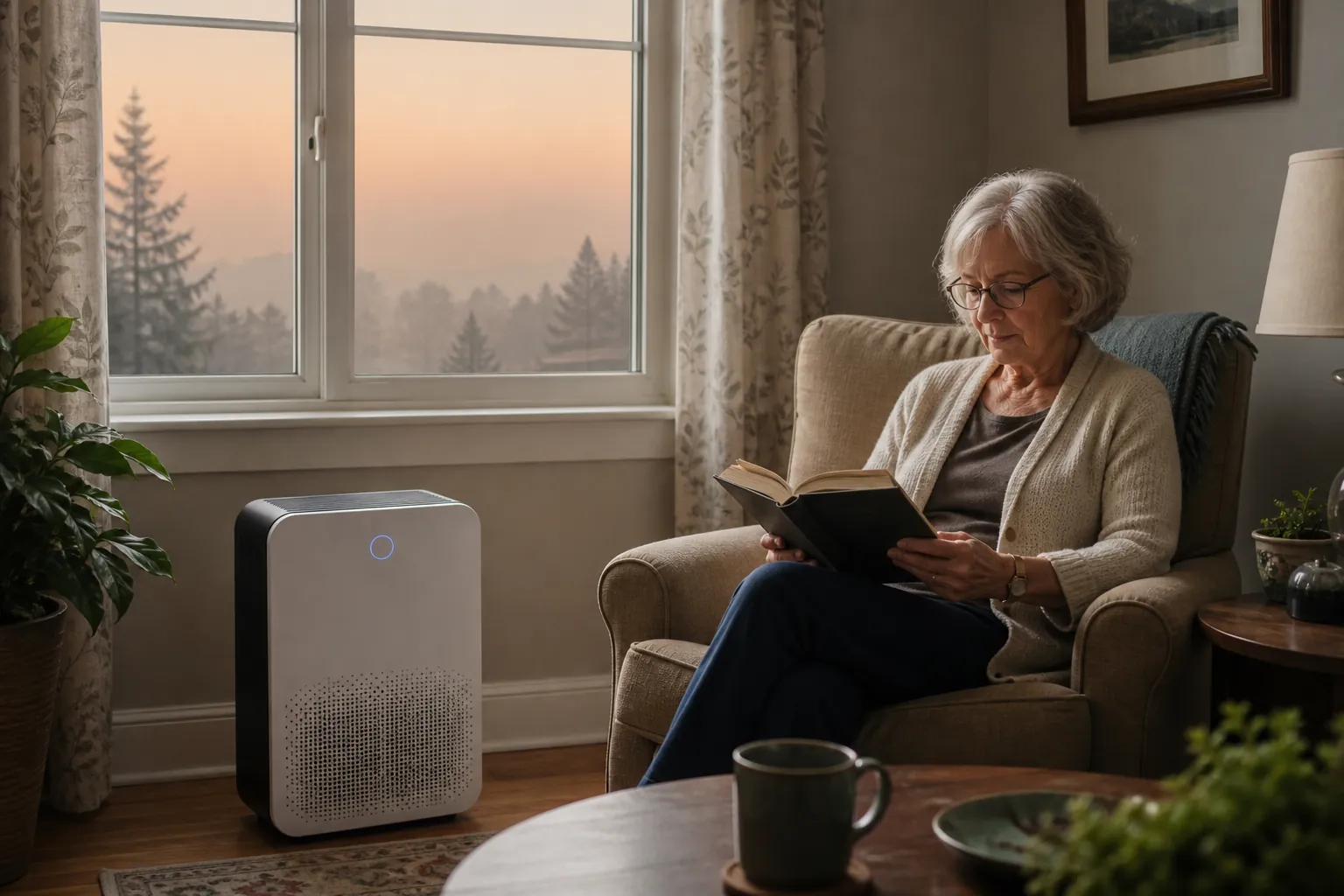
If there is central air, ask whether it is running and whether the system can recirculate indoor air. If the system has a good filter already installed, keep it running according to the system’s safe operating instructions. If there is a portable air cleaner, put it in the room where the older adult will sit or sleep and turn it on now. Do not save it for bedtime if the AQI is already high.
Keep this call operational. You do not need to calculate CADR over the phone while the person is trying to close windows. If the family is still choosing equipment, use the plan-ahead guide Protect Your Parent’s Whole Home From Wildfire Smoke for room sizing, MERV-13 filter details, and the limits of DIY box-fan approaches. During the alert, the action is simpler: get the best available filtration running in the room the person is actually using.
- Ask them to close the door to the room where the purifier is running if that room can stay comfortably cool.
- Keep indoor smoke sources off: no candles, incense, fireplace use, smoking, or unnecessary frying.
- If they smell smoke indoors after the purifier is running, look for an obvious open window, vent, or door first before assuming the purifier has failed.
- If the AQI stays high for multiple days, use How long should seniors stay indoors during wildfire smoke? for the duration question and the indoor-mobility issues that come with being shut in.
Verify medications and powered equipment before symptoms start
Once the house is closed and filtration is running, switch from the building to the person. Ask the older adult to put the medication list, inhalers, rescue medications, oxygen supplies, CPAP equipment, and phone charger where they can reach them. This is not a medication adjustment call unless their clinician has already given a smoke plan. It is a supply and access check.
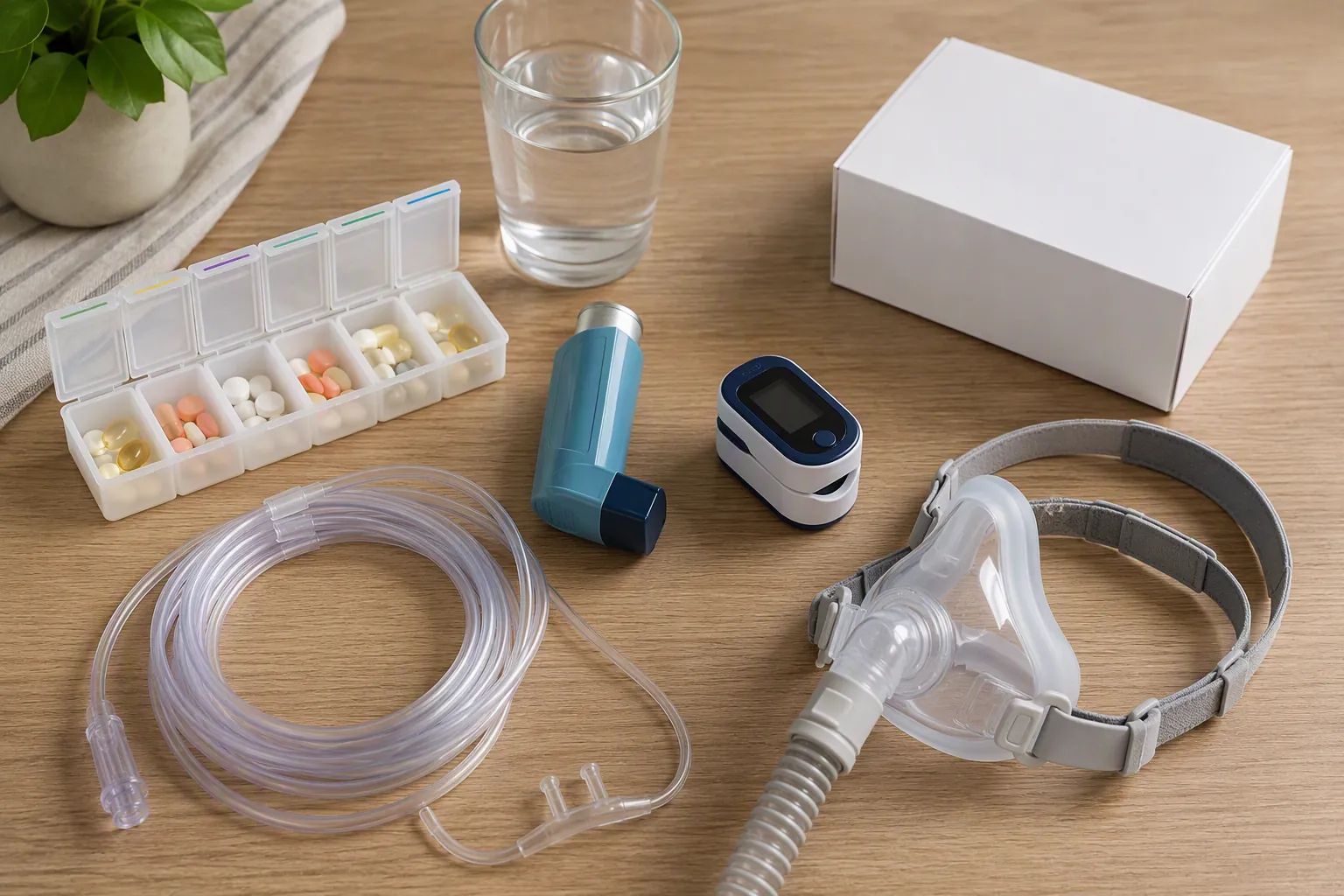
- Prescriptions: confirm at least several days on hand. CDC guidance for people with chronic conditions recommends a 7–10 day supply during wildfire smoke planning.[3]
- Inhalers and respiratory medications: check that rescue inhalers are present, not expired if the person can tell, and not sitting in a car or another room.
- Oxygen or CPAP: confirm the device is working, tubing and masks are available, and the person knows what to do if power fails.
- Phone and contacts: make sure the phone is charged and that the clinician’s number, pharmacy, nearby neighbor, and emergency contact are easy to find.
Smoke events and power outages can overlap. If oxygen concentrators, CPAP, refrigerated medications, stair lifts, or air conditioning depend on electricity, move immediately to Your Parent’s Power Is Out — What to Check First. A sealed room without filtration, cooling, or powered medical equipment may stop being the safer place.
Masks are for unavoidable trips, not for making errands normal
The first choice is to avoid going out. If someone must go outside for a medical appointment, medication pickup, pet need, or relocation, use a NIOSH-approved N95 or P100 respirator if it fits correctly. CDC/NIOSH states that NIOSH-approved respirators such as N95s and P100s filter PM2.5 and, when correctly fitted, can reduce exposure by at least 10 times.[7]
Do not substitute dust masks, surgical masks, bandanas, or wet cloths and call the problem solved; CDC says those will not protect from wildfire smoke particles.[3] Also do not treat a respirator as harmless for every older adult. NIOSH notes that respirators add breathing resistance and heat, so people with heart or lung conditions should check with a clinician about use when possible.[7] If wearing one makes the person feel worse, that is a reason to stop the trip and get medical advice, not a reason to push through.
If staying put is not working, choose cleaner air before the situation becomes dramatic
Leaving is a decision branch, not a failure. Consider a cleaner indoor location if the AQI is very high, the home cannot be filtered, the home is too hot to seal, smoke is getting inside, power is out, oxygen or CPAP support is unreliable, or symptoms are appearing despite the indoor setup.
If local officials issue an evacuation order, stop debating indoor air quality and follow the order. Use What Seniors Should Do When an Evacuation Order Is Given for the immediate response and Phase-by-Phase Wildfire Evacuation Checklist for Seniors for the broader plan. If there is no order but the home cannot provide clean, cool, powered air, call a nearby relative, neighbor, senior center, local health department, or emergency management line to ask where cleaner indoor air is available.
After the room is set, watch the person, not the sky
Once windows are closed, filtration is running, medications are reachable, and unnecessary trips are canceled, the caregiver’s job changes. The smoke may look lighter while particle levels remain unhealthy, and health effects can show up after the first hour.
During the 2023 Canadian wildfire smoke event, CDC-reported data found asthma emergency department visits averaged 17% higher on days when AQI exceeded 101, with an 82% statewide spike in New York, excluding New York City, on the worst day.[8] That does not mean every older adult will have an asthma emergency. It does mean a smoke alert deserves an active check-in schedule, especially for someone with known lung disease.
The heart watch should not end when the smell fades. Yale reported in July 2026 that a study of about 65 million Medicare beneficiaries linked cumulative wildfire-smoke exposure with higher cardiovascular hospitalization risk, with heart failure risk more than 20% higher at higher exposure levels.[9] Treat that as a reason to keep checking symptoms for days, not as a reason to panic during every alert.
A phone check should ask about function, breathing, and heart symptoms
Do not ask only, “Are you okay?” Ask questions the person can answer while sitting down:
- Can you speak in full sentences without stopping for breath?
- Are you more short of breath than usual while resting or walking to the bathroom?
- Any chest pain, chest pressure, or tightness?
- Any unusual fatigue, weakness, dizziness, sudden confusion, or faint feeling?
- Any irregular, racing, or rapid heartbeat?
- Any stroke signs: slurred speech, one-sided weakness, new facial droop, sudden severe dizziness, or sudden vertigo?
- Have you needed rescue medication more often than your clinician told you to?
This is educational guidance, not a diagnosis. If a clinician has given the person a COPD, asthma, heart failure, oxygen, or diabetes action plan, follow that plan first.
When to call 911, call the provider, or keep monitoring
Call 911 now if the older adult has trouble breathing, chest pain or pressure, severe or worsening shortness of breath, fainting, blue or gray lips, new confusion, signs of stroke such as slurred speech or sudden vertigo, or a rapid or irregular heartbeat with weakness, dizziness, chest discomfort, or shortness of breath. AARP’s emergency-care sign list includes difficulty breathing, chest pain or pressure, unusual fatigue, irregular or rapid palpitations, and stroke signs such as slurred speech or sudden vertigo.[8]
Call the person’s clinician or nurse line the same day if symptoms are new but not severe, rescue inhaler use is increasing, coughing or wheezing is getting worse, oxygen readings are lower than the person’s usual range if they have been told to monitor, blood pressure or blood sugar is unusually unstable, or the caregiver is unsure whether the person can safely remain at home. King County advises seeking medical care for severe symptoms during a smoke event and in the week after.[5]
Keep monitoring if the person is comfortable at rest, breathing is at their usual baseline, no chest pressure or neurologic symptoms are present, the home is cool enough, filtration is running, medications are available, and the AQI trend is improving or local guidance says conditions are acceptable for sensitive groups. Set the next check-in time anyway. For a high-risk older adult, “no symptoms right now” is not the same as “the alert is over.”
If you reached this page before an alert and are trying to prepare, use the broader Wildfire Smoke Safety Checklist for Seniors. During an active alert, stay with the order: AQI number, closed and filtered home, medications and equipment, unavoidable-trip protection, and symptom escalation.
References
- AQI Basics — AirNow.
- Who is at Increased Risk from the Health Effects of Wildfire Smoke Exposure? — U.S. Environmental Protection Agency.
- Wildfire Smoke and People with Chronic Conditions — Centers for Disease Control and Prevention.
- Fires and Your Health — AirNow.
- Wildfire Smoke — King County.
- Your Health and Wildfire Smoke — Michigan Department of Health and Human Services.
- Wildfire Smoke — CDC NIOSH Science Bulletin, 2025.
- Wildfire Smoke: Health Risks for Older Adults — AARP.
- Prolonged exposure to wildfire smoke increases cardiovascular health risks — Yale News, July 22, 2026.
Related reading
Noticed something outdated or inaccurate on this page? Flag a correction. We review every report against CDC, NIA, and AARP HomeFit guidance before updating a page.
Part of the Fall Prevention section.