
STEADI: Intervene
Build and Test Your Parent's Wildfire Evacuation Plan
A 2023 AARP survey found that most adults 50+ consider themselves prepared for a natural disaster, yet roughly a third had no spare prescription medicine and about half lacked an emergency phone charger. This guide helps adult children — long-distance or nearby — convert a parent's assumed wildfire plan into tested logistics: a named helper, a practiced route, a packed bag, and a backup contact method that works when networks are overloaded.
A parent can sound completely reasonable about wildfire evacuation and still have a plan that breaks the moment smoke, traffic, pain, confusion, or a dead phone enters the picture. That is the uncomfortable gap in a wildfire evacuation plan checklist for an elderly parent at home: the difference between “I know what I’d do” and “someone else can help me do it when I need to leave.”
A 2023 AARP survey found that most adults 50 and older considered themselves prepared for a natural disaster. In the same survey, about 1 in 3 had no spare prescription medicine, roughly half did not have emergency phone chargers, and only 12 percent followed local authorities on social media. [1]
That is not a character flaw. Older adults want to remain capable. Adult children do not want every conversation to become a safety audit. But wildfire readiness has to be judged by logistics, not confidence. The useful question is simple: if you are not there, can your parent actually leave?

Start by testing the assumed plan
Before buying more supplies or forwarding another county alert link, write down what everyone is currently assuming. Most family wildfire plans begin as fragments: a parent says they will drive, a neighbor says to call anytime, an adult child believes the medication list is “somewhere,” and everyone hopes cell service will cooperate.
The work is to turn each assumption into something visible enough to check.
| Common assumption | What counts as proof |
|---|---|
| “Someone nearby can help.” | A named primary helper and backup helper have agreed, know the parent’s needs, and know how to get inside. |
| “My parent can get out.” | The parent has practiced moving from bed, chair, or usual daytime location to the vehicle with the mobility aid they actually use. |
| “Medication is handled.” | A current medication list and allowable spare supply are packed or staged, and someone other than the parent knows where they are. |
| “We’ll call each other.” | There is a written call order, an out-of-state contact, paper copies of numbers, and a backup plan if calls or texts fail. |
| “The kit is ready.” | The kit has a review date, and expired, missing, or changed items are replaced on a set schedule. |
This is not meant to take independence away from your parent. It is meant to keep one person’s independence from depending on perfect memory, perfect timing, and perfect phone service during a fast-moving event.
Name the helper who can physically assist
“A neighbor will help” is not a plan. A named helper is a specific person who has agreed to act, knows when to act, can get to the home, can get inside, and understands what kind of help your parent may need. For a long-distance caregiver, this is the part that often reveals whether the plan exists only in conversation.
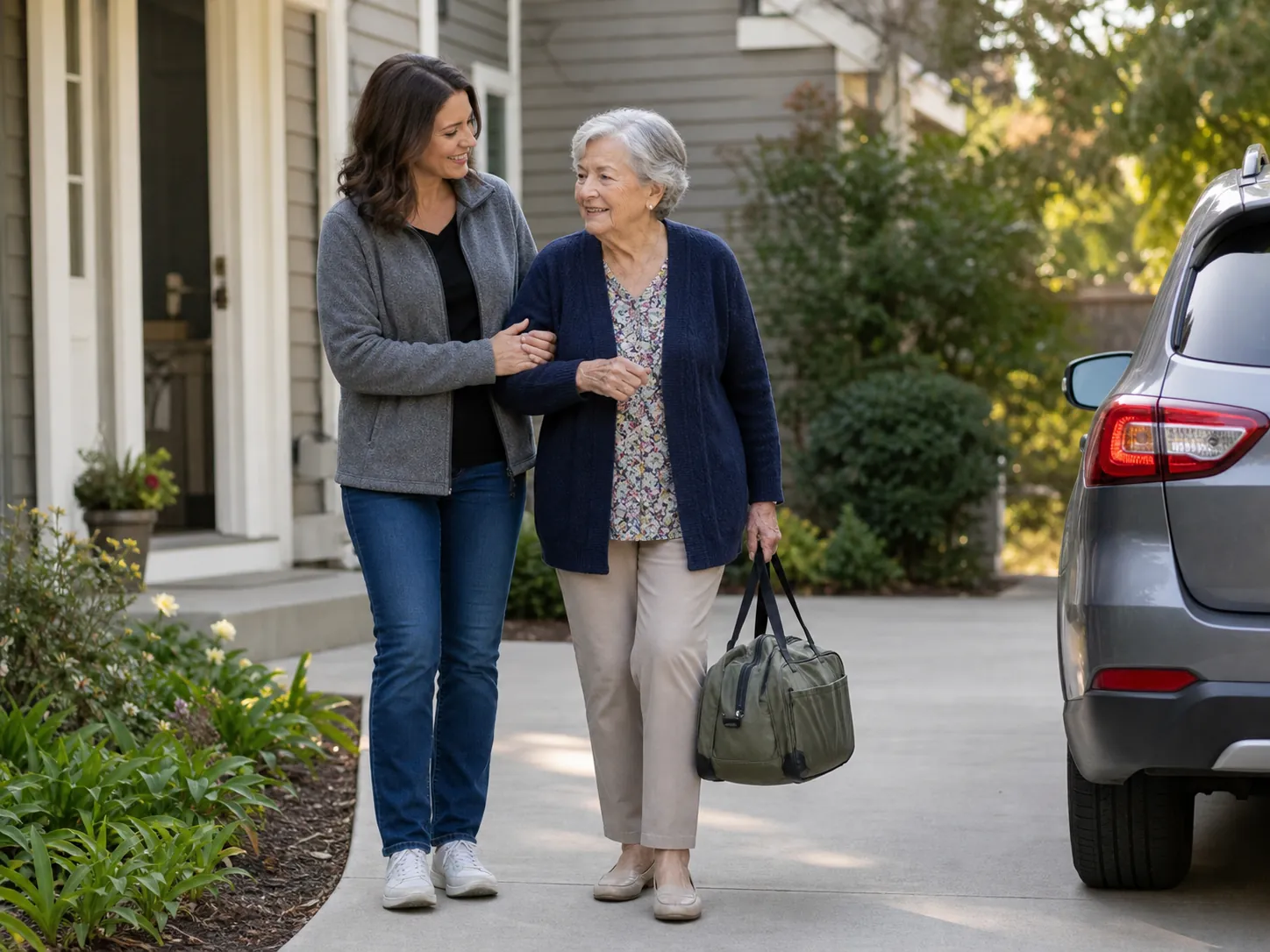
Start with the person your parent already trusts: a neighbor, nearby relative, friend, home care aide, faith community contact, building manager, or someone else who can realistically arrive. Then ask for a clear yes, not a vague offer. “Can I list you as Mom’s first evacuation helper if she receives an evacuation warning and I am not in town?” is different from “Would you keep an eye on her?”
The helper also needs permission to act. If your parent does not want anyone entering the home without them opening the door, say that plainly and solve it now. Maybe the answer is a lockbox, a spare key with a trusted person, a garage keypad, or an agreement that the helper calls first and then uses the access method if there is no answer. The right access plan depends on the home and the relationship. The wrong plan is discovering during an evacuation that no one can get in.
What the helper needs to know
- The parent’s full name, address, and best phone numbers.
- Whether the parent drives, should avoid driving under stress, or no longer drives.
- The mobility aid the parent actually uses, not the one stored in a closet.
- Whether the parent needs help standing, walking to the car, managing steps, handling oxygen equipment, locking doors, or carrying a bag.
- Where the evacuation bag, medication list, keys, wallet, phone, charger, glasses, hearing aids, and shoes are kept.
- Who to call after the parent is in the car or has reached the agreed destination.
- Who the backup helper is if the first person is away, ill, blocked by road conditions, or unreachable.
The backup helper matters because wildfire evacuation is not scheduled around anyone’s availability. If the only helper is out of town, at work across a closed road, or caring for someone else, the plan should not collapse into improvisation.
It is worth asking your parent how they want this person described. “Your evacuation helper” may feel infantilizing. “The person we’ll call if roads are closing and I can’t get there” may feel more accurate. The logistics still need to be firm, but the language does not have to turn the parent into a patient in their own house.
Make communication a protocol, not a phone-number list
A contact list is necessary, but it is not enough. During a wildfire threat, people do not just need numbers. They need to know who calls first, who confirms that your parent has left, who calls emergency services if no one can reach them, and who becomes the information hub when local networks are busy.
AARP recommends choosing an out-of-state contact person and keeping written contact lists in multiple places. [1] That out-of-state person is useful because they are less likely to be affected by the same local outage, smoke, road closure, or alert surge. They can receive short updates from different people and relay them when local calls are inconsistent.
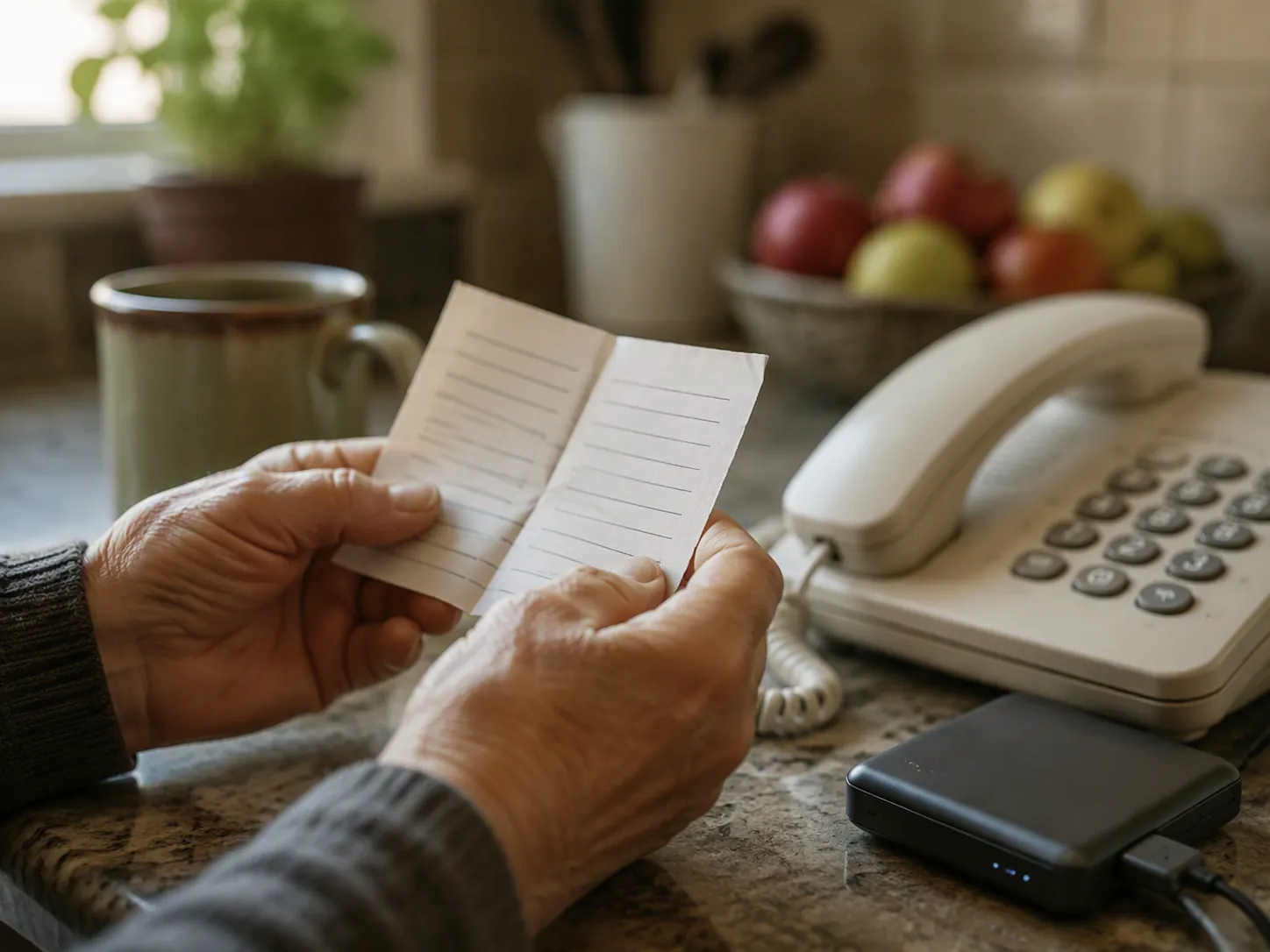
Build the protocol on paper first. Put one copy by the usual phone or charging spot, one in the go-bag, one with the named helper, and one with you. If your parent uses a smartphone, add the same names to favorites or emergency contacts, but do not let the phone be the only copy. The AARP survey finding that roughly half of adults 50 and older lacked emergency phone chargers is a useful warning: even a good phone plan can fail at the battery level. [1]
| If this happens | The protocol says |
|---|---|
| Evacuation warning, nearby fire alert, or local instruction affects the parent’s area | The adult child contacts the parent and the named helper; if the adult child is unavailable, the out-of-state contact starts the same sequence. |
| Parent answers | Confirm whether they are leaving now, who is with them, what route they are taking, and where they are going. |
| Parent does not answer | Named helper tries the agreed access method and checks the home if it is safe to do so. |
| Named helper cannot reach the home | Backup helper is contacted; if no helper can check and there is reason to believe the parent may be unable to leave, the family follows local emergency guidance for welfare checks or emergency assistance. |
| Parent leaves the home | Helper or parent updates the adult child and out-of-state contact with destination and transportation status. |
| Calls do not go through | Try text, voicemail, agreed messaging app if used, and the out-of-state contact. The written list keeps the sequence from depending on memory. |
Do not bury the county alert system in a general “stay informed” lecture. Make it part of the protocol. Decide whose phone receives official local alerts, who checks them, and who turns an alert into action for your parent. If your parent follows local authorities online, that may help; if they do not, someone else must be clearly responsible for monitoring and calling. In the AARP survey, only 12 percent of adults 50 and older followed local authorities on social media, so it is risky to assume the parent will see the same warning you see. [1]
Pack for current care, not an idealized emergency
The evacuation bag should match the parent who lives in the home today. Not last year’s medication routine. Not the walker they refuse to use. Not a list in someone’s memory. The bag should make it possible for another person to help your parent leave without stopping to search through cabinets.
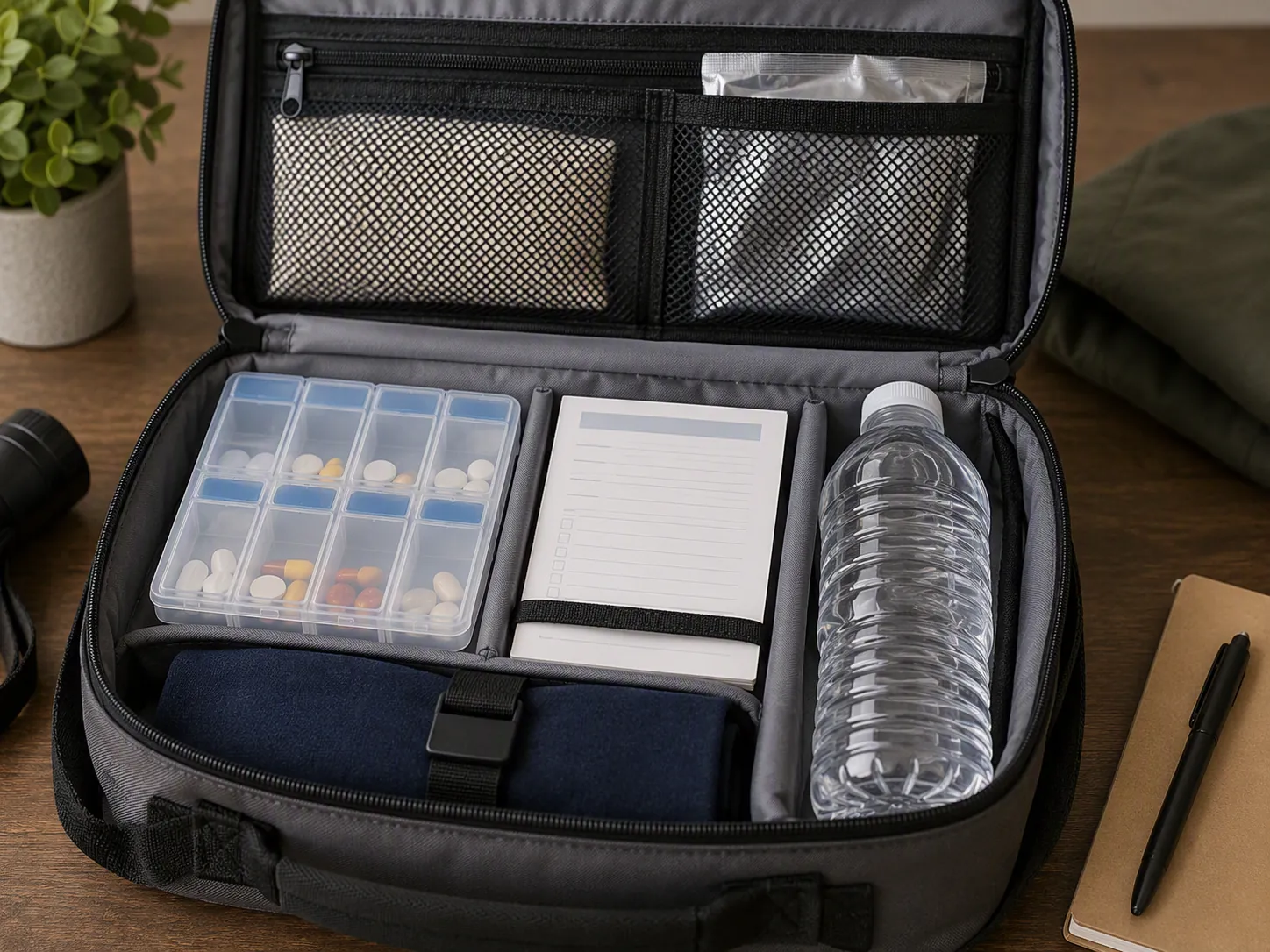
Medication deserves special attention because the preparedness gap shows up there. About 1 in 3 adults 50 and older in the AARP survey had no extra prescription medicine for emergencies. [1] For a caregiver, the practical step is to ask the pharmacist or prescriber how your parent can maintain an allowable spare supply, then keep the medication list current enough that a helper, clinic, shelter, or family member can read it without guessing.
Go-bag items that carry the plan
- Current medication list, including dose instructions as written by the prescriber or pharmacy.
- Allowable spare prescription medicine, maintained with help from the prescriber or pharmacist.
- Over-the-counter medicines or supplies the parent regularly uses.
- Copies of key medical information, insurance cards, identification, and emergency contacts.
- Phone charger and portable battery, with the charging cable that fits the parent’s current phone.
- Glasses, hearing aid batteries or charger, dentures or denture supplies, and other daily-use items that would delay departure if forgotten.
- A small flashlight, spare batteries if needed, and basic comfort items that will not make the bag too heavy to carry.
- A printed copy of the communication protocol and helper names.
Weight matters. A bag that contains everything but cannot be lifted by the parent or helper is storage, not evacuation support. If the parent uses a walker or cane, test whether the bag can be carried, attached, or placed in the car without creating another fall risk.
Practice the route before anyone is scared
AARP recommends practicing the evacuation plan every six months. [1] For an older adult at home, that practice should not be a dramatic drill. It can be a calm walk-through on an ordinary day: from the chair, bed, kitchen, or porch where the parent usually spends time to the vehicle they would actually use.
The point is not to rush your parent. The point is to notice what the family has been pretending not to notice. Is the driveway clear enough for a walker? Are the shoes near the door or in the bedroom? Does the parent need both hands on the railing? Can the helper carry the bag while offering an arm? Is the car parked where the parent can get in safely? Does the parent know which door to use if smoke or heat makes the usual exit feel unsafe?
If the parent still drives, the practice route should also cover decision-making. Where are the keys? Which road is usually preferred? Who tells the parent not to wait for a second opinion if local officials instruct the area to evacuate? If the parent no longer drives, the route practice should end at the helper’s vehicle or arranged transportation, not at the front door.
A rehearsal may feel awkward the first time. Keep it ordinary. “Let’s make sure this is easy before fire season gets worse” is enough. The parent does not have to agree that they are vulnerable for the family to agree that the path to the car should be clear.
Put the written checklist where the evacuation will happen
A checklist saved in an adult child’s email does not help the neighbor standing in the kitchen. Keep the written version close to the actual departure points: by the main phone, inside the go-bag, near the door, with the helper, and with the adult child. AARP recommends written contact lists in multiple places, and that same habit works for the evacuation steps themselves. [1]
The home copy should be short enough to use under stress. It does not need family history, every possible road, or a page of explanations. It needs the next actions.
- Call or text the named helper.
- Put on shoes, glasses, hearing aids, and mobility aid.
- Take phone, charger, keys, wallet, and go-bag.
- Leave by the practiced exit unless unsafe.
- Go to the agreed vehicle or pickup point.
- Tell the adult child and out-of-state contact when safely away.
Add parent-specific notes only when they change the action: “walker is beside the bed,” “medication bag is in the top kitchen cabinet,” “front steps are difficult; use garage door if clear.” These details are not clutter. They are the difference between a helper looking around politely and a helper knowing what to do.
Keep the plan alive with review dates
A plan that was accurate once can become wrong quietly. Medication changes. A neighbor moves. A phone number is disconnected. A parent’s balance changes. A charger no longer fits the new phone. The maintenance rhythm matters because wildfire readiness is not a one-time family project.
| When | What to update |
|---|---|
| Every three to six months | Review kit contents, replace expired or missing items, and confirm the charger, medication list, and printed contacts are current. AARP recommends reviewing kit contents every three to six months. [1] |
| Every six months | Practice the evacuation plan from the home to the vehicle or pickup point. AARP recommends practicing the evacuation plan every six months. [1] |
| Whenever medication changes | Update the printed medication list and the copy in the go-bag. |
| Whenever a helper changes | Confirm the new primary or backup helper has agreed, has the written protocol, and knows the access plan. |
| Whenever phone numbers, devices, or alert settings change | Update paper lists, emergency contacts, chargers, and the out-of-state contact copy. |
| After any close call, warning, or evacuation | Ask what slowed the parent down, what was missing, and what the helper needed but did not have. |
The parent does not have to surrender control for the family to build a plan someone else can carry out. That is the practical standard. A wildfire evacuation plan is not real because everyone discussed it; it is real when the named helper, practiced route, packed medication bag, written contacts, and review schedule still work when the adult child is not there.
References
Related reading
Noticed something outdated or inaccurate on this page? Flag a correction. We review every report against CDC, NIA, and AARP HomeFit guidance before updating a page.
Part of the Fall Prevention section.