
Is Your Senior Having a Reaction to Recalled Allergy Meds?
This guide helps you quickly identify whether an older adult is having a serious reaction to a recalled cetirizine allergy pill and tells you exactly what to do first — whether that means calling 911 or assessing fall risk.
If you have just found a recalled allergy medication and are worried about a senior’s reaction, start with the person, not the bottle. Look at breathing, alertness, swelling, and balance first. A recalled pill matters, but an older adult who is struggling to breathe, fainting, or suddenly collapsing needs emergency help before anyone finishes reading a label.
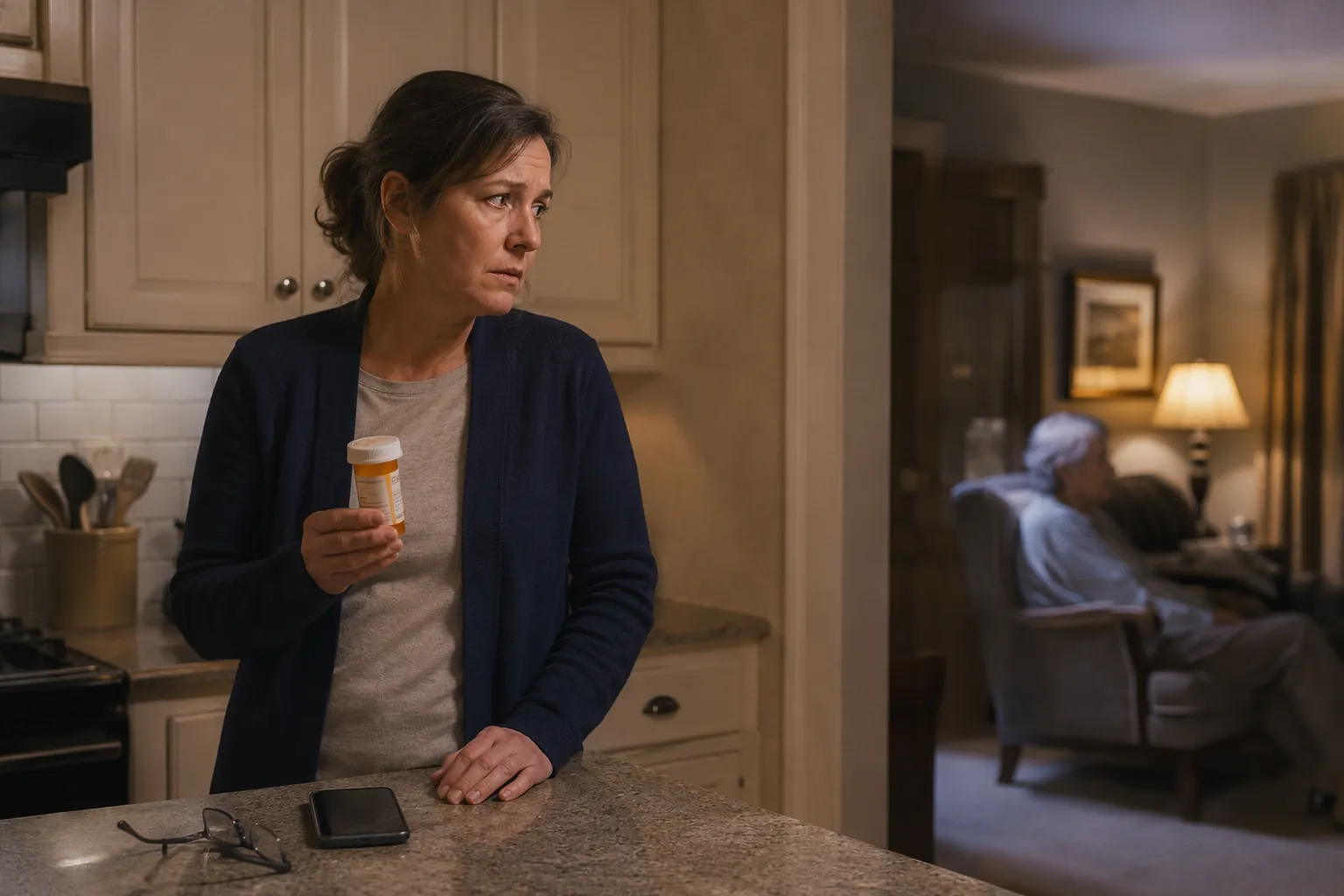
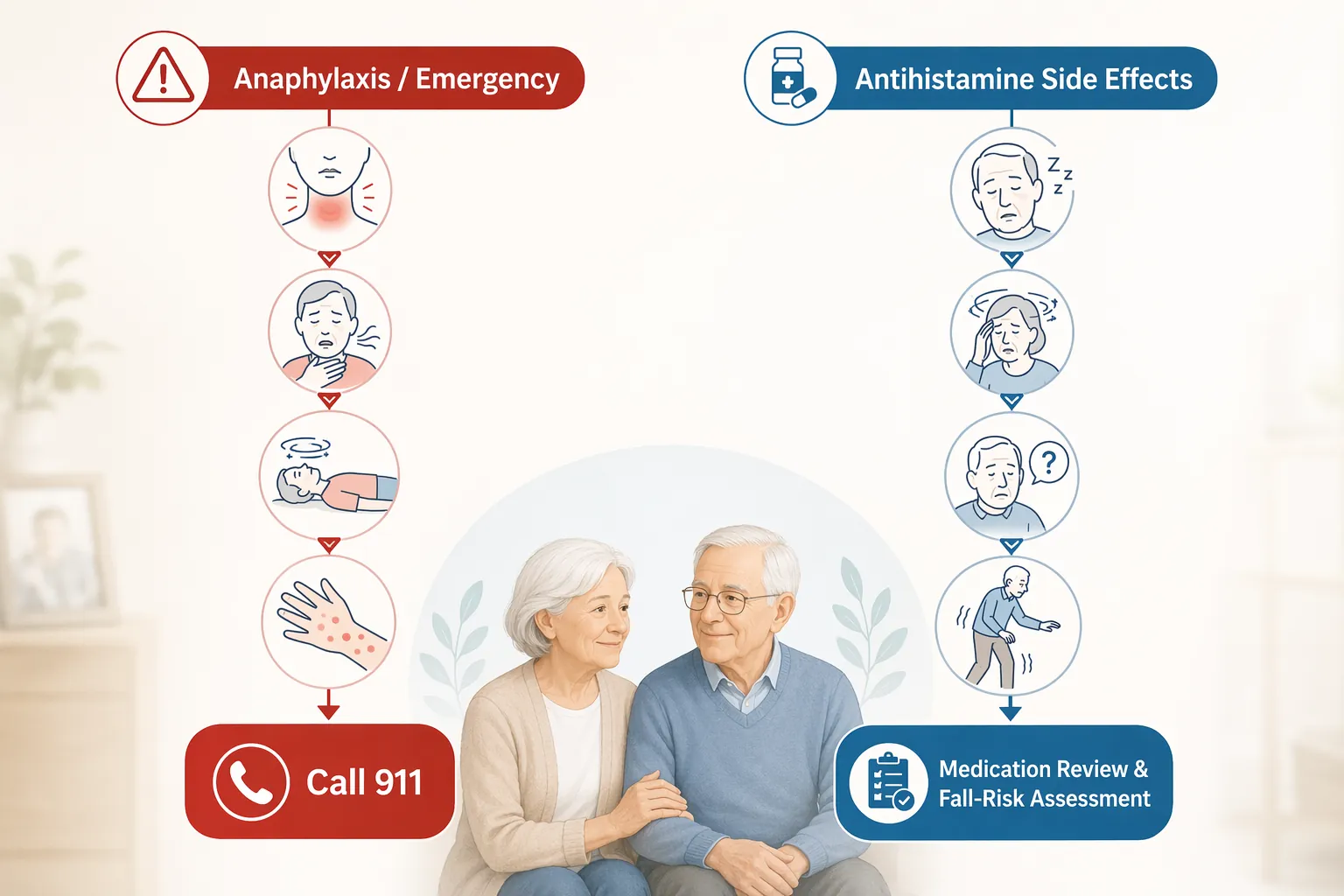
Use this order: call 911 for emergency allergic signs; check whether the bottle matches the recalled cetirizine lots; then, if there is no emergency, treat new sleepiness, confusion, dizziness, blurred vision, or unsteady walking as a fall-risk problem that still deserves prompt medication review.
First: call 911 for breathing, swelling, fainting, or collapse
Do not wait for a pharmacist callback if the senior has any sign of anaphylaxis or a sudden blood-pressure-type collapse. Call 911 now if you see trouble breathing, wheezing, throat or facial swelling, trouble swallowing, widespread hives or itching with other symptoms, fainting, loss of consciousness, or sudden severe lightheadedness.
Those signs matter because the July 2026 recall involved cetirizine HCl tablets cross-contaminated with ranitidine, and known drug-allergy reactions can include swelling, breathing problems, hives, lightheadedness from low blood pressure, and loss of consciousness.[1][2]
- If the person is having trouble breathing, do not drive them yourself unless emergency services tells you to. Call 911.
- If they fainted, nearly fainted, or seem suddenly weak and clammy, keep them still and call 911.
- If their tongue, lips, face, or throat is swelling, call 911 even if they can still talk.
- If hives or itching appear with breathing trouble, swelling, faintness, or confusion, treat it as an emergency.
While waiting, keep the bottle nearby for the responders. If the senior has a prescribed epinephrine auto-injector and you have been instructed how to use it, follow that prescription plan. Do not give extra allergy medicine to “cancel out” the reaction unless a clinician or emergency dispatcher tells you to.
Then check whether the bottle matches the recall
The FDA recall notice named four lots of cetirizine HCl 10 mg tablets from Unique Pharmaceutical Laboratories, a division of J.B. Chemicals & Pharmaceuticals Ltd. The recalled product has NDC 16571-401-10, lot numbers GY825029, GY825030, GY825031, or GY825032, and expiration 10/2028.[1]
| What to check | Recalled identifier |
|---|---|
| Medication | Cetirizine HCl 10 mg tablets |
| NDC | 16571-401-10 |
| Lot numbers | GY825029, GY825030, GY825031, GY825032 |
| Expiration | 10/2028 |
| Reason | Cross-contamination with ranitidine |
If all of those identifiers match, stop using that bottle and set it aside where no one will take another tablet by habit. If the person has emergency symptoms, that label check does not replace 911. If they do not have emergency symptoms, the label check tells you what to report when you call the prescriber or pharmacist.
As of July 22, 2026, AARP reported that no adverse events had been reported for this specific recall.[3] That is useful to know, but it is not a reason to ignore a person in front of you who is swelling, wheezing, fainting, or suddenly unable to stay upright.
If there is no emergency, look for the quieter danger: sedation and falls
A senior who is “just sleepy” after an allergy pill may still be in danger, just not necessarily the same kind of danger. New drowsiness, fogginess, slowed attention, dizziness, blurred vision, or unsteady gait can turn a short walk to the bathroom into the next crisis.
This is where caregivers often get trapped between two bad choices: panic because the medicine was recalled, or relax because there is no throat swelling. The safer middle path is to screen for emergency signs first, then treat new balance or thinking changes as medication-related fall risk until a clinician says otherwise.
Signs that point more toward antihistamine side effects
- New sleepiness or nodding off at an unusual time
- Confusion, slowed answers, or trouble following a familiar routine
- Dizziness when standing or walking
- Blurred vision or trouble focusing
- New wobbling, grabbing furniture, shuffling, or nearly tripping
- Unusual weakness without swelling, wheezing, fainting, or widespread hives
Cetirizine is a second-generation antihistamine, so it is generally treated differently from older first-generation drugs such as diphenhydramine. That does not make it invisible in an older body. A 2024 FAERS pharmacovigilance study found a cetirizine somnolence signal with ROR 10.52 based on 2,556 reports, and a disturbance-in-attention signal with ROR 3.3.[4] Pharmacovigilance signals do not prove that the drug caused every report, but they do support taking drowsiness and attention changes seriously.
Older adults can be more vulnerable because medication clearance and brain sensitivity change with age. If the person already takes blood pressure medicine, sleep medicine, anti-anxiety medicine, pain medicine, or other drugs that affect alertness, the practical question is not whether cetirizine is “supposed” to be mild. The question is whether this person is safe standing up right now.
What to do when the signs are fall-risk signs, not 911 signs
If the senior is drowsy, dizzy, foggy, or unsteady but has no breathing trouble, no throat or facial swelling, no fainting, and no collapse, move from emergency response to fall prevention. This is still active care.
- Stop using the recalled bottle. Put it away from the usual pill area so it cannot be taken again by mistake.
- Keep the person seated or lying down if they are sleepy, dizzy, or unsteady. Do not ask them to “walk it off.”
- Stay with them during bathroom trips or transfers until their walking looks normal again.
- Call the prescriber or pharmacist and report the medication name, NDC, lot number, expiration date, time taken, dose taken, and symptoms.
- Ask whether any other medications could be adding to sleepiness, dizziness, low blood pressure on standing, blurred vision, or confusion.
- If symptoms worsen, or emergency symptoms appear later, switch back to the 911 branch.
Falls are not a side issue for older adults. A 2018 systematic review found first-generation antihistamine use was associated with about a twofold increase in injurious falls or fracture among elderly patients, with an odds ratio of 2.03 and a 95% confidence interval of 1.49 to 2.76 across five studies.[5] That finding is about first-generation antihistamines, not this recalled cetirizine product specifically, so it should not be stretched into a claim that cetirizine doubles fall risk. It does show why sedating antihistamine effects belong in the fall-risk conversation.
Medication review is part of that conversation. The National Council on Aging notes that more than 1 in 4 adults age 65 and older fall each year, and it describes CDC STEADI-informed medication review as a way to identify drugs that increase fall risk, including sedating and anticholinergic medications.[6] Mayo Clinic similarly lists medicines that cause drowsiness, dizziness, confusion, blurred vision, or low blood pressure among drugs that can raise fall risk in older adults.[7]
The phone call should be specific. “She took one allergy pill and seems off” may be true, but it gives the pharmacist less to work with. Better: “She took cetirizine HCl 10 mg from NDC 16571-401-10, lot GY825030, expiring 10/2028, at about 8 a.m. She is now more drowsy than usual and grabbed the wall twice walking to the bathroom. She has no throat swelling or breathing trouble.”
Do not confuse these two symptom patterns
| What you see | More likely response path |
|---|---|
| Throat, tongue, lip, or facial swelling | Call 911 |
| Trouble breathing, wheezing, or trouble swallowing | Call 911 |
| Fainting, loss of consciousness, or sudden collapse | Call 911 |
| Hives or widespread itching with breathing trouble, swelling, or faintness | Call 911 |
| New sleepiness, fogginess, slowed attention, or confusion without emergency signs | Stop recalled tablets, supervise movement, call pharmacist or prescriber |
| Dizziness, blurred vision, unsteady walking, or near-fall without emergency signs | Treat as fall risk and request medication review |
AARP’s allergy medicine guidance for adults over 50 flags confusion, falls, urinary retention, and medication interactions as concerns with antihistamines.[8] That kind of risk is easy to miss because it does not look dramatic. Nobody’s throat closes. No one breaks out in obvious hives. The person simply stands up, gets lightheaded, and reaches for a wall that is not close enough.
Also watch for symptom overlap. A person who is dizzy and short of breath belongs in the emergency branch. A person who is sleepy and unsteady but breathing normally belongs in the medication-review and fall-risk branch unless something changes. If you cannot tell which branch fits because the person is suddenly much less responsive, call 911.
After you remove the recalled tablets
Keep the recalled bottle out of rotation, but do not throw away the information before you have documented it. Take a photo of the front label, NDC, lot number, expiration date, and any pharmacy label. Write down the time the pill was taken, the time symptoms started, what changed, and what you did. This record is useful whether the next call is to a pharmacist, prescriber, poison control, or emergency services.
If the senior has taken cetirizine regularly for a long time, new itching after stopping can create another layer of confusion. In May 2025, the FDA required a warning about rare but severe itching after stopping long-term use of oral cetirizine.[9] That withdrawal itching is not the same as an immediate emergency allergic reaction, but severe itching still deserves a clinician’s guidance, especially if it is accompanied by swelling, breathing trouble, faintness, or hives.
For the rest of the day, the floor matters as much as the pill bottle. Clear the walking path, turn on lights, keep shoes or nonslip socks on, and stay close during transfers. If the senior remains sleepy, confused, dizzy, or unsteady, ask the clinician or pharmacist whether they need same-day evaluation and a broader medication review.
The clean endpoint is simple: emergency symptoms get 911; matched recalled tablets come out of use; non-emergency sedation or balance changes get supervision, a prescriber or pharmacist call, and a fall-risk assessment. Once those steps are in motion, you are no longer guessing in front of an unreadable label.
References
- Unique Pharmaceutical Laboratories Div. J.B. Chemicals & Pharmaceuticals Ltd. Issues Voluntary Nationwide Recall of Cetirizine HCl Tablets, USP 10 mg Due to Cross Contamination With Ranitidine. FDA. July 20, 2026.
- Drug allergy — Symptoms and causes. Mayo Clinic.
- Cetirizine Allergy Drug Recalled Over Contamination. AARP. July 22, 2026.
- High-risk drug adverse events associated with Cetirizine and Loratadine. PMC. 2024.
- Antihistamine use and the risk of injurious falls or fracture in elderly patients. PubMed. 2018.
- How Can Medication-Related Falls Be Prevented in Older Adults? NCOA.
- Medicines that increase fall risk in older adults. Mayo Clinic.
- Allergy Medicine Side Effects to Know After 50. AARP.
- FDA requires warning about rare but severe itching after stopping long-term use of cetirizine. FDA. May 2025.
Continue from here
Suggest a correction
We keep this content strictly product-neutral and reviewed against CDC STEADI, NIA, and AARP HomeFit guidance. If something here looks outdated, unclear, or inaccurate, tell us — this page does not carry open public comments, because it touches medical urgency, cost, or capacity-adjacent decisions where a discussion thread is a trust liability rather than a trust asset.
See the correction process on our editorial standards page →