
STEADI: Intervene
Falls Are the Real Cruise Ship Emergency Seniors Face
Falls are the most likely emergency a senior traveler will face on a cruise — they make up 12–18% of shipboard medical-center visits — and they cluster in predictable spots like stairwells, gangways, wet decks, and tender transfers. Plan ahead with a deck-by-deck hazard check: where to be careful, which cabin and footwear choices reduce risk, and what to pack and review with a doctor before sailing.
The cruise emergency many older travelers picture is dramatic: fire alarms, lifeboats, a ship in trouble. The one more likely to interrupt the trip is smaller and faster. On Dec. 11, 2025, a 69-year-old Holland America passenger fell down stairs in rough seas off Vietnam, sustained a spleen injury with suspected internal bleeding, and required an emergency medical evacuation coordinated with the Vietnam MRCC. It began as a movement almost every passenger makes without thinking: going down stairs while the ship was moving. [1]
That case is not proof that stairs are dangerous for everyone on every sailing. It is a reminder to look at the ordinary places first. The CDC Yellow Book says injuries from slips, trips, or falls make up 12–18% of cruise ship medical-center visits, a larger share than gastrointestinal illness or seasickness alone. [2] For senior travelers, that makes fall prevention one of the most practical forms of cruise emergency preparation—not because cruising is reckless, but because the risky moments are predictable.
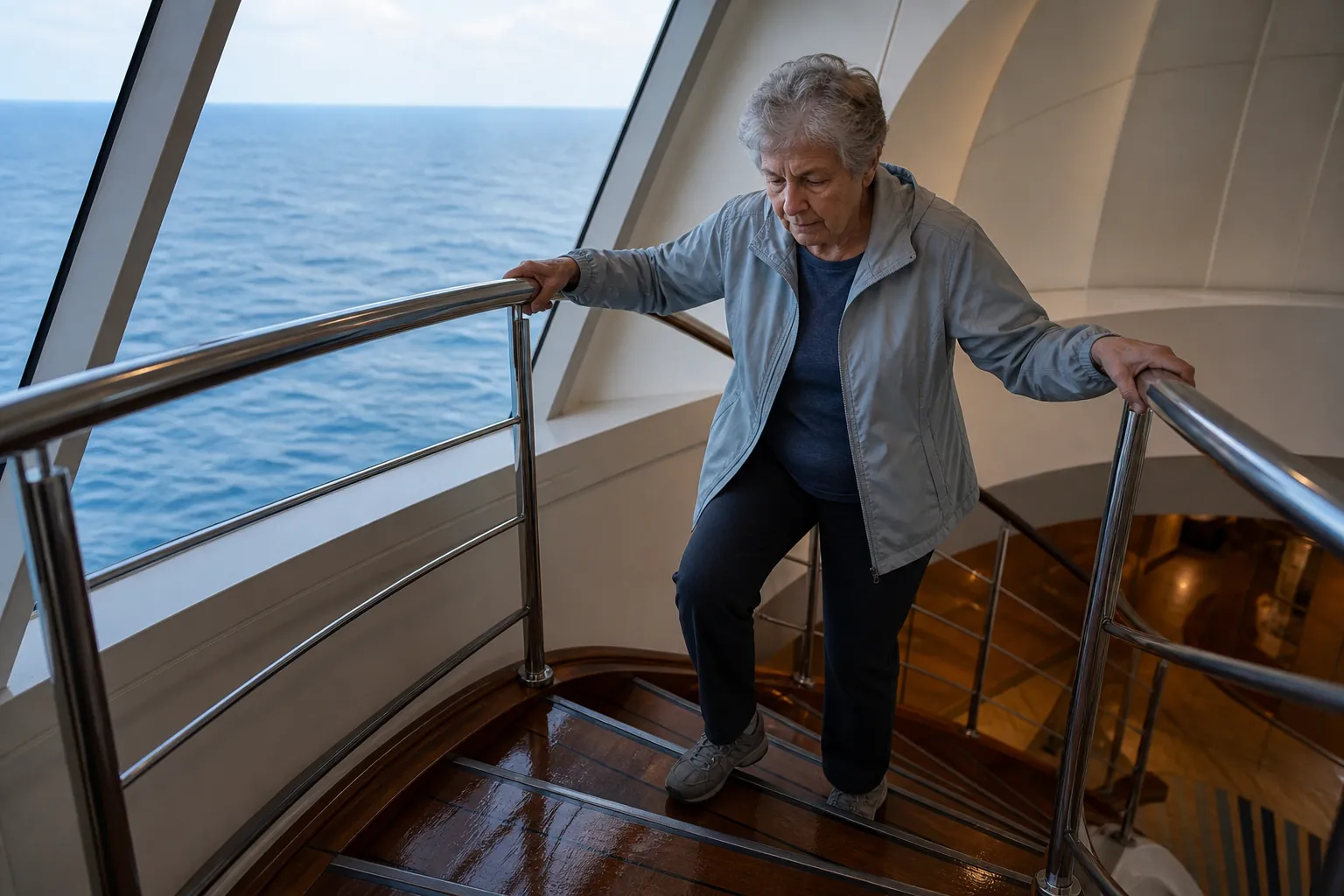
A small trauma case series points in the same direction, with proper caution. Bansal and colleagues reviewed eight cruise-ship passengers admitted to one Level I trauma center over three years; all eight had fall injuries, five occurred in stairwells, concussions were the most common injury, and one patient died. [3] Eight cases from one center cannot describe the whole cruise industry. What they can do is mark the places worth inspecting before a senior traveler takes the first step aboard.
Start with the ship’s fall map
A cruise ship is not one surface. It is a stack of changing surfaces: carpet to tile, cabin to bathroom, ship to dock, gangway to tender boat, calm hallway to moving stairwell. The safest plan is not a vague promise to “be careful.” It is knowing which transitions deserve both hands, better shoes, better timing, or crew help.
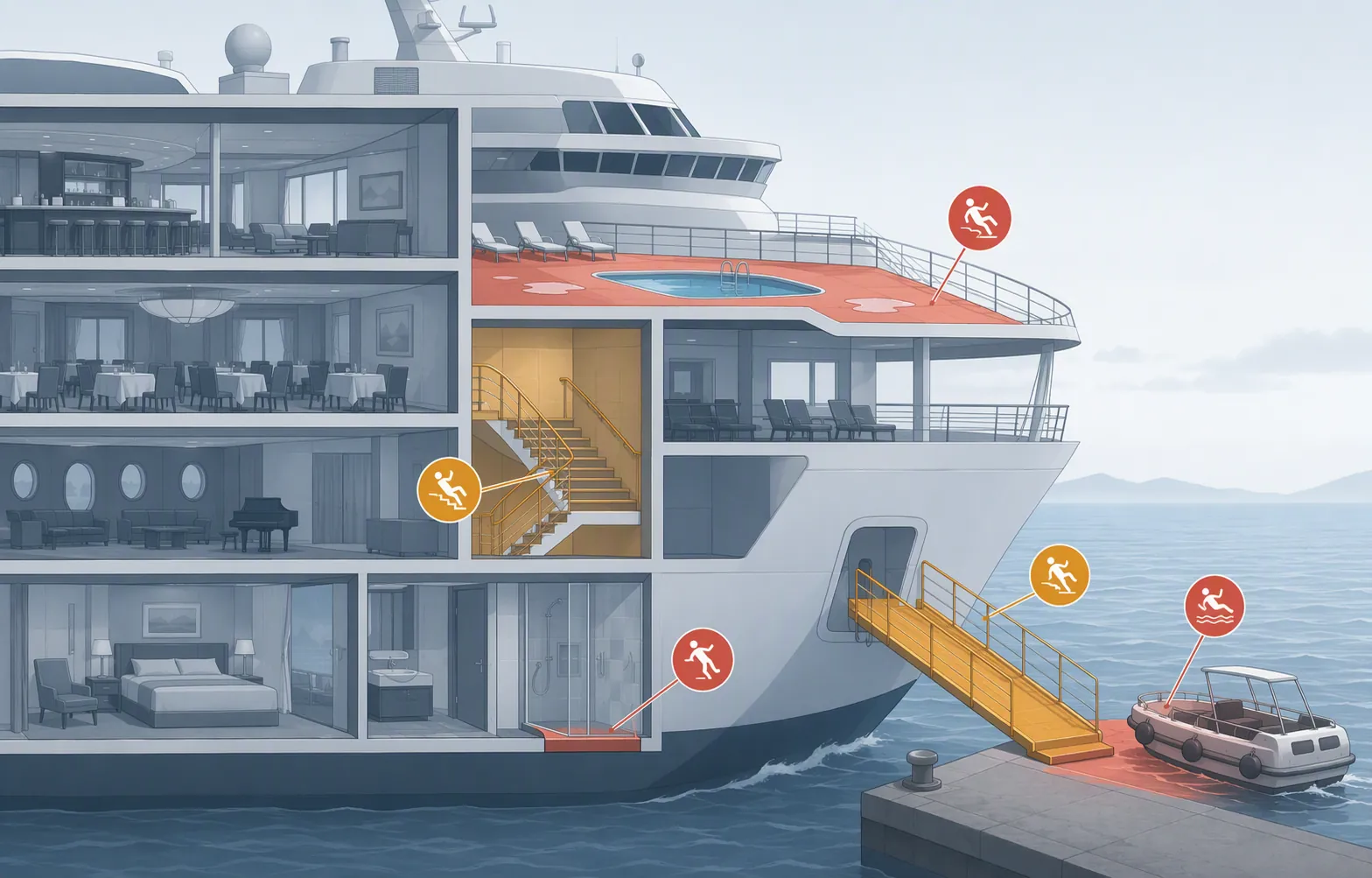
| Ship area | What changes underfoot | Safer choice |
|---|---|---|
| Stairwells | Motion, crowding, short landings, wet or polished treads | Use the handrail every time; take the elevator when carrying items or when seas are rough |
| Pool and exterior decks | Water, sunscreen, sandals, towels, glare | Wear non-slip closed-toe shoes and slow down at door thresholds |
| Cabin bathroom | Raised lip, tight turning space, wet floor, no familiar layout | Book accessible features if needed; pack a nightlight; keep shoes within reach |
| Gangway | Slope, crowd pressure, weather, a gap between ship and dock | Let crew steady the transfer and wait for a clear lane |
| Tender boat | Rocking platform, step-down movement, changing sea conditions | Confirm mobility rules before sailing and accept crew direction |
| Nighttime route | Darkness, unfamiliar furniture, urgency, medication effects | Light the bed-to-bathroom path before the first night |
Stairwells: where independence and pride can collide
Stairs are deceptively familiar. At home, an older adult may know exactly where the rail begins, where the landing turns, and which step is a little shallow. On a ship, the stairwell may be crowded after dinner, damp near exterior doors, or moving slightly before the passenger notices the swell. The Bansal case series cannot tell us how often stair injuries occur across all cruises, but five stairwell injuries among eight severe cases is enough to treat stairwells as a priority location. [3]
The rule should be plain: one hand on the rail, one step at a time, and no pride about taking the elevator. If both hands are occupied with a plate, a handbag, a cane, or a drink, the stairs can wait. In rough seas, even a short trip down one deck can become a different physical task than it was in port, as the 2025 Vietnam evacuation case showed. [1]
Adult children sometimes worry that offering an arm will sound insulting. It helps to make the offer about the setting, not the person: “This stairwell is crowded—let’s take it slowly,” or “I’m holding the rail too.” That preserves dignity better than waiting until someone is already off balance.
Wet pool decks and exterior walkways
Pool decks ask for the wrong footwear. Flip-flops, loose slides, and soft sandals feel like vacation, but they do not help much when the deck is wet, the sun is in the eyes, and someone has dropped a towel across the walking path. Exterior decks add door lips, wind, glare, and sometimes a polished threshold just inside the entrance.
Non-slip closed-toe shoes are not elegant advice, but they matter because they work in more than one place: pool deck, buffet, gangway, excursion bus steps, and the late-night walk back to the cabin. A senior traveler who wants sandals for sitting by the pool can still walk there in stable shoes and change once seated.
The practical habit is to pause at every change in surface. Carpet to tile. Inside to outside. Dry to wet. Flat deck to ramp. That brief pause is not hesitation; it is how the body recalculates before the foot commits.
Cabin bathrooms and the small lip at the door
The cabin is where travelers relax, which is why it deserves inspection on boarding day. A standard cabin can be perfectly pleasant and still be a poor match for someone who needs grab bars, turning room, or a step-free shower. Royal Caribbean describes standard cabin doorways as at least 23 inches wide, while accessible staterooms have 32- to 34-inch doorways, grab bars, roll-in showers, raised toilets of 17 to 19 inches, and a 5-foot turning radius. [4]
Those features change the trip in physical terms. A roll-in shower removes the lift-and-turn motion over a bathroom edge. Grab bars give the hand somewhere predictable to go. A raised toilet reduces the deep bend that can make standing up unsteady. This is not luxury inventory; it is safety equipment built into the room.
The problem is availability. Cruisebound notes that accessible cabins usually make up only 3–5% of ship inventory and can sell out months ahead. [5] A traveler who truly needs those features should not wait until final payment or hope the ship can improvise a safe bathroom. Book early, confirm the features in writing, and make sure the cabin fits the actual mobility device or walking pattern the traveler uses.
Even in an accessible cabin, the first night deserves a small setup. Put a nightlight in the bathroom or along the route. Keep glasses, cane, walker, and shoes in the same place every night. Move loose bags away from the bed. Find the light switch before going to sleep, not at 2 a.m. while half-awake.
Gangways: do not rush the public moment
A gangway is a social pressure point. People are lined up behind you, the crew is trying to keep the line moving, and the dock may be sunny, windy, wet, or uneven. For an older traveler, the safest choice is often to slow the whole moment down: let the crowd thin, keep one hand free, and accept the crew member’s arm before the first uncertain step.
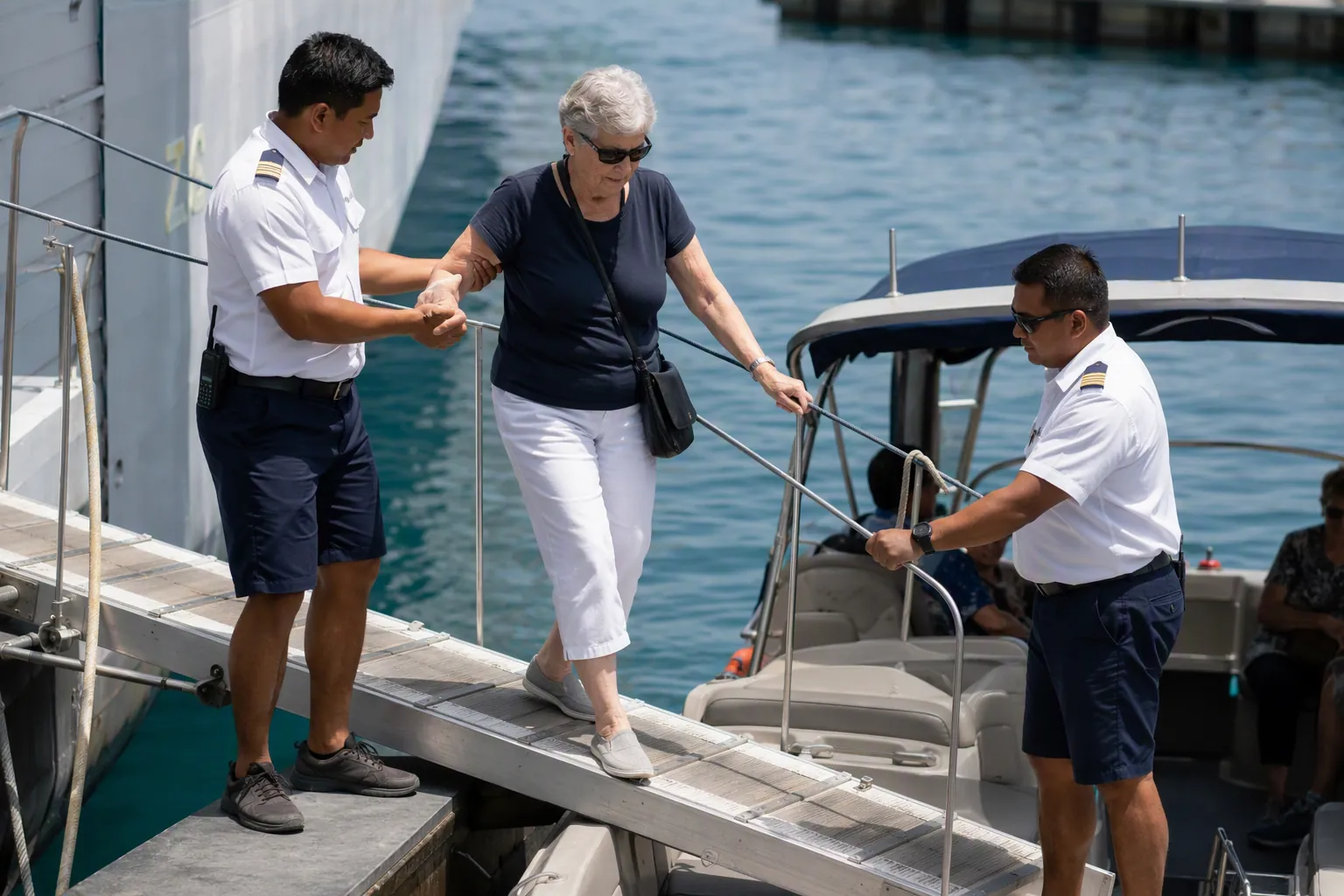
This is one of the places where dignity and safety are often misread. Crew assistance is not a verdict on a person’s independence. It is a response to a moving ramp, a changing slope, and a line of passengers who may not see how much concentration the transfer requires.
Tender boats: check the rule before the port day
Tender ports deserve special attention because the ship-to-boat transfer can turn a calm sightseeing day into the hardest movement of the trip. Cruisebound reports that scooters and power wheelchairs are banned from tenders on most cruise lines, while manual wheelchairs may be allowed only at the captain’s discretion depending on sea conditions; Travel with Annita also flags the rocking gangway and tender transfer as a high-fall-risk moment. [5][6]
That means the decision should happen before sailing, not at the tender platform with passengers waiting. If a port requires a tender, ask the cruise line how mobility aids are handled, whether the traveler must walk a few steps, and what happens if sea conditions change. If the answer depends on the captain’s judgment that morning, plan emotionally as well as logistically: missing one port may be the safer choice, not a failed vacation.
Rough seas and balance-changing medicines
Motion changes the meaning of every surface. A hallway that felt level after lunch may feel different after dinner. A staircase that was fine in port may not be fine when the ship is rolling. Seasickness can affect up to 25% of cruisers, and the CDC notes that common medications—including some antidepressants, painkillers, and blood-pressure drugs—can worsen motion sickness or affect balance. [2]
This is why seasickness planning belongs in the fall-prevention plan. The issue is not only nausea. It is dizziness, sedation, delayed reaction time, and the temptation to hurry to a bathroom or cabin while unsteady. A pre-cruise clinician or pharmacist review should ask a narrow question: “Which of my medicines could make me dizzy, sleepy, dehydrated, lightheaded, or less steady if I add motion-sickness medicine or rough seas?”
No one should stop prescribed medicine casually for a cruise. The useful work is to identify likely trouble combinations, choose a seasickness plan before boarding, and know which symptoms should send the traveler to the ship’s medical center instead of back to the buffet line.
Planning that belongs before embarkation day
The best pre-cruise preparation is specific. It should match the places where the traveler will actually lose balance: the bathroom, the stairs, the gangway, the tender, and the dark route from bed to toilet.
- Choose the cabin for movement, not just view. If grab bars, a roll-in shower, wider doors, or turning radius are needed, book an accessible cabin early and confirm the features directly with the cruise line.
- Pack shoes for walking, not only for outfits. Non-slip closed-toe shoes should be easy to put on, stable on wet decks, and comfortable enough that the traveler will actually wear them.
- Review medications before the trip. Ask about dizziness, sedation, blood-pressure drops, dehydration, sleep aids, pain medicines, and motion-sickness choices. Include recent pharmacy changes, dose changes, and over-the-counter products.
- Pack the cabin for night movement. A small nightlight, familiar slippers or shoes with backs, and a consistent place for glasses and mobility aids can prevent the half-awake search that leads to a stumble.
- Carry a typed medication list with dosages. Keep one copy with the traveler and one with a companion if traveling together.
- Bring a copy of a baseline ECG if the traveler has a cardiac history or the clinician recommends it.
Heart history should not take over the fall conversation, but it should not be ignored. The CDC Yellow Book states that cardiac events cause 80% of onboard deaths. [2] A fall can also become more serious when it occurs alongside chest pain, fainting, dehydration, internal bleeding, or medication effects. A medication list and baseline ECG do not prevent the fall; they help the ship’s medical team understand the traveler faster if something happens.
For families already working on fall prevention at home, the same habits carry aboard. A quick review of a fall prevention FAQ or a practical fall prevention handout for seniors can sharpen the packing list: lights, footwear, bathroom support, and clear walking paths. Medication review should include chronic conditions and recent prescription changes; even issues that seem unrelated to travel, such as subpotent levothyroxine and falls in seniors, belong in the broader balance conversation.
If a fall happens onboard
The first mistake after a fall is often social, not medical: the traveler wants to get up quickly because people are watching. Slow that moment down. Do not pull a person up before checking pain, dizziness, confusion, bleeding, head strike, hip pain, or whether the fall followed chest symptoms or fainting.
- Call crew or the ship’s medical center rather than walking the person back to the cabin to “rest it off.”
- Report any head impact, new confusion, vomiting, severe headache, blood thinner use, hip or groin pain, abdominal pain, chest pain, shortness of breath, or fainting.
- Bring the medication list and, if relevant, the baseline ECG copy to the medical visit.
- Write down where the fall happened: stairwell, bathroom threshold, pool deck, gangway, tender, excursion site, or nighttime route.
- Reconsider the next transfer. A person who fell on a stairwell in rough seas may need to skip a tender port, use elevators only, or ask for wheelchair assistance for the rest of the sailing.
A fall does not automatically end a cruise. Pretending it did not happen is what can turn a manageable injury into a worse one. For senior cruisers, the best emergency preparation is not fear of the ship; it is knowing where the fall hazards are before the first step aboard.
References
- Elderly Cruise Passenger Fell Down Stairs in Rough Seas on Holland America Ship, Evacuated Off Vietnam Coast, People.com, Dec. 11, 2025.
- Cruise Ship Travel, CDC Yellow Book 2026.
- Cruise ship injuries: a case series, PubMed, 2007.
- Mobility Disabilities, Royal Caribbean.
- Cruising with Mobility Aids, Cruisebound.
- The Complete Cruise Health & Safety Guide, Travel with Annita.
Related reading
Noticed something outdated or inaccurate on this page? Flag a correction. We review every report against CDC, NIA, and AARP HomeFit guidance before updating a page.
Part of the Fall Prevention section.