
STEADI: Intervene
Posture Exercises to Help Seniors Balance and Prevent Falls
A rounded upper back and forward head posture shift the center of gravity forward, increase sway, and raise fall risk in older adults. Posture-correcting exercises such as thoracic extension, chin tucks, and scapular strengthening measurably improve balance and help prevent falls, with a safe, progression-friendly routine you can start at home.
If you’ve noticed more rounding through your upper back, a forward head, or a habit of looking down while walking, posture may be affecting more than how you look. For many older adults, the issue is not “stand up straighter” as a matter of pride. It is whether the body is still stacked well enough to sense where it is, shift weight safely, and recover when a foot catches the edge of a rug or a curb.
That is why posture exercises for seniors to improve balance and prevent falls deserve a more careful conversation than a few reminders to pull the shoulders back. More than 1 in 4 adults age 65 and older falls each year in the United States, and fall prevention has to include the usual practical pieces: medication review, vision, home hazards, footwear, strength, balance practice, and the right mobility aid when one is needed. [1]
Posture belongs in that same conversation because a rounded upper back and forward head posture can change the mechanics of balance. The body shifts forward. Sway increases. The head and neck send less reliable position information. The person has less time and less margin to correct a stumble.
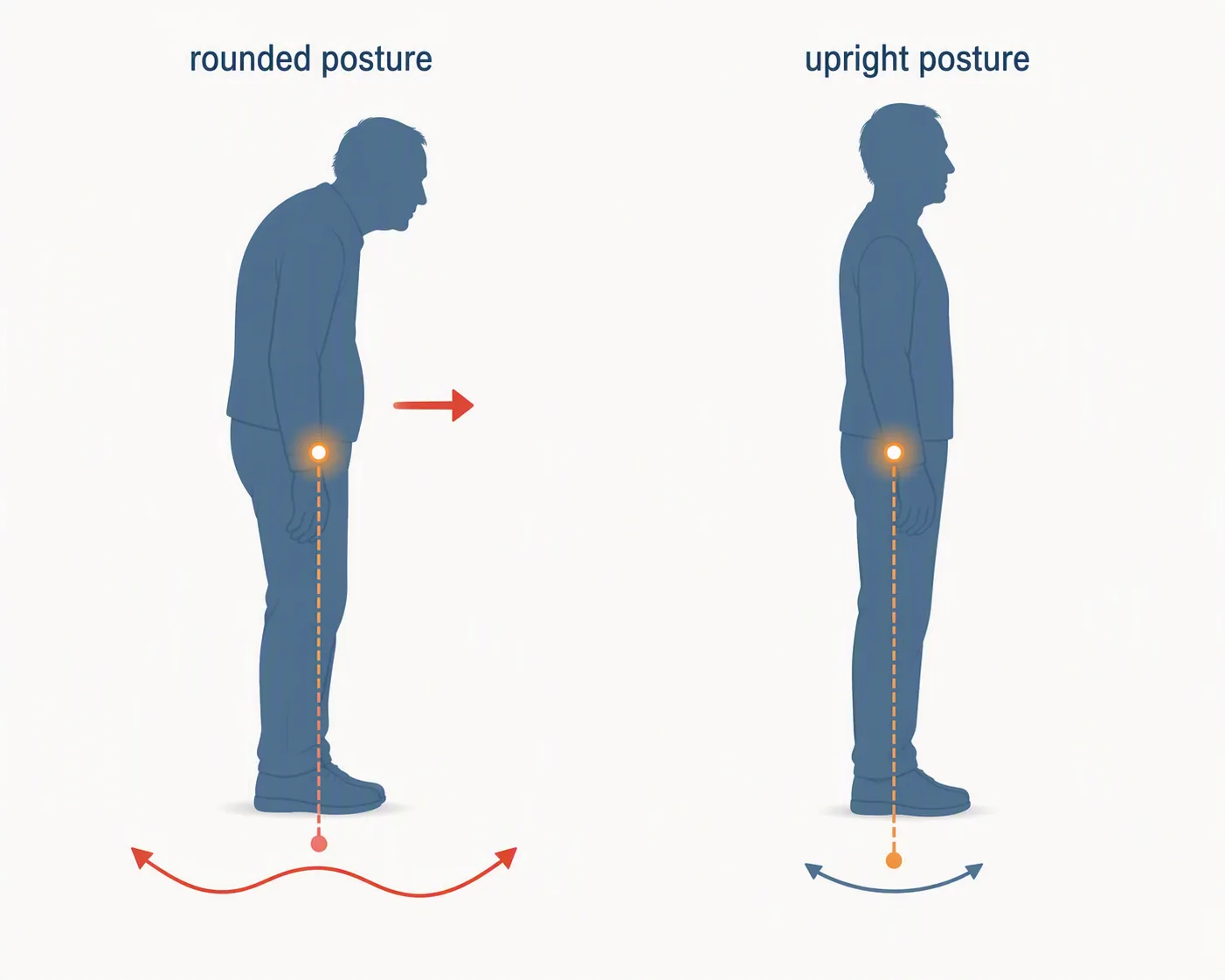
How a rounded upper back can make balance harder
When the upper back rounds, the rib cage and shoulders tend to drift forward. The head often follows. To keep the eyes level, the neck works harder, the hips may compensate, and weight can move closer to the front of the feet. A younger, stronger body may correct that quietly. An older body with slower reaction time, weaker hip extension, painful feet, neuropathy, or bifocals may not have as much reserve.
A 2025 Scientific Reports study on age-related hyperkyphosis gives a useful way to explain this. Researchers found that older adults with hyperkyphosis had higher short-term center-of-pressure diffusion coefficients and greater critical displacement in the front-to-back direction. In plain language, their balance system allowed more early sway before slower feedback corrections took over, especially in the anteroposterior direction—the same forward-backward direction that matters when a person pitches forward. [2]
That matters at the kitchen counter, in the hallway at night, and when stepping off a curb. If the body is already biased forward, the distance between “I lost balance” and “I could not recover” becomes smaller. The fall may look like it came from one missed step, but the posture problem was helping set the stage.
Hyperkyphosis has also been described as an independent predictor of falls in older adults, which is an important distinction. It does not mean posture is the only cause, or that every rounded back leads to falling. It means the rounding itself carries information about risk, apart from the obvious fact that frailer people may also stand differently. [3]
Forward head posture adds another layer. The neck is not just a stack of joints holding up the head; it is also part of the body’s position-sensing system. Evidence on forward head posture has linked it with reduced cervical proprioception and altered vestibular integration, both of which can make orientation and balance less reliable. [4]
This is why “look up” is often the wrong first cue. Many older adults look down because the floor feels unsafe, the toes feel uncertain, or the body feels pulled forward. A safer cue is to rebuild the available movement: gently extend through the upper back, bring the head back without pain, strengthen the shoulder blade muscles, and practice balance in a way that is graded rather than brave.
Before starting: the safety line is simple
Posture work should feel like mild muscular effort or a gentle stretch. It should not cause dizziness, chest pain, sharp back pain, new numbness, a headache, or a sense that you might fall. If any of those happen, stop and get medical guidance.
Get clinician or physical therapist clearance first if you have osteoporosis, a recent fall, unexplained dizziness, a known balance disorder, new weakness, spinal surgery history, significant pain, or a major medication change. If you are not sure how risky exercise is for you, use a formal screening pathway such as the CDC STEADI-based fall prevention action plan or ask about the fall-risk assessment included in the Medicare Annual Wellness Visit.
This article is general education, not medical advice. A licensed clinician, physical therapist, occupational therapist, or geriatric care team can adapt these exercises to your spine, bone health, medications, pain pattern, and fall history.
A posture routine that supports balance
The goal is not to hold a military posture. The goal is to restore enough upper-back extension, head alignment, shoulder blade strength, core control, and hip support that standing and walking have a better base.
Posture programs in the research are not one-week fixes. In a 12-week daily posture exercise program for women age 65 and older, Katzman and colleagues used thoracic extension, scapular strengthening, and hip extension work and reported an 11% improvement in kyphosis angle. [5]
A later 16-week home program designed for older people with hyperkyphosis reported large effect sizes for reducing falls and fear of falling, including improvement on the Falls Efficacy Scale–International. [6]
At home, that means consistency matters more than intensity. Start with a chair, a wall, or a counter nearby. Use slow repetitions. Keep breathing. Stop before fatigue turns the exercise sloppy.
| Exercise | What it trains | Safe starting dose |
|---|---|---|
| Thoracic extension over a towel roll | Upper-back extension so the chest can lift without forcing the low back | 5 to 8 slow breaths or 5 gentle repetitions |
| Chin tuck or head retraction | Forward head correction and deep neck flexor control | 5 to 10 gentle repetitions |
| Scapular retraction or standing row | Shoulder blade support for a less rounded upper back | 8 to 12 repetitions |
| Shoulder-blade squeezes | Light postural endurance without equipment | 5 to 10 repetitions with a 2-second hold |
| Pelvic tilts | Awareness of pelvis and trunk position | 8 to 10 slow repetitions |
| Bird dog or supported opposite arm/leg reach | Core and hip control while the trunk stays steady | 4 to 8 controlled repetitions per side |
| Hip extension or sit-to-stand support work | Posterior-chain strength needed to stand tall and recover balance | 6 to 10 repetitions, using support as needed |
Thoracic extension: make room for the chest to lift
Place a rolled towel horizontally behind the upper back while sitting in a firm chair. The towel should sit around the mid-to-upper back, not under the low back. Keep both feet flat. Support the head with the hands if that feels comfortable, then gently lean the upper back over the towel as you breathe.
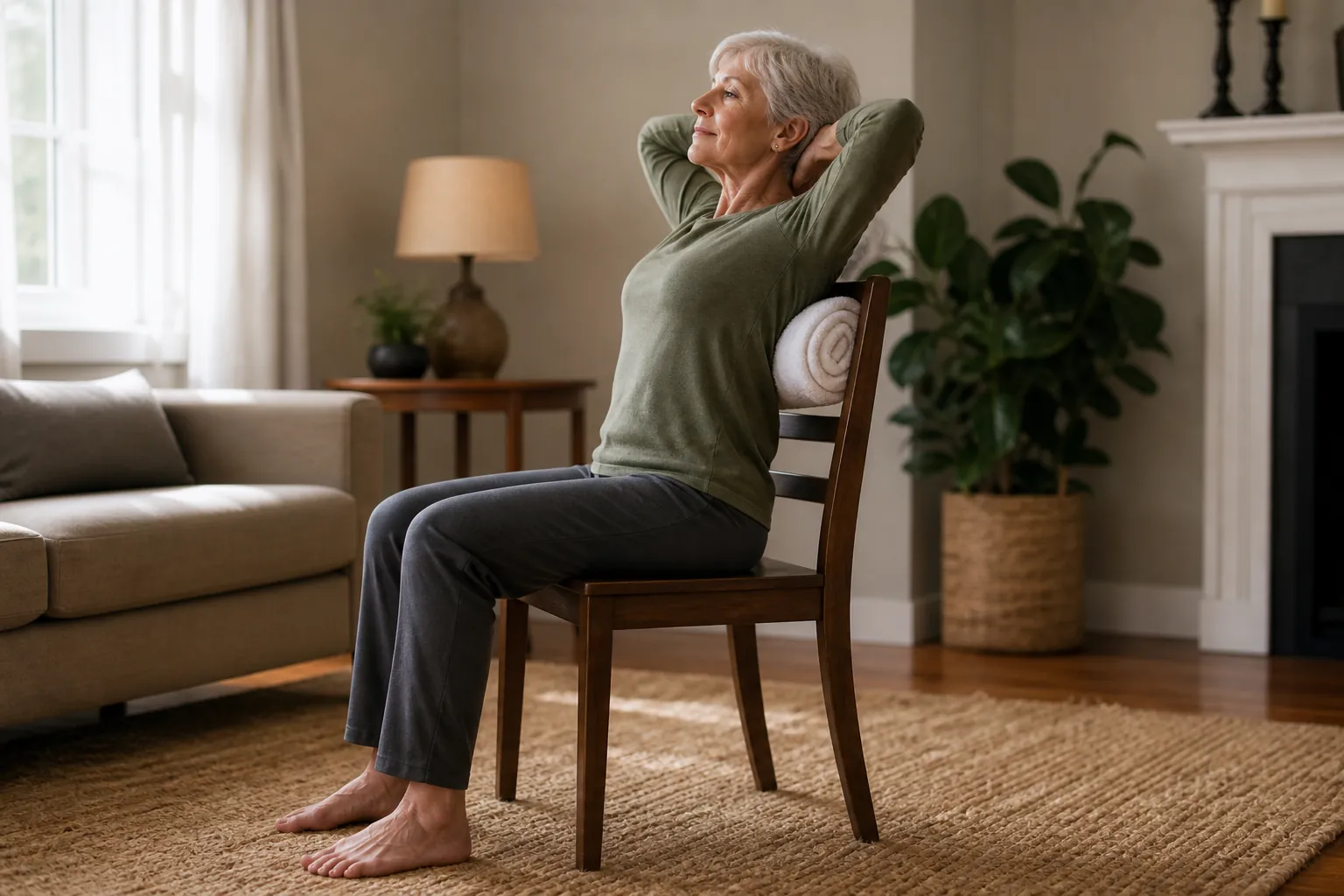
The movement should come from the upper back. If the low back pinches, reduce the range or move the towel slightly higher. If the neck strains, keep the head more supported. The useful sensation is a broad opening across the chest and upper back, not a forced arch.
Chin tucks: bring the head back without tipping it down
Sit or stand tall near a wall. Keep the eyes level. Slide the head straight back, as if making a small double chin, then release. The chin should not jab downward, and the head should not tilt up. Think of the ears moving back toward the shoulders.
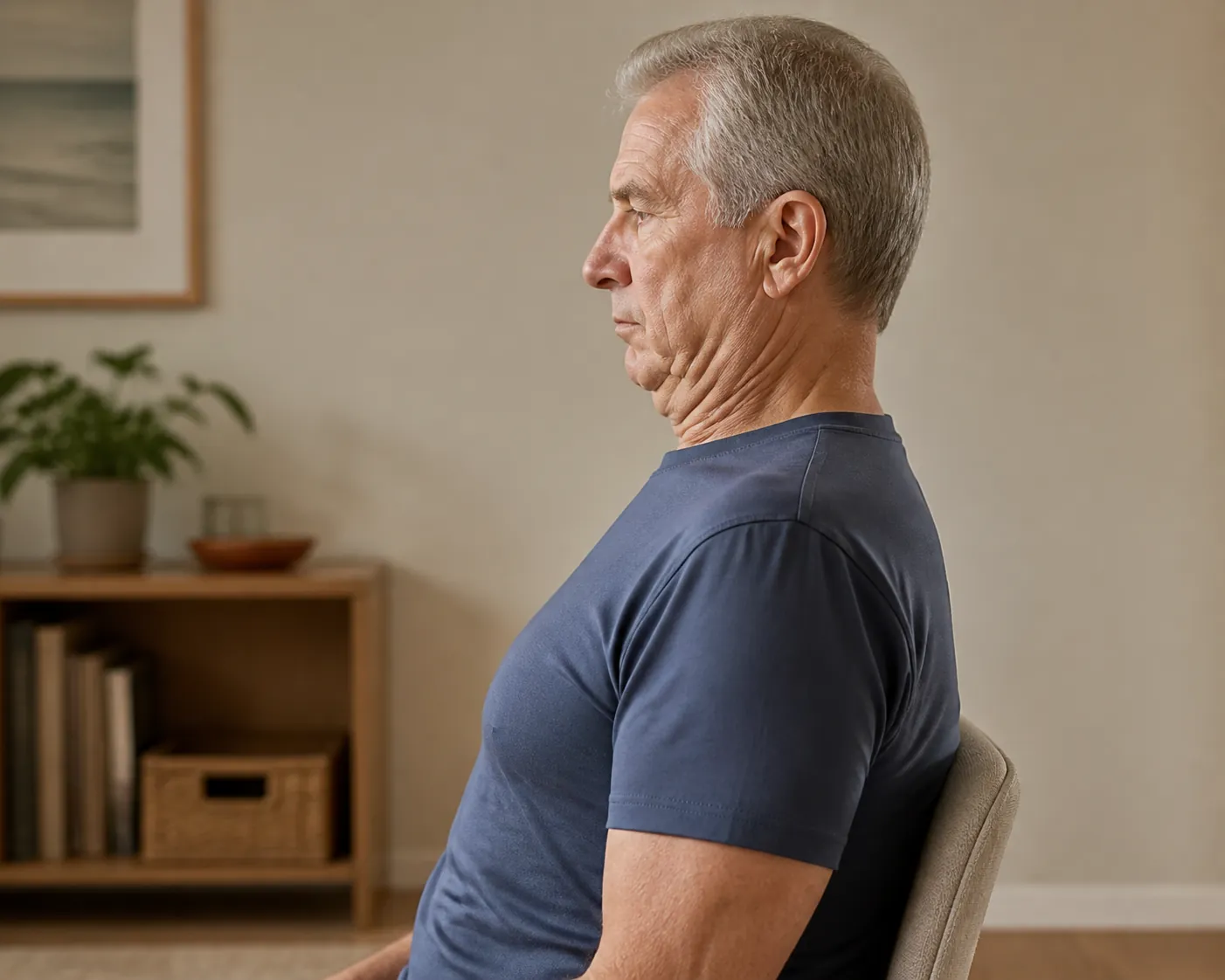
This is often a small movement. More is not better. If it causes pain, dizziness, or a headache, stop. For many people, the first success is simply finding the motion without clenching the jaw or hiking the shoulders.
Scapular retraction and standing rows: train the shoulder blades to help
Rounded posture is not only a spine problem. The shoulder blades often sit forward and wide, so the upper back has less support. A simple shoulder-blade squeeze is the easiest entry point: sit or stand, let the arms rest by the sides, and gently draw the shoulder blades back and slightly down. Do not pinch hard. Do not thrust the ribs forward.
If that feels easy and safe, a standing row with a light resistance band can add strength. Anchor the band at about chest height, stand with a chair or counter nearby, and pull the elbows back while the shoulders stay relaxed. NASM’s posture guidance for older clients and Cleveland Clinic’s posture exercise guidance both emphasize this kind of upper-back and shoulder-blade work as part of correcting slumped posture. [7][8]
Pelvic tilts: find the middle instead of bracing all day
Some people try to fix a rounded upper back by squeezing the low back. That usually creates stiffness, not better balance. Pelvic tilts teach control without forcing.
Lie on your back with knees bent, or sit upright on a firm chair. Slowly roll the pelvis so the low back gently flattens, then roll the other way so a small natural arch returns. Move through a comfortable range. After a few repetitions, settle near the middle, where breathing is easy and the ribs are not flared.
Bird dog, modified if needed: keep the trunk steady while the limbs move
A full bird dog starts on hands and knees: extend one leg back, or one arm forward, while the trunk stays quiet. Many older adults should begin with an easier version. Stand facing a counter and slide one foot back a few inches, keeping the chest lifted and pelvis steady. Or sit tall and slowly lift one arm without letting the body collapse to one side.
The balance value is not in making the movement large. It is in keeping the trunk organized while something else moves. That is closer to real walking than holding a stiff “good posture” pose.
Hip and posterior-chain support: posture does not stop at the shoulders
Standing taller also depends on the hips and back of the legs. If the hips cannot extend well, the trunk may pitch forward during standing and walking. A supported hip extension drill is a reasonable starting point: hold a counter, stand tall, and move one leg gently backward without leaning the chest forward. Keep the toes pointing mostly ahead. Return slowly.
Sit-to-stand practice can also support posture if it is done with control. Use a firm chair. Bring the feet under the knees, hinge slightly at the hips, stand, pause tall, then sit slowly. If you need the arms, use them. The aim is safe repetition, not proving you can stand without help.
Where balance practice fits
Posture exercises can improve the position you bring into standing and walking. They should not be asked to do the whole fall-prevention job.
The World Falls Guidelines recommend balance-challenging and functional exercise at least 3 times weekly, individualized, progressed, continued for at least 12 weeks, and maintained long term. [9]
That means a posture routine pairs well with a separate balance and strength plan. A typical safe bridge is stance work near a counter: feet apart, feet closer together, semi-tandem stance, tandem stance, and eventually brief single-leg support if appropriate. Mayo Clinic and Johns Hopkins both present balance exercises with this kind of gradual support-and-stance progression. [10][11]
For a fuller step-by-step balance and strength program, use the Fall Prevention Exercises: A 4-Level Balance and Strength Progression Ladder. Keep the posture routine as the piece that helps you stand and move from a better starting position.
A realistic 12-week starting plan
Most people do better with a small routine they can repeat than with a long list they abandon. A practical starting plan is 10 to 15 minutes, 5 or more days per week, with balance and functional exercise on at least 3 of those days if cleared to do it. The research timeline supports patience: measurable posture and balance-related changes are more plausible over 12 to 16 weeks than after a weekend of stretching. [5][6][9]
- Weeks 1–2: learn the movements. Use a chair, wall, or counter. Keep the range small.
- Weeks 3–6: add repetitions gradually if there is no pain, dizziness, or unusual fatigue.
- Weeks 7–12: keep the posture exercises consistent and progress balance work separately, not by making posture drills risky.
- After week 12: keep the exercises that help and ask a clinician or PT whether your routine should become more challenging.
A caregiver can help by changing the cue. “Mom, you’re leaning forward” often lands like criticism. “Let’s put the chair near the wall so this feels steadier” is more useful. So is, “Try the small chin tuck we practiced,” or “Let’s do the towel exercise before your walk.” The person doing the work needs safety, not a posture inspection.
Do not ignore the rest of the fall picture
If you are arriving here after a fall, a near-fall, or a new fear of walking, posture exercises are only one part of the response. Review home hazards, talk through medications and dizziness, check vision and footwear, and ask whether a cane, walker, or rollator needs to be fitted rather than guessed at.
Useful next steps include a printable fall-prevention handout for seniors, the CDC STEADI home fall-prevention checklist, and the post-fall care guide if an incident has already happened.
Posture is not a cure-all. It is a real, modifiable contributor to balance. A safe posture routine done consistently for roughly 12 weeks or more, paired with balance training and professional screening when needed, is a reasonable home starting point.
References
- Facts About Falls — CDC.
- Effect of age-related hyperkyphosis on open and closed-loop postural control in older adults — Scientific Reports, 2025.
- Kado 2007 study on hyperkyphotic posture and falls.
- Szczygiel 2015 study on forward head posture, cervical proprioception, and vestibular integration.
- Katzman 2007 posture exercise program study — Archives of Physical Medicine and Rehabilitation, 2007.
- Effect of a Hyperkyphosis-specific Exercise Program on the History of Falls, Fear of Falling and Satisfaction in Older People with Hyperkyphosis: A Pilot Study — Open Orthopaedics Journal, 2023.
- Posture Exercises for Seniors: Improving The Health of Older Clients — NASM.
- 8 Posture Exercises To Sit and Stand Straighter — Cleveland Clinic.
- World guidelines for falls prevention and management for older adults: a global initiative — 2022.
- Balance exercises — Mayo Clinic.
- Fall Prevention: Balance and Strength Exercises for Older Adults — Johns Hopkins Medicine.
Related reading
Noticed something outdated or inaccurate on this page? Flag a correction. We review every report against CDC, NIA, and AARP HomeFit guidance before updating a page.
Part of the Fall Prevention section.