
STEADI: intervene
Severe Weather Emergency Checklist for Seniors
Build a senior-specific severe weather plan with two kits: a 3-day Go-Kit for evacuation and a 2-week Stay-at-Home Kit, stocked with the medications, medical records, glasses, mobility aids, and documents a generic survival checklist omits — plus a six-month refresh routine.
A flashlight, bottled water, and a radio are a start. They are not enough for a severe weather emergency checklist for seniors. The weak spot usually shows up later: the pill bottle left in the bathroom cabinet, the hearing-aid batteries that were not packed, the walker that does not fit behind the cooler, or the adult child trying to name a blood thinner from memory while everyone is tired.
For an older adult, the checklist works better when it is split into two separate systems: a 3-day Go-Kit for evacuation and a 2-week Stay-at-Home Kit for sheltering in place. The American Red Cross uses that split for water planning: 1 gallon of water per person per day, with a 3-day supply for evacuation and a 2-week supply for home use.[1] The containers, quantities, and medical assumptions are different enough that one overstuffed tote in the garage is rarely the cleanest answer.
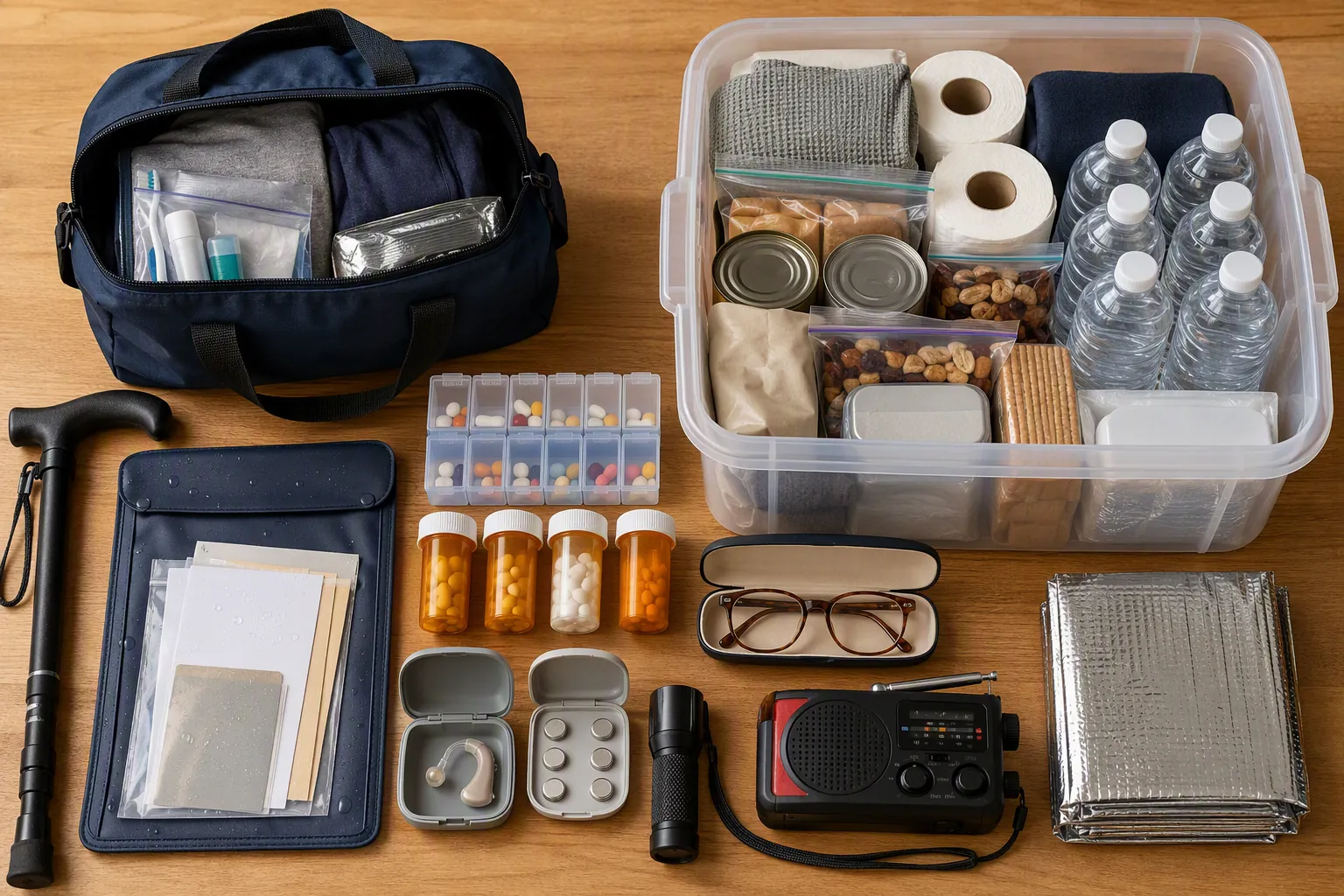
Start with two kits, not one
The Go-Kit should be light enough to move quickly and organized enough that another person can grab it from the same place every time. The Stay-at-Home Kit can be larger, heavier, and more redundant because it is meant for the first days after power, roads, pharmacies, or caregiver routines are disrupted.
| Kit | Purpose | Minimum water planning | Best container |
|---|---|---|---|
| 3-day Go-Kit | Evacuation, temporary shelter, staying with family, or leaving before conditions worsen | 1 gallon per person per day for 3 days | Duffel, backpack, small rolling bag, or labeled bin that fits in the vehicle |
| 2-week Stay-at-Home Kit | Power outage, winter storm, road closure, severe storm damage, or other shelter-at-home period | 1 gallon per person per day for 2 weeks | Clear storage bin, pantry shelf, closet shelf, or divided home stations that do not block walking paths |
The Red Cross also lists nonperishable food, a flashlight, battery-powered or hand-crank radio, extra batteries, first aid kit, copies of personal documents, chargers, cash, and an emergency blanket as core survival-kit supplies.[1] Those basics belong in both systems, scaled to the job. The Go-Kit gets compact versions. The home kit gets enough quantity to cover the wait.
For fall prevention, the storage location matters as much as the contents. Do not stack water cases where a walker has to turn. Do not put the Go-Kit on a high shelf. Do not let storm supplies narrow the path between the bed, bathroom, kitchen, and exit door. If the home has already had near-falls during bad weather, use this kit checklist alongside a broader severe weather fall-prevention checklist or a storm checklist that puts falls first.
The base layer: what goes in both kits
Build the ordinary emergency layer first, then add the senior-specific layer. Skipping the basics creates a different problem; over-explaining them can hide the items that actually keep an older adult functioning.
- Water: 1 gallon per person per day, planned as 3 days for evacuation and 2 weeks for home use.[1]
- Nonperishable food that the older adult can open, chew, and eat with usual diet restrictions in mind.[1]
- Flashlight or lantern, plus extra batteries.[1]
- Battery-powered or hand-crank radio.[1]
- First aid kit.[1]
- Phone chargers and backup power bank where possible.[1]
- Cash in small bills.[1]
- Emergency blanket or warm layer.[1]
- Sanitation supplies, including wipes, bags, toilet paper, hand sanitizer, and any incontinence supplies normally used.
The food line deserves one caregiver check: can the person open it without help? Pull-tabs, lightweight containers, a manual can opener, and familiar foods matter more than a perfect-looking pantry shelf. If arthritis, tremor, low vision, dentures, swallowing problems, diabetes, kidney disease, or other diet restrictions are part of daily life, the emergency food should reflect that daily life.
Medications are the part to slow down for
Medication guidance looks inconsistent until it is tied to the situation. The Red Cross survival-kit page lists a 7-day supply of medications and medical items.[1] The Red Cross older-adult guidance says to keep at least 30 days of medications and extra assistive items such as a cane or eyeglasses.[2] ReadyWisconsin’s older-adult additions name a 3–5-day medication supply for an emergency kit.[5] Ready.gov adds the reason this matters: about half of all Americans take a prescription medicine every day, and an emergency can make refills hard to find.[3]
Handle the conflict this way: the Go-Kit should hold the shortest practical evacuation supply that can be kept safe, current, and legally filled; the Stay-at-Home Kit should aim higher because roads, pharmacies, deliveries, and prescribers may not be reachable. For many households, that means treating 3–7 days as the Go-Kit working range and asking the prescriber or pharmacist how to build toward a longer home reserve, up to the 30-day older-adult recommendation when it is medically and financially possible.[1][2][5]
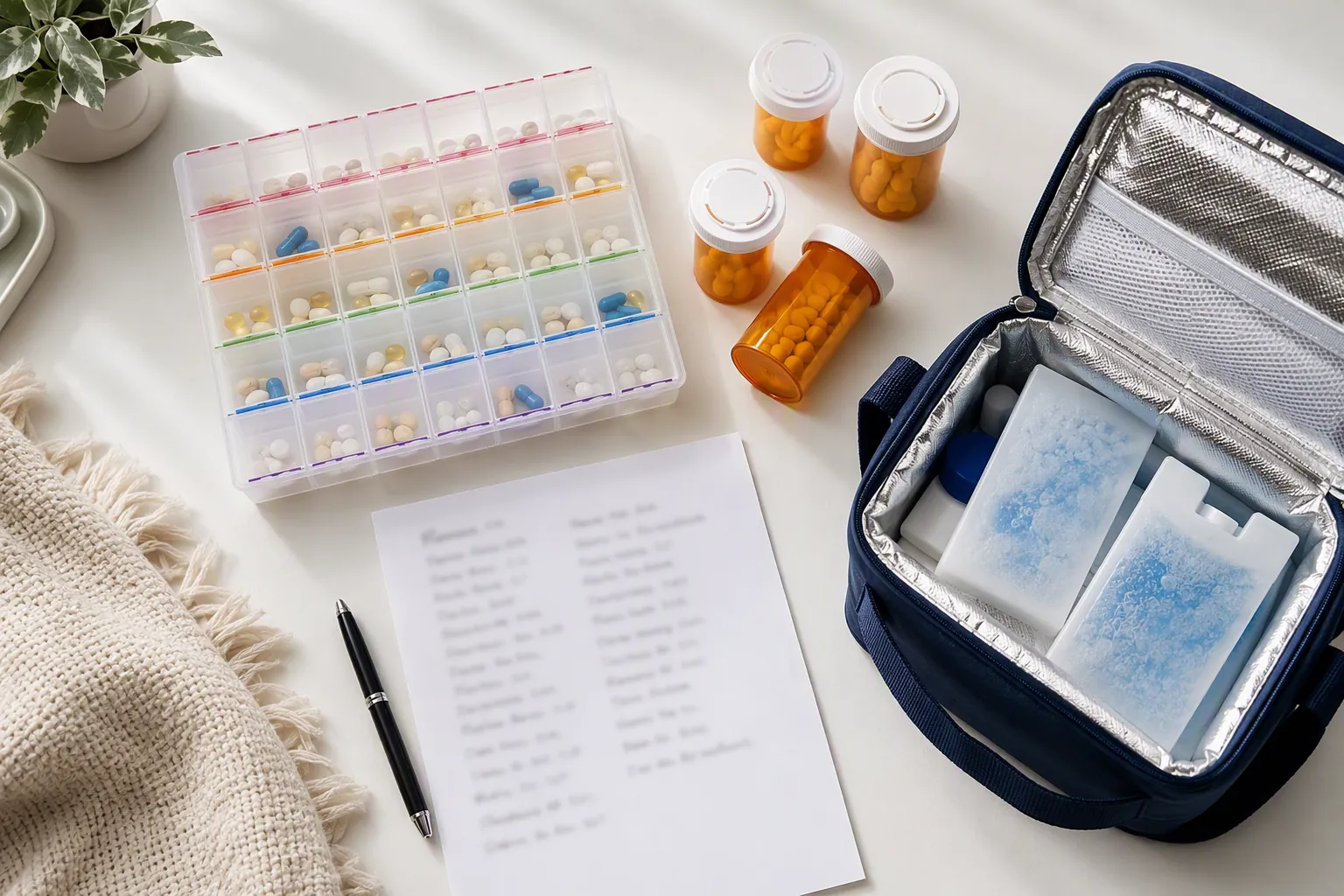
Do not pack loose pills in an unlabeled plastic bag. Keep medications in original containers when possible, or use a clearly labeled system that a responder, shelter nurse, pharmacist, or family member can understand. If insurance refill limits, controlled-substance rules, refrigeration, cost, or changing prescriptions make a reserve difficult, the backup plan may be a current medication list plus a call plan for the prescriber and pharmacy. That is not as strong as having the supply in hand, but it is better than guessing under pressure.
What the medication list should say
Ready.gov’s disability preparedness guidance says to keep a list of prescription medicines with diagnosis, dosage, frequency, medical supply needs, and allergies.[4] That is the difference between “Mom takes a little white pill for her heart” and information someone can actually use.
- Medication name, including generic name if known.
- Diagnosis or reason it is taken.
- Dose and strength.
- Time and frequency: for example, morning, bedtime, weekly, or as needed.
- Prescribing clinician and pharmacy phone number.
- Medication allergies and serious reactions.
- Medical supplies tied to the medication, such as syringes, testing strips, alcohol pads, sharps container, or tubing.
- Whether the medicine must be refrigerated.
For refrigerated medicines, Ready.gov specifically recommends a cooler and chemical ice packs.[4] Keep those with the Go-Kit or in a clearly marked location beside it. If a power outage is the most likely problem in the home, pair the medication plan with a 72-hour power outage safety checklist and a room-by-room power-outage fall-proofing plan. A cold pack does not help if the person trips over the cooler in a dark hallway.
Glasses, hearing aids, mobility aids, and medical devices
The senior-specific layer is not optional. It is what lets the person see instructions, hear announcements, walk to the bathroom, transfer from a chair, sleep safely, monitor blood sugar, or use oxygen. Red Cross names hearing aids with extra batteries, glasses, and contact lenses as unique-need additions to a survival kit.[1] Its older-adult guidance also points to extra assistive items such as a cane or eyeglasses and batteries to back up power-dependent devices.[2]
| Need | Go-Kit | Stay-at-Home Kit |
|---|---|---|
| Vision | Spare glasses, contacts if used, lens solution, magnifier if used | Backup glasses in a known location; large-print medication and contact lists |
| Hearing | Hearing aids, labeled case, extra batteries or charger | Extra batteries, charger, written instructions for changing batteries or cleaning devices |
| Mobility | Cane, walker, rollator, transfer belt, wheelchair cushion, or compact backup aid as appropriate | Clear walking paths, backup tips/glides, labeled equipment, plan for stairs or blocked exits |
| Power-dependent devices | Device chargers, portable battery where appropriate, device list | Backup batteries, charging schedule, generator or medical power plan if already used safely |
| Oxygen or respiratory support | Portable oxygen supplies as prescribed, tubing, cannula, device information | Backup oxygen supply and power plan discussed with the supplier or clinician |
Ready.gov also recommends extra eyeglasses, contacts, hearing aids and batteries, a backup supply of oxygen, and a list of the style and serial number of medical devices.[4] ReadyWisconsin gives similar older-adult examples, including medical device information for a wheelchair, walker, or oxygen.[5] Put the device list with the medication list, and keep a second copy in the document pouch.
AgingCare notes that many shelters do not have durable medical equipment on site, so older adults should bring their own equipment such as oxygen equipment, CPAP, or blood sugar monitors when needed.[7] Treat that as a planning warning, not a guarantee about every shelter. If a device is essential for breathing, sleeping, transferring, walking, or monitoring a dangerous condition, the kit needs the device, the supplies, the power plan, and the written identifying information.
Evacuation is also a packing problem. A walker that technically fits in the car but blocks the Go-Kit, oxygen bag, or passenger seat creates a decision at the worst time. Practice loading the vehicle once in ordinary weather. If flooding is the concern, the flash flood safety checklist for older adults can sit beside the kit list. If the harder question is who drives, who calls, and where the parent goes, use an emergency evacuation plan for elderly parents to assign those jobs before a warning is issued.
Documents that belong in a waterproof pouch
Ready.gov recommends storing important family documents in a waterproof, portable container.[3] For an older adult, that container should not become a bulky archive. It should answer the questions that delay care, shelter intake, insurance calls, prescription replacement, or decision-making.
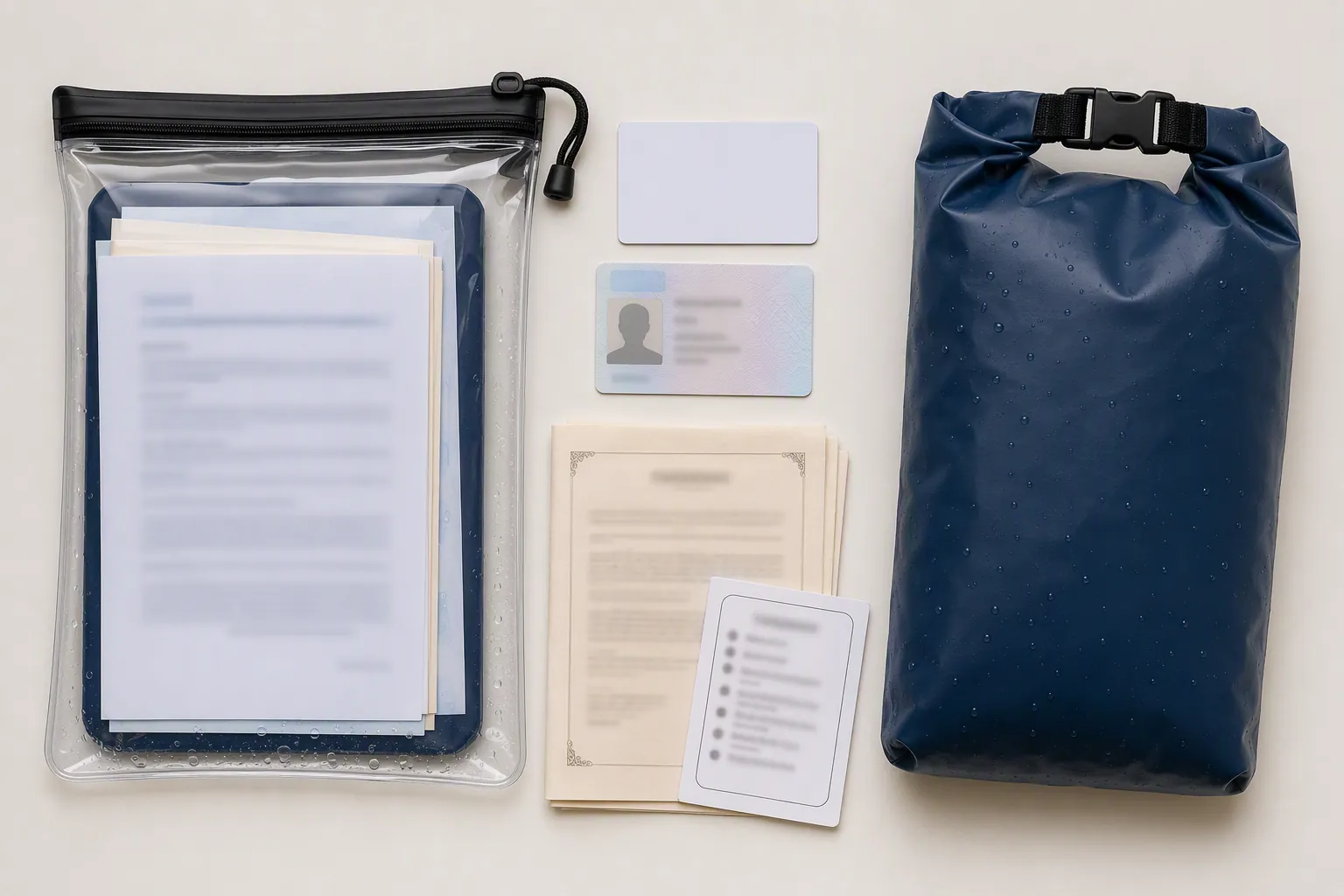
- Photo ID copy, if available and appropriate.
- Medicare card and health insurance card copies; Ready.gov includes insurance and Medicare cards in disability preparedness documents.[4]
- Medication list, allergy list, and key diagnoses.
- Emergency contacts, including out-of-area contact if the family uses one.
- Clinician, pharmacy, home health agency, medical equipment supplier, and oxygen supplier numbers.
- Power of attorney, medical power of attorney, advance directive, or health care proxy copies if those documents exist; ReadyWisconsin specifically lists waterproof POA and medical POA copies for older adults.[5]
- Care plan, including mobility help, dementia-related needs, communication needs, diet limits, and daily routines; ReadyWisconsin includes a care plan as an older-adult kit addition.[5]
- Medical device style, serial number, and supplier contact information.[4]
The power-of-attorney conversation can be the hardest item on the list. It does not need to be handled as a one-afternoon paperwork ambush. Start by asking what information the older adult would want available if they were too tired, sick, or overwhelmed to answer questions. Keep copies where they can be found, and store originals according to legal advice and state rules.
Last verified for Medicare- and insurance-card checklist language: Q3 2026. This article is general preparedness information, not medical, legal, financial, insurance, or benefits advice. A clinician, pharmacist, attorney, insurance plan, benefits office, or local emergency management office may need to answer household-specific questions.
Pets and service animals need their own line in the plan
Ready.gov tells older adults to plan food, water, and essentials for pets or service animals and to research pet-friendly evacuation centers because not all shelters accept pets.[6] Do not assume a national rule will answer the local question. Shelter options, special-needs registries, animal intake rules, and transportation support vary by county and state.
- Pack food, water, bowls, leash or harness, waste bags, medications, and vaccination or veterinary records.
- Label carriers and equipment with the older adult’s name and emergency contact.
- Call or check the local emergency management office for pet-friendly shelter information before storm season.
- If a service animal supports mobility, hearing, vision, medical alerting, or psychiatric disability needs, write that role into the care plan.
Weather changes the fall hazards around the kit
A severe-weather kit that increases fall risk has failed part of its job. The older adult may be moving in dim light, rushing to answer a phone, stepping around water containers, carrying a bag with one hand, or walking over wet leaves, ice, debris, or extension cords. Put the most-used supplies between waist and shoulder height, keep the floor clear, and give the Go-Kit a single home near the safest exit.
Lighting belongs in the path, not just in the box. A flashlight in a duffel helps after someone reaches the duffel. Night-lights with battery backup, easy-grip flashlights by the bed, and a lantern in the bathroom path do more during the first dark hour of an outage. If winter storms are the local threat, add traction and entryway planning from a room-by-room winter-proofing checklist. If earthquakes are realistic where the older adult lives, pair this kit with an earthquake preparedness checklist for seniors or a one-weekend earthquake safety checklist for furniture, glass, and bedside hazards.
A buildable checklist for the kitchen table
This does not have to be finished perfectly in one afternoon. A useful approach is to build the parts in the order that prevents the biggest failures first: water and food, then medications and medical information, then devices and documents, then local rules.
- Choose the containers: one portable Go-Kit and one larger Stay-at-Home Kit. Label both in large print.
- Add water: 3 days for the Go-Kit plan and 2 weeks for the home plan, using 1 gallon per person per day.[1]
- Add nonperishable food, flashlight, radio, batteries, first aid kit, chargers, cash, and blanket.[1]
- Make the medication list with diagnosis, dosage, frequency, medical supply needs, and allergies.[4]
- Pack the medication supply that is realistic for each kit, using 3–7 days as the evacuation working range and discussing a longer home reserve with the prescriber or pharmacist.[1][2][5]
- Add the cooler and chemical ice packs if any medicine requires refrigeration.[4]
- Add spare glasses, hearing-aid supplies, assistive items, oxygen backup, and medical-device style and serial numbers where applicable.[1][2][4]
- Copy the documents that affect care, payment, identification, contacts, and decision-making; place them in a waterproof portable pouch.[3][4][5]
- Check local emergency management information for evacuation routes, accessible transportation, special-needs registries if available, and pet-friendly shelter rules.
- Practice the grab-and-go: lift the bag, load the mobility device, place the oxygen or cooler, and confirm the older adult can still move safely through the exit path.
For a long-distance caregiver, the same checklist can be done by video call in pieces. One call can verify where the Go-Kit lives. Another can read medication labels into a shared list. Another can test whether the walker, bag, and cooler fit into the car. Progress counts when it makes the next emergency less confusing.
Refresh every six months; rethink every year
ReadyWisconsin says to review emergency kits at least every six months.[5] Ready.gov says to rethink the kit every year and replace expired items.[3] Those are two different maintenance jobs. The six-month review catches stale water, expired food, dead batteries, old medication lists, outgrown incontinence products, changed phone numbers, and missing chargers. The yearly rethink asks whether the whole plan still matches the person.
| When | What to check |
|---|---|
| Every six months | Water, food dates, batteries, flashlight, radio, first aid items, cash, chargers, medication list, allergy list, document copies, hearing-aid batteries, glasses, incontinence supplies, pet supplies |
| After any medication change | Medication name, dose, frequency, diagnosis, allergy information, supply needs, prescriber, pharmacy, refrigeration plan |
| After a new diagnosis, fall, surgery, hospitalization, or mobility change | Walker or cane needs, transfer help, oxygen or device needs, car-loading plan, shelter accessibility questions, caregiver contact list |
| Every year | Whether the 3-day Go-Kit and 2-week Stay-at-Home Kit still fit the older adult’s health, home layout, transportation, pets, finances, and local shelter options |
Reviewed by Elena Morris, RN, BSN. Last verified: August 2, 2026. This article provides general emergency-preparedness information for older adults and caregivers. It is not a substitute for medical advice, legal advice, financial advice, insurance guidance, or instructions from local emergency officials.
References
- What Do You Need In a Survival Kit — American Red Cross
- Older Adults Emergency Preparedness — American Red Cross
- Build A Kit — Ready.gov
- People with Disabilities — Ready.gov
- Home Emergency Kit — ReadyWisconsin
- Older Adults — Ready.gov
- 10 Things to Include in a Senior Emergency Kit — AgingCare
Related reading
Noticed something outdated or inaccurate on this page? Flag a correction. We review every report against CDC, NIA, and AARP HomeFit guidance before updating a page.
Part of the Fall Prevention section.