
How to Flood-Proof Your Older Parent's Home Room by Room
A room-by-room flood preparedness guide for family caregivers of older adults. Covers emergency kit items for medical needs, evacuation routes for limited mobility, fall prevention during floods, and how to build a neighborhood support network before a storm hits.
Most flood checklists sound reasonable until the person using them moves slowly, uses a walker, sleeps with a CPAP, takes several daily medications, cannot hear instructions clearly without hearing aids, or needs both hands to steady themselves in a hallway. Then the usual advice to “grab your go-bag” and “move to higher ground” becomes less like a plan and more like a wish.
Flood preparedness for older adults has to start inside the actual home: the threshold that catches the walker, the bathroom rug that slides when wet, the stairs that become unusable in a power outage, the prescription refill that is due three days after the storm, the oxygen concentrator that cannot run without electricity. The goal is not to turn your parent’s home into an emergency operations center. It is to make sure the plan still works when water is rising, the lights are out, and your parent is tired, anxious, or moving more slowly than usual.
The urgency is not theoretical. A Columbia and Harvard study matched 17 years of Medicare data with flood maps and found statistically significant increases in hospitalizations among adults 65 and older in the four weeks after flood exposure, including skin diseases, nervous system events, musculoskeletal conditions, and injuries or poisonings.[1] Falls already affect one in four older adults each year, with 3 million emergency department visits and more than 38,000 deaths annually; flood conditions add wet flooring, debris, darkness, rushing exits, and contaminated water to a risk that is already high.[2]
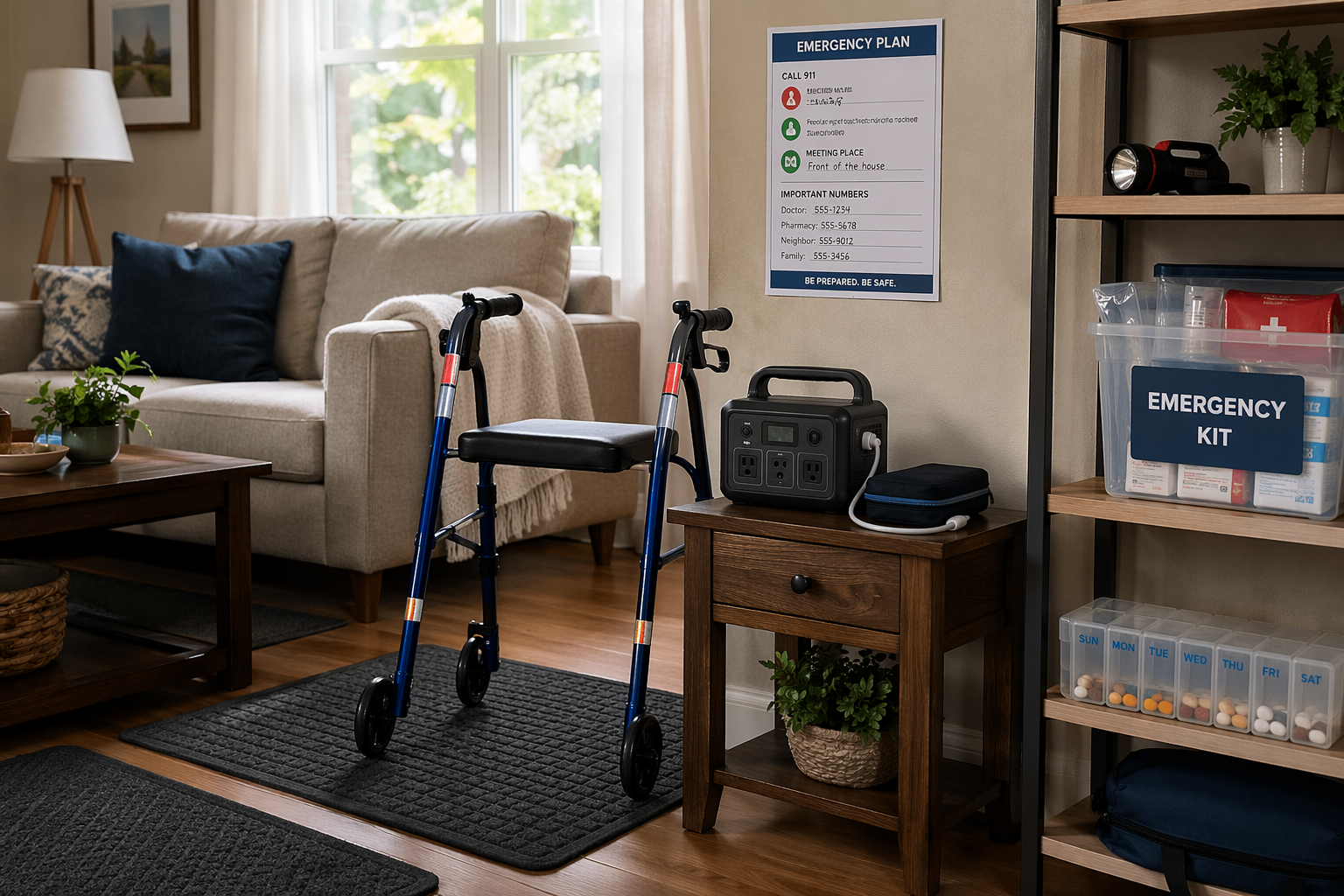
Start With The Body That Has To Use The Plan
Before buying bins or printing checklists, walk through one ordinary day with your parent’s limitations in mind. How do they get from bed to bathroom at night? Which hand do they use on the railing? Can they stand long enough to unlock the front door? Do they hear weather alerts without hearing aids? Can they carry anything while using a cane or walker? If the answer is no, the emergency plan has to assign the carrying, unlocking, calling, and driving to someone else.
The American Red Cross advises older adults to identify helpers who can assist with evacuation and to plan two ways out of every room.[3] Ready.gov frames older-adult disaster planning around assessing needs, creating a plan, and engaging a support network; it also advises making special arrangements in advance for anyone who cannot use stairs.[4] Those are useful instructions because they do not assume that independence in normal conditions equals independence during a flood.
Make the first pass through the house without moving anything. Notice what would fail first: a narrow route, a low battery, a locked gate, a stairway, a heavy door, a cord across the floor, a medication routine stored in one person’s memory. The second pass is where you fix what you can.
Entryways: Make Leaving Boring
The front door is not ready just because it opens. It is ready when your parent can reach it safely, unlock it quickly, and pass through it with the mobility device they use on their worst day, not their best one.
- Clear a path wide enough for the walker, wheelchair, cane, or rollator to pass without turning sideways.
- Remove loose mats or replace them with low-profile, non-slip mats that do not curl at the corners.
- Add battery-powered lighting near the door, the key hook, and any step down to a porch or garage.
- Keep shoes with firm soles near the exit, not slippers that become slick when wet.
- Store a waterproof pouch with identification, insurance information, medication lists, and emergency contacts where a helper can find it.
- Test whether the door can be opened from a seated position if your parent uses a wheelchair or may need to sit while waiting.
If there is a ramp, inspect it after rain, not on a dry afternoon. A ramp that feels safe in sunshine may become slick at the exact moment it is needed. Add grip tape or other non-slip surfacing where appropriate, check that handrails are stable, and make sure the route does not drain water toward the ramp landing.
If your parent lives in an apartment building, the entryway plan includes the building’s elevator policy, stairwell lighting, accessible exits, and who has authority to open locked gates or side doors. For a parent who cannot use stairs, “wait for help” is not a plan unless the helper, route, and contact method have already been named.
Bedroom: Prepare For The 2 A.M. Version Of The Emergency
Many flood warnings and evacuation decisions happen when an older adult is not dressed, medicated for the morning, or fully awake. The bedroom plan should assume darkness, urgency, and slower movement.
- Place a flashlight or battery lantern where your parent can reach it from bed without standing.
- Keep eyeglasses, hearing aids, hearing aid batteries, dentures, phone, charger, and mobility device in the same reachable location every night.
- Add reflective tape to walkers, canes, or wheelchairs so helpers can see them in low light.
- Remove throw rugs and low furniture from the bed-to-door and bed-to-bathroom routes.
- Set out a small bag with a change of clothes, incontinence supplies if needed, and weather-appropriate outerwear.
- Write the emergency contact sequence in large print near the bed, including who to call first if you are unreachable.
If your parent uses a CPAP, oxygen equipment, nebulizer, hospital bed, lift chair, or powered mobility device, the bedroom is also part of the medical power plan. Label cords so a helper can tell what must be unplugged and transported. Keep backup batteries charged if the device supports them. If the equipment cannot be moved easily, write down the device name, supplier, settings, and customer support number in the emergency folder.
Bathroom: Treat Wet Tile As A Flood Hazard Before The Flood Arrives
Bathrooms are already fall-prone; flood preparation makes them more demanding. A power outage, anxious trip to the toilet, damp floor, or rushed shower before evacuation can turn a familiar room into the most dangerous room in the house.
- Install or check grab bars near the toilet and shower; towel bars do not count.
- Use non-slip strips or mats inside the tub or shower and remove any bath mat that skids on the floor.
- Keep a night light with battery backup or a motion-activated battery light near the bathroom path.
- Store extra incontinence briefs, wipes, gloves, and disposal bags in a waterproof bin if your parent uses them.
- Move essential hygiene items above expected low-level water intrusion, especially in ground-floor bathrooms.
- Do not let your parent step into standing water to retrieve toiletries, towels, or medications.
If your parent has urgency, incontinence, or takes diuretics, build that into the evacuation timing. Waiting until the last possible hour can mean a hurried bathroom trip, a wet floor, and a fall before anyone has even left the house. For broader severe-weather fall planning, the site’s guide to protecting seniors from falls during severe weather can help you connect flood-specific hazards with the larger fall-prevention routine.
Kitchen: Keep Food Simple And Medications Safer
The kitchen matters less as a cooking space during a flood and more as a medication, hydration, and safe-movement space. If your parent normally prepares meals by leaning on counters, reaching high shelves, or carrying hot drinks while using a walker, the storm plan should reduce those demands.
- Place ready-to-eat foods at waist height so your parent does not need a step stool or deep bending.
- Keep bottled water where it can be reached and moved without lifting a heavy case.
- Store a manual can opener, disposable utensils, and easy-open food options.
- Move medications and medication lists out of low cabinets that could take on water.
- If refrigerated medication is used, write down the storage requirements and ask the pharmacist or prescriber in advance what to do during a power outage.
- Keep a chair near the kitchen work area if your parent cannot stand long while waiting, packing, or sorting medication.
Do not rely on memory for medication timing during a flood. Stress changes routines, and so does displacement. A large-print medication schedule should travel with the emergency kit, and another copy should stay in the home where a neighbor or responder can find it.
Stairs, Hallways, And Interior Routes: Test The Path With The Device
A hallway that looks clear to an adult child walking through empty-handed may not be clear to someone using a walker. Test the route with the actual device. If your parent uses different devices on different days, test with the largest and least maneuverable one.
| Area | What To Check | What To Change Before Flood Season |
|---|---|---|
| Hallways | Walker or wheelchair clearance, cords, small tables, baskets, pet items | Create one straight, uncluttered route from bedroom to exit |
| Stairs | Handrail stability, lighting, ability to descend when tired or dizzy | Add lighting, repair rails, and make a no-stairs backup plan if needed |
| Doorways | Threshold height, door swing, ability to pass with mobility equipment | Remove obstacles, add threshold ramps where appropriate, keep doors unlocked during evacuation prep |
| Interior rugs | Corners that curl, mats that slide, rugs that bunch under wheels | Remove them or secure them with non-slip backing |
| Power-outage route | Whether the path is visible without overhead lights | Install battery lights or keep lanterns along the route |
If stairs are part of the only exit route, make arrangements before the storm. Ready.gov specifically advises advance arrangements for older adults who cannot use stairways.[4] That may mean identifying neighbors who can assist, calling the building manager about evacuation procedures, asking local emergency management what services exist, or deciding that leaving earlier is safer than waiting until stair assistance is urgent.
For families already working on fall reduction, a flood plan should sit beside the broader CDC STEADI-style fall prevention action plan. Flood preparation does not replace strength, vision, medication, and home-safety work; it tests those systems under worse conditions.
Basement Or Lower Level: Decide What Is Not Worth Retrieving
Basements are where flood plans often fail because the pull of belongings is strong: photo boxes, tools, freezers, laundry, holiday bins, medical supplies stored “out of the way.” For an older adult, the rule should be settled ahead of time: no one goes downstairs once water is entering, power is unreliable, or a warning has escalated.
- Move essential medical supplies, mobility-device chargers, and documents out of the basement before flood season.
- Photograph valuables and important household items in advance instead of planning to carry them out later.
- Keep laundry, extra shoes, and clean clothing upstairs if your parent may need to leave quickly.
- Do not store the emergency kit below grade.
- If the electrical panel, sump pump, or shutoff valves are downstairs, decide who is physically able to access them safely and when the attempt stops.
The lower level is also where contaminated water becomes a fall and infection concern. The Medicare flood study’s hospitalization findings included increases in skin diseases and injuries or poisonings after flood exposure among older adults.[1] That does not mean every flooded basement leads to hospitalization, but it is enough reason to keep an older parent out of standing water and debris.
Outdoor Routes: Walk Them In Bad Conditions, Not Just Good Ones
The safe route from house to car may change completely in rain. A driveway slope, uneven paver, curb, gravel strip, soft lawn, or poorly lit side gate can become the obstacle that delays evacuation.
- Identify the primary exit route and one backup route that avoids stairs if possible.
- Check whether a walker, wheelchair, or transport chair can move from the door to the vehicle without crossing grass or gravel.
- Keep the route free of hoses, planters, extension cords, trash bins, and outdoor furniture.
- Add solar or battery lighting along steps, ramps, and the path to the vehicle.
- Choose a pickup spot where your parent can sit while waiting if standing is difficult.
- Practice loading the walker, wheelchair, oxygen equipment, or go-bag into the actual vehicle.
Build more time into the evacuation plan if your parent uses a wheelchair or walker; the Insurance Information Institute specifically recommends doing so and creating a network of neighbors, relatives, and friends for disaster planning.[5] “We can leave in ten minutes” is rarely true when someone needs medication, shoes, hearing aids, a mobility device, a bathroom trip, a charged phone, and help getting into a car.
The Emergency Kit Has To Match Medical Reality
A standard three-day kit is not enough for many older adults. The Red Cross recommends that older adults keep a 30-day supply of medications in emergency kits, along with extra assistive items such as a cane, eyeglasses, and hearing aid batteries.[3] That recommendation is sensible and hard. Insurance refill rules, pharmacy timing, controlled-substance limits, and cost can make a clean 30-day backup difficult.
Treat the 30-day supply as the target, then ask the pharmacist and prescribers how close you can get legally and safely. Some families may be able to use 90-day fills, synchronize refills, request early refills before a declared storm, or keep a small emergency reserve that is rotated before expiration. Do not quietly skip medications to build a reserve; make the plan with the clinician or pharmacist.
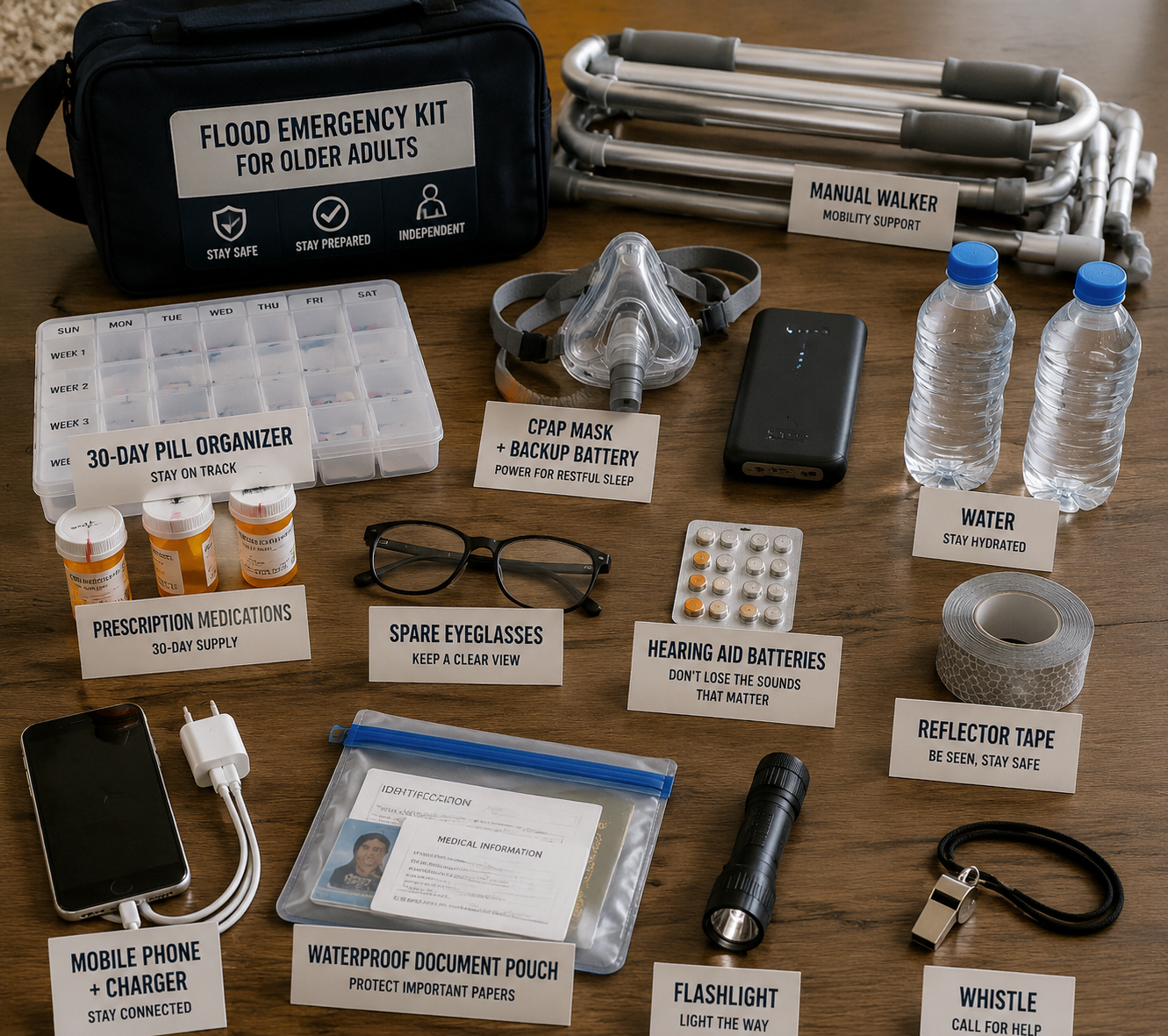
Pack For The Things Your Parent Cannot Do Without
- Medications: current prescription bottles or organized doses, a large-print medication list, dosing schedule, allergies, pharmacy name, prescriber names, and refill information.
- Medical documents: copies of insurance cards, Medicare or Medicaid information if applicable, advance directives if available, diagnoses, device settings, and emergency contacts.
- Sensory supports: spare eyeglasses, hearing aid batteries, hearing aid charger if used, magnifier, and written instructions for communicating if hearing is limited.
- Mobility supports: cane tips, walker glides, wheelchair charger, transfer belt if used by trained helpers, and a plan for transporting the primary device.
- Medical-device power: charged backup battery packs compatible with CPAP, oxygen, nebulizer, or other essential equipment, plus wall chargers and car adapters where appropriate.
- Personal care: incontinence supplies, wipes, gloves, masks if used, skin-protection items, denture supplies, and any nutrition items your parent depends on.
- Communication: charged phone, simple written contact tree, portable charger, whistle, and a paper map or written route if cell service fails.
- Basic emergency items: flashlight, batteries, water, easy-open food, first aid supplies, cash in small bills, and a waterproof document pouch.
If your parent uses a motorized wheelchair or scooter, consider whether a manual wheelchair backup is realistic for the home, vehicle, and caregiver. AgingCare recommends keeping a manual wheelchair as a backup for motorized chair users during emergencies.[6] That is not useful if no one can push it, it cannot fit through the hallway, or it cannot be loaded into the car; test it before relying on it.
Label the kit in plain language. If several people may help, do not make them guess which bag has the medications and which has clothing. Put the medical pouch on top or in a clearly marked section. A neighbor who has thirty seconds to help should not have to search through canned food to find hearing aid batteries.
Deciding Whether To Evacuate Or Shelter
The safest choice is not the same for every older adult or every storm. A parent in a one-story home in a flood zone, dependent on powered oxygen, may need to leave early. A parent in a higher, structurally sound building with reliable support may be safer staying put for a lesser event if evacuation would mean exhaustion, confusion, missed medications, or separation from essential equipment.
That tension is real. AARP’s disaster resilience materials note transfer trauma concerns and report that nursing home evacuations during Hurricane Irma were associated with higher death rates than sheltering in place; the same toolkit also reports that 61 of 87 Hurricane Ian fatalities were people age 60 or older.[7] The lesson is not “never evacuate” or “always evacuate.” It is that evacuation timing, destination, transport, medication continuity, and equipment continuity matter.
| Question | If The Answer Is No | What To Do Before The Warning |
|---|---|---|
| Can your parent leave using the planned route with their usual mobility device? | The route is not an evacuation route yet. | Clear or modify the route, identify helpers, or leave earlier. |
| Can medical devices run if power is out? | Sheltering may become unsafe quickly. | Arrange backup power, charging options, or a destination with power. |
| Can medications travel with your parent? | Evacuation may interrupt treatment. | Pack a medication pouch and refill plan now. |
| Can your parent communicate needs in a shelter or with responders? | Instructions may be missed. | Pack hearing, vision, written communication, and contact supports. |
| Can the destination handle mobility and medical needs? | The destination may be safer from water but unsafe for care. | Confirm accessibility, electricity, bathroom access, and sleeping arrangements. |
For a medically fragile parent, the destination is part of the medical plan. Ask whether there is an accessible bathroom, a place to plug in equipment, space for a walker or wheelchair by the bed, refrigeration if needed for medication, and someone who understands the medication schedule. If the destination is a public shelter, check ahead with local emergency management about medical needs, power availability, transportation, and pet or service animal rules rather than assuming accommodations will be simple at arrival.
Build The Support Network Before Anyone Is Afraid
A support network is not a list of kind people who once said, “Call me anytime.” It is a small group of people who know exactly what they may be asked to do.
- One person checks on your parent when a flood watch is issued.
- One person has a key or lockbox code.
- One person can help move the walker, wheelchair, oxygen supplies, or emergency kit.
- One person can drive if you cannot arrive in time.
- One person knows the backup route and destination.
- One person is responsible for calling you after contact is made.
Write these roles down and give copies to your parent and helpers. Practice once, even if it feels awkward. Ask the neighbor to open the lockbox, find the medication pouch, fold the walker, and identify the exit route. The first rehearsal usually reveals the problem: the key sticks, the walker does not fit behind the passenger seat, the emergency bag is too heavy, or no one knows where the hearing aid charger is.
Do not assume your parent’s community has a reliable vulnerable-person registry, wellness-check system, or 211-style disaster service. Some jurisdictions offer registries or transportation support, and others do not. Verify with the local emergency management office, area agency on aging, utility company, building manager, or county services. If a registry exists, ask what it actually does: does it provide evacuation transport, prioritize wellness checks, flag power-dependent medical equipment, or simply keep contact information on file?
Rural caregivers should be especially careful about assuming rapid assistance. A Virginia Tech study found that more than 30% of older adults in some rural census tracts had ambulatory difficulty, and the same article cites a nationwide survey finding that most older adults lack an emergency plan.[8] Distance, road flooding, limited public transportation, and fewer nearby helpers can turn a delay into the main danger.
Keep The Plan Small Enough To Maintain
The best flood plan is not the longest one. It is the one your parent and helpers can use under stress. Put the maintenance tasks on a simple calendar tied to routines you already have.
| When | What To Check |
|---|---|
| Monthly | Charge backup batteries, test flashlights, confirm phone numbers, and check that the exit route has not filled with clutter. |
| At prescription refill | Update the medication list, rotate emergency doses if approved, and check expiration dates. |
| Before flood season | Practice the exit route, confirm helpers, review local alerts and registries, and inspect ramps, rails, mats, and outdoor lighting. |
| When health changes | Retest the plan with the new mobility level, medication schedule, device, oxygen need, or cognitive concern. |
| When a flood watch is issued | Move the kit near the exit, charge devices, call helpers, confirm the destination, and decide early whether to leave. |
If your parent resists visible emergency supplies, make the plan less intrusive. A labeled drawer can hold the medical pouch. A normal side table can hold the flashlight and charger. A printed plan can go inside a cabinet door instead of on the wall. Preparedness should protect dignity as well as safety.
A home is not flood-proof because water can be controlled. It is flood-ready when your parent’s medications, devices, mobility, hearing, vision, bathroom needs, exit routes, and helpers have all been accounted for before the warning arrives.
References
- Large Study Uncovers Specific Impacts of Flooding on Older Adult Health, Columbia University Mailman School of Public Health, 2025
- Facts About Falls, Centers for Disease Control and Prevention
- Older Adults Emergency Preparedness, American Red Cross
- Disaster Preparedness Guide for Older Adults, Ready.gov
- Disaster Planning for Older Adults, Insurance Information Institute
- 10 Things to Include in a Senior Emergency Kit, AgingCare
- Disaster Resilience Tool Kit, AARP
- Aging in flood-prone coastal areas: Discerning the health and well-being risk for older adults, Virginia Tech
Related reading
Noticed something outdated or inaccurate on this page? Flag a correction. We review every report against CDC, NIA, and AARP HomeFit guidance before updating a page.
Part of the Fall Prevention section.