
How to Protect Seniors from Falls During Severe Weather
Severe weather events create specific, predictable fall hazards for older adults. This guide walks through a scenario-based approach — covering winter storms, power outages, evacuations, and post-storm cleanup — to help caregivers reduce fall risk before injury occurs.
Severe weather safety for elderly adults has to start in a different place than the usual storm checklist. The danger is not only outside, where the ice, wind, rain, or debris are obvious. It is also inside the house, where a familiar hallway becomes dark, a safe entryway becomes wet, a walker catches on a rug that was never a problem before, and a quick trip to the bathroom at 2 a.m. turns into the highest-risk moment of the night.
That distinction matters because older adults are already carrying a baseline fall risk before the weather changes. Falls are the leading cause of injury-related death among adults 65 and older, and about 1 in 4 older adults falls each year. After one fall, the chance of falling again within a year roughly doubles.[1] Severe weather does not create that vulnerability from nothing; it rearranges the home around it.
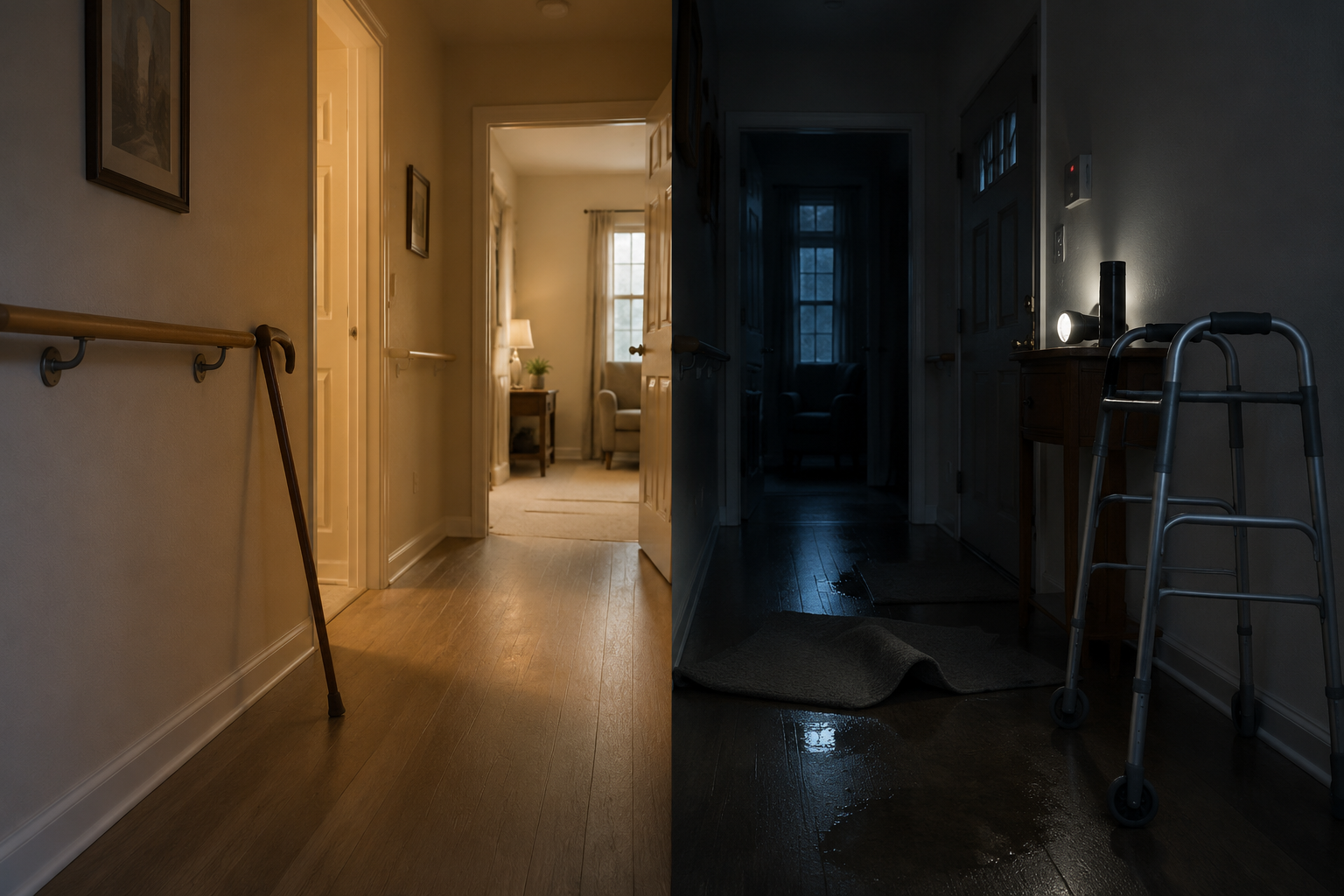
A useful weather plan asks one question before every storm: what will change in the spaces this person has to move through? Winter storms change traction. Power outages change visibility. Evacuations change timing and assistance. Cleanup changes the walking surface after everyone has emotionally decided the emergency is over.
This guide is meant for older adults with intact cognition or mild cognitive changes who can usually follow a home safety plan with help. It is not a dementia wandering guide, and it cannot promise that every fall can be prevented. The point is more modest and more useful: reduce the predictable hazards before an older adult has to negotiate them tired, cold, rushed, or in the dark.
Start With the Weather Scenario, Not a Generic Safety List
Year-round fall prevention still matters: handrails, grab bars, medication review, proper footwear, vision care, strength work, and clear walking paths are the baseline. A general fall prevention handout is the companion piece for that work. But weather-specific prevention has to be more tactical. It asks where the older adult will walk during this event, what will be underfoot, what they will be holding, what they will be able to see, and who will be available if something goes wrong.
| Weather scenario | What changes | Fall-prevention focus |
|---|---|---|
| Winter storm | Ice, snow, wet floors, stiff joints, unstable footwear, slick cane or walker tips | Traction outdoors, dry entryways indoors, mobility-device winterization |
| Power outage | Dark hallways, hidden rugs and cords, disrupted bathroom access, medical-equipment pathways | Room-by-room lighting, clear routes, accessible mobility supports |
| Evacuation | Rushed movement, uneven ground, wet shoes, missing devices, unavailable helpers | Go-bag mobility planning, charged equipment, assistance contacts |
| Post-storm cleanup | Branches, wet leaves, loose railings, fatigue, slick thresholds | Delayed reentry, walkway checks, limits on helping |
The same parent who is steady walking from the recliner to the kitchen on a normal afternoon may be unsafe on that route when the lights are out and an extension cord crosses the floor. The same porch step that has been manageable for years may become dangerous when someone has shoveled the snow but tracked meltwater onto the mat inside.
Winter Storms: Treat Ice as a Mobility Problem, Not Just a Shoveling Problem
Winter falls are not rare enough to dismiss as bad luck. CoxHealth, a Missouri health system, reported 43 ice- and snow-related falls treated in a single winter through its trauma registry, with the average patient age in the mid-60s.[2] That is a local example, not a national rate. Still, it makes the mechanism plain: a short walk to the mailbox, car, porch, or trash bin can become a trauma event when ice changes the surface faster than the older adult changes the plan.
Before a winter storm, do not stop at “make sure the walkway is clear.” Walk the actual path your parent uses: bed to bathroom, chair to kitchen, door to car, door to mailbox, door to trash. Then decide which of those trips should be eliminated, which need assistance, and which need traction.
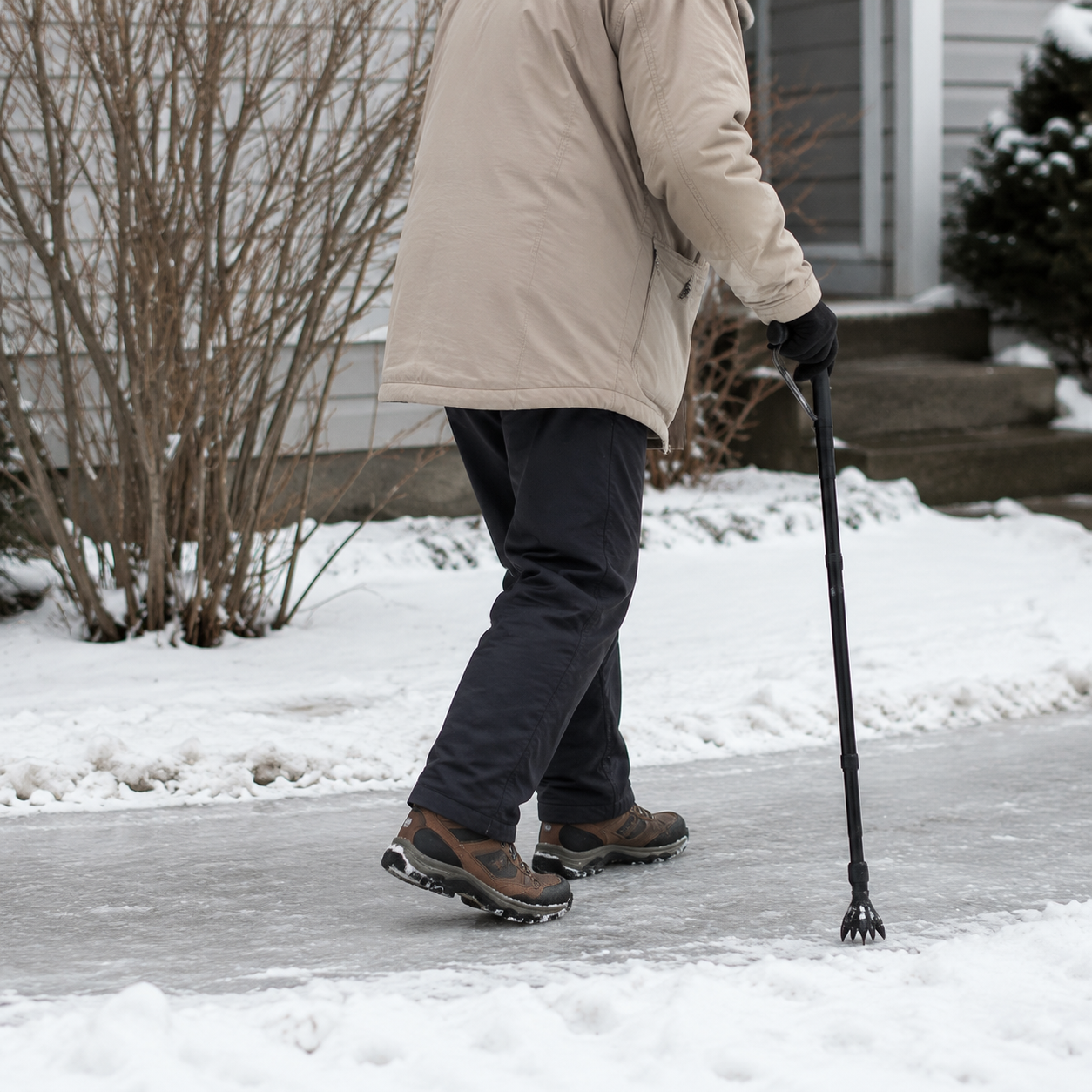
Fix the first five steps outside the door
The first few steps outside are where confidence can outrun traction. An older adult may be willing to “just step out for a second” because the errand feels small. That is exactly why the threshold, porch, ramp, and first section of walkway deserve more attention than the far end of the driveway.
- Keep a small bag or container of ice melt, sand, or cat litter near each exterior door that the older adult uses, so traction can be added before someone steps out.
- Clear snow beyond the door swing, not just a narrow strip, so a cane, walker, or helper can fit without awkward turning.
- Check railings before relying on them; a loose rail is worse than no rail if someone grabs it while slipping.
- Move packages, planters, and snow shovels away from the entry path before the storm, not after the porch is slick.
The National Council on Aging recommends practical winter measures such as using cat litter for icy patches and taking short, flat-footed “penguin” steps with a slight forward lean when walking on ice.[3] That technique is not a reason to send a high-risk parent outside. It is a backup for the unavoidable moment, such as moving from the car to a medical appointment entrance.
Winterize the cane, walker, and shoes
A cane with a worn rubber tip is not winter-ready just because it is familiar. Before snow season, look at the bottom of every cane, walker leg, and crutch. If the rubber is smooth, cracked, uneven, or hardened, replace it. NCOA specifically notes ice-gripper cane tips as one winter option, including products such as the Sure Snow Cane Tip.[3] HealthInAging.org also advises attention to winter footwear and mobility devices as part of older-adult winter safety.[4]
- Use non-slip winter boots with good tread for any unavoidable outdoor walking.
- Do not let slippers, loose house shoes, or smooth-soled dress shoes become “just for the porch” footwear.
- Keep the cane or walker within reach before the storm; do not leave the stable device in the car or garage.
- If an ice-gripper attachment is used, practice with it before the first icy morning so it does not change balance unexpectedly.
Cold itself can also make movement less reliable. CDC material on temperature vulnerability notes that older adults do not adjust as well to sudden temperature changes; cold-related stiffness can affect balance and gait.[5] For fall prevention, that means the first walk after sitting still in a cold room or car should be treated as a higher-risk movement, not a normal one.
Do not bring the ice hazard indoors
A shoveled walk can still end in a fall if the entryway becomes wet. This is the part many families miss because the responsible task has already been done. Someone cleared the snow. Someone salted the step. Then boots drip onto a mat that slides, or meltwater spreads onto tile where a walker has to turn.
- Use a low-profile, non-slip entry mat that does not bunch under a walker.
- Place a towel or absorbent mat where wet boots are removed, but keep it out of the walking line.
- Create a seated place to change shoes so the older adult is not balancing on one foot.
- Dry the floor after every outdoor trip; do not wait until the storm is over.
For a broader seasonal walkthrough, use a storm-prep fall prevention checklist before winter weather is in the forecast. The day of the storm is when small missing pieces become urgent.
Power Outages: Put Light Where the Fall Will Happen
During a power outage, the most dangerous trip may be the ordinary one: bed to bathroom, chair to kitchen, recliner to thermostat, bedroom to medication. A flashlight in the kitchen drawer does not help much if the fall risk is the dark hallway between the bed and the bathroom.
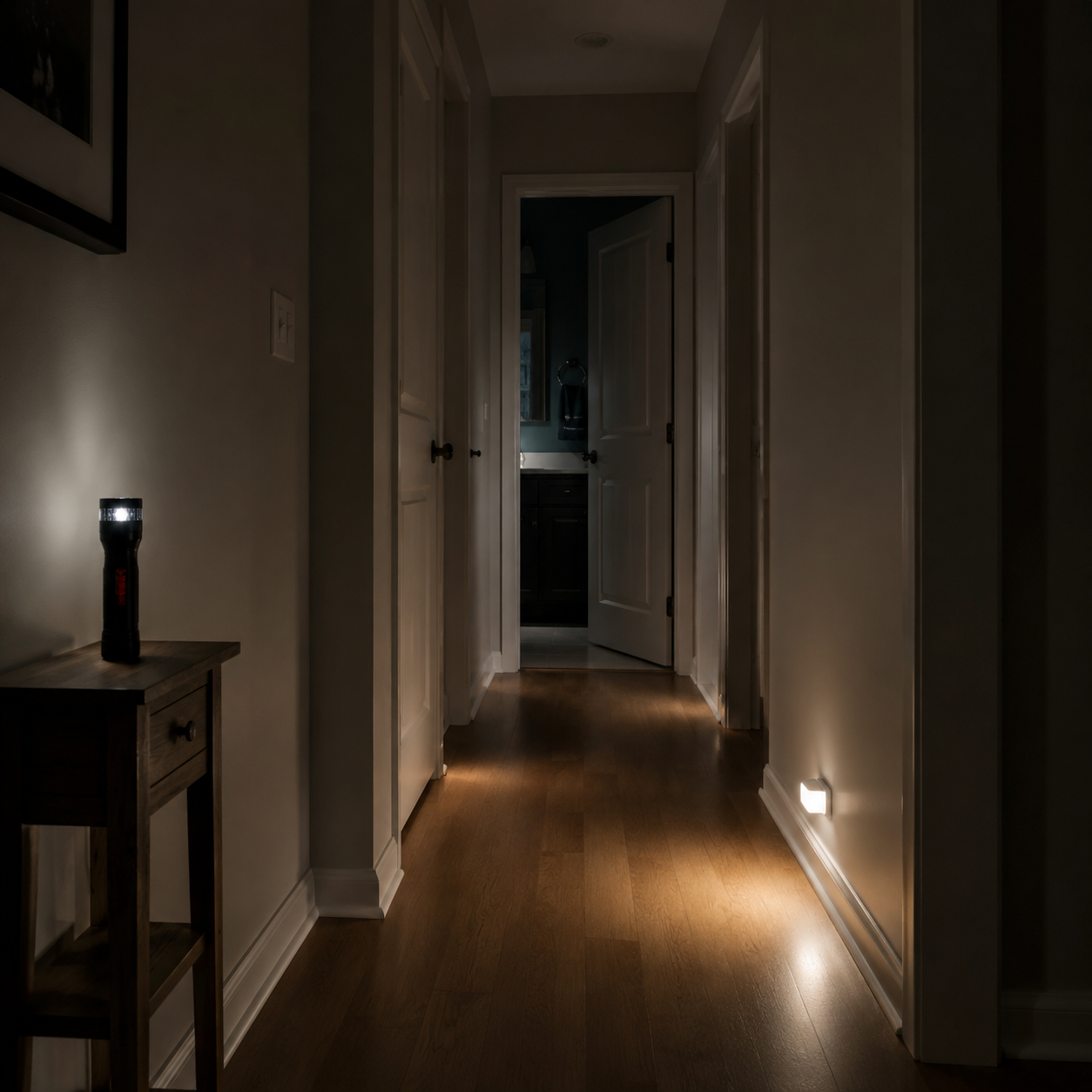
The power-outage plan should be set up before the lights go out, while everyone can still see the rugs, cords, oxygen tubing, thresholds, and furniture corners. If your parent uses oxygen, CPAP, a powered recliner, an electric bed, or a wheelchair, the lighting plan belongs with the medical-equipment plan. A deeper equipment-focused guide is available in severe weather safety tips for elderly with medical needs.
Build the bedroom-to-bathroom route first
If only one route gets special attention, make it the overnight bathroom route. Fatigue, urgency, darkness, and bare feet are a bad combination. The fix is not complicated, but it has to be placed correctly.
- Put a working flashlight within arm’s reach of the bed, not across the room.
- Place battery-powered motion lights low along the hallway and near the bathroom entrance.
- Keep the bathroom door partly open if that makes the route easier to identify.
- Make sure the walker, cane, or bedside commode is exactly where the older adult expects it to be.
- Remove small rugs from the route before the storm; do not rely on someone remembering they are there in the dark.
HealthInAging.org includes area-rug removal and safe indoor footwear among winter safety steps for older adults.[4] Those same basics matter during an outage because darkness makes a known obstacle behave like a hidden one.
Do a daylight cord and tubing sweep
Cords and tubing become worse during outages because people improvise: phone chargers move, extension cords appear, oxygen tubing gets rerouted, and battery packs end up where feet need to go. Before the outage, walk the main route at floor level and clear anything that can catch a toe, cane tip, walker wheel, or slipper.
- Tape or route necessary cords along walls, never across the walking path.
- Keep oxygen tubing out of the hallway whenever possible, and shorten the route if safe to do so.
- Move charging stations onto stable tables rather than the floor.
- Check that grab bars, bed rails, and chair arms can be reached without groping in the dark.
For a room-by-room blackout setup, use the power outage fall prevention checklist for seniors. The main principle is simple: light should already be waiting in the places where the older adult will move, not stored where a younger person would think to look for it.
Evacuations: Plan for the Body That Has to Leave, Not Just the Bag
Evacuation advice often centers on documents, prescriptions, water, chargers, and contact numbers. Those matter. But for an older adult with balance or mobility problems, the first emergency may be getting from the chair to the car, from the car to a shelter entrance, or from a curb across wet and uneven ground.
The mobility part of the evacuation plan should be decided before the warning becomes urgent. Rushed walking is not a neutral detail; it changes how carefully someone places a cane, whether they accept help, and whether they choose proper shoes.
- Keep the usual cane or walker accessible, not packed underneath supplies.
- Store a backup cane, spare cane tips, or walker accessories with the go-bag if the older adult depends on them.
- Charge wheelchair or scooter batteries early, and know how the device will be transported.
- Set out closed-back, non-slip shoes before the evacuation order is possible.
- Identify one person who can provide physical assistance, not just someone who can “check in.”
For hurricane-prone households, evacuation planning overlaps with medical-equipment planning. The hurricane preparedness guide for seniors with medical needs is the better place to go deeper on power-dependent devices, transportation, and medical documentation. Here, the fall-prevention question stays narrower: can this person move safely through the evacuation route with the device, footwear, lighting, and help they will actually have?
After the Storm: Do Not Retire the Fall Plan Too Early
Fall risk often lasts longer than the alert. After a storm, people are tired, routines are disrupted, and the house may look safe enough from the doorway. That is when an older adult may try to help by picking up branches, checking the mailbox, sweeping water, or stepping onto the porch before anyone has inspected the surface.
The post-storm check should happen before the older adult resumes normal outdoor routines. Look for wet leaves on walkways, branches partly hidden in grass, loose railings, shifted pavers, torn mats, puddles near thresholds, and slick floors just inside exterior doors. If there was a power outage, also check whether cords, battery packs, and temporary lights are still creating trip hazards.
- Assign cleanup tasks that do not require bending, carrying, or walking on wet ground.
- Delay mailbox, trash, and porch trips until the route has been checked.
- Keep non-slip shoes on during cleanup days, even for short outdoor trips.
- Re-dry the entryway repeatedly if people are tracking water or debris indoors.
- Treat fatigue as a fall hazard; the second or third cleanup trip may be less safe than the first.
This is also where family dynamics matter. Many older adults want to prove they are still useful, especially after watching others work around them. The safer answer is not to forbid every contribution. It is to choose the contribution before the hazardous one appears: folding towels, making calls, sorting batteries, checking medication lists, or sitting near the door to tell others what still needs to be moved.
A Reusable Weather-Fall Walkthrough
Before the next alert, walk through the home once with the specific weather event in mind. Do not try to redesign the whole house. Follow the older adult’s real movements and fix what the weather will change.
- Name the scenario: winter storm, power outage, evacuation, cleanup, heat wave, or another weather event.
- Trace the required routes: bed to bathroom, chair to kitchen, door to car, door to mailbox, bedroom to medication.
- Identify what will change: traction, lighting, surface wetness, timing, temperature, equipment access, or help.
- Place the fix where the movement happens: light in the hallway, cane by the bed, cat litter near the door, shoes by the exit.
- Remove the new trip hazards created by preparation itself: cords, mats, stacked supplies, buckets, chargers, and relocated furniture.
For a broader explanation of why storms raise fall risk, see why storms create a dangerous fall risk for seniors. For the warm-weather counterpart, heat-wave fall risk in older adults deserves its own planning because dehydration, heat stress, and medication routines create a different pattern of risk.
Caregivers cannot control the storm, and they should not carry guilt for every hazard that appears. But they can anticipate how the storm will alter walking surfaces, lighting, routines, mobility aids, and cleanup demands. That is the part of severe weather safety that is small enough to do and important enough not to leave vague.
References
- Older Adult Falls Data and Statistics, Centers for Disease Control and Prevention.
- Winter Falls Aren’t Inevitable, CoxHealth.
- Winterize to Prevent Falls, National Council on Aging.
- Tip Sheet: Winter Safety for Older Adults, HealthInAging.org.
- Heat and Older Adults, Centers for Disease Control and Prevention.
Related reading
Noticed something outdated or inaccurate on this page? Flag a correction. We review every report against CDC, NIA, and AARP HomeFit guidance before updating a page.
Part of the Fall Prevention section.