
STEADI: Intervene
There's No Single Ideal AC Temperature for Seniors at Night
Most AC-temperature advice for seniors at night quotes different numbers because it answers different questions. Here is the evidence-backed target: measure the bedside temperature and aim for 68–77°F, then set the thermostat to reach it — an adjustment that also works as a practical fall-prevention step.
The reason you keep seeing different answers for the ideal AC temperature for seniors sleeping at night is that the numbers are answering different questions.
For an older adult’s bedroom, the most useful starting target is not a thermostat setting. It is a measured bedside room temperature of about 68–77°F. In a monitored study of 50 community-dwelling adults age 65 and older in Boston, sleep was most efficient and restful when bedroom temperature was 20–25°C, or 68–77°F; sleep efficiency dropped by 5–10% as measured bedroom temperature rose from 25°C to 30°C, or 77°F to 86°F.[1]
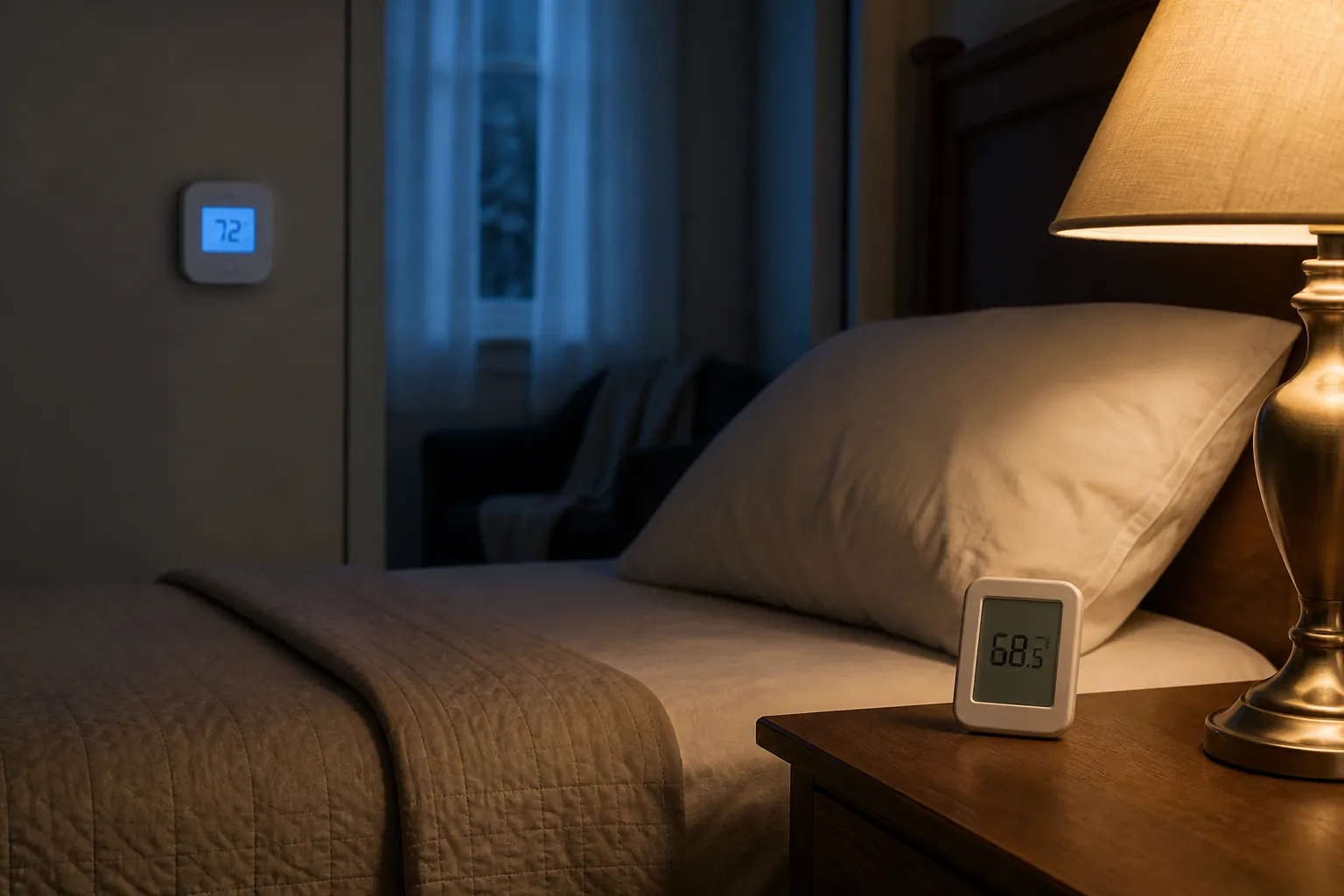
That does not mean every senior should set the wall thermostat to 72°F and stop thinking. A thermostat in the hallway may have very little to do with the air around the pillow. A sunny upstairs bedroom, a closed door, a weak vent, a window unit on the far wall, or heavy bedding can make the sleeping area several degrees warmer or cooler than the display suggests. The number that matters is the one near the person sleeping.
Why the common temperature numbers disagree
The 60–67°F number often quoted online is general adult sleep-environment advice, not a senior-specific bedroom finding.[2] The 68–77°F range comes from measured bedroom-temperature research in older adults.[1] The 75°F line belongs to a newer cardiovascular signal: in adults 65 and older, bedroom temperatures at and above 24°C were associated with higher odds of clinically relevant drops in heart-rate variability compared with temperatures below 24°C.[3] And the 78°F awake / 82°F asleep figures commonly attributed to Energy Star are energy-saving defaults, not a health guideline for older adults sleeping through a hot night.[4]
| Number you may have seen | What it is actually about | How to use it for an older adult |
|---|---|---|
| 60–67°F | General adult sleep advice | Do not treat it as senior-specific. Some older adults may find it too cold. |
| 68–77°F | Measured bedroom-temperature range where older adults in one study slept most efficiently and restfully | Use as the starting bedside target, then personalize. |
| About 75°F / 24°C | A heart-rate-variability signal in older adults, not a separate AC prescription | Pay attention when the bedroom is regularly warmer than this, especially in frail adults or those with heart concerns. |
| 78–82°F | Energy-saving thermostat guidance | Do not use it as proof that a senior’s bedroom is safe or sleep-friendly. |
There is another number that gets misused in summer AC advice: the National Institute on Aging advises keeping heat set to at least 68–70°F in cold weather, and warns that even mildly cool homes at 60–65°F can contribute to hypothermia in older adults.[5] That is winter heating and hypothermia guidance. It is not a recommendation to air-condition a bedroom to 68°F in July.
Set the bedroom, not the thermostat
A thermostat is a control, not a measurement of the bed. For a senior sleeping at night, the practical setup is simple: put a small digital thermometer on the nightstand, dresser, or shelf near bed height, away from a direct AC blast, lamp heat, or sunny window. Check it at bedtime. If possible, check it again during the warmest part of the night or first thing in the morning before the room has been cooled down by daytime routines.
If the bedside thermometer says 80°F while the thermostat says 76°F, believe the bedside thermometer. If the bedroom is measuring 78–80°F overnight and the older adult is waking sweaty, restless, dizzy, or unusually tired in the morning, lower the thermostat by 1–2°F for several nights and watch what changes. If the bedside area measures 68°F but the person wakes chilled, stiff, or layered under heavy blankets, that may be too cool for that person even though it sits inside the research range.
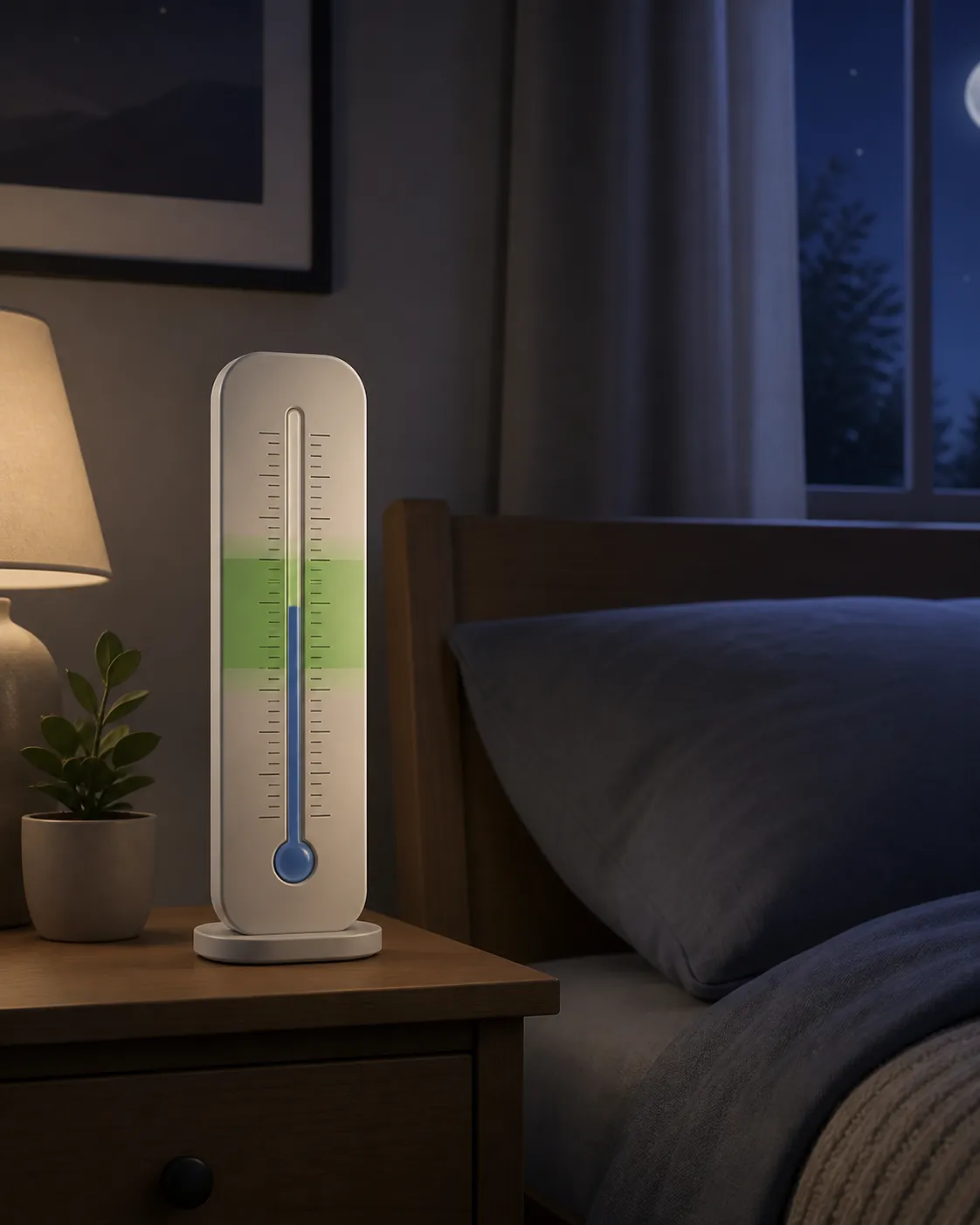
The Boston study is useful precisely because it gives families a defensible range without pretending every older body responds the same way. It included about 10,903 person-nights from 50 adults age 65 and older, with substantial person-to-person variation in the temperature associated with better sleep.[1] That variation matters in real homes. One parent may sleep well at a measured 70°F. Another may do better closer to 75°F. A third may need a cooler room because the upstairs bedroom traps heat after sunset.
So the cleanest rule is this: aim for 68–77°F where the person sleeps, then adjust the thermostat only as much as needed to make that happen. In many homes, that means setting the AC a few degrees lower than the desired bedside temperature, especially when the bedroom is upstairs, the door is closed, or the thermostat is in a cooler hallway.
For a broader home heat routine, especially when an older adult lives alone or has unreliable cooling, use a room thermometer as part of a simple daily check. The heat-wave safety checklist for seniors is a better next step than arguing over one thermostat number.
Why warmer nights matter beyond comfort
The sleep-temperature study does not prove that a warm bedroom causes falls. It does show that, in older adults, warmer measured bedrooms were associated with less efficient sleep over monitored nights.[1] That is enough to take the bedroom temperature seriously, because the next parts of the nighttime chain are already familiar in caregiving: poor sleep, waking to urinate, standing up half-alert, walking to the bathroom in low light, and trying to get back to bed without a stumble.
A 2026 analysis of 10,321 adults age 65 and older found that sleeping fewer than 7 hours was associated with about 1.5 times higher odds of a past-year fall.[6] That is an association, not proof that extending sleep prevents falls. Still, if a too-warm bedroom is one of the reasons an older adult sleeps badly, it becomes part of the fall-prevention conversation.
Bathroom trips are the part of that conversation families often underestimate. A review in Sleep Medicine reported that about 53% of older adults cited bathroom trips as a nightly cause of disturbed sleep; nocturia independently predicted insomnia, and most nocturnal falls occurred in connection with bathroom trips, compared with less than 20% of daytime falls.[7] Northwestern Medicine also notes that about 25% of all falls in older adults happen in the middle of the night, with some related to nocturia.[8]
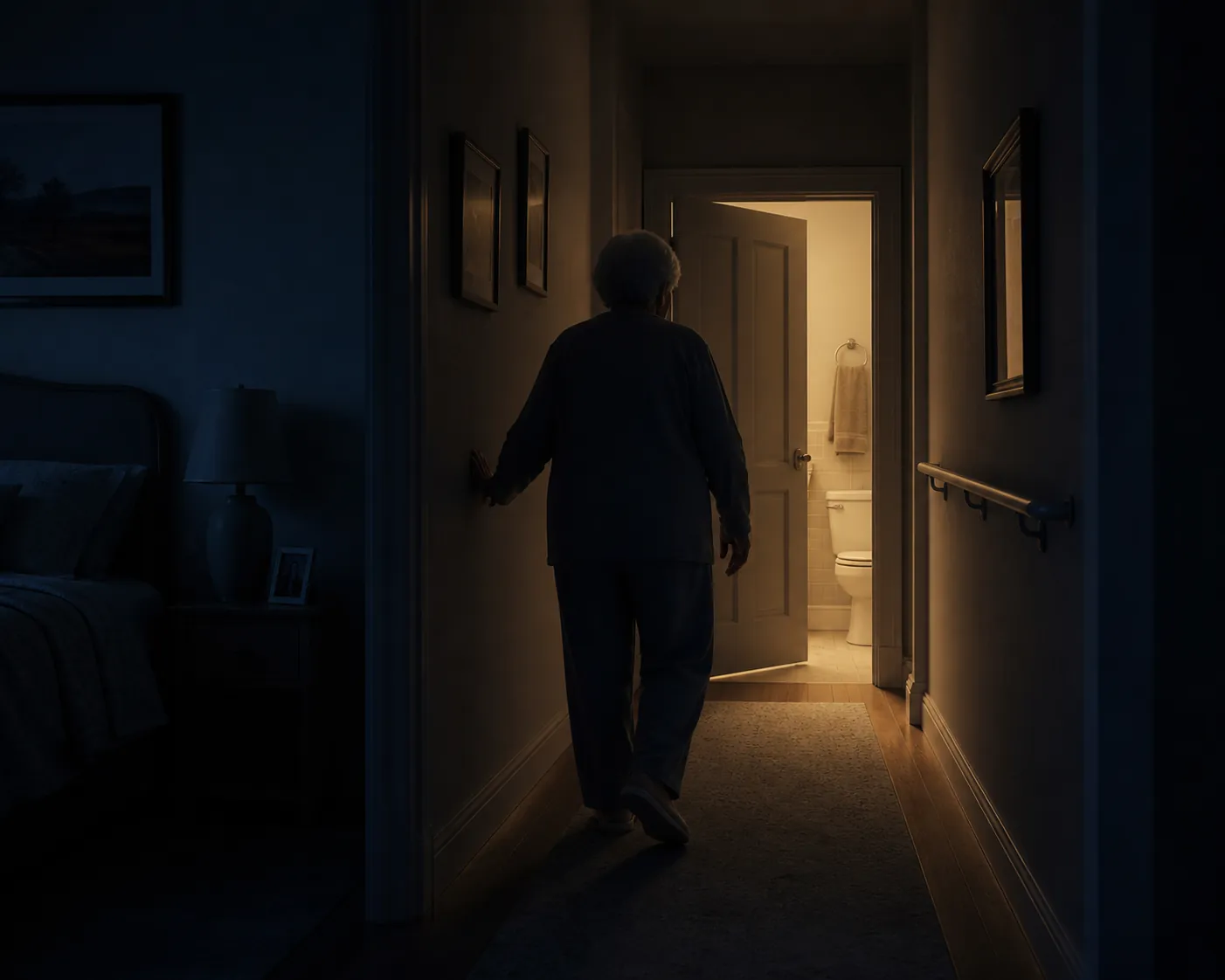
This is the useful, honest claim: controlling bedroom temperature may reduce one contributor to poor sleep and nighttime waking. Fewer restless awakenings may mean fewer risky trips across the room or down the hall. The evidence does not let anyone say that setting the AC to a certain number prevents falls. It does support treating the sleeping environment as part of the route to the bathroom.
The 75°F heart signal belongs in the background, not on the thermostat dial
The heart-rate-variability research is a good reason not to wave away warm bedrooms as merely uncomfortable. In a 2025 study of 47 adults age 65 and older, compared with bedroom temperatures below 24°C, temperatures of 24–26°C, 26–28°C, and 28–32°C were associated with progressively higher odds of clinically relevant heart-rate-variability drops, with odds ratios of 1.4, 2.0, and 2.9; the study also found elevated nighttime heart rate at warmer temperatures.[3]
Use Celsius carefully here: 24°C is about 75°F, not 79°F. Public coverage of the study also reported a median bedroom temperature of 25.9°C, meaning many monitored older adults were sleeping above the 68–77°F sleep-efficiency zone.[9] That does not create a new universal cutoff. It adds physiological weight to the practical observation that, for many seniors, a bedroom drifting above the mid-70s overnight deserves attention.
How to adjust the AC without overcorrecting
Start with measurement for three ordinary nights if the situation is not urgent. Write down the bedside temperature at bedtime and, if practical, once overnight or early in the morning. Also note whether the person woke sweaty, chilled, lightheaded, unusually thirsty, confused, or more tired than usual.
- If the bedside temperature is above 77°F and sleep is restless, lower the thermostat by 1–2°F and recheck the bedside reading.
- If the bedside temperature is within 68–77°F and the person sleeps well, do not chase a colder number just because one chart says adults sleep best in the 60s.
- If the person wakes chilled or stiff, raise the target slightly or adjust bedding before assuming colder is safer.
- If the bedroom stays hot despite AC changes, look for blocked vents, closed doors, sun-heated rooms, weak window units, or a thermostat located far from the sleeping area.
- If cooling is limited by cost, prioritize the sleeping room first. A safe sleeping zone matters more than making the whole home feel equally cool overnight.
Older adults may not respond to heat and cold as predictably as younger adults. The CDC notes that people age 65 and older adjust less well to sudden temperature changes, and that some medicines can affect temperature control or sweating.[10] UCLA Health describes age-related changes that can affect temperature regulation, including a less sensitive hypothalamus, slower metabolism, thinner skin and fat insulation, and reduced circulation.[11] That is why “I feel fine” is useful information, but not the only safety check.
The same goes for the thermostat display. “It says 78” does not tell you whether the pillow area is 81°F, whether the person is sweating through pajamas, or whether the bathroom route is being used four times a night after poor sleep.
When a fan or small adjustment is not enough
This article is not a heat-wave emergency plan, but the boundary matters. The CDC warns that older adults should not rely on a fan as the main cooling source during extreme heat.[10] A fan can make a tolerable room feel better; it cannot make a dangerously hot room safe by itself.
Heat stroke is a medical emergency. The National Institute on Aging lists warning signs including body temperature above 104°F, confusion, staggering, and dry, flushed skin.[12] Sudden dizziness or faintness in hot conditions can also happen indoors.[12] If those signs appear, call 911. If heat is rising in the home and the older adult is alone, unwell, or not drinking normally, the safer move may be relocation to a cooled space, a call to a neighbor or family member, or emergency care—not one more thermostat experiment.
For seniors who live alone in extreme heat, thirst is also an unreliable safety signal. The guide In Extreme Heat, Seniors Living Alone Can’t Trust Thirst covers indoor temperature checks, fan limits, and when the situation should escalate.
The opposite problem is possible too, especially with overcooling, poor circulation, thin bedding, illness, or a person who cannot adjust the thermostat independently. Hypothermia is a body temperature below 95°F and requires emergency care; call 911 if it is suspected. The NIA warns that older adults can become dangerously cold even when a home does not feel freezing to someone else.[5]
Low-cost fixes that usually come before a new cooling system
A bedside thermometer is the first purchase, not a fancy thermostat accessory. After that, the best low-cost changes are the ones that keep the sleeping area closer to the measured target and make the bathroom route safer if the person wakes anyway.
- Put the thermometer near the bed and use it nightly during hot spells.
- Keep the bedroom door positioned in the way that actually improves cooling; in some homes that means open, in others it means closed with a room unit running.
- Use lighter bedding and sleepwear before driving the room much colder.
- Block late-day sun in the bedroom before it loads the room with heat.
- Add night lights from bed to bathroom so waking up is not followed by walking blind.
- Clear cords, shoes, laundry, and throw rugs from the nighttime bathroom path.
If money is tight, rank purchases by what changes the actual risk: a thermometer, night lights, working AC or a properly placed room unit, hydration supplies, and a safer bathroom path. For a cost-ranked version, see Which Summer Safety Essentials Matter Most on a Budget.
The practical answer
There is no single ideal AC setting for seniors at night. There is a better target: measure the temperature where the person sleeps and aim first for 68–77°F. Then use the thermostat, fan, door position, bedding, and window coverings to make the bedside reading—not the wall display—land in that range.
Treat that adjustment as both sleep care and fall-prevention housekeeping. A cooler, steadier bedroom will not guarantee fewer falls. It can reduce one common source of restless nights and nighttime bathroom exposure, which is a small, concrete safety gain worth making before the next hot night.
References
- Nighttime ambient temperature and sleep in community-dwelling older adults. Science of the Total Environment. 2023. https://pmc.ncbi.nlm.nih.gov/articles/PMC10529213/
- The Best Temperature for Sleep. Sleep Foundation. https://www.sleepfoundation.org/bedroom-environment/best-temperature-for-sleep
- Bedroom temperature linked to sleep autonomic cardiovascular health in older adults. BMC Medicine. 2025. https://pubmed.ncbi.nlm.nih.gov/41462246/
- Energy Star recommends you keep your home this hot during summer. CNN. 2019. https://www.cnn.com/2019/08/20/health/thermostat-recommendations-energy-star-trnd
- Cold Weather Safety for Older Adults. National Institute on Aging. https://www.nia.nih.gov/health/safety/cold-weather-safety-older-adults
- Association between sleep duration and falls in older adults: evidence from a nationally representative sample. BMC Geriatrics. 2026. https://pmc.ncbi.nlm.nih.gov/articles/PMC12918536/
- Nocturia and disturbed sleep in the elderly. Sleep Medicine. 2009. https://pmc.ncbi.nlm.nih.gov/articles/PMC2735085/
- How to Stop Peeing in the Middle of the Night. Northwestern Medicine. https://www.nm.org/healthbeat/healthy-tips/how-to-stop-peeing-in-the-middle-of-the-night
- Study links warmer bedrooms to heart stress in older adults. ScienceDaily. 2026. https://www.sciencedaily.com/releases/2026/02/260210040625.htm
- Heat and Older Adults Aged 65+. Centers for Disease Control and Prevention. https://www.cdc.gov/heat-health/risk-factors/heat-and-older-adults-aged-65.html
- Feeling colder as you get older? Why it happens and what to do. UCLA Health. https://www.uclahealth.org/news/article/feeling-colder-you-get-older-why-it-happens-and-what-do-2
- Hot Weather Safety for Older Adults. National Institute on Aging. https://www.nia.nih.gov/health/safety/hot-weather-safety-older-adults
Related reading
Noticed something outdated or inaccurate on this page? Flag a correction. We review every report against CDC, NIA, and AARP HomeFit guidance before updating a page.
Part of the Fall Prevention section.