
STEADI: Intervene
Tornado Warning Checklist for Seniors and Caregivers
Tornado warnings average about 13 minutes of lead time — too little for an older adult to improvise. This warning-time checklist starts at the watch stage for limited mobility, branches sheltering by need, and covers the all-clear.
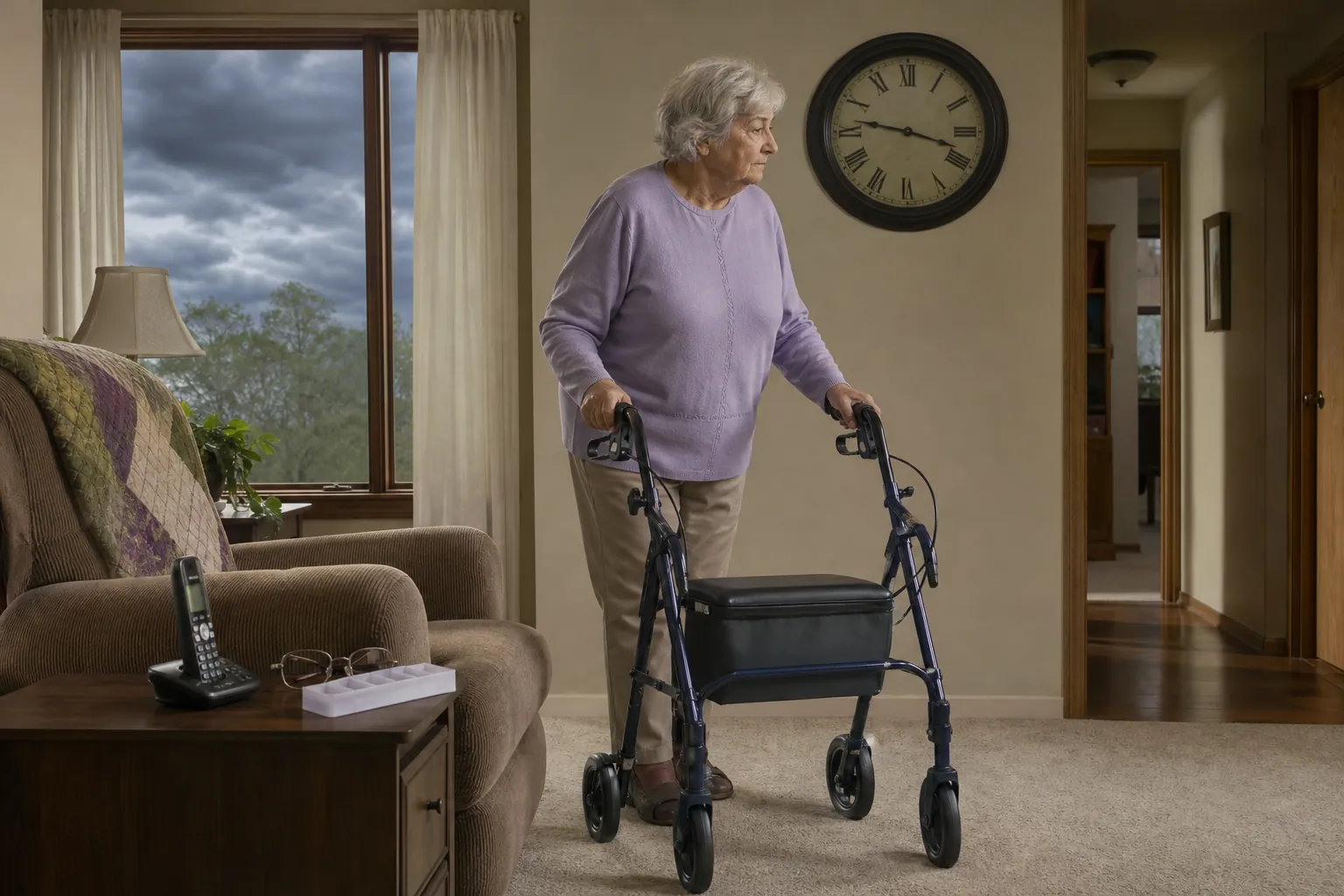
A tornado warning is a short clock for anyone. For an older adult who needs time to stand up, steady a walker, put on shoes, hear the alert clearly, gather a phone, and reach an interior room, it can become too short to spend on decisions.
NOAA says current average tornado warning lead time is about 13 minutes, and describes tornado warnings as usually covering portions of one or two counties for an hour or less [1]. That is the reason an emergency preparedness checklist for seniors during a tornado warning cannot begin with “decide where to go.” The decision has to be made earlier.
The National Weather Service makes that distinction explicit: elderly or disabled people with lower mobility may need to act when a tornado watch is issued instead of waiting for the warning [2]. That is not panic. It is time management.
CareWise Guide places this article in fall prevention because, for many seniors, the danger is not only the tornado. It is the rushed transfer out of a chair, the cluttered hallway, the dim bathroom route, the stairway to a basement that is no longer realistic, and the debris-strewn trip back afterward. This checklist supports planning and communication; it does not replace official tornado watches, warnings, local emergency instructions, or individualized medical advice.
The short version: what happens at each stage
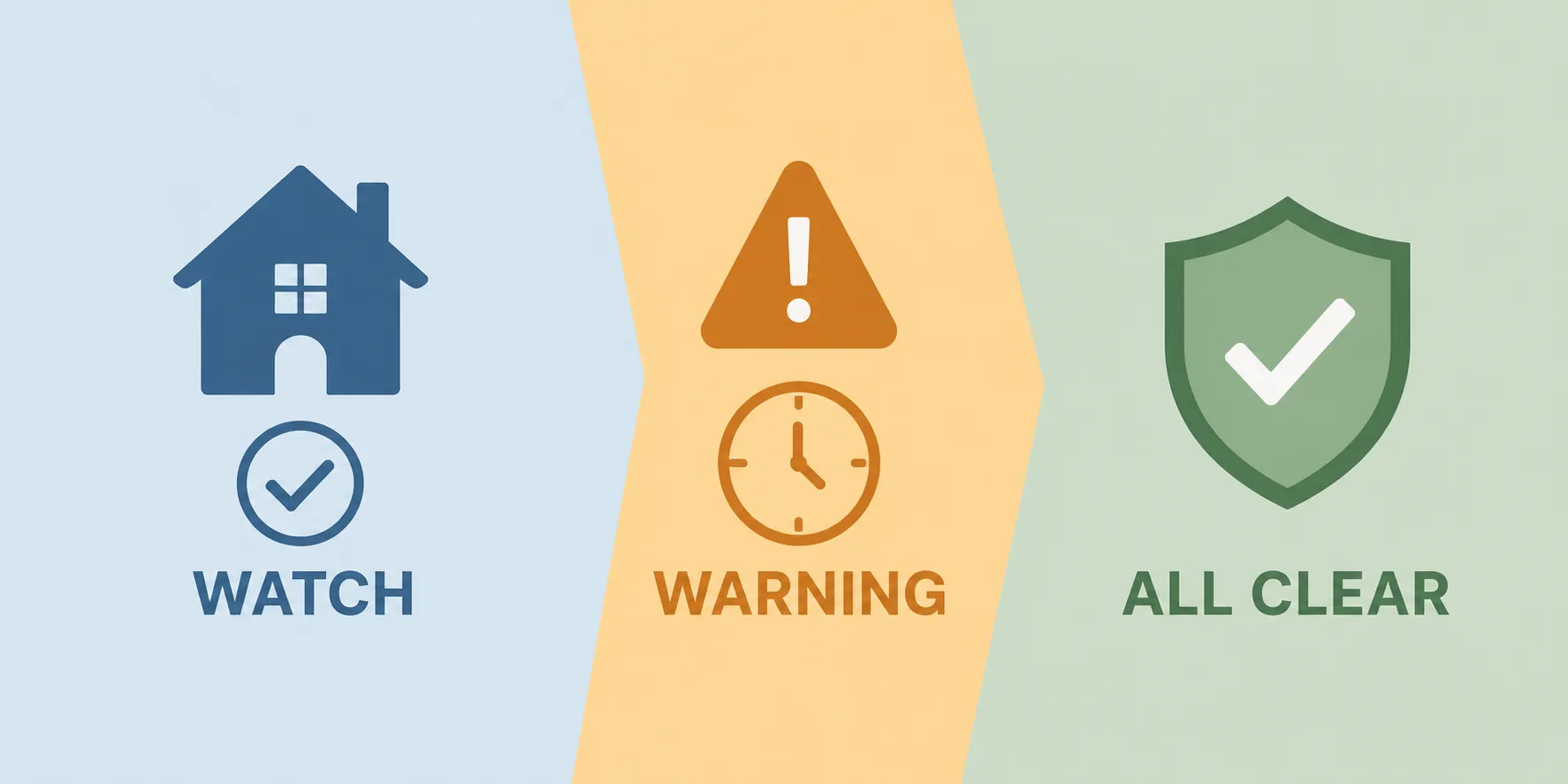
| Stage | What it means for a senior | What to do |
|---|---|---|
| Tornado watch | Conditions are possible; this is the decision window for anyone who moves slowly or needs help. | Choose the shelter spot, clear the route, place shoes/phone/keys/medication list nearby, confirm alerts, and arrange helper access. |
| Tornado warning | The movement window is open, but it may be very short. | Go to the preselected shelter immediately. Do not start comparing rooms, looking for supplies, or calling multiple people before moving. |
| Shelter time | The safest position depends on the home, mobility, and equipment limits. | Use a basement if reachable; otherwise use a small interior windowless room on the lowest floor. Cover the head and neck. |
| All-clear | Leaving too early can put the person back into wind, debris, broken glass, or electrical hazards. | Stay sheltered until the warning expires or officials give the all-clear, then move slowly and check the route before standing or transferring. |
At the watch stage, remove decisions from the warning
For a senior with good mobility, a tornado watch may simply mean staying alert. For a person who needs a walker, wheelchair, oxygen tubing, hearing support, help with stairs, or several minutes to rise safely from bed, the watch is the time to begin the route.
Start with the shelter decision. If the basement is reachable without rushing, make it the first choice. If stairs are unsafe, too slow, or require a helper who is not already there, choose the best reachable room instead: a small interior room without windows on the lowest floor, such as an interior bathroom, closet, or hallway. Ready.gov identifies a basement or small interior windowless room on the lowest floor as the tornado shelter priority, with the head and neck covered once there [4].
Then walk the route in plain terms. From the recliner. From the bed. From the bathroom. From the kitchen. If the person cannot get from each likely starting place to the shelter location before the warning window closes, the plan is not ready.
- Move throw rugs, cords, baskets, pet bowls, and low furniture out of the shelter route.
- Put sturdy slip-on shoes where they can be reached without crossing the room.
- Place the phone, charger or battery pack, keys, glasses, hearing aids, and mobility device on the travel side of the chair or bed.
- Keep a written list of medical needs, limitations, medications, allergies, and emergency contacts in the go-with-you bag or pocket.
- Put any must-travel medical items close enough to grab without delaying movement.
- Unlock or arrange access only if doing so is part of a safe helper plan; do not leave exterior doors unsecured without a reason.
CDC tornado guidance for people with special health-care needs recommends carrying written information about needs, limitations, medications, and allergies, and arranging a spare key and copy of that information with a nearby trusted person [5]. That matters most when the caregiver is not in the house. A daughter two states away cannot lift a parent from a recliner, but she can know which neighbor has the spare key, which room is the shelter room, and which phone number to call if the parent stops answering.
Confirm alerts in a way the person will actually notice
A warning that arrives silently is not a warning for that household. At the watch stage, confirm that at least two alert channels are working: Wireless Emergency Alerts on the phone, a weather radio if used, local TV or radio, local emergency alerts, or a trusted call plan. CDC notes accessible alert options such as scrolled television warnings and call-in weather lines for people who may need them [5].
For hearing loss, do not rely only on an outdoor siren. Sirens are mainly outdoor alerts, and a senior inside with the television off, hearing aids out, or a loud appliance running may not hear them clearly. Use alerts that vibrate, flash, display text, or trigger a caregiver call.
When the warning fires: move first, then communicate
Once a tornado warning is issued for the area, the senior should go to the preselected shelter place immediately. The caregiver’s first sentence should be short and directional: “Go to the hallway bathroom now. Take your walker, phone, shoes, and blue bag.” A long explanation costs time and may lead the person to stop in place.
If the older adult is already moving, stay on the phone only if it helps. If holding the phone interferes with the walker, wheelchair, transfer, or stair rail, the phone belongs in a pocket, pouch, or bag. The safest call is not the one that keeps the caregiver reassured; it is the one that gets the person into shelter without dividing attention.
- Stand up slowly enough to avoid losing balance, but do not detour for nonessential belongings.
- Put on shoes if they are within reach; do not cross the home barefoot to find a different pair.
- Take the phone, keys, glasses, hearing aids if available, medication/needs list, and needed mobility or medical items already staged.
- Move to the chosen shelter by the cleared route.
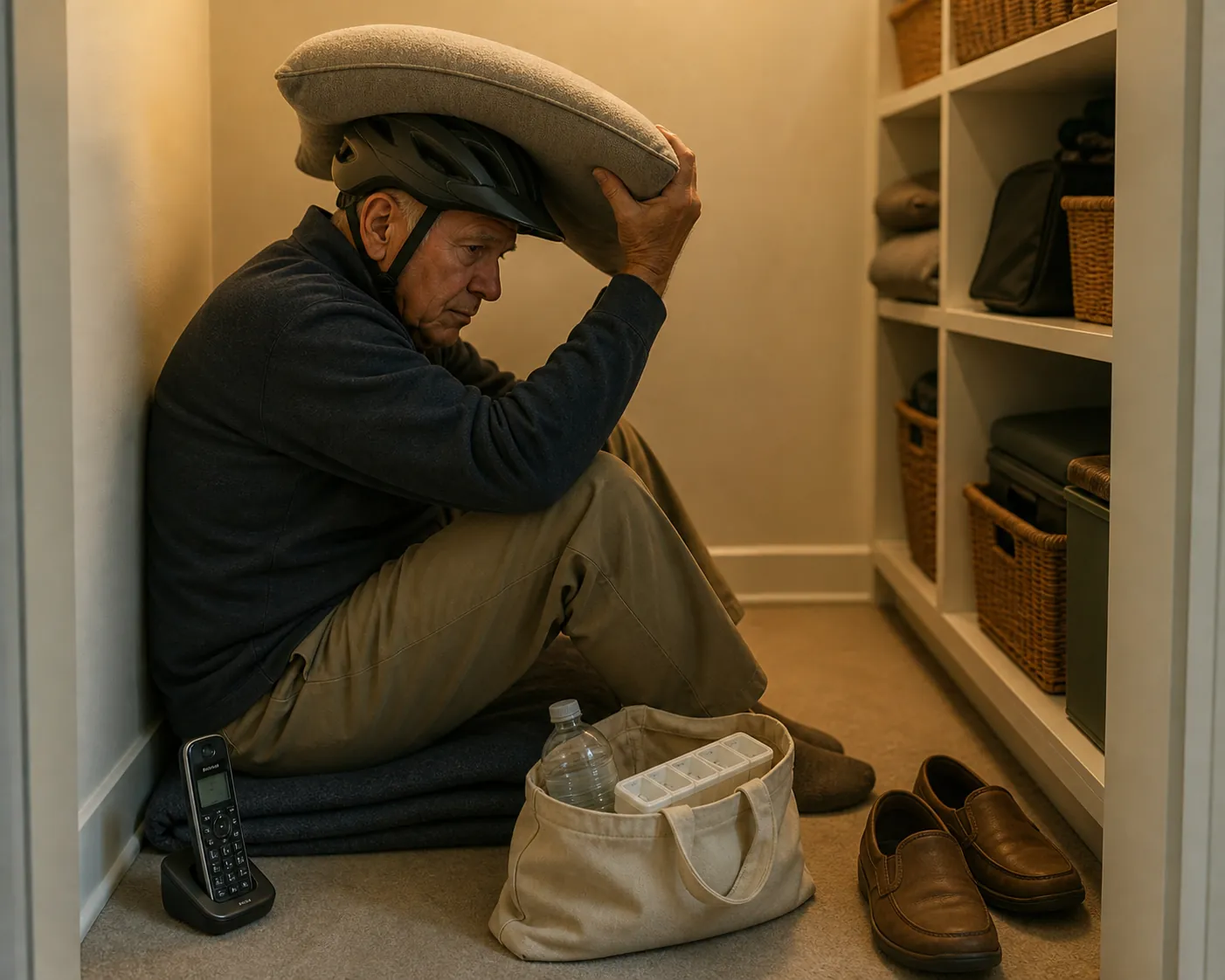
- Sit or position as low as safely possible and cover the head and neck.
Choose the shelter branch that matches the real limitation
The best shelter is not the theoretically strongest place in the home if the person cannot reach it safely under warning conditions. Use the highest-protection option that is actually reachable before the warning window is gone.
If the basement is reachable
Go there early, especially if stairs are slow. Keep one hand on the rail, use the mobility plan already practiced, and do not carry loose items that block balance. Once downstairs, stay away from windows and position under sturdy protection if available. Cover the head and neck.
If the basement is not realistic
Use a small interior windowless room on the lowest floor. A half bath, interior closet, or short interior hallway may be safer than trying to manage stairs during a warning. Close doors if that can be done without delaying shelter, sit low, lock walker brakes if seated on a rollator only as a last resort, and cover the head and neck.
If the person uses a walker or rollator
The watch-stage route matters most here. The walker should already be beside the person, not parked across the room. The shelter path should be wide enough for turns, with no rug edges or cords to catch the wheels. If the safest room is a bathroom, check in advance whether the walker fits through the doorway; a plan that fails at the door is not a plan.
During the warning, the person should not abandon the walker to move faster unless a helper is physically assisting and the transfer has been practiced. A fall in the hallway can leave the person exposed and unreachable.
If the person uses a wheelchair
Choose a shelter room with a doorway, turning radius, and floor surface that the wheelchair can manage. If the ideal interior room is too narrow, choose the nearest safer interior area that can be entered quickly rather than depending on a transfer that may not happen under stress.
Once in place, lock the wheels. If a transfer to the floor is not safe, stay in the chair, move away from windows, protect the head and neck, and keep the medical/needs list on the person or attached to the chair.
If hearing loss may delay the warning
The caregiver plan should not depend on the senior answering a single call. Use layered alerts: phone vibration, text, weather radio with visual or bed-shaker features if available, captioned television alerts, and a neighbor or building staff contact when appropriate. At the watch stage, hearing aids, glasses, and phone should be placed together so the person is not searching for the tools needed to understand instructions.
If the senior lives in a mobile home
A mobile home should not be treated as the shelter plan. Ready.gov states not to stay in a mobile home during a tornado and not to shelter in a vehicle or under an overpass [4]. For a senior with lower mobility, that means relocation has to happen at the watch stage if a sturdy building, community shelter, or neighbor’s home is part of the plan.
The practical question is not “Where should Mom go if the warning comes?” It is “Who helps Mom get to the sturdy shelter before the warning?” If the answer requires driving after the warning is issued, the plan is already too late for many households.
If the person is in a vehicle
The vehicle is not the shelter destination. If there is time to get to a sturdy building immediately, do that. Do not use an overpass as a tornado shelter [4]. For caregivers, the safer plan is to keep weather-aware days from becoming errand days for a senior who cannot move quickly from a parking lot to a building.
If medical equipment depends on power
Power-dependent equipment belongs in the plan-ahead column, not in the warning-time scramble. At the watch stage, bring portable equipment, backup supplies already designated for travel, and the written medical needs list to the shelter area if doing so does not delay movement. If the device cannot move, the caregiver and senior should know in advance what the backup action is and who to call if power is lost.
Do not improvise medical changes because of a checklist. Equipment settings, oxygen use, and medication decisions should follow the person’s clinician-approved emergency plan.
Head protection is not an extra
Older adults deserve a separate tornado checklist partly because their risk is not evenly shared across the population. In CDC’s report on tornado-related fatalities across five states during April 25–28, 2011, 32.5% of decedents were aged 65 or older, and head injury was involved in 21.9% of deaths [3]. That report does not tell us what will happen in any one home, but it does support taking head and neck protection seriously.
A helmet, thick cushion, folded blanket, or firm pillow should be staged where the senior shelters, not stored on a high shelf. The item only helps if it can be reached while seated or after getting low. Ready.gov also instructs people sheltering from a tornado to cover the head and neck [4].
Caregiver script for a warning call
A caregiver calling during a warning has one job first: get the person moving to the already chosen shelter. The call should not begin with weather details, radar interpretation, or debate.
- “There is a tornado warning for your area. Go to the interior bathroom now.”
- “Take your walker, phone, glasses, shoes, and emergency information card.”
- “Do not go to the front window or porch to look.”
- “Sit low, away from windows, and cover your head and neck.”
- “I will stay on the line if it does not slow you down. If the call drops, stay sheltered until the warning expires or officials give the all-clear.”
If the caregiver is remote and the senior does not answer, use the agreed backup order: nearby helper, building staff, local nonemergency line if appropriate, or emergency services if there is reason to believe the person is in immediate danger. This order should be written before storm season, not invented while alerts are sounding.
Medication and documents: carry information, do not count pills during the warning
Medication planning matters, but the warning window is the wrong time to sort bottles. Keep a current medication list, allergy list, diagnoses or key limitations, clinician contacts, pharmacy information, and emergency contacts in a small bag, folder, or wallet card that travels with the person.
If a medication, inhaler, glucose item, hearing aid case, or other item is essential during a short shelter period, stage it at the watch stage. Longer medication supplies belong in a broader emergency plan and should follow the person’s health needs, refill rules, and clinician or pharmacist guidance. This checklist should not collapse different supply recommendations into one warning-time rule.
When to come out
Stay in the shelter place until the warning expires or officials give the all-clear. Do not leave because the wind sounds calmer, because a neighbor stepped outside, or because the caregiver wants a visual check of the house. The first move after sheltering is often when a fall happens: standing too quickly, stepping onto broken glass, catching a walker on debris, or walking into a dark hallway without checking the floor.
- Before standing, turn on a flashlight or phone light and look for glass, water, loose objects, and shifted furniture.
- Put on shoes before leaving the shelter room if they are not already on.
- Check that the walker, cane, or wheelchair path is clear before transferring.
- Avoid downed lines, damaged electrical areas, gas smells, and unstable debris.
- Use the helper plan if the normal route through the home is blocked or unsafe.
CDC tornado safety guidance also warns against carbon monoxide hazards after a storm, including unsafe generator or fuel-burning equipment use [5]. For a senior sheltering at home, that means generators, grills, camp stoves, and similar equipment do not come indoors or into enclosed spaces because the power is out.
For seniors, the safest tornado-warning checklist starts before the warning and leaves the warning window for movement, not decision-making.
References
- Tornadoes 101 — NOAA — https://www.noaa.gov/stories/tornadoes-101
- Social Media: Tornado Safety — National Weather Service — https://www.weather.gov/wrn/tornado-sm
- Tornado-Related Fatalities — Five States, April 25-28, 2011 — CDC MMWR — https://www.cdc.gov/mmwr/preview/mmwrhtml/mm6128a3.htm
- Tornadoes — Ready.gov — https://www.ready.gov/tornadoes
- Tornadoes safety page — CDC — https://www.cdc.gov/tornadoes/safety/index.html
Related reading
Noticed something outdated or inaccurate on this page? Flag a correction. We review every report against CDC, NIA, and AARP HomeFit guidance before updating a page.
Part of the Fall Prevention section.