
STEADI: intervene
Wildfire Evacuation Tips for Family Caregivers of Seniors
Research from the 2025 Los Angeles fires shows that seniors with mobility or cognitive challenges face unique risks during wildfire evacuations. This guide helps family caregivers plan ahead for mobility device transport, oxygen backup, and fall prevention — steps that standard checklists often miss.
During the January 2025 Los Angeles fires, evacuation was not simply a matter of hearing an alert, grabbing a bag, and driving away. CalMatters reported that an estimated 2,500 people were evacuated from nursing homes alone, the largest simultaneous facility evacuation in Los Angeles County history.[1] Prism Reports described disabled and elderly residents who were left behind or abandoned during the fires, including the Mitchell family’s account of trying to survive after promised help did not arrive.[2] AJMC reported that the majority of Los Angeles fire victims were age 65 or older or had a disability.[3]
Those reports do not prove that every tragedy could have been prevented by a better family checklist. They also point to failures larger than one household: facility accountability, transportation access, emergency response capacity, and public evacuation support. But they do make one thing hard to ignore for family caregivers: senior wildfire evacuation is a different physical and cognitive problem from ordinary evacuation advice.
A person who uses a walker cannot move faster just because smoke is in the air. A wheelchair does not become narrower because the caregiver is scared. Oxygen tubing still catches on furniture. A parent with dementia may not understand why everyone is suddenly rushing, may refuse to leave, or may freeze at the threshold. In a 2013 United Nations survey, only 20% of people with disabilities said they could evacuate immediately without difficulty in a disaster.[4]
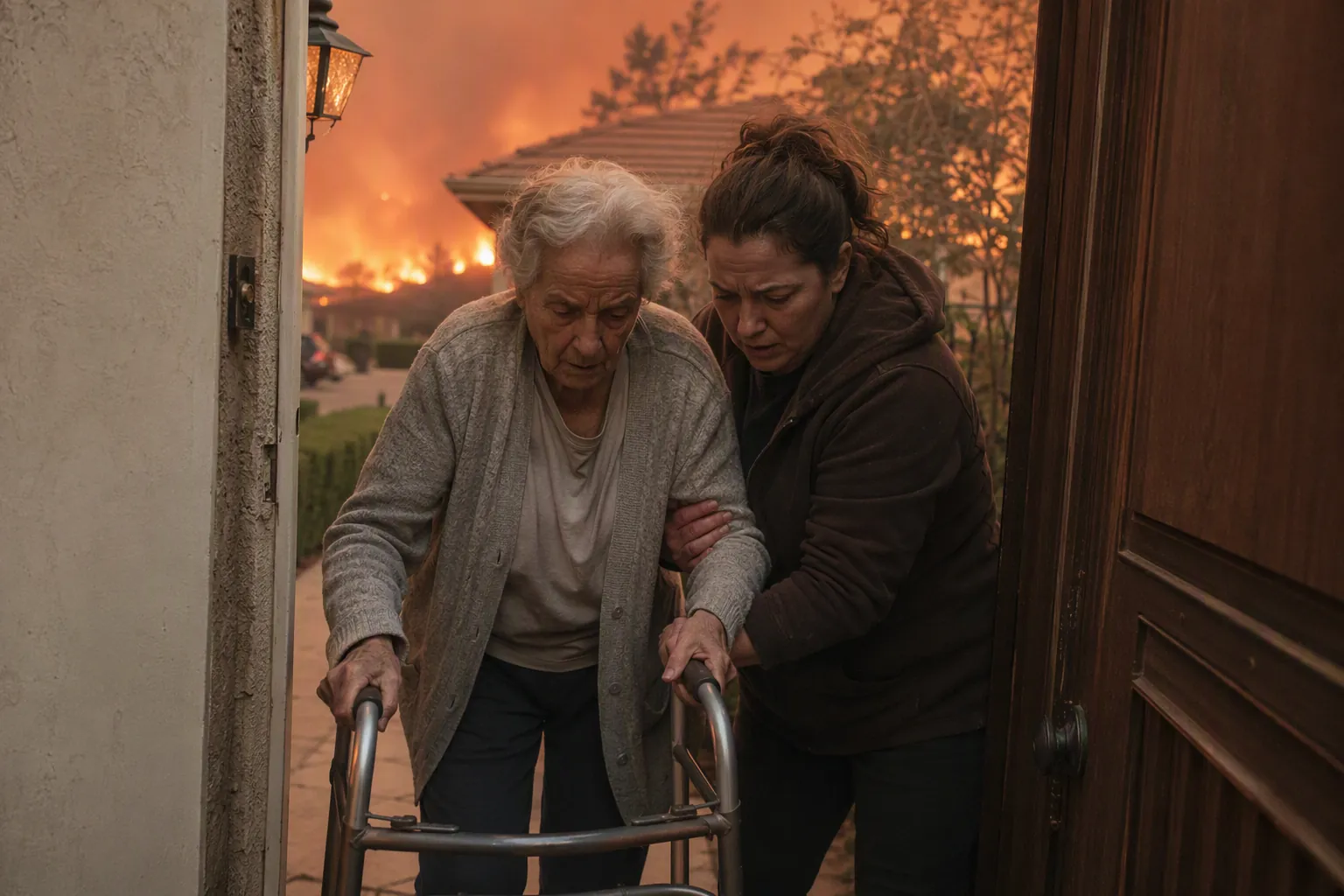
So the useful question is not only “What should be in the go-bag?” It is: before an evacuation order comes, what must already be solved so the older adult can leave without being rushed into a fall, separated from medical equipment, or left waiting for a level of help that may not arrive in time?
Start with the exit path, not the supply list
For a senior with mobility limitations, the evacuation route begins inside the home. The front door, garage door, hallway corner, porch step, driveway slope, and car seat are all part of the plan. If any one of those points fails under pressure, the caregiver may end up improvising while smoke, sirens, pets, phones, and frightened relatives compete for attention.
Walk the route with the actual mobility device before fire season becomes active in your area. Do not estimate. Push the wheelchair through the doorway. Roll the walker over the threshold. Turn around in the hallway. Open the door fully and notice whether a shoe rack, plant stand, side table, oxygen concentrator, or folded rug steals the clearance you thought you had.
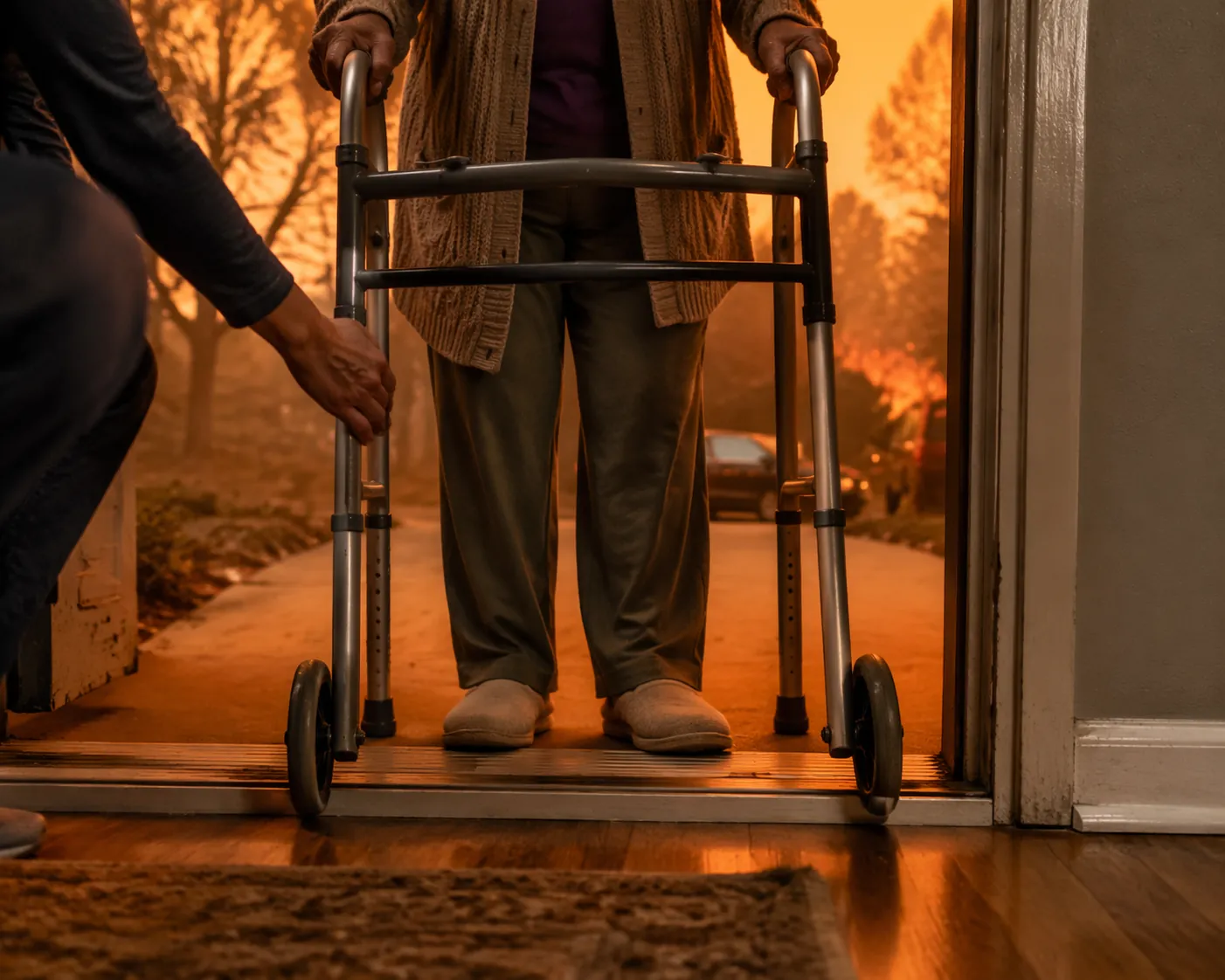
The doorway threshold deserves special attention. A raised lip that seems minor on a quiet afternoon can stop a walker wheel, twist a cane tip, or make a wheelchair jolt forward. If the older adult already has poor balance, neuropathy, weakness, vision changes, or fear of falling, that moment can turn the evacuation itself into the injury.
During wildfire season, keep the evacuation path boringly clear. That means no laundry basket in the hallway “just for now,” no delivery boxes near the door, no loose throw rugs along the route, and no furniture that requires a tight sideways maneuver. This is not housekeeping perfection. It is making sure the caregiver is not trying to move a person and rearrange a room at the same time.
Practice the hard parts while nobody is panicking
A realistic rehearsal does not need to be dramatic. It should answer a few plain questions:
- Can the walker, wheelchair, rollator, or transport chair clear every doorway on the exit path?
- Does the older adult need help rising from the bed, recliner, toilet, or dining chair before leaving?
- Where are the brakes on the wheelchair or rollator, and does every caregiver know how to lock them?
- Is there a step, porch, gravel path, curb, or sloped driveway between the door and the vehicle?
- Can the mobility aid fit in the vehicle without unloading half the trunk first?
- If the main exit is blocked, is the backup exit actually usable with the senior’s device?
This is where generic wildfire evacuation safety tips for seniors often fall short. They tell people to know two ways out. That advice only helps if both routes work for the body that must use them. A back gate with three steps is not a safe backup route for someone who cannot manage stairs unless there is a realistic plan for assistance.
Treat evacuation as a high-risk transfer
Getting into the vehicle may be the most dangerous part of the evacuation for some seniors. A caregiver may be tempted to rush: pull harder, lift under the arms, hurry the person across uneven ground, or ask for “just one more step” when the older adult is already unsteady. That is how a fall can happen at the exact moment everyone is trying to escape danger.
Before an emergency, decide which vehicle will be used first. Then test the transfer with the senior’s usual device. Notice seat height, door opening, driveway slope, and whether the person can turn and sit without losing balance. If the wheelchair or walker has to be folded and loaded, decide who does that job while another person stays close enough to steady the older adult.
| Evacuation point | Fall-risk question to solve in advance |
|---|---|
| Bedroom or recliner | Can the senior stand safely, or is a second helper needed? |
| Hallway | Is there enough width for the mobility aid and caregiver support? |
| Doorway threshold | Do walker wheels, wheelchair footrests, or cane tips catch on the lip? |
| Porch, driveway, or walkway | Is the surface uneven, sloped, wet, smoky, dark, or cluttered? |
| Vehicle transfer | Can the senior sit without twisting, rushing, or being pulled by the arms? |
| Loading the mobility aid | Who loads it, and where does the senior wait safely while that happens? |
If only one caregiver is usually present, the plan has to match that reality. A heavy wheelchair, oxygen tank, emergency bag, pet carrier, and frightened older adult may be too much for one person to manage safely. That does not mean the caregiver has failed. It means the plan needs named backup help, earlier departure triggers, or advance coordination with local emergency services where available.
Earlier departure matters. A senior who needs transfer assistance should not be treated as if leaving at the last possible moment is a normal option. If local officials issue evacuation warnings before mandatory orders, caregivers should consider whether the older adult’s mobility, oxygen needs, cognition, and transportation limits justify leaving sooner, while roads and helpers are still easier to access.
Plan the medical pieces as things people must carry, not just remember
Medication and oxygen plans often sound tidy on paper. In a real evacuation, someone has to pick up the medications, verify the oxygen backup, manage tubing, carry chargers or supplies, and still help the older adult move. Put those tasks into the plan as physical jobs, not vague reminders.
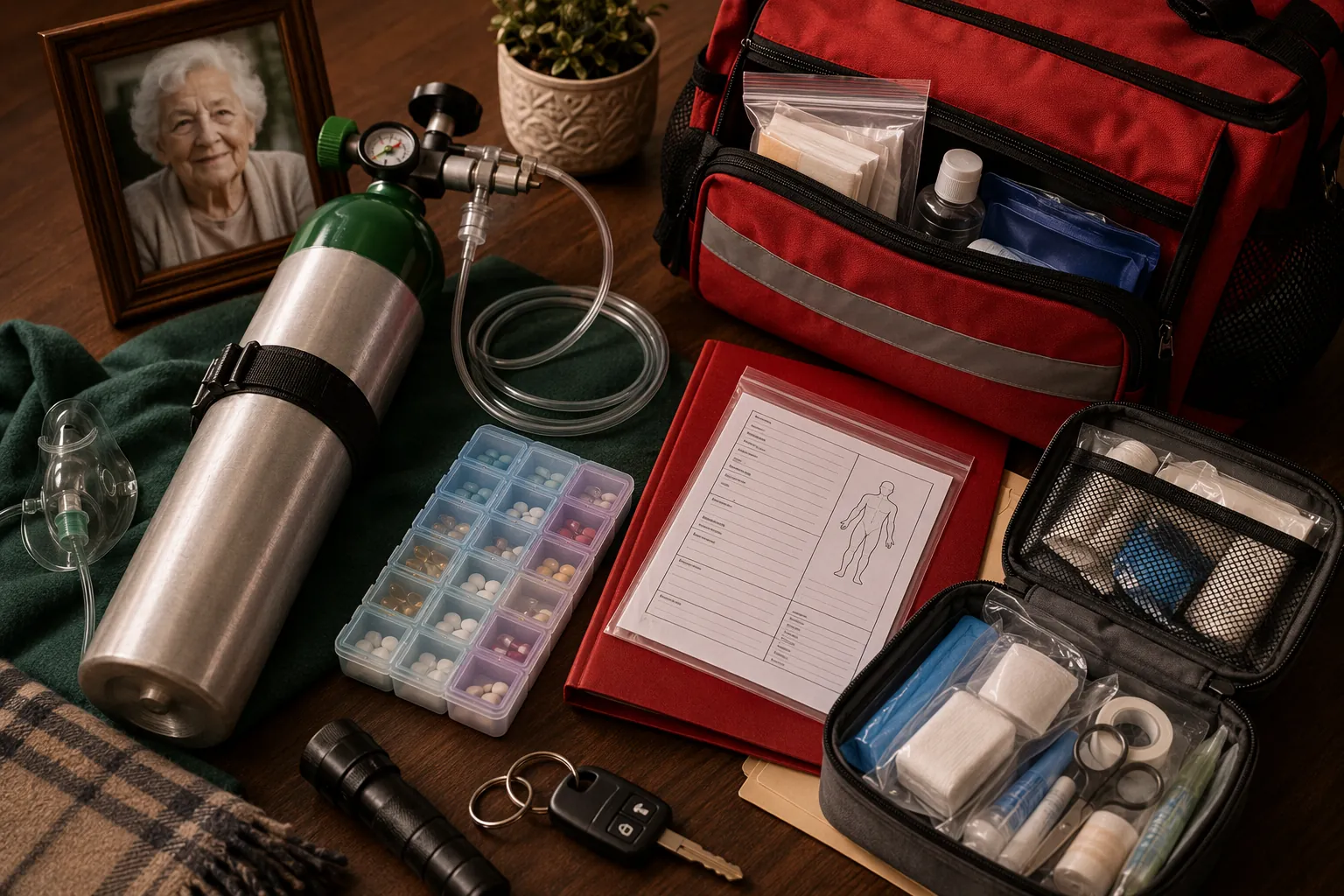
The American Red Cross recommends keeping at least a 30-day supply of medications and medical supplies when possible.[5] For many families, the obstacle is not knowing that extra medication would help; it is keeping refills, insurance limits, expiration dates, refrigeration needs, and controlled substances organized enough that the supply is actually ready when the car needs to leave.
A senior’s evacuation bag should keep medical continuity near the top, not buried under comfort items. Depending on the person’s needs, that may include current medication containers or a clearly updated medication list, copies of prescriptions, glasses, hearing aid batteries or chargers, continence supplies, wound-care supplies, blood glucose supplies, mobility-device chargers, and written instructions for equipment that a substitute caregiver might not know.
For oxygen users, the plan should be reviewed with the clinician, oxygen supplier, or other qualified professional before an emergency. Caregivers need to know how long portable oxygen will last at the prescribed flow rate, whether backup tanks are available, how to transport them safely, and what to do if power-dependent equipment cannot be used. Do not guess at oxygen settings during a wildfire evacuation.
Keep health information where another adult can find it quickly. The California Department of Aging provides a Vial of Life template intended to make key medical information accessible in an emergency.[6] A completed version can help if the primary caregiver is separated from the older adult, injured, delayed, or simply overwhelmed.
Assign the handoff before the handoff is needed
If more than one person may help, give each person a job that can be done under stress. One person helps the senior transfer. One gathers medications and the medical folder. One handles oxygen or equipment. One loads the mobility aid. One contacts relatives or the receiving location. In a small household, one person may carry more than one role, but the roles should still be named.
Write down the order of action in plain language. A caregiver should not have to decide in the doorway whether to load the walker before or after helping the senior into the car. The answer depends on the senior’s abilities and the vehicle setup, but it should be decided while everyone can think clearly.
When dementia or confusion changes the evacuation
A person with dementia may not experience evacuation as a safety step. They may experience it as strangers rushing them, routines disappearing, smoke changing the light, alarms making noise, and familiar rooms becoming unsafe. Resistance in that moment is not a character flaw. It may be fear, confusion, pain, fatigue, sensory overload, or inability to understand what is happening.
The caregiver’s script should be simple and repeatable. Long explanations usually make the moment harder. A calm sentence such as “There is smoke nearby. We are going to the car now. I will stay with you,” may be more usable than a detailed account of fire maps, evacuation zones, and family text messages. Use the same cue again if needed.
Familiar items can help some people leave with less distress: a favorite sweater, glasses, hearing aids, a familiar blanket, a photo, or a small object they routinely carry. These items should not delay departure, but they can be kept near the evacuation bag if they help the person feel oriented enough to move.
There will still be situations where reassurance is not enough. If the older adult becomes physically unsafe, refuses to leave, or cannot be moved without injury, caregivers should follow local emergency instructions and seek emergency assistance. Planning can reduce confusion, but it cannot make dementia predictable in smoke, noise, and fear.
Use ordinary wildfire checklists only after adapting them
Emergency alerts, evacuation routes, documents, pets, chargers, cash, and clothing still matter. The problem is that ordinary checklists often assume a body that can move quickly, carry supplies, understand instructions, and sit in any available vehicle. For a senior with mobility, medical, or cognitive needs, each checklist item needs a caregiver version.
| Ordinary checklist item | Senior-specific question |
|---|---|
| Go-bag | Can the caregiver carry it while also assisting the senior, oxygen, or mobility aid? |
| Evacuation route | Does the route work for a walker, wheelchair, cane, low vision, or oxygen tubing? |
| Emergency alerts | Who receives the alert if the senior cannot hear, read, understand, or respond to it? |
| Medication | Is there a current supply, list, and backup plan if the caregiver is separated? |
| Transportation | Can the senior transfer into the vehicle safely, and can the mobility aid fit? |
| Pets | Who handles the pet so the caregiver is not pulled away during a transfer? |
| Documents | Are medical contacts, diagnoses, medications, and equipment needs easy to find? |
The alert plan is especially important for seniors who live alone or spend part of the day without a caregiver present. If the older adult may not respond to a phone alert, siren, or knock at the door, someone else needs to be designated to check in. That person needs permission, access information if appropriate, and a realistic understanding of how long it takes the senior to leave.
The same practical thinking applies to pets. A small dog underfoot can create a trip hazard during a transfer. A cat carrier in the hallway can narrow the path. If the senior will not leave without the animal, the pet plan is part of the senior evacuation plan, not a separate errand to figure out later.
Leave room for systems to fail without pretending families can replace them
The Los Angeles fire reporting matters because it shows how thin the margin can become for older and disabled people when evacuation systems are strained.[1][2][3] A family caregiver can clear a hallway, label medications, practice a transfer, and call neighbors. A family caregiver cannot single-handedly fix regional transportation shortages, unsafe facility practices, inaccessible public alerts, or delayed emergency response.
That distinction is important. Preparedness should not become a way to blame the person left with the hardest work. The point of planning is to reduce preventable danger in the first hard minutes: the blocked doorway, the missing medication list, the walker that does not fit in the trunk, the oxygen question no one asked until the power failed, the rushed transfer on a sloped driveway.
A sober senior evacuation plan is physical. It knows the width of the door. It knows who locks the wheelchair brakes. It knows where the oxygen backup is stored. It knows which neighbor can help lift the transport chair into the vehicle. It knows the sentence that may help a frightened parent take the next step. It also knows when to call for emergency assistance instead of attempting a dangerous move alone.
If the caregiver waits until smoke, alerts, or a knock at the door to solve wheelchair clearance, oxygen continuity, medication access, dementia reassurance, and transfer safety, the plan is already late. Wildfire evacuation planning for seniors does not guarantee safety. It reduces the number of things that have to be invented while everyone is scared.
This article is for general education only. It is not medical, legal, or emergency-response advice. Always follow instructions from local emergency authorities. For individual needs—especially oxygen use, medication planning, mobility assistance, dementia-related safety, and evacuation support—consult the older adult’s clinicians, emergency management office, durable medical equipment provider, facility staff where applicable, or other qualified professionals.
References
- CalMatters report on January 2025 Los Angeles nursing home evacuations — CalMatters, February 2025.
- Prism Reports coverage of disabled and elderly residents abandoned during the Los Angeles fires — Prism Reports, February 2025.
- AJMC article on Los Angeles fire victims age 65+ or with disabilities — AJMC, January 2025.
- UN 2013 survey on people with disabilities and disaster evacuation — United Nations, 2013.
- Medication and medical supply preparedness recommendation — American Red Cross.
- Vial of Life template — California Department of Aging.
Related reading
Noticed something outdated or inaccurate on this page? Flag a correction. We review every report against CDC, NIA, and AARP HomeFit guidance before updating a page.
Part of the Fall Prevention section.