
STEADI: intervene
Wildfire Evacuation Plan for Seniors with Mobility Limitations
Learn how to build a personalized wildfire evacuation plan for a senior who uses a walker, wheelchair, or oxygen. This step-by-step guide covers transportation matching, go-bag contents by device type, backup power for medical equipment, and building a support network — moving beyond generic checklists to address the specific logistics that matter.
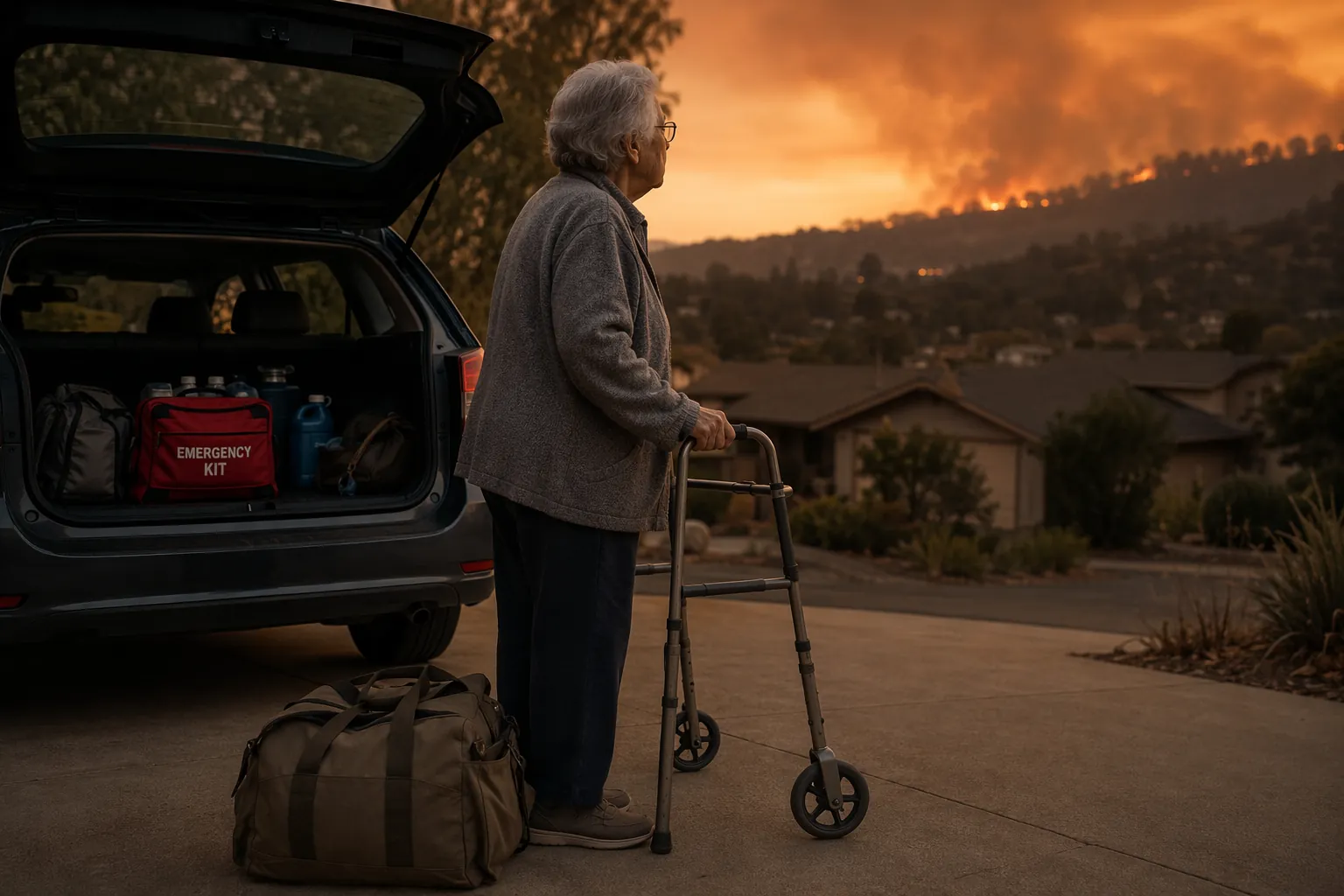
A generic wildfire checklist assumes too much. It assumes the person hears the alert, understands the order, walks to the car, sits upright for the ride, breathes safely through smoky air, and can manage for hours without the equipment normally plugged into the wall. That is not a wildfire evacuation plan for seniors with mobility issues. It is a plan for someone who can move quickly without help.
The difference matters at 2 a.m., when the recliner has to become a vehicle seat, the walker has to fit behind the oxygen tank, the medication list has to be visible to strangers, and the person who says “I’m fine” may still need two people to get down the front steps. The January 2025 Los Angeles fires made that problem painfully concrete: among 25 confirmed victims cited in reporting, most were age 65 or older or had a physical disability that made evacuation extremely difficult.[1]
Families should not read that as a reason to panic. They should read it as a reason to stop relying on a one-page emergency kit list. A 2019 California state audit found that Butte, Sonoma, and Ventura counties had not completed needs assessments for vulnerable populations or pre-arranged evacuation assistance before the 2017–2018 wildfires.[2] In plain terms: the perfectly matched vehicle, the trained helper, and the disability-specific supplies may not appear unless someone has arranged them before the smoke is visible.
Start by naming the actual mobility level
The first planning mistake is using one label for every older adult: “needs help.” That is too vague to dispatch the right ride or pack the right bag. Before choosing a route, shelter, or go-bag, write down what the senior can do on their hardest normal day, not their best day.
| Mobility level | What to test before fire season | Transportation implication |
|---|---|---|
| Walks independently but slowly | Can leave the home, enter the vehicle, and sit for the evacuation route without hands-on help | Standard vehicle may work, but allow extra time and avoid last-minute evacuation |
| Uses cane or walker | Can transfer from chair to standing, manage steps or ramp, and fold or store the device | Standard vehicle may work only if a helper can assist and the device fits with supplies |
| Uses manual wheelchair | Can transfer to a car seat, or must remain in the chair | May need a wheelchair-accessible van if transfer is unsafe or unrealistic |
| Uses power wheelchair or scooter | Can transfer, has charger and backup power, and has a plan if the chair battery is low | Often needs accessible transport with space for chair, charger, and backup mobility option |
| Bedbound, stretcher-level, or cannot sit upright safely | Requires medical positioning, lifting help, or oxygen monitoring during transport | May need non-emergency medical transport, ambulance, or pre-arranged emergency medical assistance |
Do this test when there is no emergency. Ask the person to move from the usual chair to the vehicle using the same path they would use during evacuation. Time it once without rushing. Notice the sticky points: a threshold, a narrow hallway, a loose rug, a walker that does not turn well, a portable oxygen tank that has to be carried by someone else, or a front step that becomes a serious obstacle when the air is smoky.
Ready.gov’s guidance for older adults and people with disabilities recommends planning for accessible transportation, building a support network, and registering with local emergency management or disability registries where available.[3][4] Those are useful principles, but they only become useful after the family has decided which kind of help is physically required.
Match the ride before you pack the bag
Transportation is the part of the plan most likely to fail if it is left as “we’ll take my car.” A sedan may be fine for a parent who uses a cane. It may be impossible for a parent who cannot bend one knee, needs a high seat, cannot transfer without a gait belt, or must keep oxygen tubing arranged while getting in.
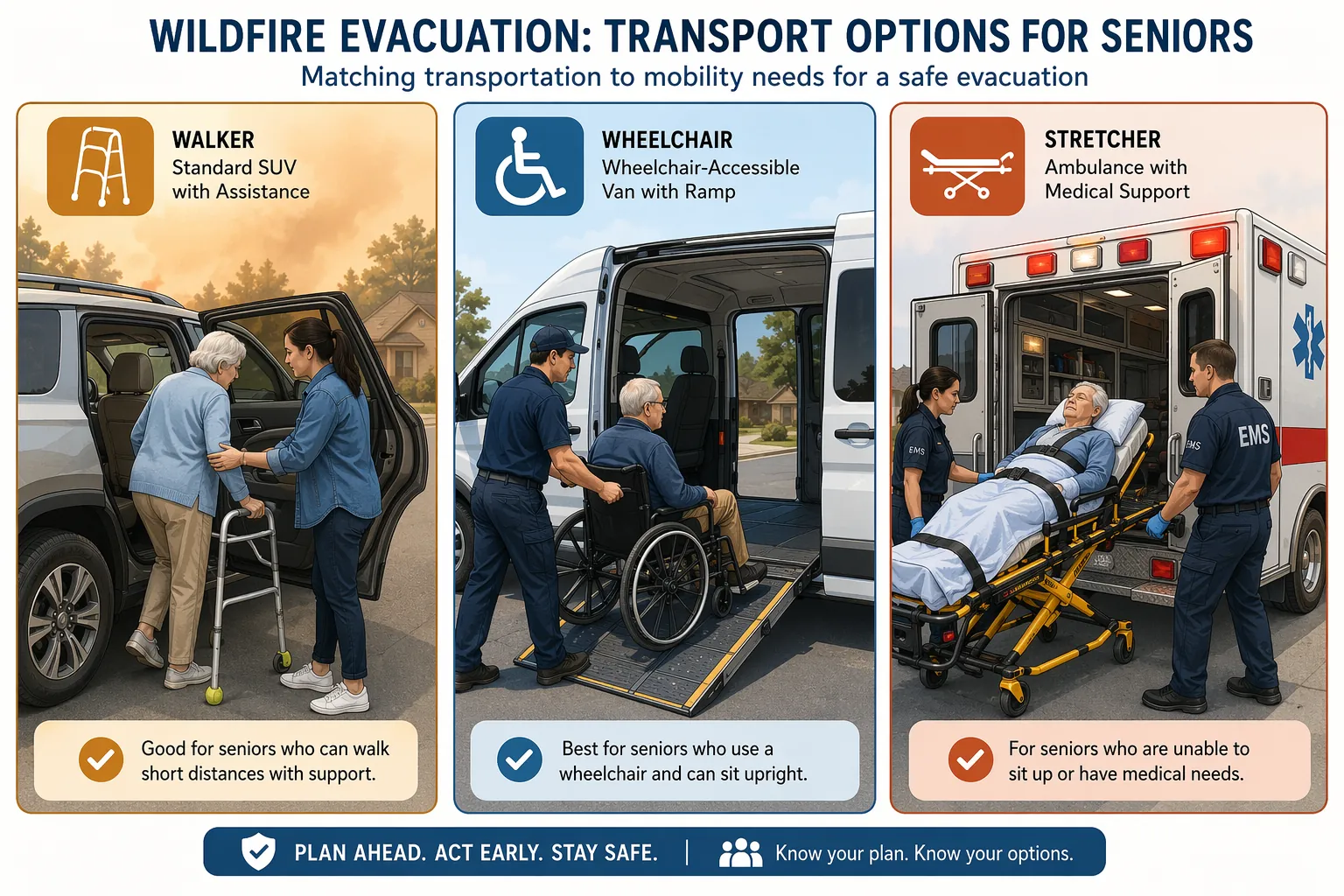
For a senior who walks with a cane or walker, test the exact vehicle. Can they back up safely to the seat? Is the seat too low? Does the door open wide enough? Can the walker be folded and stored without burying the oxygen tank, go-bag, or caregiver’s supplies? If one adult must both steady the senior and load equipment, the plan is already short one person.
For a wheelchair user, decide whether transfer is safe under stress. Some people can transfer from wheelchair to vehicle on an ordinary day but not when they are tired, short of breath, or frightened. If the person must stay in the wheelchair, identify wheelchair-accessible transportation in advance: paratransit, local disability transport, a medical transport company, a community emergency registry, or a neighbor with an accessible van. Do not wait until the evacuation order to discover whether the ramp vehicle is available.
For someone who cannot sit upright, needs stretcher transport, or has a fragile oxygen or cardiac situation, ask the physician, home health agency, hospice provider, or local emergency management office what evacuation transport category applies. Keep those phone numbers in paper form. A phone with a dead battery is not a plan.
- Write the primary vehicle choice and the backup vehicle choice.
- Confirm who can physically assist with transfers and who is only able to make calls.
- Measure whether the walker, wheelchair, oxygen tank, concentrator, charger, and go-bag fit together.
- Keep fuel above half a tank during red flag conditions or local fire weather alerts.
- Practice loading once in daylight, then write down the order: person first, device second, medical power third, documents last.
This is also where families should ask about local programs. In California, names may include county access and functional needs registries, paratransit programs, utility Medical Baseline programs, or disability disaster access programs. In other states, the names differ, but the questions are the same: who knows this person may need evacuation help, what kind of transport do they need, and how will that need be flagged during an emergency?
Build a support network with jobs, not just names
A support network is not a group text that says “check on Dad.” It is a short roster of people with assigned tasks. One person may be able to drive. Another may be close enough to knock on the door. Another may know how to disconnect the oxygen concentrator and load the backup tank. Another may only be available by phone but can call shelters, hotels, or relatives.
The roster should include at least three layers: nearby help, transportation help, and decision help. Nearby help is the neighbor who can reach the door quickly. Transportation help is the person or service that can move the senior safely. Decision help is the family member who has permission to say, “We are leaving now,” when the senior wants to wait.
Do not assume a paid caregiver has emergency training. In California, only about 4,000 of roughly 600,000 In-Home Supportive Services workers had received emergency planning training since 2021, according to reporting on the Center for Caregiver Advancement.[2] That does not mean caregivers are unwilling. It means the family still has to provide the written plan, the equipment instructions, and the authority to act.
- Give each helper the address, gate code, key location, pet information, and evacuation destination.
- Label who can lift, who can drive, who can stay overnight, and who can manage calls only.
- Ask helpers to confirm before fire season, not during the evacuation order.
- Keep one printed copy in the home and one in the caregiver’s vehicle.
Pack by device type, not by generic category
Food, water, flashlight, phone charger, copies of documents, cash, hygiene supplies, glasses, hearing-aid batteries, and several days of medications still belong in the bag. CAL FIRE’s Go Evacuation Guide and Fire Safe Marin’s access and functional needs resources are good starting templates for the standard pieces.[5][6] The senior-specific part is what gets added because of the device, the transfer method, and the medical routine.
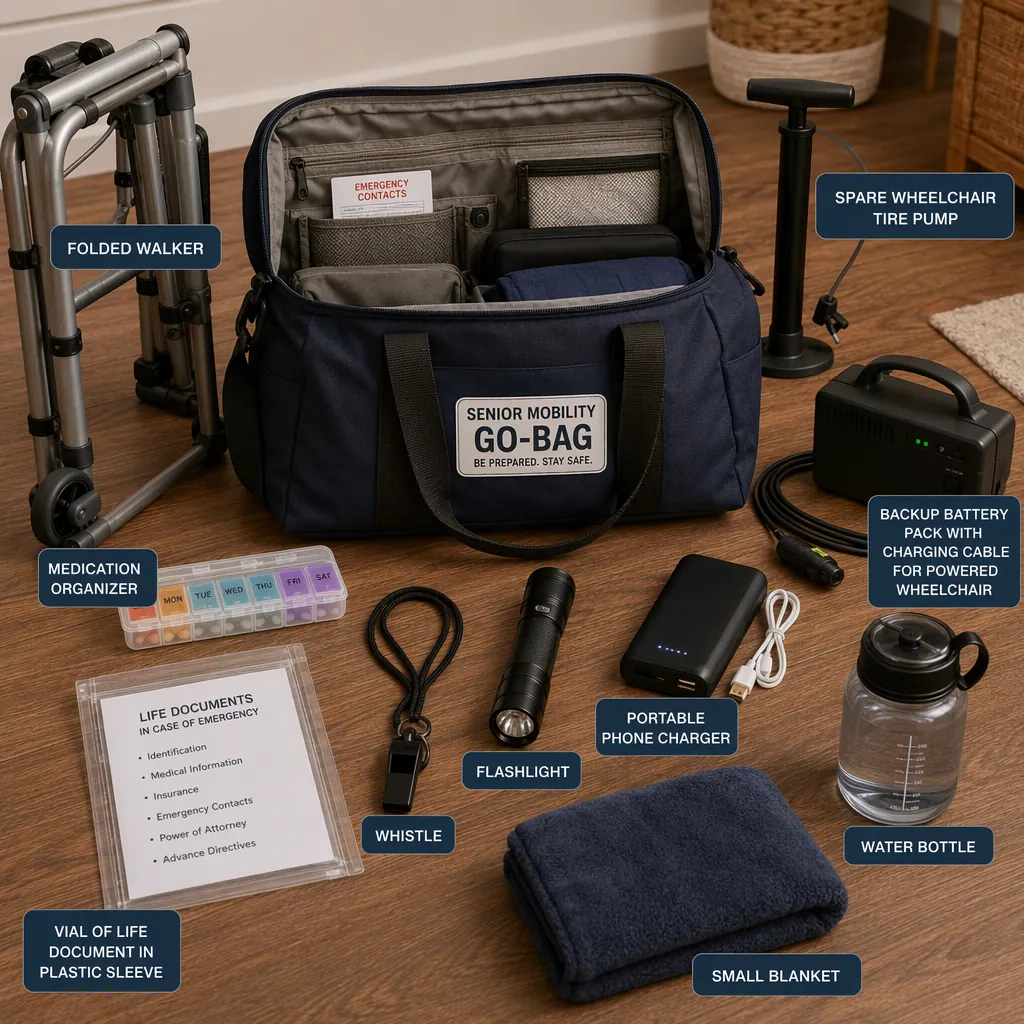
If the senior uses a walker or cane
- Label the walker or cane with the senior’s name and phone number.
- Pack rubber tips, a small roll of bright tape, and a compact flashlight or clip-on light.
- Keep sturdy shoes near the bed, not in a closet across the room.
- Add a lightweight blanket or jacket that does not drag near the walker wheels.
- Practice folding and loading the walker into the chosen vehicle.
If the senior uses a wheelchair or scooter
- Pack the charger, a compatible extension cord, and any removable joystick, cushion, or footrest parts.
- Keep a manual backup plan if the power chair cannot be charged.
- Add a tire pump or repair item only if it matches the chair and someone knows how to use it.
- Write down chair weight, battery type if known, and whether the person can transfer.
- Attach identification to the chair, cushion, and detachable parts.
If the senior uses oxygen, CPAP, or other powered medical equipment
- Pack tubing, cannulas or masks, filters, adapters, and the exact charger or power cord.
- Write the prescribed oxygen flow rate and whether it changes with exertion or sleep.
- Keep supplier, physician, and equipment company phone numbers on paper.
- Mark which equipment can run on battery, which needs an outlet, and how long each battery usually lasts.
- Store backup tanks according to supplier instructions and keep the wrench or key with the tank if required.
Shelters try to help, but families should not assume every disability-specific item will be waiting. During the January 2025 fires, the Pasadena Convention Center shelter reportedly lacked enough cots, respirators, and incontinence products for evacuees with disabilities.[2] That is not a criticism of the people working the shelter. It is a warning to pack the items that would cause immediate distress or health risk if unavailable.
Plan medical-device power as its own problem
Power planning deserves more attention than most checklists give it. A phone charger is not enough when the senior uses an oxygen concentrator, power wheelchair, CPAP machine, nebulizer, adjustable bed, or refrigerated medication. The plan has to answer two separate questions: what happens during a power shutoff at home, and what happens after evacuation if the first destination has limited outlets?
In California, the Disability Disaster Access and Resources program and utility Medical Baseline programs can help eligible people who rely on powered medical devices, including backup battery support in some circumstances during Public Safety Power Shutoff events.[2] Ready.gov also tells people who use electricity-dependent medical equipment to talk with their power company about priority services and backup power options.[4] Outside California, the program names vary, so the practical step is to call the utility and use plain words: “My parent uses electrically powered medical equipment. What medical baseline, priority restoration, outage notification, or backup battery program applies?”
| Equipment | Write this down | Backup action |
|---|---|---|
| Oxygen concentrator | Model, flow setting, battery runtime if portable, supplier number | Keep backup tank plan and ask supplier what to do during evacuation |
| CPAP or BiPAP | Pressure settings if available, mask type, water chamber needs, power cord type | Pack cord, adapter, and a battery option if prescribed or recommended |
| Power wheelchair | Charger type, chair weight, battery information if known, transfer ability | Charge fully before high-risk days and identify accessible transport |
| Nebulizer or other respiratory device | Medication schedule, power need, device model | Ask clinician about portable or battery-compatible options |
| Refrigerated medication | Storage temperature instructions from the medication label or pharmacist | Pack cooler method and ask pharmacist how long the medication can be out |
Do not guess battery runtime under emergency conditions. Test it when it is safe, or ask the supplier. A device that lasts one evening at home may not last through a long traffic delay, a shelter intake line, and a night in a room where outlets are already claimed.
Make the medical information visible
The person helping at the door may not be a family member. They may be a neighbor, firefighter, paramedic, shelter worker, or volunteer who has seconds to understand what matters. Los Angeles County recommends a “vial of life” packet for first responders, including medication lists, emergency contacts, and mobility or equipment needs, kept visibly on the refrigerator.[2]
The packet should be boring, current, and easy to read. Put it in a clear sleeve or envelope marked in large print. Keep one on the refrigerator, one in the go-bag, and one in the caregiver’s car.
- Full name, date of birth, address, phone number, and preferred language.
- Emergency contacts, including who has medical decision-making authority if applicable.
- Medication list with dose schedule, allergies, pharmacy, and prescribing clinicians.
- Diagnoses that change evacuation care, such as dementia, COPD, heart failure, diabetes, seizure disorder, or severe fall risk.
- Mobility status: walker, wheelchair, transfer needs, stairs, oxygen use, CPAP, power chair, hearing or vision limitations.
- Equipment instructions written for a stranger: what must go, what can be left, and what must stay plugged in until departure.
Leave earlier when smoke or power loss changes the risk
The safest evacuation time for a senior with mobility limitations is usually before the official order becomes urgent. Waiting may preserve independence for a few more hours, but it can also turn a slow transfer into a dangerous one. The plan should name early triggers that do not require a family debate.
- A local evacuation warning, not only a mandatory order.
- Power outage affecting oxygen, CPAP, chair charging, elevator access, or cooling.
- Visible smoke, heavy ash, or poor indoor air that worsens breathing.
- Loss of caregiver coverage, transportation availability, or phone service.
- Any instruction from local emergency officials to prepare to leave.
Smoke is not just uncomfortable for older adults. CDC identifies older adults as especially vulnerable to fine particle pollution from wildfire smoke, which can worsen heart and lung problems.[7] A scoping review citing Medicare research reported a 7.2% increase in respiratory hospital admissions among Medicare enrollees during intense smoke days.[8] That number does not mean every older adult will be hospitalized, and it does not prove what will happen in a specific fire. It does mean that “we’ll wait unless flames are close” is a poor rule for someone with COPD, heart disease, oxygen dependence, or limited stamina.
Early evacuation is also a transportation strategy. Roads fill, accessible vans get claimed, caregivers get blocked by closures, and smoke makes transfers slower. If the senior needs help standing, rolling down a ramp, managing tubing, or charging equipment, leaving early is not overreacting. It is how the plan buys time.
Choose destinations that fit the person, not just the map
The destination list should have more than one option: a relative or friend outside the risk area, an accessible hotel, and a public shelter or reception center identified through local emergency channels. For each destination, check the things that matter for the senior’s actual body: no stairs, a bathroom they can enter, space beside the bed for a walker or wheelchair, electrical outlets, temperature control, and a place to store oxygen or medical supplies safely.
Public shelters may be essential, especially when a fire moves fast or hotels fill. Still, January 2025 showed the scale such systems may face: about 2,500 nursing home residents were evacuated during the Los Angeles fires, a scale described as unprecedented in Los Angeles County’s experience by Aging & Disabilities Department director Laura Trejo.[2] A family plan cannot assume the nearest shelter will immediately have the right cot height, incontinence products, quiet space for dementia, or charging access for every device.
When arriving at a shelter, say the needs plainly at intake: “He uses oxygen,” “She cannot transfer without assistance,” “He has dementia and may wander,” “Her power chair needs charging,” or “He needs a cot, not a floor mat.” Give the vial of life packet to the intake worker or keep it visible with the senior. If the first shelter cannot safely support the person, ask where the accessible or medical needs area is being coordinated.
Return home only after the house works again
Returning is part of the evacuation plan, not an afterthought. A house can be standing and still be unsafe for a senior with mobility limitations. Power may be out. Refrigerated medications may be spoiled. The ramp may be covered in ash. The air may still be smoky. A favorite pathway from bedroom to bathroom may be blocked by debris, hoses, extension cords, or boxes brought back too quickly.
- Wait for local officials to say the area is open for return.
- Confirm power, water, heat or cooling, phone service, and elevator access if needed.
- Check that oxygen, CPAP, wheelchair chargers, and medical devices work before the senior is brought inside.
- Clear walking paths, thresholds, ramps, and bathroom access before unloading supplies.
- Ask the pharmacist or clinician about any medication exposed to heat, smoke, or loss of refrigeration.
- Replace used go-bag items immediately, while the missing pieces are still obvious.
This is the point where a simple checklist becomes a chain. The senior has to be alerted, helped up, moved through the home, transported in the right vehicle, supported with the right equipment, received at a workable destination, and brought back only when the home can support the same limitations it supported before the fire.
The readiness standard
A wildfire evacuation plan for a senior with mobility limitations is ready when someone outside the household can understand it and act on it. The test is not whether the bag looks complete. The test is whether the logistics still work when the caregiver is scared, the air is bad, the power is out, and the senior is moving slowly.
- Mobility level is written down and based on a real transfer test.
- Transportation is matched to the person: standard vehicle, accessible van, medical transport, or ambulance-level help.
- At least two helpers know their specific jobs and have access information.
- Go-bags include device-specific supplies for walker, wheelchair, oxygen, CPAP, or powered equipment.
- Backup power, utility registrations, and medical equipment instructions are current.
- The vial of life packet is visible, duplicated, and updated.
- Early evacuation triggers are written before anyone is under pressure.
- Return-home checks cover power, air, medication safety, device function, and fall hazards.
The bag by the door matters. But for an older adult who uses a walker, wheelchair, oxygen, or powered medical equipment, the bag is only one link. The plan is the transportation, the power, the helpers, the written instructions, and the decision to leave while there is still time to move carefully.
References
- Wildfire Evacuations Spell Difficulties for Disabled, Elderly Residents, AJMC
- California wildfires emergency preparedness, CalMatters, February 2025
- Older Adults, Ready.gov
- People with Disabilities, Ready.gov
- Go! Evacuation Guide, CAL FIRE Ready for Wildfire
- Resources and Tips for People with Access and Functional Needs, Fire Safe Marin
- How to Stay Safe During a Wildfire, CDC
- Wildfire smoke exposure and human health: Significant gaps in research for a growing public health issue, PMC
Related reading
Noticed something outdated or inaccurate on this page? Flag a correction. We review every report against CDC, NIA, and AARP HomeFit guidance before updating a page.
Part of the Fall Prevention section.