
STEADI: Intervene
How to Help Seniors During Wildfire Smoke and Evacuation
A two-track guide for caregivers: what to do in the hours wildfire smoke is in the air, and what to prepare so an evacuation order never catches an older adult off guard. Covers clean-air room setup, medication and go-bag prep, symptom watch, and stay-versus-go decisions tied to air quality and official orders.
Start with two tracks: today’s smoke and the evacuation order that may come later
The practical answer to how to help seniors during wildfire smoke and evacuation is to separate two jobs that often get blurred together. First, there is the same-day smoke response: checking air quality, keeping smoke out, setting up the cleanest indoor space, limiting exertion, and watching symptoms. Second, there is the before-the-order evacuation preparation: medications, mobility equipment, chargers, documents, transportation, helpers, routes, pets or service animals, and a written plan for who does what.
For an older adult with a walker, oxygen equipment, hearing loss, low vision, dementia, heart disease, COPD, medication dependence, or slow transfers, the second track is not a nice extra. It is what makes the first track survivable. A smoke warning at noon is the wrong time to discover that the portable air cleaner is still in the garage, the medication list is out of date, the wheelchair does not fit through the back door, or the only reliable driver is across town.
| If this is happening | Work the smoke-response track | Work the evacuation-prep track |
|---|---|---|
| Smoke is already in the air | Check AirNow or local air-quality alerts, close the house, use the cleanest room, reduce activity, watch symptoms. | Confirm medications, oxygen or power needs, go-bag location, transportation, and who can come now if an evacuation warning arrives. |
| A fire is nearby but no order has been issued | Treat the senior as sensitive to smoke; keep the indoor air as clean as possible and reduce trips outside. | Consider leaving early if mobility, medical equipment, nighttime driving, pets, or caregiver availability would make a later evacuation harder. |
| An evacuation warning or order is issued | Do not let a clean-air room become a reason to ignore official instructions. | Use the written plan: helper, route, go-bag, medications, assistive devices, documents, chargers, and destination. |
The reason to be blunt about this is not fear; it is the mismatch between standard emergency advice and the way frail bodies actually move. In the January 2025 Los Angeles fires, LA County Aging & Disabilities reported that 26 of 31 deaths were people age 65 or older or people living with a disability. The same agency also cited a post-fire national survey finding that fewer than one in three adults ages 50–80 had an emergency kit ready. [1]
That vulnerability is not limited to one county. USFA/FEMA reports that older adults had 2.5 times the general population’s risk of dying in a fire in 2023. [2] Smoke adds another layer: a JAMA Network Open cohort study of 10.4 million Medicare beneficiaries age 65 and older found that daily respiratory hospitalizations rose by about 2.40 per 100,000 beneficiaries when wildfire-smoke PM2.5 increased from 0 to 40 micrograms per cubic meter. [3]

When smoke is already in the air
The first hour is for reducing exposure, not for reorganizing the whole house. Put one person in charge of air-quality information and one person, if available, in charge of the senior’s room, medications, mobility path, and phone. If there is only one caregiver, do the air and symptom steps first, then check the evacuation pieces that would fail fastest.
- Check AirNow, your local air district, and local emergency alerts. AirNow’s wildfire-smoke guidance tells people to pay attention to smoke conditions, reduce exposure, and follow local instructions when smoke is present. [4]
- Close windows and doors, then choose the cleanest room the senior can safely reach. A bedroom often works because the person can rest, use medications, keep a phone nearby, and avoid unnecessary walking.
- Run a portable air cleaner continuously if one is available, and use the right size unit for the room if you already have that information. If the home has central HVAC and it is safe to use, set it to recirculate and use high-efficiency filtration such as MERV-13 or better where the system can handle it. CDC wildfire guidance and AirNow smoke guidance both emphasize keeping indoor air cleaner and reducing smoke entry. [4][5]
- Reduce indoor particle sources. Skip vacuuming, frying, smoking, candles, incense, and fireplaces. This is not the day to “freshen” the house with anything that adds particles or fumes.
- Limit outdoor trips. If the senior must go outside, keep the trip short and use a properly fitting NIOSH-approved N95 or P100 respirator if the person can safely tolerate it. Cloth masks and loose surgical masks do not provide the same smoke-particle protection. [4][5]
- Watch for new or worsening symptoms, especially shortness of breath, wheezing, chest pain, unusual fatigue, confusion, dizziness, fainting, or needing rescue medication more often than usual. Do not wait for the air-quality number to look dramatic if the person looks worse.
For a deeper AQI-by-AQI breakdown, use the site’s guide to air quality precautions for older adults and sensitive groups. If the senior has COPD or another lung condition, the more specific guide to keeping seniors with COPD safe during air-quality warnings is the better next read.
Make the clean-air room usable, not just cleaner
A clean-air room that the older adult cannot safely use is only half a solution. Put the phone, charger, water, medications, inhaler, glasses, hearing aids, walker, cane, commode supplies, and a light source within reach. Clear the route from bed to bathroom. If the room is sealed up but getting hot, treat heat as a real competing danger, especially for people with heart disease, limited sweating, cognitive impairment, or medications that affect temperature regulation. The smoke plan may need to become a relocation plan if the room cannot stay both cleaner and safe.
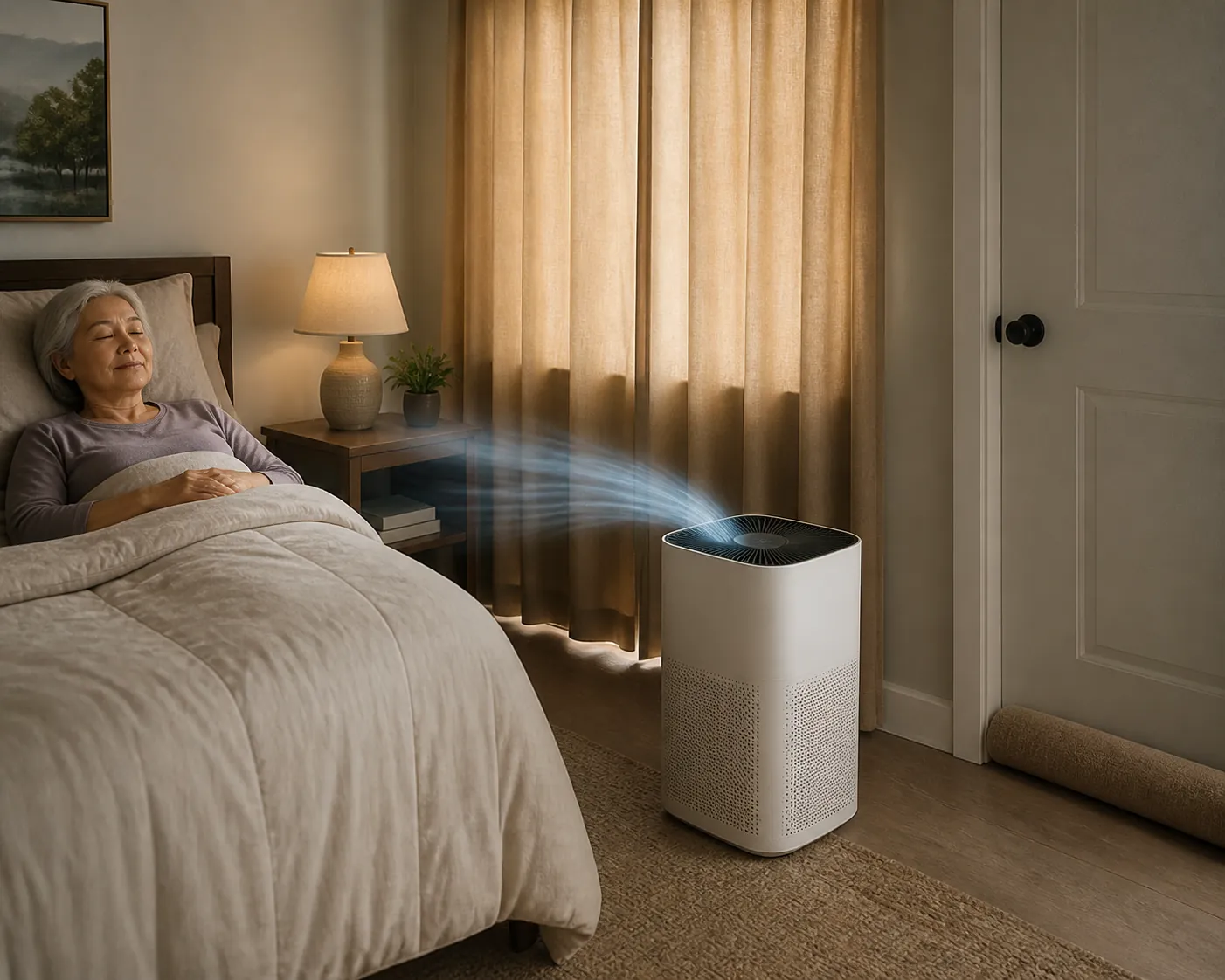
The heat-and-smoke trade-off gets complicated quickly when the power is out or the home has no air conditioning. Do not solve smoke exposure by trapping an older adult in dangerous heat. For that overlap, use the guide to wildfire safety for older adults during a heat dome. If the lights, oxygen concentrator, lift chair, refrigerator, or hallway lighting are affected, also review power outage fall risks for senior caregivers.
Before an evacuation order: build the plan you wish you had at noon
The preparation track is where caregivers prevent the most predictable failures. It is also where families tend to procrastinate, because each item feels small until the order arrives. The work is not glamorous: refill timing, battery packs, copies of documents, the spare glasses case, the neighbor’s phone number, the second route, the question of whether Dad can get into the SUV without a second person.
Start with medications and medical information. CDC guidance for wildfire readiness includes keeping a 7–10 day supply of prescription medicines, and Red Cross guidance for older adults recommends planning for at least a 30-day supply of medications and medical supplies when possible. [5][6] For many families, that means asking the clinician or pharmacist what is realistic under the senior’s insurance rules, which medicines cannot be interrupted, and what documentation is needed if the person leaves home without the original bottles.
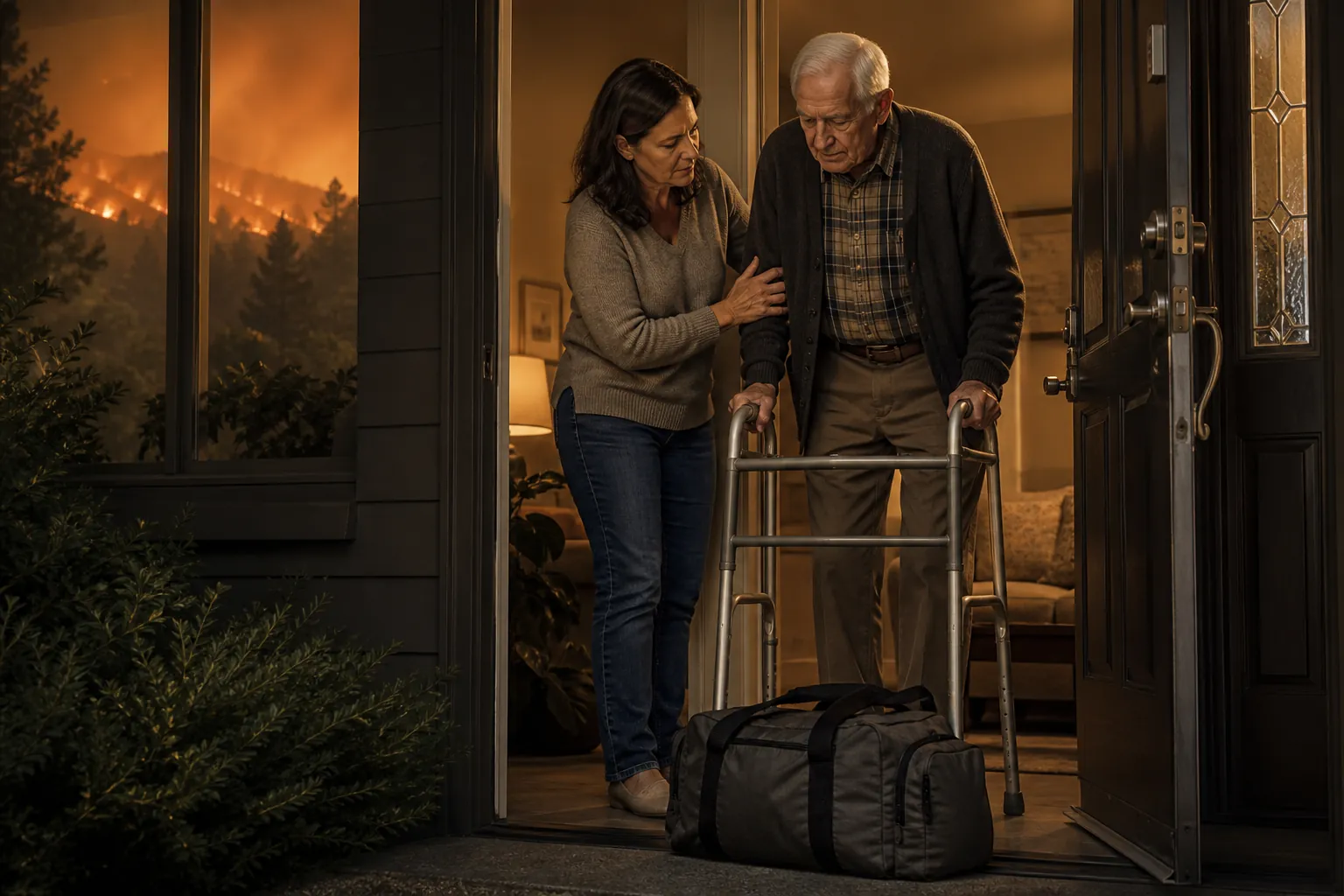
Do not rebuild the entire go-bag from memory. Use a written checklist and keep it where the person will actually leave from. At minimum, the caregiver should be able to find medications, a medication list, allergies, diagnoses, clinician contacts, insurance cards, identification, glasses, hearing aid batteries, mobility aids, phone chargers, cash, keys, masks or respirators, hygiene supplies, and essential comfort items. For the fuller list, use the site’s wildfire evacuation checklist for seniors.
| Preparedness item | The caregiver question that matters |
|---|---|
| Medication supply | Can the senior leave for several days without missing essential prescriptions, inhalers, insulin supplies, or medical equipment? |
| Assistive devices | Is there a backup cane, walker tip, wheelchair cushion, hearing aid battery, glasses, or charger if the primary item is forgotten or damaged? |
| Power-dependent equipment | What happens to oxygen, CPAP, a hospital bed, lift chair, stair lift, refrigerated medication, or phone access if power fails? |
| Transportation | Who can physically help the senior transfer, load equipment, and drive if the primary caregiver is at work or roads close? |
| Routes | Are there two usable routes, and has anyone checked whether the walker, wheelchair, oxygen cart, or pet carrier fits through the exit path? |
| Communication | Who gets the official alerts, who calls the senior, and who has permission to contact neighbors, building staff, or local services? |
| Destination | Where can the senior go with medications, mobility needs, pets or a service animal, and enough quiet to rest? |
Ready.gov’s older-adult preparedness guidance emphasizes building a support network and planning around medical, transportation, communication, and assistive-device needs. [7] That support network cannot be a vague “someone will come.” It needs names, phone numbers, backup names, and a clear threshold for action: who leaves work, who checks the front door, who brings the car, who carries the oxygen tank, who takes the cat, who has the medication list, and who can make the call if the older adult hesitates.
For seniors who live alone, the plan needs a non-family layer. A neighbor, building manager, faith community contact, local aging services contact, or medical-alert service may be the first person close enough to help. The broader severe weather safety checklist for seniors living alone can help fill that gap without pretending every older adult has an available adult child nearby.
The evacuation plan is also fall prevention
In a wildfire, fall prevention is not limited to rugs, grab bars, and shoes. It includes the rushed transfer into the car, the walker caught on the threshold, the dark hallway after a power outage, the oxygen tubing underfoot, the pet carrier in the exit path, and the older adult who becomes weak or lightheaded after breathing smoke.
There is no need to invent a statistic for falls during wildfire evacuations to take this seriously. The practical risk is visible: everything that is already slow on a calm day becomes harder when the air smells like smoke, the phone keeps buzzing, and a caregiver is trying not to panic. The plan should slow down the dangerous steps before the emergency speeds everything up.
- Practice the exit route with the actual walker, cane, wheelchair, oxygen tubing, shoes, and bag.
- Check the car transfer before fire season, not during an evacuation warning.
- Keep a flashlight or headlamp at the bed, the main exit, and the go-bag.
- Move the go-bag near the exit without putting it where the senior can trip over it.
- Decide who gives physical assistance and who manages doors, pets, equipment, and documents.
For the detailed doorway, walker, wheelchair, and car-transfer work, use the site’s wildfire evacuation plan for seniors at fall risk. Use that plan alongside the smoke exposure and evacuation-timing decisions here.
Stay or go: use AQI, symptoms, mobility, and official orders together
AQI helps decide smoke precautions. It does not override evacuation orders. Official evacuation orders, law-enforcement instructions, and local emergency alerts come first. The caregiver’s harder judgment usually happens earlier, during an evacuation warning or nearby fire, when leaving now feels disruptive but leaving later may require moving a frail person through worse smoke, darkness, traffic, or panic.
EPA’s AQI Basics define 101–150 as “Unhealthy for Sensitive Groups,” and the American Lung Association identifies older adults and people with heart or lung disease among those who may need extra precautions as air quality worsens. [8][9] For a senior, that “sensitive group” label should change behavior early: less exertion, fewer outdoor trips, cleaner indoor air, and a lower threshold to relocate if the home cannot stay safe.
| Situation | Caregiver action | Why the decision changes |
|---|---|---|
| Evacuation order is issued | Leave according to official instructions or accept official transport help if needed. | A clean-air room is temporary protection from smoke, not protection from fire, road closure, or emergency access loss. |
| Evacuation warning, nearby fire, or likely road closure | Consider leaving early if the senior uses a walker or wheelchair, depends on oxygen or powered equipment, needs two-person transfers, cannot tolerate smoke, has dementia, or would be harder to move after dark. | Delay can turn a manageable transfer into a rushed transfer. |
| AQI is unhealthy for sensitive groups and there is no evacuation warning | Shelter in the cleanest indoor space, limit exertion, keep medications close, and monitor symptoms. | Older adults and people with heart or lung disease may be affected before healthier adults notice much. |
| AQI is unhealthy, very unhealthy, or hazardous, and the home cannot maintain cleaner air | Look for a cleaner-air destination: family home outside the smoke, a public clean-air location if available, or other locally announced option. | Staying put only works if the indoor environment is actually safer and the senior remains stable. |
| Smoke is present and the home is becoming dangerously hot | Do not keep the senior sealed in a room that is overheating. Relocate if cooling and cleaner air cannot both be maintained. | Heat illness can become an immediate danger, especially after power loss or during a heat dome. |
| Symptoms are new, severe, or worsening | Call emergency services for severe symptoms; call the clinician or nurse line for worsening respiratory or cardiac symptoms that are not immediately life-threatening. | The person’s condition matters more than the map color. |
When to stop troubleshooting and get help
Call 911 or local emergency services for severe trouble breathing, chest pain, blue or gray lips, fainting, new confusion, signs of stroke, severe weakness, a fall with injury, or oxygen equipment failure that cannot be corrected quickly. If an evacuation order is active and the senior cannot leave safely, contact emergency services or the local emergency information line rather than trying to force a dangerous transfer alone.
Call the clinician, pharmacist, home-health agency, oxygen supplier, or nurse line for worsening cough, wheezing, shortness of breath, increased rescue-inhaler use, medication problems, lost prescriptions, oxygen questions, or uncertainty about whether the senior’s medical condition makes early relocation safer. This kind of call is much easier before the road is closed and the phone battery is at 12 percent.
After the smoke event or evacuation, review what failed while it is still fresh: the battery that was dead, the mask that did not fit, the route that was blocked, the medication that was almost empty, the helper who could not come, the bag that was too heavy, the room that overheated. If the senior has been displaced, the first 24–72 hours deserve their own attention, including hydration, cooling, medications, sleep, and mobility in an unfamiliar space; the guide to heatstroke prevention for seniors after a disaster is a useful handoff.
This article is general safety information, not medical advice. For an older adult with heart disease, lung disease, oxygen use, dementia, major mobility limits, or complex medications, ask the person’s clinician what symptoms, AQI levels, equipment failures, or evacuation warnings should trigger a call, a medication change, or early relocation.
References
- Lessons from the January Wildfires: Why Preparedness Matters. LA County Aging & Disabilities.
- Older Adults. U.S. Fire Administration / FEMA.
- Wildfire Smoke PM2.5 and Daily Respiratory Hospitalizations Among Medicare Beneficiaries. JAMA Network Open.
- When Smoke is in the Air. AirNow.
- How to Stay Safe During and After a Wildfire. Centers for Disease Control and Prevention.
- Older Adults. American Red Cross.
- Older Adults. Ready.gov.
- AQI Basics. AirNow.
- Air Quality Index. American Lung Association.
Related reading
Noticed something outdated or inaccurate on this page? Flag a correction. We review every report against CDC, NIA, and AARP HomeFit guidance before updating a page.
Part of the Fall Prevention section.