
STEADI: intervene
How to Prepare Aging Parents for Wildfire Evacuation
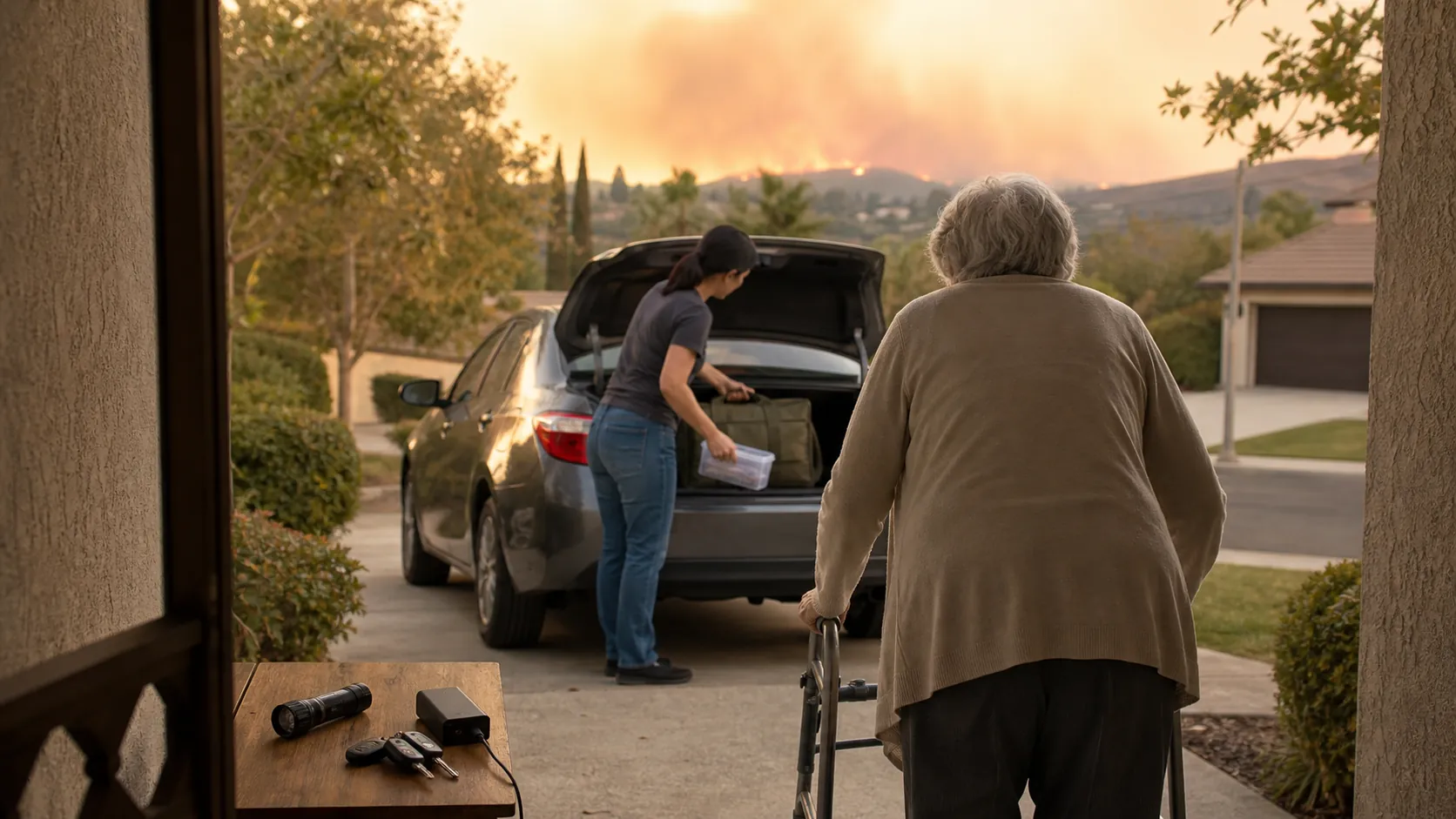
Generic wildfire checklists miss older-adult needs: mobility aids, medications, medical-device power, and transportation. Build the full system — assess needs, pack two kits, map routes with a support network, and practice — so evacuation becomes a rehearsed plan, not a crisis decision.
“Pack a go bag and know two routes” sounds adequate until the person leaving uses a walker, takes eight medications, sleeps with a CPAP, cannot lift the pet carrier, and may wait for an order that never arrives. The American Red Cross tells older adults directly that they may not receive an official evacuation notice, which is exactly why a wildfire plan for an aging parent cannot depend on one perfect phone alert at the worst possible moment.[1]
The practical answer to how to prepare elderly parents for wildfire evacuation is this: build a rehearsed support system, not just a bag. Older adults are overrepresented in disaster harm in ways that planning cannot politely ignore; a 2023 scoping review, for example, cites disaster research showing older adults made up 15% of New Orleans’ population but 71% of deaths after Hurricane Katrina, and it also summarizes evidence that older adults may be less likely to receive warnings.[2] Wildfire has its own timing, smoke, road, and power problems, but the caregiving lesson carries over: waiting too long turns ordinary limitations into evacuation barriers.
Use this as planning guidance, not medical, legal, or financial advice. The parent’s clinician, pharmacist, oxygen supplier, equipment company, insurer, and local emergency management office may all need to review pieces of the plan before fire season.
| Part of the system | What has to be decided before smoke is in the air |
|---|---|
| Assess the parent’s actual needs | Mobility, medications, powered devices, cognition, transportation, pets, and who can physically help |
| Build both kits | A portable Go-Kit, a Stay-at-Home Kit, and a medication/device plan that works if power or pharmacy access fails |
| Set routes and departure triggers | Two evacuation routes, alert sources, meeting point, out-of-state contact, fuel and garage-door habits, and when to leave early |
| Name the support network | People with keys, driving roles, medication knowledge, document access, and equipment familiarity |
| Practice and review | A drill every six months and kit checks every three to six months, so the plan proves itself before it is needed |
That flow follows Ready.gov’s older-adult structure — assess needs, create a plan, and engage a support network — but the useful work is in the details attached to each verb.[3] “Assess” means finding out whether the walker fits in the car trunk. “Plan” means deciding who drives if the parent should not. “Engage” means someone nearby has a spare key and knows where the oxygen tubing, medication list, and insurance cards are kept.
Start with the parent’s body, devices, and real habits
Do the needs assessment in the home, not over a cheerful phone call. Walk from the bed to the bathroom, from the recliner to the front door, from the front door to the car. Notice the step down into the garage, the rug that catches the walker, the oxygen cord that runs behind the chair, the shoes that are never where they should be. A wildfire evacuation at night is not a questionnaire; it is a sequence of small movements under pressure.
Ready.gov tells older adults to consider daily living needs and build support around them.[3] For an adult child, that assessment should be concrete enough that a neighbor could act from it if you were two states away.
- Mobility: Does your parent use a cane, walker, wheelchair, scooter, transfer pole, stair rail, shower chair, or lift recliner? Which one must leave with them? Can they get from bed to car without furniture-walking? If a walker or cane is part of the evacuation, use a separate mobility run-through like this walker and cane evacuation guide to tighten the details.
- Medication: List every prescription, over-the-counter medicine, inhaler, eye drop, insulin, supplement, and as-needed medication. The Red Cross advises older adults to keep at least 30 days of medications available, which means the refill cycle is part of the evacuation plan, not an errand to remember later.[1]
- Refrigerated medication: Write down what must stay cold, what temperature range matters, how long it can safely be out, and what the pharmacist says to do during an evacuation or outage. Put the pharmacy phone number on the medication list.
- Powered medical equipment: CPAP, oxygen concentrators, nebulizers, adjustable beds, lift chairs, powered scooters, hearing-aid chargers, and phone-dependent medical apps all need a power plan. The Red Cross specifically tells older adults to plan backup power for medical devices.[1] For the outage piece, keep a separate 72-hour power outage safety checklist with the device instructions.
- Vision and hearing: Pack extra eyeglasses, hearing-aid batteries, hearing-aid charger, magnifier if used, and written instructions in large print. A parent who cannot hear the alert or read the medication label has not really been prepared.
- Cognition and decision-making: Does your parent minimize danger, confuse alerts, forget where supplies are, or refuse to leave until a familiar person says so? Do not try to solve complex dementia refusal inside this general plan, but do write down the person whose voice the parent trusts and the exact phrase that starts the evacuation.
- Transportation: Who drives? Who is the backup driver? Can the parent get into the vehicle without a boost? Does the walker, oxygen, pet carrier, and Go-Kit fit after the parent is seated? If the parent still drives, decide now what conditions mean someone else takes over.
- Hands-on help: Name the person who can lift the folding walker, carry the oxygen cylinder, load the cat, open the garage manually, or steady the parent on the front step. If no one is named, no one has the job.
The Red Cross also advises identifying two ways out of every room.[1] For an aging parent, that does not mean drawing arrows on a page and calling it done. It means checking whether both exits are usable with the parent’s mobility aid, whether the second exit has a step, whether the ramp is blocked by planters, and whether the parent can find shoes and a flashlight from bed. Shoes and a flashlight beside the bed are not cosmetic preparedness. They are the difference between leaving and searching.
Build two kits, then build the medication and device layer around them
The Red Cross wildfire guidance separates supplies into a Go-Kit for about three days and a Stay-at-Home Kit for about two weeks, while also calling for a one-month supply of medication.[4] That structure is useful because wildfire can create two different problems: leaving quickly or staying put through smoke, road closures, outages, and disrupted services.
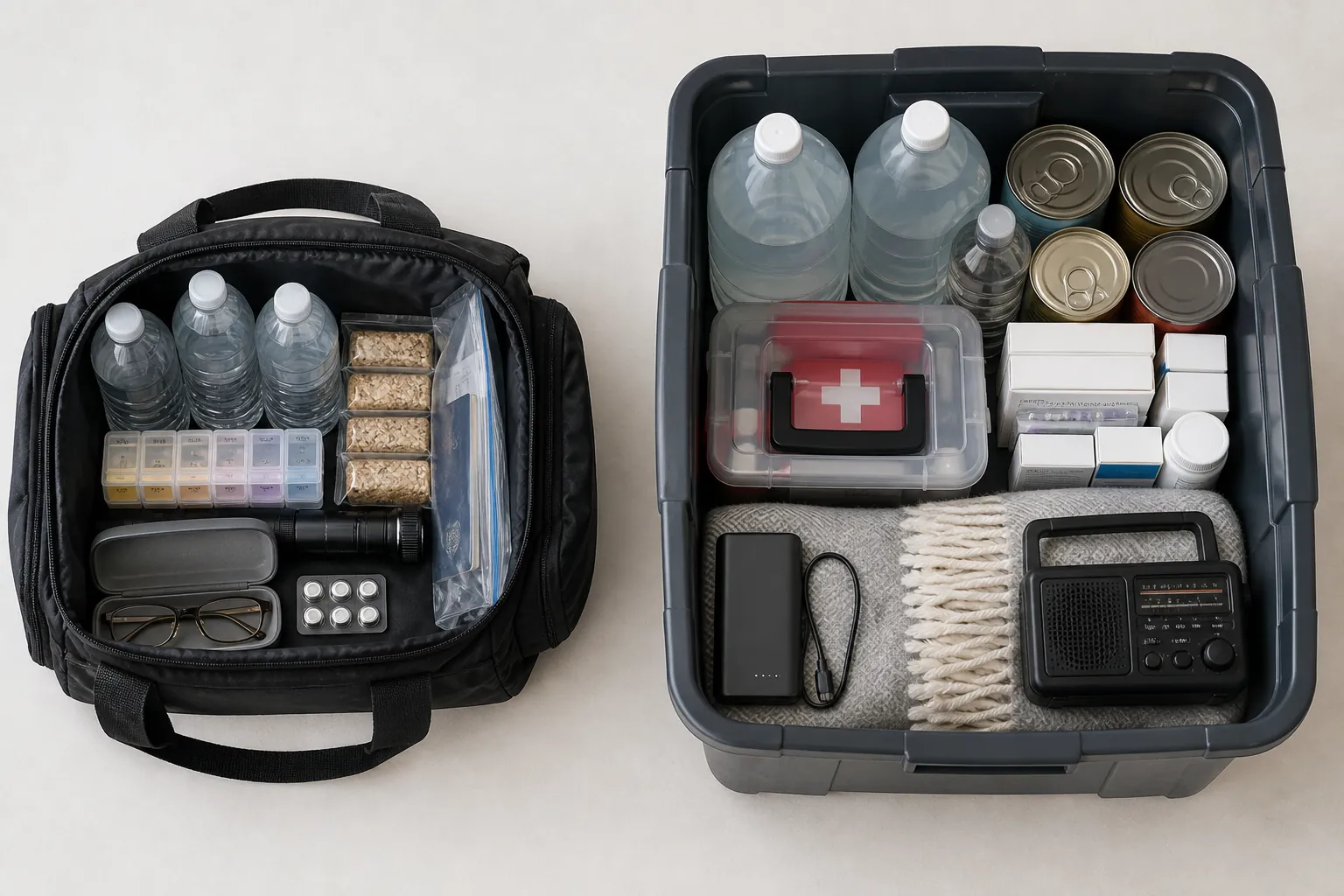
Water guidance is one place to keep the source labels straight. CAL FIRE’s emergency supply kit page calls for a three-day supply of non-perishable food and three gallons of water per person.[5] Ready.gov’s general kit guidance uses a standard of one gallon of water per person per day for several days.[6] In practice, both point to the same caregiving question: can your parent physically carry what is in the Go-Kit, and where is the larger water supply stored if staying home becomes the safer short-term option?
| Supply area | Go-Kit: leaving quickly | Stay-at-Home Kit: sheltering temporarily |
|---|---|---|
| Food and water | Portable three-day supply; use CAL FIRE’s three-gallon-per-person go-bag guidance as one state-specific benchmark.[5] | About two weeks of shelf-stable food and water, following the Red Cross stay-at-home structure.[4] |
| Medication | Current doses for immediate departure, plus written medication list and pharmacy contacts | At least 30 days of medications when possible, consistent with Red Cross older-adult guidance.[1] |
| Medical devices | CPAP mask or tubing if portable, oxygen supplies, inhalers, nebulizer parts, chargers, batteries, and written equipment instructions | Backup power plan, extension cords used safely, battery packs, and supplier contact numbers |
| Vision and hearing | Extra glasses, hearing-aid batteries, hearing-aid charger, labeled case | Backup batteries, cleaning supplies, large-print copies of key instructions |
| Documents | Waterproof pouch with medication list, allergies, doctors, pharmacy, emergency contacts, insurance cards, identification copies, and advance-directive location | Backup copies in a known location and digital copies accessible to the support network |
| Money and communication | Cash in small bills, phone charger, power bank, written phone numbers | Battery radio, NOAA Weather Radio if used, additional power banks, paper contact list |
Do not bury the medication plan inside the duffel. Put a printed medication list in three places: the Go-Kit, a waterproof document pouch, and the support-network folder. Include medication name, dose, timing, reason taken if known, prescribing clinician, pharmacy, allergies, and what cannot be skipped. If the parent uses a pill organizer, keep the actual prescription bottles or pharmacy labels accessible too; shelters, clinicians, and pharmacies may need the original details.
Use child-resistant or child-proof storage where medication could be reached by children or pets, but do not make the system so clever that the parent or helper cannot open it under stress. Label the container plainly. If medication is refrigerated, keep a small cooler, cold packs, and pharmacist instructions with the kit, not in a separate “someday” pile.
Documents deserve the same treatment. Copies of Medicare, Medicaid, and insurance cards belong where the helper can reach them; Ready.gov specifically recommends giving support-network members copies of Medicare, Medicaid, and insurance information.[3] Add photo identification copies, a current photo of the parent, a current photo of pets if relevant, deed or lease contact information if needed, and the location of legal documents rather than stuffing originals into a bag that may be misplaced.
The Go-Kit should be light enough for the actual evacuation team. If your parent cannot carry it and the neighbor has to manage a walker and oxygen at the same time, a rolling bag may be better than a backpack. If the home has steps, test the rolling bag on those steps before trusting it. If the parent has a pet, the pet carrier, leash, food, medication, and vaccination record need to live near the human kit, because no one needs a scavenger hunt with ash falling outside.
Turn routes into departure decisions, not just lines on a map
CAL FIRE recommends a map with at least two evacuation routes.[5] Its evacuation guidance also emphasizes knowing evacuation routes and being ready to leave when directed.[7] For an aging parent, the map is only the first layer. The route plan also needs a trigger: what alert level, smoke condition, road closure, power outage, or caregiver concern means the parent leaves before the mandatory order.
Leaving early is not panic when the person needs extra time to stand, dress, gather devices, load the car, and tolerate traffic. It is the safer interpretation of the same facts. If the parent says, “I just need five more minutes,” the plan should already say who has authority to answer, “No, we are going now.”
- Alert sources: Set up local emergency alerts, the FEMA app, and NOAA Weather Radio if appropriate; Ready.gov lists the FEMA app and NOAA Weather Radio as alert tools for older adults.[3]
- Departure triggers: Write plain-language triggers such as evacuation warning issued, heavy smoke making breathing harder, power loss affecting medical equipment, nearby road closure, caregiver cannot reach parent by phone, or support helper says conditions are worsening. For smoke-specific preparation, keep the separate wildfire smoke safety checklist for seniors with the kit.
- Two routes: Drive both routes during daylight before fire season. Note steep driveways, left turns across traffic, gates, dirt roads, low-fuel stretches, and places where cell service drops.
- Meeting point: Choose one nearby meeting point and one farther-away destination. The nearby point helps if people are separated locally; the farther destination helps when the neighborhood is closed.
- Out-of-state contact: AARP recommends building a local contact list with an out-of-state contact, because local lines may be overloaded.[8]
- Short status text: Teach one short message such as “IMOK,” which AARP suggests as a simple way to communicate when networks are overloaded.[8]
- Car readiness: Keep the car parked facing out when fire risk is high, do not let the tank run low, and make a household rule to refill around half a tank. The National Council on Aging includes keeping a car’s gas tank at least half full among emergency-preparedness steps for older adults.[9]
- Garage and gates: Practice opening the garage door manually. If there is a coded gate, write the code where the named helper can find it.
- Special-needs registry: Ask the local emergency management office whether it maintains a voluntary registry for people who may need evacuation assistance. Sign-up is not a substitute for a family plan, but it may add one more channel of help.
Fall hazards during evacuation are real, but they can swallow this whole plan if treated as the only subject. Keep the route plan here, then use a dedicated wildfire evacuation fall-prevention checklist to handle lighting, footwear, steps, rugs, thresholds, and transfer points in more detail.
Name the people who can act when you cannot
A support network is not “neighbors know Mom.” It is names, phone numbers, roles, keys, and permission. Ready.gov tells older adults to give at least one network member a spare key, show that person where emergency supplies are kept, and make sure they know how to use lifesaving equipment and administer medicine.[3] That is the standard to use.
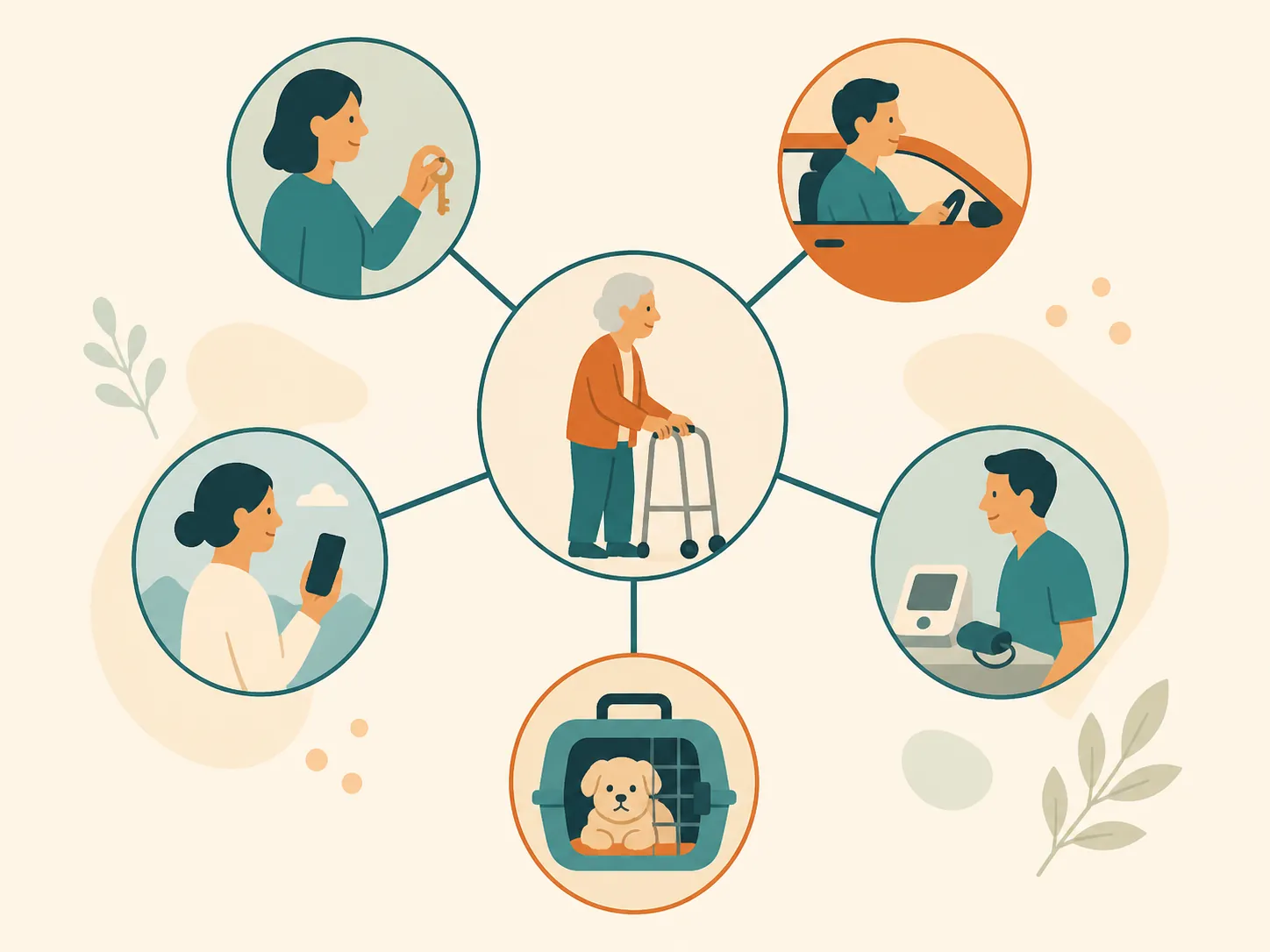
Build the network around jobs, not sentiment. One person may hold more than one job, but every job needs a primary and a backup if possible.
- Key holder: Has a spare key or lockbox code, knows the alarm code, and can enter if the parent does not answer.
- Driver: Can arrive quickly, help the parent into the vehicle, load mobility equipment, and drive one of the planned routes.
- Medication/device helper: Knows where medications, oxygen, CPAP supplies, chargers, batteries, and written instructions are stored.
- Document holder: Has copies or secure access to insurance cards, emergency contacts, medication list, clinician names, and the location of legal documents.
- Distant contact: Receives status updates and relays information when local calls and texts are unreliable.
- Pet helper, if needed: Knows where the carrier, leash, food, medication, and vaccination records are.
Put the role sheet in the Go-Kit, on the refrigerator or inside a kitchen cabinet, in the adult child’s phone, and with the key holder. If the parent dislikes visible paperwork, use a clearly labeled folder in one agreed location. The point is not to make the house look prepared. The point is that a helper can walk in at 10 p.m. and find what keeps the parent alive.
For long-distance caregivers, this is the part that deserves the most honesty. A plan that requires you to arrive first may be no plan at all. The local helper does not need to replace you; they need enough access and instruction to start the evacuation while you are still on the phone.
Practice until the plan shows its weak spots
Practice is not the soft ending. It is the test. AARP recommends practicing an evacuation or shelter drill every six months and reviewing kit contents every three to six months.[8] That rhythm is sensible because medications change, batteries die, glasses move, caregivers change jobs, neighbors travel, and a parent’s stamina can decline between fire seasons.
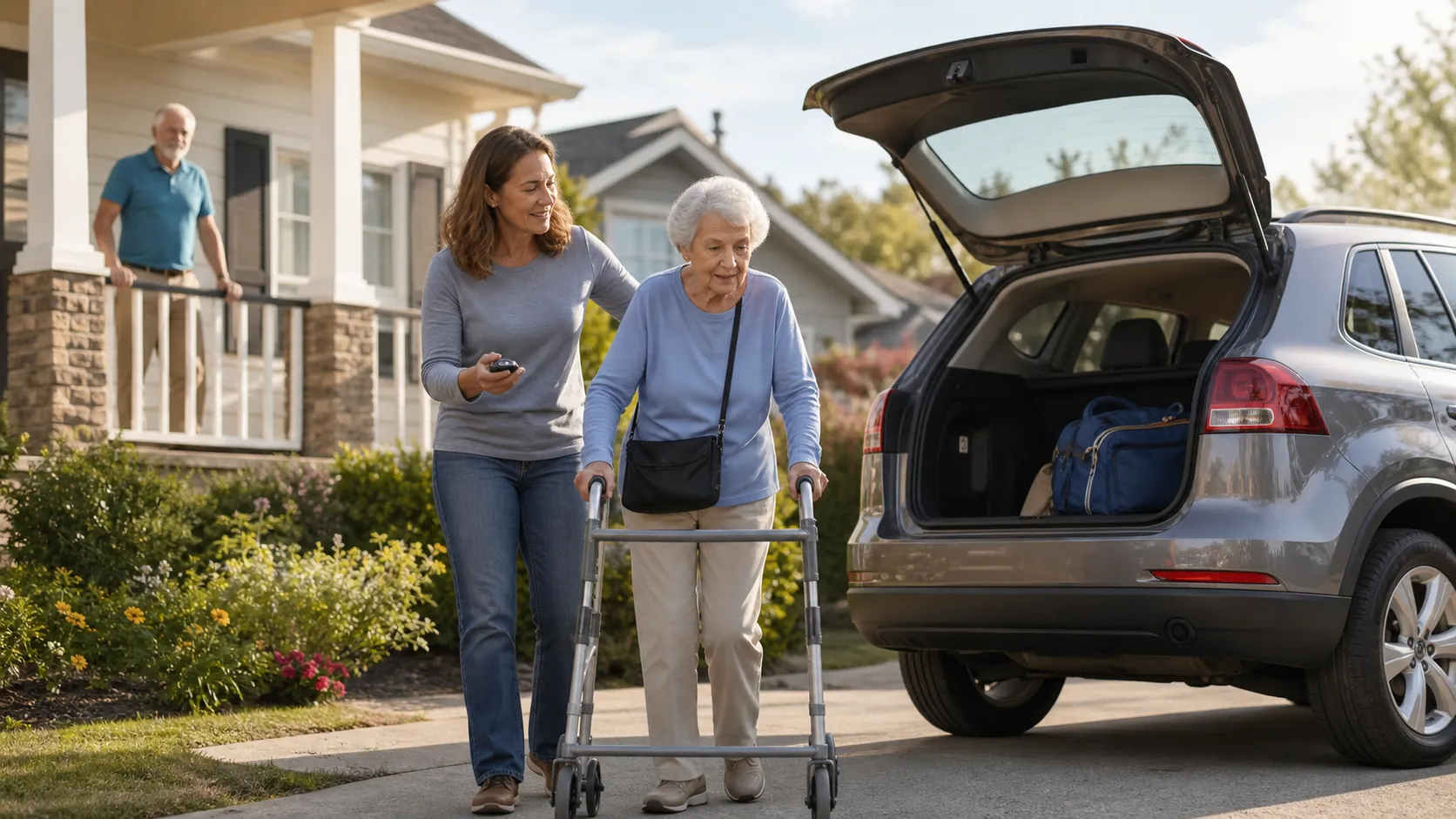
Run the first drill calmly in daylight. Start where evacuation would likely start: bed, recliner, kitchen table, or wherever the parent spends the evening. Then move through the real sequence.
- Parent puts on shoes, glasses, and hearing aids.
- Parent gets the mobility aid used for evacuation.
- Helper retrieves the Go-Kit, medication container, phone, charger, document pouch, and device supplies.
- Helper loads oxygen, CPAP, walker, wheelchair, pet carrier, or other essential equipment.
- Parent gets into the vehicle safely.
- Driver pulls out using the planned route.
- Parent or helper sends the short status text to the distant contact.
Do not grade the drill by whether everyone felt prepared. Write down what actually failed. Maybe the walker did not fit once the water was loaded. Maybe the parent could not find the hearing aids. Maybe the garage door was too heavy to open manually. Maybe the backup driver did not know the oxygen supplier’s number. These are not embarrassments; they are the reason to practice before the sky turns orange.
After the first daylight drill, do one evening drill without making it theatrical. The goal is not to frighten the parent. The goal is to learn whether the flashlight is reachable, whether the path from bed to door is clear, whether the parent can hear instructions, and whether the helper can do the job without you narrating every step.
Each kit review should be boring and specific: replace expired food, rotate water according to the container guidance, check medication dates, confirm prescriptions have not changed, recharge power banks, test flashlights, replace batteries, update phone numbers, verify the spare key still works, and confirm the evacuation destinations are still available.
What the finished plan should look like
By the time this plan is usable, it should fit on paper and in people’s hands. The parent should know where the Go-Kit is. The key holder should know where the supplies and medications are. The driver should know the two routes. The distant contact should expect the short status text. The medication list should be current. The CPAP, oxygen, hearing aids, glasses, chargers, and batteries should have a place. The car should not be trapped in the garage with a nearly empty tank. The next drill date should already be on the calendar.
That is the difference between a checklist and a plan: when the alert comes, the work has names, locations, quantities, and a practiced order.
References
- Older Adults, American Red Cross.
- Disaster preparedness among older adults: A scoping review, PubMed Central, 2023.
- Older Adults, Ready.gov.
- Wildfire Safety, American Red Cross.
- Emergency Supply Kit, Ready for Wildfire.
- Build A Kit, Ready.gov.
- Go! Evacuation Guide, Ready for Wildfire.
- Preparing for Emergencies, AARP.
- Emergency Preparedness 101: What to Do Before, During, and After a Disaster, National Council on Aging.
Related reading
Noticed something outdated or inaccurate on this page? Flag a correction. We review every report against CDC, NIA, and AARP HomeFit guidance before updating a page.
Part of the Fall Prevention section.