
STEADI: intervene
How to Help Your Aging Parent Evacuate Before Wildfire Strikes
This playbook shows family caregivers how to build a wildfire evacuation plan around their parent's actual mobility and medical needs, with three critical elements generic checklists leave out: a named helper, medical-equipment packing, and leaving well before Level 3.
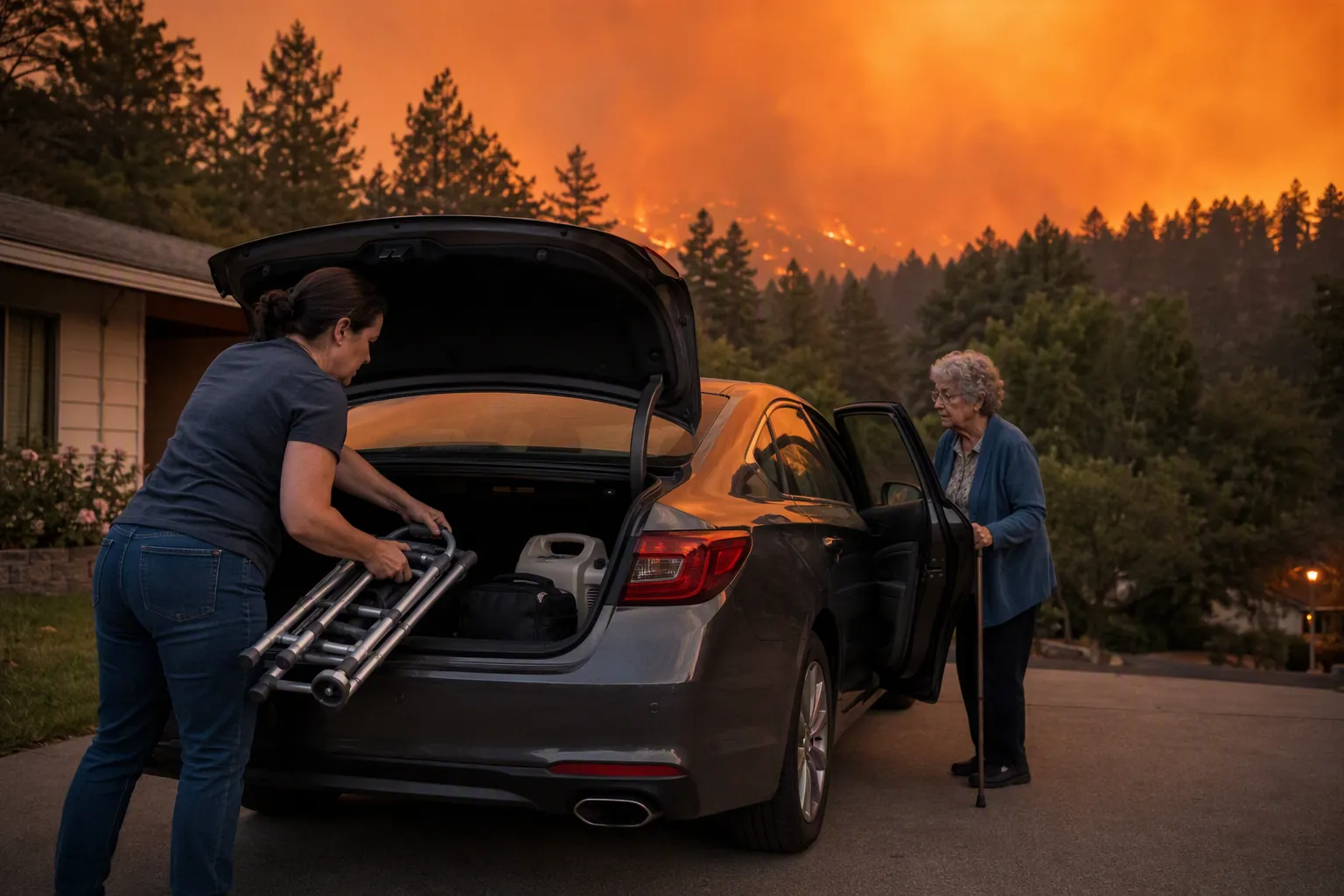
If your parent cannot simply grab a bag and go, wildfire evacuation planning has to start somewhere more specific than a supply list. It starts with the body that has to move: the distance your parent can walk, the stairs between the bedroom and the car, the oxygen tubing, the rollator that does not fold easily, the medications that cannot be skipped, and the person who will actually get all of that into a vehicle before smoke, traffic, fear, and darkness make every task harder.
For an aging parent, the working rule is plain: match the evacuation plan to their mobility and medical needs, assign a named helper and backup, and leave at Level 1 or Level 2 instead of waiting for Level 3. That is especially important because older adults already face higher fire-death risk overall: the U.S. Fire Administration reports that adults 65 and older have 2.5 times the general population’s risk of dying in a fire, and adults 85 and older have 3.4 times the risk. Those figures are for fire deaths generally, not wildfire-specific deaths, but they are a blunt warning against waiting until movement becomes chaotic [1].
The Camp Fire is another warning, not because every wildfire follows the same pattern, but because it showed how notification, traffic, temporary refuge, and vulnerable residents can collide. NIST’s Camp Fire case study describes an evacuation involving about 40,000 people, and it treats evacuation timing and traffic as central life-safety issues, not side details [2]. For a parent who uses a walker, oxygen concentrator, CPAP, insulin, or a wheelchair for distance, the evacuation problem is not theoretical. It is a sequence of physical jobs that someone must be ready to do.
Start with an evacuation profile, not a go bag
Ready.gov’s older-adult preparedness guidance starts with a useful sequence: assess needs, create a plan, and engage a support network [3]. For an adult child planning from another town, that sequence only works if “assess needs” becomes concrete enough that a neighbor, sibling, aide, or firefighter could understand the parent’s evacuation limits in one minute.
Write the profile as if the person reading it will be standing in the doorway with keys in hand. A vague note such as “Mom uses a walker” is not enough. The plan needs to say whether she can walk from the bedroom to the driveway without sitting, whether she needs help standing from a recliner, whether the walker fits through the hallway, whether there are porch steps, and whether she freezes when rushed. If your parent has already had falls, this wildfire plan belongs in the same folder as your fall-prevention plan, because a rushed evacuation creates exactly the conditions that make falls more likely: uneven thresholds, poor lighting, smoke, panic, unfamiliar bathrooms, and people hurrying.
If you have not already tested the route from bed, chair, bathroom, and kitchen to the car, use a separate device-and-route walkthrough rather than trying to solve it during a warning. CareWise has a deeper route-testing and mid-evacuation fall protocol in Wildfire Evacuation Plan for Seniors at Fall Risk. This article stays focused on the parent’s evacuation command plan: who moves them, what moves with them, and when they leave.
| Need to document | What to write in the plan |
|---|---|
| Walking distance | How far the parent can walk on a good day and on a bad day; where they must sit; whether smoke or heat worsens breathing. |
| Transfers | Whether they can stand from bed, toilet, recliner, and car seat without hands-on help. |
| Stairs and thresholds | Number of steps, rails, porch layout, garage slope, loose rugs, and any threshold that catches a walker wheel. |
| Mobility devices | Walker, rollator, cane, wheelchair, transfer belt, spare tips, brake issues, and whether the device fits in the assigned vehicle. |
| Respiratory equipment | Oxygen concentrator, portable oxygen, tubing, CPAP or BiPAP, batteries, chargers, and who knows how to disconnect and pack them. |
| Time-sensitive medications | Insulin, refrigerated medications, inhalers, cardiac medications, seizure medications, anticoagulants, pain medications, and who checks the supply. |
| Continence and skin care | Briefs, pads, wipes, barrier cream, gloves, disposable bags, pressure-relief cushion, wound dressings, or skin-protection items. |
| Cognition and anxiety | Whether the parent may refuse to leave, forget instructions, wander, remove oxygen tubing, or become unable to make decisions under stress. |
| Bag management | Whether the parent can lift, carry, identify, and bring the bag without prompting. |
The last line in that table is where many checklists quietly fail. If the parent cannot lift the bag, remember the bag, or get the bag down the porch steps, the bag belongs to the helper’s job list. Labeling it “Dad’s go bag” does not make Dad physically able to manage it.
Name the person who will physically do the evacuation work
A plan that says “family will help” is not a plan yet. The Red Cross specifically advises older adults to identify who will help them evacuate and to look into local registries where available [4]. For a long-distance adult child, that means converting good intentions into assignments before fire season.
The person you name should be close enough to arrive early, physically able to assist, comfortable handling the parent’s equipment, and willing to leave before the situation looks dramatic. A beloved sibling who lives two hours away may be the decision-maker, but not the evacuation helper. A neighbor across the street may be the helper, with the sibling on the phone directing medication checks and destination changes.
| Job | Primary person | Backup person | What they must know |
|---|---|---|---|
| Call the parent at Level 1 | Name and phone | Name and phone | What to say if the parent minimizes the warning or refuses to pack. |
| Drive or arrange transport | Name and phone | Name and phone | Which vehicle fits the walker, oxygen, wheelchair, pet carrier, and bags. |
| Enter the home and assist movement | Name and phone | Name and phone | Where keys are, how the parent transfers, and what level of hands-on help is safe. |
| Load equipment | Name and phone | Name and phone | Where the oxygen, CPAP, chargers, mobility device, cushion, and documents are stored. |
| Check medications | Name and phone | Name and phone | Which medications must come, which need cooling, and where the current list is kept. |
| Receive the parent | Name and phone | Name and phone | Destination address, entry access, bathroom setup, sleeping setup, pet rules, and backup lodging. |
| Update the family | Name and phone | Name and phone | Who sends one group message so the helper is not answering five calls while driving. |
One person can hold more than one job, but every job needs a name. The helper loading oxygen tubing should not also be expected to negotiate with three relatives by phone. The driver should not be trying to remember whether insulin is in the refrigerator. The adult child coordinating from another town should assume that the person at the house will be under stress and give that person a short, written sequence.
If your parent may resist leaving
Plan for refusal before there is smoke in the neighborhood. Some older parents resist because they have evacuated before and nothing happened. Some fear losing pets, medical equipment, privacy, or control. Some cannot process a fast-changing warning. The script should be short: “We leave at Level 1 because your walker, oxygen, and medications take time. We are not waiting until roads close.”
If decision-making capacity, dementia, psychiatric illness, or guardianship questions are involved, do not improvise a legal answer during a fire warning. Discuss the situation ahead of time with the parent’s clinician, care manager, attorney, or local emergency-management contact as appropriate. The evacuation helper needs authority, access, and a script; they should not be left to argue on the porch.
Set the leaving trigger before the alert arrives
For a mobile, healthy adult, Level 1 may feel like “watch and wait.” For a parent who needs help transferring, packing oxygen, finding medications, loading a walker, and reaching an accessible destination, Level 1 is the time to move from readiness to action. Oregon emergency officials advise older adults and people with disabilities to consider leaving at Level 1 instead of waiting until Level 3 [5]. Western Fire Chiefs Association guidance describes the standard three-level pattern as Level 1 “Be Ready,” Level 2 “Be Set,” and Level 3 “Go Now,” with Level 3 indicating immediate danger and a need to leave without delay [6].

The family rule should be written in advance, not negotiated by text while everyone is scared. For many older parents at fall risk or with medical equipment, the safest rule is: at Level 1, the helper comes over, medications and equipment are checked, the car is loaded, and the parent is ready to leave; at Level 2, the parent leaves; Level 3 is not the planned departure time.
That rule will feel inconvenient on days when the fire changes direction or the order never escalates. It may cost money, interrupt routines, and make a parent angry. The alternative is asking a less-mobile person to move during the narrowest, smokiest, most congested part of the event. If the parent needs a walker, oxygen, wheelchair loading, continence care, or repeated reassurance, waiting for certainty is usually waiting too long.
| Evacuation level | Caregiver action for an aging parent |
|---|---|
| Level 1: Be Ready | Helper contacts parent, comes over if assigned, checks medications, charges devices, loads nonessential equipment, confirms destination, and prepares pet carriers. |
| Level 2: Be Set | Parent leaves if they have mobility limits, oxygen or CPAP needs, cognitive impairment, fall risk, no nearby driver, pets, or a long route to safety. |
| Level 3: Go Now | This is the emergency fallback, not the family’s planned trigger. Leave immediately and do not spend time searching for noncritical items. |
If your region uses different alert language, translate the same principle into local terms: the parent leaves at the first serious readiness or pre-evacuation stage, not at the final mandatory stage. Sign up for local alerts, but do not make the alert system carry the whole plan. Someone still has to hear the alert, believe it, reach the parent, load the equipment, and drive.
Pack medical equipment as if the shelter will not have it
Generic emergency lists often say “bring medical supplies,” which sounds complete until the parent arrives without the one device that lets them sleep, breathe, transfer, or sit without skin breakdown. WVU School of Public Health’s emergency-planning checklist for seniors warns families not to assume shelters will provide durable medical equipment and specifically calls out items such as oxygen, walkers, rollators, CPAPs, skin-protection cushions, and a manual wheelchair backup [7].
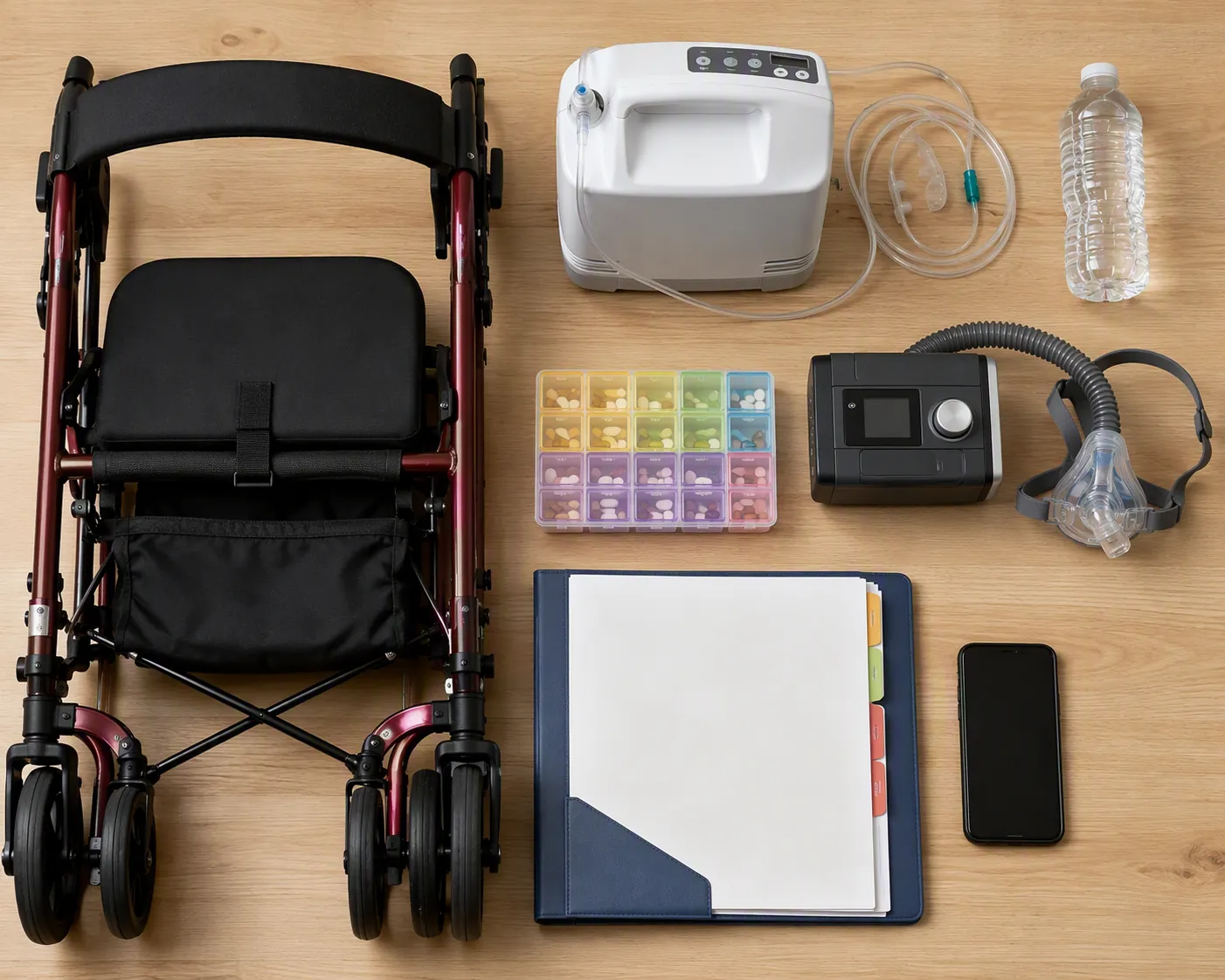
The packing plan should separate “always packed” from “grab at Level 1.” A spare pair of glasses can live in the go bag. The CPAP used every night cannot. The current insulin pen may be in the refrigerator. The oxygen concentrator may be plugged in beside a chair. The helper needs a room-by-room pickup list and permission to take what is currently being used.
| Category | Pack or prepare |
|---|---|
| Mobility | Walker, rollator, cane, wheelchair, transfer belt, spare rubber tips, cushion, and any tool needed to fold or secure the device. |
| Breathing and sleep | Portable oxygen, concentrator, tubing, CPAP or BiPAP, mask, distilled water if used, batteries, chargers, extension cord, and power strip. |
| Medication continuity | Current medication list, pharmacy phone number, prescriber names, pill organizer, time-sensitive medications, refrigeration plan, and dosing schedule. |
| Continence and hygiene | Briefs, pads, wipes, gloves, barrier cream, disposal bags, change of clothing, and odor-control bags. |
| Skin protection | Pressure-relief cushion, wound-care supplies, dressings, tape, and written instructions if a clinician has provided them. |
| Documents | Photo ID, insurance cards, Medicare or Medicaid cards, advance directive if available, power-of-attorney documents if applicable, emergency contacts, equipment supplier contacts, and a printed medication list. |
| Communication | Phone, charger, backup battery, written phone numbers, hearing-aid batteries or charger, and a note explaining communication needs. |
| Pets and service animals | Carrier, leash, food, medications, vaccination records, waste bags, and the name of the destination that will accept the animal. |
A manual wheelchair backup deserves special attention. A parent who normally walks with a rollator may not be able to walk the same distance after poor sleep, smoke exposure, dehydration, or hours in a parking lot. The backup chair is not an insult to independence. It is a way to keep the evacuation from becoming a fall.
Handle medication supply as a range, not a magic number
There is no single medication-supply number that fits every older adult, insurance plan, pharmacy rule, disaster duration, or medical condition. Public guidance uses different ranges for different contexts. Sonoma County’s personal go-bag guidance recommends 3 to 7 days of medications, CDC wildfire safety guidance recommends 7 to 10 days of prescription medicines, and the Red Cross advises older adults to prepare a 30-day supply where possible [8][9][4].
Treat those numbers as a planning range. The short range is the minimum you do not want to fall below. The longer range is the resilience goal, especially for medications that are hard to refill quickly, require refrigeration, require prescriber approval, or come through mail order. The family’s job is to ask the pharmacist and prescriber what is realistic before fire season, not to discover refill limits from a motel room.
- Keep a current printed medication list in the go folder and update it whenever a medication changes.
- Ask the pharmacy how early refills work during wildfire season or declared emergencies.
- Write down which medications cannot be missed and which require refrigeration, food, timing, or monitoring.
- If the parent uses insulin, inhalers, oxygen, seizure medication, anticoagulants, heart medications, or pain medication, ask the clinician what continuity planning is appropriate for that specific treatment.
- Put the medication-check job on one person’s assignment list so it does not become an assumption shared by everyone and completed by no one.
Choose destinations that can handle the parent you actually have
“Go to my house” may be the right answer, but only if your house works for the parent’s body and equipment. Before naming a destination, check the entrance, bathroom, sleeping surface, oxygen and CPAP power access, pet rules, smoke exposure, distance from the fire area, and whether the receiving person can help at night. A second-floor guest room is not a destination for a parent who cannot safely climb stairs after a long drive.
Name at least two destinations: one close enough for early relocation and one farther away if smoke or evacuation zones expand. If the parent may need a shelter, call the local emergency-management office before fire season and ask how disability, oxygen, mobility-device, service-animal, and transportation needs are handled locally. The Red Cross also advises older adults to learn about local registries or emergency-assistance options where available [4].
For broader stay-or-go planning across hazards, CareWise’s Earthquake Evacuation Safety Checklist for Elderly Parents can help families think through when sheltering in place becomes more dangerous than leaving. For wildfire paired with extreme heat, use Wildfire Safety for Older Adults During a Heat Dome so cooling, smoke, hydration, and power needs are planned together.
Make the car plan boring on purpose
The assigned vehicle should be tested with the actual equipment, not imagined. Fold the walker. Load the rollator. Put the oxygen concentrator where it will ride. Try the wheelchair. Add the pet carrier, go bag, medication cooler, and documents. Then have the parent get into the seat they will use. If the parent cannot transfer safely into a high SUV during a calm afternoon, that SUV is not the evacuation plan.
The driver also needs a route plan that assumes the most familiar road may close. Choose at least two routes out, fill the gas tank early during red-flag conditions, and keep the vehicle parked facing out if that is safe and practical. Do not block the walker path with boxes, garden tools, or hoses. A garage that works on a normal day can become a trap if the power fails, the opener will not work, and no one knows how to release the door manually.
For a broader four-layer supply structure, see Severe Weather Safety Checklist for Seniors Living Alone. For the checklist gaps that often get missed when CPAP, insulin, walker parts, and continence supplies are involved, see Storm Prep for Older Adults Misses These 7 Checklist Gaps.
What the long-distance adult child should do before fire season
If you live in another town, your most important role is not heroic last-minute driving. It is orchestration. You can build the plan, confirm helpers, keep documents updated, schedule the route test, ask the pharmacy questions, and make sure the person near your parent is not guessing.
- Create a one-page evacuation profile with mobility, medical equipment, medications, cognition, pets, destination, and contact details.
- Ask the parent’s permission to share the profile with the named helper, backup helper, receiving household, and any paid aide or care manager.
- Schedule a calm-day drill: parent moves from usual chair or bed to car, helper loads equipment, and everyone sees what does not fit.
- Place equipment pickup notes where they will be seen: oxygen area, CPAP table, refrigerator, medication drawer, garage, and front door.
- Confirm the Level 1 and Level 2 family rule in writing, including who has authority to say, “We are leaving now.”
- Check that the receiving destination can support bathroom access, sleep, power, pets, medications, and mobility devices.
- Set one family communication channel so the evacuation helper is not managing separate calls, texts, and arguments.
If your parent lives alone, the support network needs special attention. A phone tree is useful only if someone is assigned to go in person when the parent does not answer. A neighbor who can look through a window but cannot lift equipment may still be valuable, but not as the only evacuation helper. A paid aide may know the routine best, but may not be on duty when the alert comes. The plan has to cover the hour that actually happens, not the hour that would be convenient.
Keep defensible space and general kits in their lane
Home hardening, defensible space, alert signups, water, flashlights, batteries, and basic food supplies still matter. They are just not the missing piece in many aging-parent evacuations. The missing piece is usually the gap between owning supplies and being able to move a medically complicated person with those supplies at the right time.
That distinction matters because the consequence falls on the person at the house. If a checklist says “bring important papers,” someone must know where the papers are. If it says “bring medications,” someone must open the refrigerator. If it says “take your mobility device,” someone must know whether the rollator fits in the trunk after the oxygen concentrator and pet carrier are loaded.
CareWise safety note
This article is for general caregiver education and home-safety planning. It is not medical, legal, financial, or emergency-response advice. For individual decisions about evacuation assistance, oxygen, medications, mobility devices, cognitive impairment, advance directives, transportation, or shelter needs, consult the parent’s clinician, pharmacist, local emergency-management office, attorney, or other qualified professional as appropriate.
Clinical and home-safety review note: A credentialed reviewer, such as an occupational therapist, geriatric RN, or Certified Aging-in-Place Specialist, should verify transfer-safety guidance, oxygen and CPAP handling, medication-continuity language, and the limits of nonprofessional caregiver assistance.
The final readiness test
Ask one practical question before fire season: if a Level 1 alert arrives today, can this parent leave early with the right person, the right vehicle, the right medical equipment, enough medication continuity, and a destination that can actually receive them? If any critical decision is being saved for Level 3, the plan is not finished.
References
- Older Adults, U.S. Fire Administration
- Case Study of the Camp Fire — Notification, Evacuation, Traffic, and Temporary Refuge Areas (NETTRA), National Institute of Standards and Technology
- Older Adults, Ready.gov
- Older Adults, American Red Cross
- Prepare for wildfire season by having an evacuation plan, Oregon Department of Emergency Management
- Wildfire Evacuation Levels Explained, Western Fire Chiefs Association
- Checklist: Emergency planning for seniors, WVU School of Public Health
- Personal Go Bags, Sonoma County Emergency and Preparedness Information
- Wildfire Safety, Centers for Disease Control and Prevention
Related reading
Noticed something outdated or inaccurate on this page? Flag a correction. We review every report against CDC, NIA, and AARP HomeFit guidance before updating a page.
Part of the Fall Prevention section.