
STEADI: Intervene
How to build a senior wildfire evacuation checklist
Generic wildfire checklists assume you can hear the alert, move fast, and manage without medical equipment. This senior-specific evacuation checklist shows a caregiver how to plan routes and transportation, pack a room-by-room go-bag for medications and mobility aids, and use leave-early triggers — with a condensed printable version.
A senior wildfire evacuation checklist has to answer the questions a generic checklist usually skips: who is driving, which walker fits in which car, where the hearing aids are, whether the oxygen or CPAP supplies are ready, and whether the prescription bottle has enough medicine to get through a displacement.
The urgency is real, but it does not need to be made dramatic to be useful. After the January 2025 Los Angeles wildfires, Los Angeles County Aging & Disabilities described 31 deaths, while a Domestic Preparedness analysis reported a median victim age of 77. Those figures come from different sources, but both point to why older adults need plans that account for slower, more complicated evacuations. [1][2]
Older-adult fire risk also shows up in broader national fire data, not wildfire-only data. The U.S. Fire Administration reports that from 2014 to 2023, adults ages 65 to 74 had 2.2 times the relative risk of dying in a fire compared with the general population, that their fire-death rate trend rose 41% over that decade, and that adults ages 85 and older had 3.4 times the relative risk in 2023. [3]
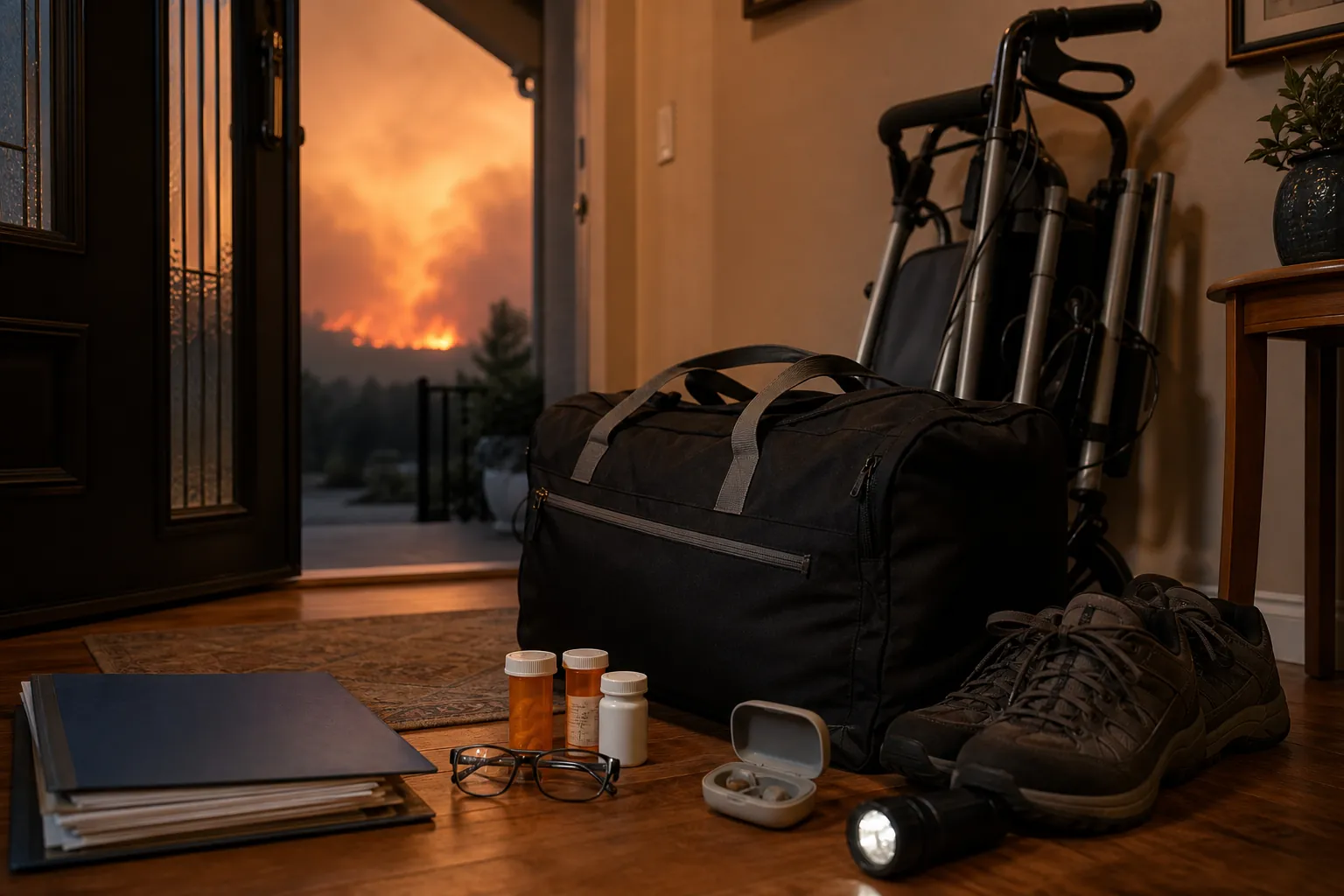
This is a build-before-fire-season checklist, not an evacuation-day pep talk. The work falls into three phases: plan the exit, pack the senior go-bag by room, and use leave-early triggers so the person is not forced to move at the speed of a younger, fully mobile household.
First, decide who gets the senior out
The American Red Cross tells older adults to identify who will help them evacuate and to keep at least 30 days of medications, along with assistive items they rely on. That one instruction changes the checklist from “be ready” into names, phone numbers, car seats, ramps, keys, and medication refills. [4]
Write the evacuation plan as if the caregiver who usually helps is unavailable. That does not mean removing the senior’s choice from the process. It means making the physical route, transportation, and medical needs visible enough that another trusted person can follow the plan without guessing.
| Plan-ahead decision | What to write down | Why it matters for a senior |
|---|---|---|
| Primary and backup evacuation routes | Two drivable routes from the home to a safe destination; note gates, steep driveways, stairs, gravel paths, narrow turns, and places where a walker or wheelchair slows movement. | Cal Fire’s Ready for Wildfire guidance includes a map marked with at least 2 evacuation routes; for a slower-moving senior, the second route should be checked before smoke, darkness, or road closures make the choice harder. [5] |
| Out-of-area contact | One person outside the likely fire area who receives updates from the senior, caregiver, driver, and destination household. | Local calls and local roads may be disrupted at the same time. A single contact reduces the number of people trying to call the senior directly. |
| Alert signups | County emergency alerts, local fire agency alerts, weather alerts, and a backup method if the senior does not reliably hear a phone at night. | NCOA includes signing up for alerts as part of older-adult emergency preparedness; the plan should not depend on one sound, one app, or one person being awake. [6] |
| Named evacuation helper | Primary helper, backup helper, and a third person who can check in by phone if neither can arrive quickly. | A “nearby relative” is not a plan unless that person has agreed to the role and knows where the go-bag, medications, devices, and keys are. |
| Transportation | Who drives, whose car fits the senior and mobility aid, where the car will park, who loads the walker or wheelchair, and what happens if the driver is at work. | The plan needs to match the body and equipment: a folded rollator, wheelchair, oxygen equipment, or transfer board can change which car works. |
| Medical-needs inventory | Medications, diagnoses, allergies, prescribers, pharmacy, oxygen or CPAP details, mobility devices, hearing aids, glasses, dentures, implanted devices, and care routines. | The inventory is what keeps a shelter, hotel, family home, or emergency clinician from starting from scratch. |
Check the route with the actual mobility aid
Do not just ask whether there are two ways out. Walk or drive them with the senior’s real limitations in mind. Can the senior get from the bedroom to the front door without crossing clutter? Is there a stair-free path? Does the walker fit through the side gate? Can the wheelchair turn on the porch? Is the driveway too steep for a slow transfer in smoke or darkness?
Then test the car. Put the folded walker, rollator, wheelchair, portable oxygen equipment, or shower chair into the vehicle that would actually be used. If it takes one person ten minutes on a normal afternoon, it will not become easier under an evacuation warning.
For device-by-device loading, backup power, and transportation matching, use this deeper guide to wildfire evacuation for seniors with mobility issues.
Make transportation a named arrangement, not a hope
The transportation section should name the driver, the pickup location, the backup driver, the vehicle that fits the senior, and the condition that starts the pickup. “If there is an evacuation warning within our zone, Maria leaves work and drives to Mom’s house” is stronger than “Maria can help.”
If the senior no longer drives, does not drive at night, uses oxygen, has dementia, or cannot transfer safely without help, the plan should move earlier. Oregon’s wildfire evacuation checklist explicitly tells older adults, people with disabilities, and people without transportation to act early. [7]
For households where the caregiver is coordinating from another city, the transportation plan should also say who has permission to enter the home, where a spare key or lockbox is, and whether the senior is comfortable leaving with that person. If cognitive changes, resistance, or anxiety may slow departure, pair this checklist with practical senior wildfire evacuation tips for caregivers rather than trying to solve it during an evacuation.
Build a medical-needs inventory that can travel
A medical-needs inventory should be printed, stored in the document folder, saved on the caregiver’s phone, and reviewed with the senior. It should be plain enough that a shelter volunteer, pharmacist, urgent-care clinician, or family member can use it.
| Inventory item | What to include |
|---|---|
| Medication list | Medication name, dose, schedule, reason if known, prescribing clinician, pharmacy, and whether the bottle is in the go-bag or must be grabbed from the medicine area. |
| Prescription supply plan | Target a 30-day medication reserve when feasible, matching Red Cross older-adult guidance; if that is not possible, NCOA’s preparedness framework still treats a two-week prescription supply as an important baseline. [4][6] |
| Medical equipment | Oxygen supplier, CPAP or BiPAP model, mask size, tubing, distilled water if needed, battery or power needs, and who can troubleshoot the device. |
| Assistive devices | Walker, cane, wheelchair, rollator, hearing aids, eyeglasses, dentures, braces, transfer belt, shower chair if needed at the destination, and charging cords or batteries. |
| Clinician and insurance details | Primary care clinician, specialists, pharmacy, insurance cards, Medicare or other coverage information, and advance directive or medical power of attorney if used. |
| Daily care notes | Mobility assistance, fall risks, swallowing issues, memory concerns, toileting needs, diet restrictions, wound care, and what helps the senior stay oriented. |
Keep the inventory respectful. It is not a dossier to be passed around casually. It is a tool for the people the senior has agreed may help in an emergency.
Pack the senior go-bag from the rooms where the items actually live
A senior go-bag is easier to build room by room than by abstract categories. Medications are usually in the bathroom or kitchen. Hearing aids may be on the nightstand. Shoes are by the bed or in the entry. The walker may be in the hallway, not in a supply closet. Pack from the real home, not from an idealized checklist.
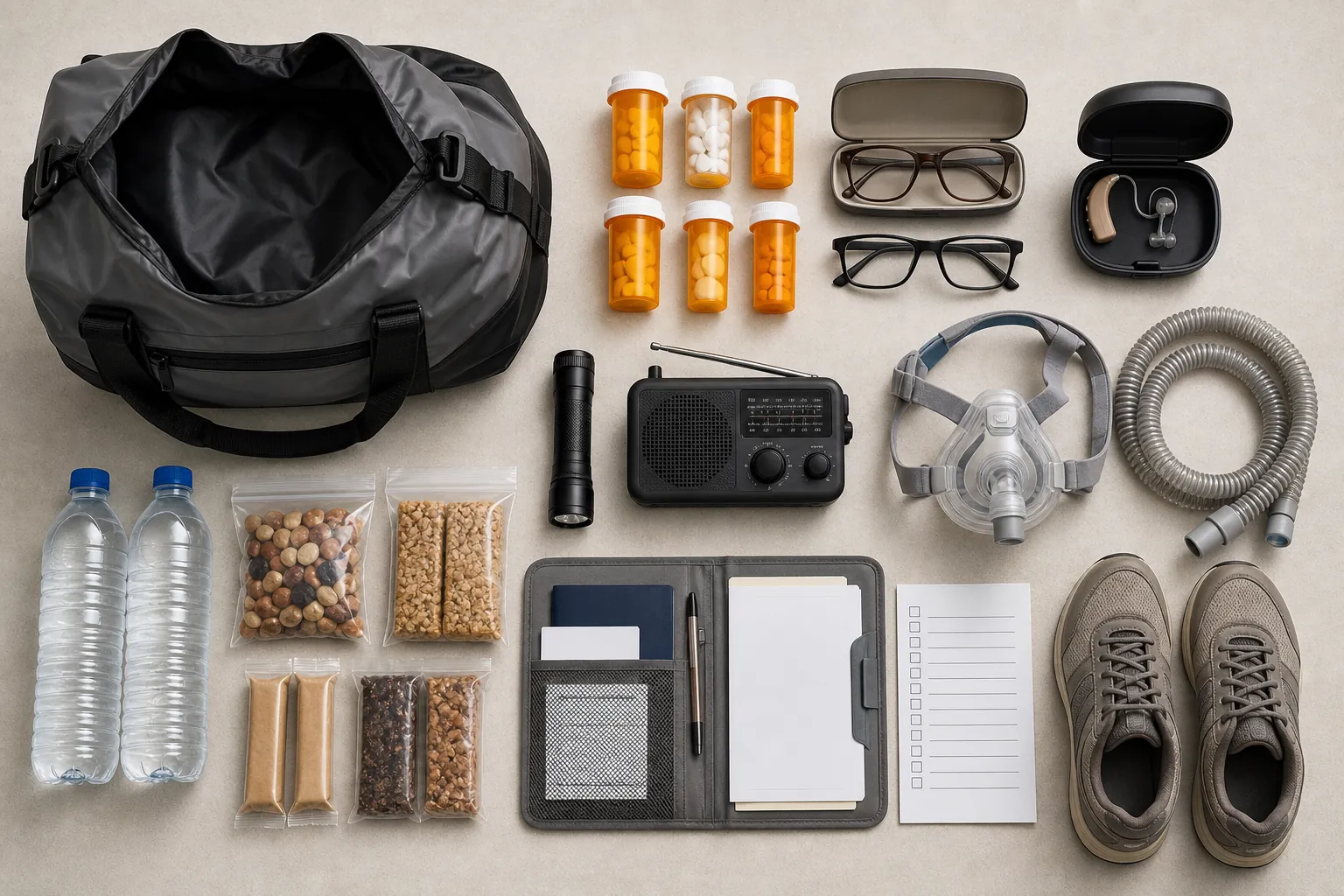
Cal Fire’s Ready for Wildfire emergency supply kit includes a 3-day food supply, 3 gallons of water per person, prescriptions, extra eyeglasses, a flashlight, and a battery-powered radio. Those are baseline items; for a senior, the checklist has to add the objects that make seeing, hearing, walking, sleeping, breathing, and taking medicine possible. [8]
| Where to pack from | Put in or beside the go-bag | Senior-specific check |
|---|---|---|
| Bedroom | Sturdy shoes, socks, flashlight, hearing aid case and batteries or charger, spare eyeglasses if available, phone charger, warm layer, and a small bedside grab list. | Cal Fire advises keeping sturdy shoes and a flashlight by the bed for night evacuations. This also reduces rushing barefoot or in slippers. [5] |
| Bathroom or medicine area | Medication reserve, printed medication list, pill organizer if used, prescription copies or pharmacy printout, inhalers, glucose supplies if used, wound supplies, hygiene items, dentures and case, and continence supplies. | Do not pack only a list if the bottles are nearly empty. Check refill timing before fire season and again when fire weather is forecast. |
| Entryway | Main go-bag, keys, wallet or purse, mask if used for smoke, cane or walker parking spot, route map, and shoes if the senior normally enters and exits there. | The entryway should not become a pile. Leave a clear walking path wide enough for the senior’s usual device. |
| Kitchen | Water, shelf-stable food, manual can opener if needed, special diet items, thickened liquids if used, easy-open snacks, pet food if applicable, and a small trash bag. | Use foods the senior can actually chew, swallow, open, and tolerate. A generic protein bar is not useful if it is too hard or conflicts with a diet restriction. |
| Documents | Photo ID, insurance cards, Medicare or other coverage information, medication list, medical-needs inventory, emergency contacts, out-of-area contact, copies of prescriptions, advance directive if used, home insurance information, and a recent photo of the senior. | Use a waterproof folder or pouch. Keep a second digital copy with the caregiver. |
| Medical equipment and assistive-device storage | CPAP or BiPAP mask and hose, oxygen tubing, portable oxygen details, batteries, chargers, extension cord, power bank if appropriate, extra hearing aid batteries, wheelchair charger, walker basket, transfer belt, and repair or supplier contact. | Label cords and small parts. A helper should know what must be unplugged, what must stay with the senior, and what can be left behind. |
Medication packing needs its own small routine
The medication section should be checked more often than the rest of the bag. Bottles expire, doses change, pharmacies switch manufacturers, and a “spare” inhaler may be empty. Put a refill review on the calendar and use the printed medication list to compare the go-bag against what the senior actually takes.
If controlled substances, refrigerated medications, or insurance refill limits make a full reserve difficult, write the workaround into the plan: which bottle must be grabbed from the refrigerator, which pharmacy to call, which clinician can authorize an emergency refill, and who is responsible for checking before fire season.
Night evacuation items belong at the bed, not buried in the bag
Some items are too important to pack away. Sturdy shoes, a flashlight, hearing aids, eyeglasses, and the phone charger should be reachable from the bed or from the senior’s normal nighttime path. This is where wildfire evacuation overlaps with fall prevention: the first few steps out of bed should not happen barefoot, disoriented, and in the dark.
If the home already has a night-lighting or bed-to-bathroom safety plan, connect it to the evacuation route. The same logic used for power-outage fall-proofing applies here: the senior needs light, footwear, a clear path, and a familiar sequence before anyone asks them to hurry.
Use leave-early triggers that match a slower departure
Evacuation day is not the time to debate whether the walker fits, whether the senior can tolerate smoke, or whether the caregiver can cross town in time. The plan should name conditions that move the household earlier than a generic evacuation order might suggest.
- A fire weather watch or similar forecast opens a preparation window. Use the time to top off gas, charge devices, place the go-bag by the door, confirm transportation, and review the route. For a more detailed timing worksheet, use the fire weather watch checklist for seniors.
- An evacuation warning is issued nearby, even if the senior’s exact address is not yet under an order.
- The planned driver is not immediately available, is at work, is across a bridge or canyon road, or may be delayed by traffic.
- The senior depends on power for oxygen equipment, CPAP, a lift chair, a powered wheelchair, refrigerated medication, or communication devices.
- Smoke worsens enough that walking, transferring, breathing, or staying oriented becomes harder.
- The caregiver cannot arrive quickly enough to help load devices, medications, pets, or documents.
- The senior becomes anxious, confused, fatigued, or resistant in a way that means departure will take longer than usual.
The rule is simple to write and hard to honor: when transportation, mobility, medical equipment, cognition, or smoke makes departure slower, the senior leaves during the warning window if possible, not at the last possible order.
Evacuation-day grab-and-go sequence
- Put on sturdy shoes and give the senior the flashlight if visibility is poor.
- Put in hearing aids, eyeglasses, dentures, and any brace or support the senior needs to move safely.
- Grab medications, the medication list, and any refrigerated or last-minute medical item.
- Disconnect and load essential medical equipment: oxygen supplies, CPAP or BiPAP parts, chargers, batteries, and labeled cords.
- Take the document folder and phone chargers.
- Load the mobility aid before the senior is waiting outside or standing unsupported.
- Secure pets, keys, wallet, and the senior’s phone if they are part of the household plan.
- Call or text the out-of-area contact with the departure time, driver, destination, and chosen route.
- Use the safer of the two planned routes and leave without adding nonessential stops.
If a step consistently takes longer in practice — getting shoes on swollen feet, transferring into a high vehicle, finding the hearing aids, calming a confused parent — the checklist should be changed, not blamed on the senior.
Printable senior wildfire evacuation checklist
| Phase | Checklist |
|---|---|
| Plan ahead | □ Choose 2 evacuation routes. □ Pick a destination and backup destination. □ Name an out-of-area contact. □ Sign up for local alerts. □ Name primary and backup evacuation helpers. □ Confirm who drives and which vehicle fits the senior and mobility aid. □ Test loading the walker, wheelchair, oxygen, or other equipment. □ Make a medical-needs inventory. □ Print and save emergency contacts. |
| Medications and medical needs | □ Keep a medication list in the go-bag and on the caregiver’s phone. □ Review refill dates. □ Pack a medication reserve when possible. □ Identify refrigerated or controlled medications that must be grabbed last. □ List pharmacy, prescribers, allergies, diagnoses, and insurance information. □ Label oxygen, CPAP, hearing aid, wheelchair, and other device supplies. |
| Bedroom | □ Sturdy shoes by the bed. □ Flashlight by the bed. □ Hearing aids, batteries, or charger reachable. □ Eyeglasses reachable. □ Phone and charger reachable. □ Clear path from bed to exit. |
| Bathroom or medicine area | □ Prescription bottles or packed reserve. □ Pill organizer if used. □ Inhalers, glucose supplies, wound supplies, hygiene items, dentures, continence supplies, and spare glasses if stored there. |
| Entryway | □ Go-bag by exit. □ Keys and wallet or purse. □ Route map. □ Cane, walker, rollator, or wheelchair positioned without blocking the path. □ Shoes if normally stored there. |
| Kitchen | □ Water. □ Shelf-stable food the senior can open, chew, swallow, and tolerate. □ Manual can opener if needed. □ Special diet items. □ Pet food if applicable. |
| Documents | □ Photo ID. □ Insurance and Medicare or other coverage cards. □ Medication list. □ Medical-needs inventory. □ Emergency contacts. □ Prescriptions. □ Advance directive or medical power of attorney if used. □ Home insurance information. □ Recent photo. |
| Medical equipment and assistive devices | □ CPAP or BiPAP mask, hose, and power cord. □ Oxygen tubing and supplier details. □ Chargers and batteries. □ Hearing aid supplies. □ Wheelchair charger. □ Transfer belt if used. □ Device instructions or supplier phone number. |
| Leave-early triggers | □ Fire weather watch or dangerous forecast. □ Evacuation warning nearby. □ Transportation uncertainty. □ Power-dependent medical equipment risk. □ Worsening smoke. □ Caregiver delay. □ Senior fatigue, confusion, anxiety, or slow transfer. |
| Evacuation day | □ Shoes and flashlight. □ Hearing aids, glasses, dentures, and phone. □ Medications and medical devices. □ Documents. □ Mobility aid. □ Pets, keys, and wallet. □ Confirm contact. □ Choose route. □ Leave. |
Seasonal review: keep the plan current
Review the checklist before local fire season, at the start of peak fire-weather months, after any medication or device change, and after any hospitalization, fall, new diagnosis, or change in driving status. As of July 2026, if the plan has not already been reviewed for this season, treat the review as a same-week task.
- Refresh medications, batteries, water, food, and printed contact sheets.
- Confirm the helper still agrees to the role and can still enter the home.
- Check that the transportation plan still fits the senior’s mobility, weight-bearing ability, equipment, and comfort.
- Practice the bedroom-to-car route slowly, with the walker, cane, wheelchair, oxygen, or other device the senior actually uses.
- Ask the senior what part of the plan feels intrusive, confusing, or unrealistic, then adjust the plan while there is still time.
A good senior evacuation checklist is not thicker than everyone else’s. It is more specific: the right helper, the right vehicle, the right medications, the right devices, the right shoes, and enough lead time for the person who cannot safely leave in a rush.
References
- Lessons from the January Wildfires: Why Preparedness Matters, LA County Aging & Disabilities
- Evacuation Lessons From the 2025 Los Angeles Wildfires, Domestic Preparedness
- Older Adult Fire Death Risk, U.S. Fire Administration
- Older Adults, American Red Cross
- Go! Evacuation Guide, Ready for Wildfire
- Emergency Preparedness 101: What to Do Before, During and After Disaster, National Council on Aging
- Wildfire Evacuation Checklist, Oregon Wildfire Response & Recovery
- Emergency Supply Kit, Ready for Wildfire
Related reading
Noticed something outdated or inaccurate on this page? Flag a correction. We review every report against CDC, NIA, and AARP HomeFit guidance before updating a page.
Part of the Fall Prevention section.