
STEADI: Screen
8 Signs of Decision-Making Decline That Raise Fall Risk
This guide connects eight clinically recognized signs of declining decision-making capacity to specific, preventable fall risks. See why each worrisome behavior affects your parent's safety and how to act before a fall happens.
The first clues usually do not arrive as one clean, dramatic event. They arrive as a stack of unopened mail, a parent insisting the cane is “for old people,” a spoiled carton in the refrigerator, the same question about the porch step asked three times in one visit. Any one of those can be explained away. Together, they can start to mean something more practical: your parent may be having trouble making certain safety decisions reliably, and that can raise fall risk before anyone has a diagnosis or a crisis.
Decision-making capacity sounds like a legal or clinical phrase, but for a caregiver standing in a hallway with loose rugs and a parent who refuses a walker, it becomes very concrete. Capacity is commonly evaluated through four abilities: understanding the relevant information, appreciating how it applies personally, reasoning through options and consequences, and communicating a choice.[1] When one of those abilities weakens, the result may not look like confusion in a doctor’s office. It may look like a risky step, a skipped pill, an unpaid repair bill, or a refusal that no longer connects to the danger in front of them.
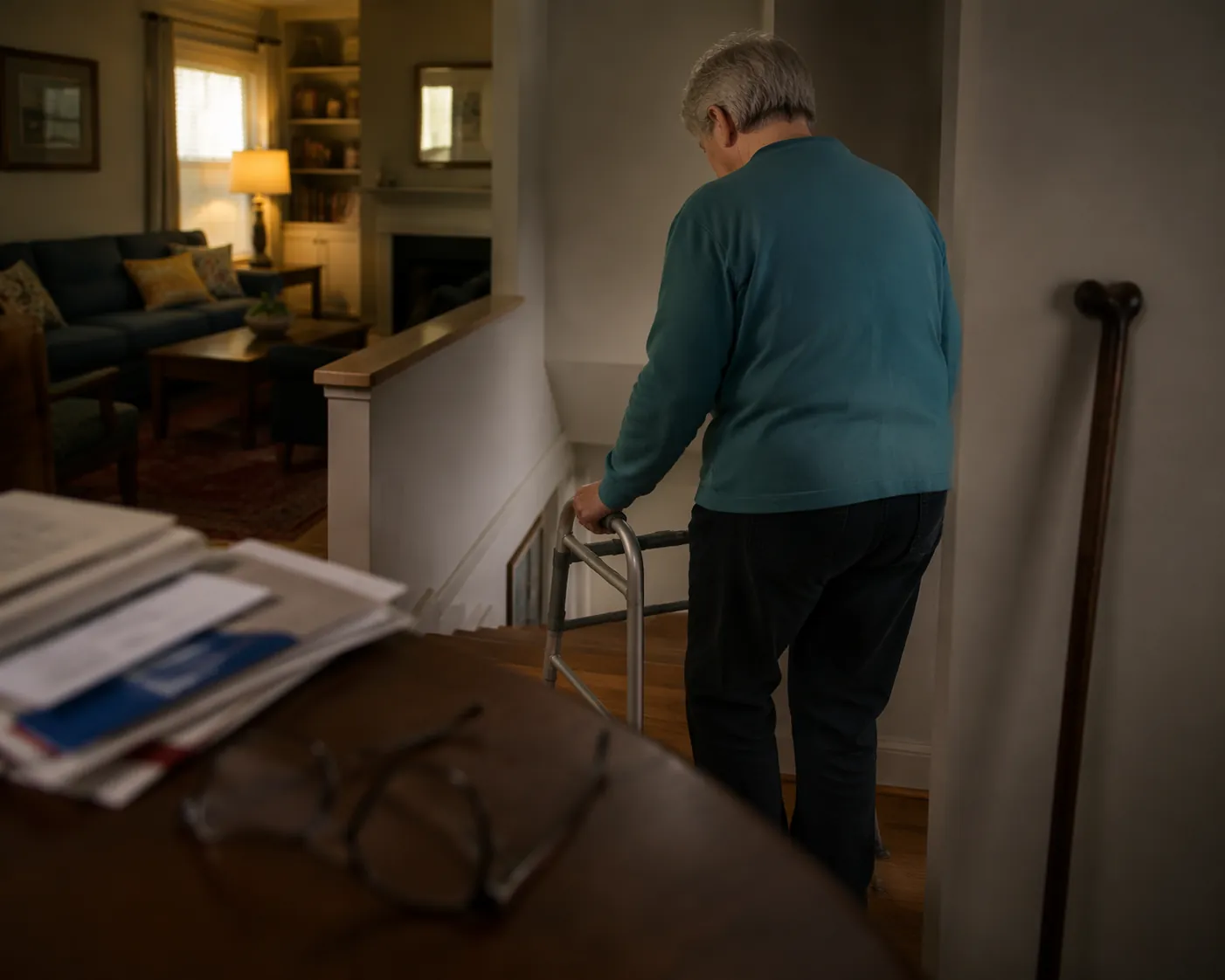
This is not a checklist for declaring that a parent “lacks capacity.” Capacity is decision-specific, and it can fluctuate with illness, medication changes, stress, pain, poor sleep, or an infection.[2][3] A parent may still make many everyday choices well while struggling with higher-stakes safety decisions. The point is narrower and more useful: these signs can tell you which fall hazards need attention now.
Why Capacity Matters For Fall Prevention
Falls are often treated as a balance problem, a footwear problem, or a home-design problem. Those matter. But a parent also has to recognize the risk, accept that it applies to them, choose a safer option, and repeat that choice when nobody is watching. That is where decision-making decline becomes a fall issue.

A parent who understands that the floor is wet may still fail to appreciate that their own slow reaction time makes it dangerous. Another parent may appreciate the danger but be unable to reason through a safer plan, such as waiting for help instead of carrying laundry downstairs. Someone else may know what they want but cannot explain why they are refusing help clearly enough for a clinician or family member to evaluate the decision.
Routine care can miss this. In one review cited by the American Academy of Family Physicians, physicians identified only 42% of patients with incapacity in routine encounters.[1] That does not mean families should diagnose capacity at home. It does mean that careful observations from daily life matter, especially when those observations point to hazards that can be reduced without taking over every part of a parent’s life.
8 Signs Your Elderly Parent Needs Help With Decision Making And Capacity
1. They Refuse Help But Cannot Explain Why
Refusing help is not automatically a capacity problem. Many older adults refuse help because they value privacy, dislike being rushed, or have had bad experiences with equipment that feels clumsy or stigmatizing. The sign becomes more concerning when the refusal has no stable explanation, shifts from one reason to another, or ignores the specific danger you are trying to address.
For example, your parent may say they do not need a cane because they “walk fine,” even after grabbing the wall several times between the bedroom and bathroom. When you ask what they would do if they felt dizzy halfway down the hall, they may brush off the question rather than show that they understand the risk. That points most strongly to impaired appreciation: they may understand what a cane is, but not accept that the risk applies to them.
The fall mechanism is direct. Refusing a cane, walker, grab bar, raised toilet seat, night light, or standby help keeps the same risky transfer or walking route in place. The danger is often greatest in predictable locations: the bathroom at night, the first step outside the door, the turn from bed to dresser, the basement stairs.
What to do next: separate the argument about independence from the immediate hazard. Instead of trying to win a broad debate about whether they “need help,” identify the one movement that worries you most and make it safer. Put the walker where it is actually reachable, clear the path to the bathroom, add lighting, and document what you observed. Then bring the pattern to a clinician: what happened, where it happened, what help was refused, and whether your parent could explain the consequence.
2. They Keep Asking About The Same Thresholds, Steps, Or Obstacles
Repeated questions about the same physical obstacle deserve more attention than families often give them. A parent may ask, “Is there a step here?” every time they approach the back door. They may pause at the same rug edge, misread the curb, or ask whether the hallway is clear even when the objects have not moved.
This can suggest a problem with understanding the environment in real time. It may also involve vision, depth perception, attention, or memory, so it should not be reduced to one cause. For fall prevention, the important part is that the parent is no longer reliably interpreting the walking surface in front of them.
The fall risk is a navigation error: catching a toe on a threshold, stepping too early off a curb, turning into furniture, or freezing and then rushing when someone behind them waits. Research on falls has increasingly examined the role of decision-making and judgment, including evidence that overestimating one’s ability to step or balance can predict future falls independently of actual physical ability.[4]
What to do next: treat the repeated question as a map. Mark that spot as a hazard until proven otherwise. Remove loose rugs, add contrast tape to step edges if appropriate, improve lighting, and reduce visual clutter. If the hesitation happens outside the home, note whether it is worse on curbs, uneven pavement, glare, or stairs. Ask for a vision review, medication review, and mobility assessment rather than assuming it is “just memory.”
3. Unpaid Bills Are Piling Up Or Repairs Are Being Deferred
A stack of unpaid bills can look separate from fall risk until the heat stops working, the stair rail stays loose, the porch light remains broken, or the eyeglass prescription is delayed. Money-management decline is especially important because it can appear early. Research highlighted by UAB found that warning signs can predict diminished ability to manage money, and financial capacity decline may precede other detectable signs of impairment.[5]
This sign often reflects reasoning and executive function problems: sorting priorities, tracking due dates, comparing consequences, and following through. It can also reflect depression, grief, low vision, or simple overwhelm, so the explanation should stay open. The safety consequence, however, should not wait for a perfect explanation.
Deferred maintenance can turn a home into a fall-risk machine. A burned-out hallway bulb makes the bathroom route darker. A loose handrail makes the front steps less forgiving. A cluttered entryway stays cluttered because the parent no longer schedules help, pays the handyman, or opens the mail with the overdue notice. The financial task and the physical hazard become linked.
What to do next: do not start by taking over everything if that is not necessary. Start with safety-linked bills and repairs. Check utilities, home insurance, rent or mortgage, medical bills, pharmacy costs, and urgent maintenance. Walk through the home with a narrow question: “Which unpaid or delayed task could make walking, bathing, cooking, or getting outside more dangerous?” If you have legal authority to help, use it. If you do not, ask your parent for permission to sit together for one bill-paying session and document what seems hard.
4. Food Spoils, Meals Become Erratic, Or Old Routines No Longer Work
Spoiled food in the refrigerator can mean many things: appetite changes, dental pain, low mood, trouble shopping, loss of smell, or difficulty cooking. It becomes a decision-making concern when the parent cannot recognize that the routine has broken down or cannot adjust the plan. They may insist they are “eating fine” while the same leftovers sit untouched, or they may keep buying groceries but stop preparing meals.
The capacity issue here is often reasoning and planning. The parent may still know what lunch is, but the chain of steps has frayed: notice hunger, choose safe food, prepare it, eat enough, clean up, and repeat tomorrow. When that chain fails, weakness, dehydration, dizziness, and slower reactions can follow. Those are fall risks even when the kitchen itself looks tidy.
What to do next: check patterns rather than one meal. Look at what is eaten, not only what is purchased. Notice whether meals are skipped before bathing, stairs, errands, or bedtime bathroom trips. Consider simpler food access: ready-to-eat meals, labeled portions, grocery delivery, shared meals, or a home-care visit at the time of day when eating most often fails. Raise sudden changes with a clinician, especially if weight, hydration, dizziness, or medication timing may be affected.
5. They Say “I Can Still Do That” After Near-Falls
Near-falls are easy to minimize because nobody was injured. A parent catches the counter, laughs it off, and says they just turned too fast. Another stumbles on the porch and blames the shoe. Sometimes that is fair. The warning sign is the repeated mismatch between what happened and what your parent concludes from it.
This is appreciation and reasoning under stress. Can your parent connect the near-fall to a changed safety plan? Can they explain why carrying laundry downstairs while holding the rail with one hand is riskier now? Can they accept a different method after the body has already given them a warning?
Misjudgment of ability matters because falls are not only caused by weak muscles. They can be caused by choosing a task as if balance, reaction time, and step height perception have not changed. A 2024 review in Frontiers in Aging Neuroscience describes aberrant decision-making as an emerging fall-risk factor and discusses studies linking overestimation of physical ability with later falls.[4]
What to do next: write down near-falls as carefully as you would a fall. Include time of day, footwear, lighting, surface, task, medication timing, and what your parent said afterward. Then change the task, not just the lecture. Move laundry to the main floor, add a second rail if appropriate, arrange delivery for heavy items, or create a rule that certain tasks wait for another person. If near-falls are increasing, ask for a fall-risk evaluation, physical therapy assessment, medication review, and cognitive screening.
6. They Leave The Stove On Or Miss Other Obvious Safety Hazards
Leaving the stove on often gets treated as a fire issue, which it is. It is also a fall issue when it shows that safety awareness is eroding across the home. A parent who does not notice a burner left on may also stop noticing water on the floor, a cord across the walkway, a box left near the stairs, or a pet bowl in the kitchen path.
The capacity element may be understanding, appreciation, or attention rather than one neat category. The practical concern is that hazards no longer trigger the old correction loop: see the problem, recognize the danger, stop, fix it, and avoid repeating it. Once that loop weakens, the home depends more on design than memory.
What to do next: reduce hazards that require constant judgment. Use automatic shutoff devices where appropriate, simplify cooking routines, remove cords from walkways, secure rugs, improve lighting, and keep frequently used items between shoulder and knee height so reaching and climbing decrease. If one type of safety lapse appears, look for others in the same visit. A single missed burner does not prove global incapacity, but it does justify a home-safety review.
7. Medication Errors Are Showing Up
Medication errors can look small at first: one missed dose, two pills left in the morning compartment, a refill that should have run out sooner, an old bottle mixed with a new one. The fall connection is not subtle. Too much, too little, or the wrong timing of certain medications can contribute to dizziness, sedation, low blood pressure, confusion, urgency to reach the bathroom, or unsteady walking.
This sign touches all four capacity elements. Your parent has to understand the instructions, appreciate why the medication matters to them, reason through what to do when a dose is missed, and communicate accurately with clinicians about what they actually took. A confident answer is not always a reliable answer if the pillbox tells a different story.
What to do next: bring the pill bottles, supplements, and pill organizer to a pharmacist or clinician for review. Ask specifically which medications may affect balance, alertness, blood pressure, nighttime urination, or cognition. Put one person in charge of setup if possible, use one pharmacy when practical, and watch for changes after a new prescription, dose change, hospital visit, or over-the-counter addition. Sudden confusion after a medication change should be treated as a clinical issue, not a character flaw.
8. They Wear The Same Clothes Daily Or Stop Adapting To Conditions
Wearing the same clothes for several days may seem less urgent than a near-fall or medication error. Sometimes it is about comfort, pain, laundry access, depression, or simply not caring about appearances as much. The safety concern appears when clothing choices show that protective routines are slipping.
A parent may keep wearing loose slippers with poor traction, skip socks that help shoes fit properly, wear long hems that catch underfoot, or go outside without weather-appropriate layers. They may not change after a spill, leaving a slick floor and damp clothing. The decision-making issue is often executive function: initiating the task, sequencing it, choosing appropriate clothing, and noticing when the situation requires a change.
What to do next: avoid making the first conversation about embarrassment. Make it about function. Place safe shoes where they dress, remove the worst footwear from the usual rotation if you can do so respectfully, simplify clothing choices, and check whether laundry, bathing, pain, or closet layout is the real barrier. If dressing changes appear alongside missed meals, bills, medication errors, or repeated confusion, tell the clinician that the issue is not only hygiene; it is a change in daily safety behavior.
How To Act Without Overreaching
The safest first steps are usually low-regret changes: better lighting, clear walking paths, medication reconciliation, a repaired handrail, a reachable walker, a safer shower setup, and a written record of what you are seeing. These do not require you to settle every question about independence. They require you to notice that a pattern has started to produce physical hazards.
- Document patterns: dates, locations, what happened, what your parent said, and what changed afterward.
- Reduce the immediate fall hazard: lighting, clutter, footwear, rails, bathroom supports, stairs, and trip points.
- Review routines that affect balance: meals, hydration, sleep, bathroom trips, alcohol use, and medication timing.
- Ask for clinical help: primary care, pharmacy review, physical therapy, occupational therapy, vision care, or neuropsychological assessment when indicated.
- Keep the question decision-specific: which choices are still reliable, and which safety choices now need backup?
Formal capacity assessment belongs with qualified clinicians, and legal decisions require appropriate legal guidance. The signs here are screening clues, not diagnoses. They are still enough to justify action when the next likely consequence is a fall in the hallway, bathroom, kitchen, or front steps.
A parent does not have to be globally unable to make decisions before you make the home safer. Capacity can fluctuate, and some abilities remain intact while others weaken.[2][3] If the pattern says your parent is no longer judging certain risks reliably, do not wait for a broken hip to prove the pattern mattered.
References
- Evaluating Medical Decision-Making Capacity in Practice, American Academy of Family Physicians, 2018.
- Mental Incompetence & Losing Decision Capacity: A FAQ, Better Health While Aging.
- Decision Making in Older Adults with Dementia, Hartford Institute for Geriatric Nursing.
- Aberrant decision-making as a risk factor for falls in aging, Frontiers in Aging Neuroscience, 2024.
- Warning signs can predict seniors' diminished ability to manage money, UAB News.
Related reading
Noticed something outdated or inaccurate on this page? Flag a correction. We review every report against CDC, NIA, and AARP HomeFit guidance before updating a page.
Part of the Fall Prevention section.