
STEADI: intervene
Storm Emergency Checklist for Seniors Living Alone
An older adult living alone needs a storm checklist built around what generic lists assume away: medications and backup power, assistive aids, a support contact with a spare key, and paper documents. This printable before/during/after plan gives the exact quantities and power-outage rules to act on, plus a six-month review cadence.
A storm emergency checklist for seniors living alone has to assume something ordinary checklists often do not: no one may be in the next room when the power fails. The flashlight may be in a drawer across the house. The walker may be parked by the bed while the medication list is in the kitchen. The person with the spare key may be willing to help, but not know where the oxygen instructions, hearing-aid batteries, or go-bag are kept.
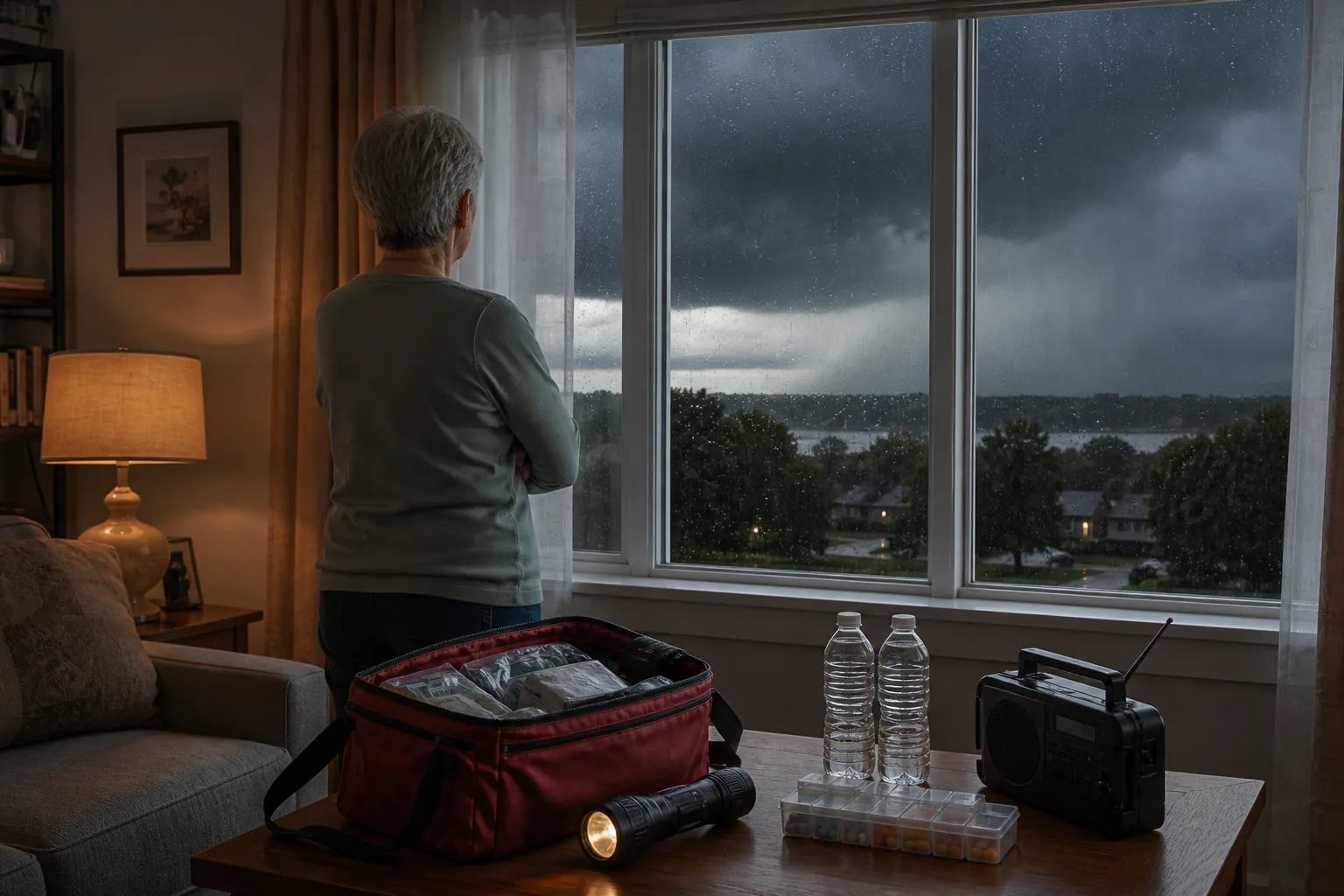
That is why this checklist is built around the points where storms actually break a routine: medications, power-dependent equipment, mobility and sensory aids, paper documents, food safety, and one named person who can get inside if you cannot come to the door.
The gaps are common enough to plan for without blaming anyone. The 2019 National Poll on Healthy Aging found that more than half of older adults were not signed up for local emergency alert systems, most got emergency information from television, and among the 9% who depended on electricity-powered medical devices, only 25% had backup power available.[1] A checklist that depends on television, charged phones, and easy walking through a dark house is not much of a plan.
Printable storm checklist at a glance
Print this section and keep it with your emergency papers. If an adult child or neighbor is helping, do not let them keep the only copy.
| Phase | What to do | Minimum standard to write on the printed copy |
|---|---|---|
| Before the storm | Store water | 1 gallon per person per day; aim for a 2-week home supply and a 3-day evacuation supply.[2] |
| Before the storm | Prepare medications | Ask your pharmacist how to maintain an emergency supply; Red Cross guidance recommends about 30 days at home and a 7-day supply in a go-bag.[3] |
| Before the storm | Name a support-network contact | Choose one person who has a spare key, knows where supplies are, and knows how to use lifesaving equipment if you have it.[4] |
| Before the storm | Plan for power-dependent devices | Write down what needs electricity, how long batteries last, and who to call if backup power fails. |
| Before the storm | Pack assistive and sensory backups | Include spare eyeglasses, hearing-aid batteries, cane or walker supplies, and a manual backup if you use a power wheelchair when possible.[3] |
| During the storm | Stay reachable | Keep phone battery use low, keep the charged device near you, and check in with your named contact on the schedule you agreed to. |
| During an outage | Use food-safety limits | Refrigerator: about 4 hours. Full freezer: about 48 hours. Discard food held at 40°F or higher for 2 or more hours.[5] |
| During an outage | Use generators safely | Run generators outdoors at least 20 feet from windows, doors, and attached garages; keep working carbon monoxide detectors on every level.[5] |
| After the storm | Check before resuming routines | Check medications, food, walking paths, medical equipment, and whether your support contact still needs to come by. |
| Every 6 months | Review the plan | Repeat after medication changes, equipment changes, a move, or before your local storm season. |
Before the storm: set up the house for the night the power goes out
The best storm preparation for an older adult living alone is not a beautiful kit in the hall closet. It is a house arranged so the important items can still be reached when the room is dark, the floor is wet, and the phone is nearly dead.
Put water where you can lift it
Ready.gov’s basic water standard is 1 gallon per person per day, with a 2-week supply for staying home and a 3-day supply for evacuation.[2] For one person, that means planning for 14 gallons at home if space and lifting ability allow.
Do not stack all of it on a high shelf or in the garage if you cannot safely reach it. Keep some water in smaller containers near the room where you spend the evening, and keep a few bottles in the go-bag. The safest supply is the one you can actually carry without losing your balance.
Handle medications before the refill problem becomes an emergency
Medication planning needs more care than “keep extras.” Red Cross guidance for older adults recommends keeping about 30 days of medications at home and a 7-day supply in a go-bag.[3] Treat that as preparedness guidance, not medical advice. Confirm the plan with your pharmacist, because insurance refill rules, controlled substances, refrigeration, and medication changes can all affect what is possible.
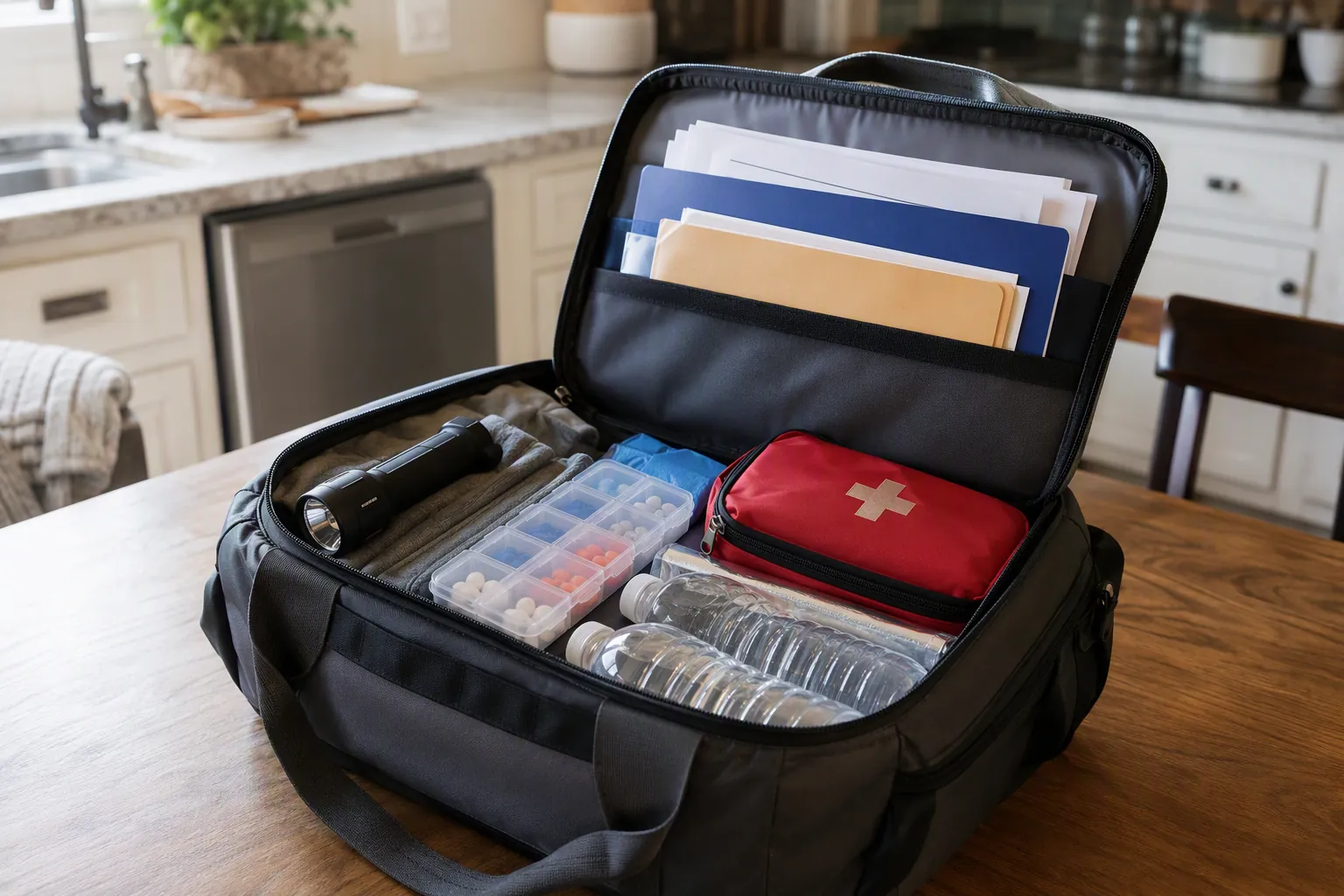
- Keep a printed medication list in the go-bag and another copy on or near the refrigerator, where emergency responders or a support contact can find it.
- Write the prescribing doctor, pharmacy phone number, dose, schedule, allergies, and the reason the medication is taken.
- If a medication needs refrigeration, write the rule for that specific medication on the printed list and ask the pharmacist what to do during a long outage.
- Put the 7-day go-bag supply in a clearly labeled pouch, then set a calendar reminder to rotate it before it expires.
If you use a weekly pill organizer, do not make that organizer the only source of information. A neighbor holding a key cannot safely guess what the small white tablet is.
Write down every device that depends on electricity
Make a plain paper list titled “Equipment That Needs Power.” Include oxygen equipment, CPAP, nebulizer, power wheelchair or scooter, stair lift, hospital bed, lift chair, refrigerator for medication, phone, medical alert system, internet router if needed for communication, and any charger you rely on.
For each item, write three things: how long it works on battery, where the charger or backup battery is kept, and who to call if power is out longer than the battery lasts. Ready.gov’s older-adult guidance specifically calls for a support network that knows where emergency supplies are and knows how to operate lifesaving equipment.[4]
| Device or need | Battery or backup time | What helper needs to know | Who to call |
|---|---|---|---|
| Oxygen, CPAP, nebulizer, or other medical device | Write actual battery time | Where backup power is kept and how to connect it | Doctor, supplier, utility, emergency contact |
| Power wheelchair or scooter | Write actual battery time | Where charger is; whether a manual chair is available | Support contact, mobility equipment provider |
| Medication refrigerator | Depends on appliance and outage | Which medications are inside and what the label or pharmacist says | Pharmacy, prescribing doctor |
| Phone or medical alert device | Write actual battery time | Where charging cord and power bank are kept | Support contact, device company |
Pack the aids that keep you mobile, oriented, and able to communicate
The emergency item that matters most may not look like emergency equipment. It may be the spare eyeglasses that let you read a label, the hearing-aid batteries that let you hear a warning, or the cane that keeps you from furniture-walking through a dark hallway. Red Cross older-adult guidance names extra assistive items such as a cane, eyeglasses, hearing-aid batteries, and a manual wheelchair backup where needed.[3]
- Keep a flashlight within reach of the bed, your favorite chair, and the kitchen—not only in the emergency kit.
- Store extra batteries in the same labeled container as the device they power.
- Put reflective tape or bright labels on the walker, cane, flashlight, medication pouch, and go-bag handle.
- If you use hearing aids, keep a small written note in the go-bag explaining how you communicate best if the aids are not working.
- Keep shoes with firm soles near the bed before a storm, not slippers that slide on wet floors.
Make paper copies because phones fail at the worst time
A phone contact list is useful until the battery dies or the screen breaks. Put paper copies in a waterproof folder or zip-top bag. Keep one set in the go-bag and one set in a visible place your support person knows.
- Medication list, allergies, diagnoses, doctors, pharmacy, and insurance information.
- Emergency contacts, including one local person and one out-of-area person if possible.
- Copies of identification, Medicare or insurance cards, and key medical device instructions.
- Utility account numbers, medical equipment supplier numbers, and transportation contacts.
- Pet information, veterinarian contact, and pet medication list if you have an animal.
If you receive federal benefits by paper check, Ready.gov advises switching to direct deposit or the Direct Express card so a disaster does not interrupt access to funds in the same way a missed mail delivery can.[4]
Set up alerts that do not depend only on the television
Television is a weak emergency plan during a power outage. Sign up for local emergency alerts through your city, county, or state emergency management office. If you use a smartphone, Ready.gov also notes that the FEMA app can monitor up to five locations, which can help if a trusted relative wants alerts for your area or you want alerts for a loved one’s area.[4]
Keep at least one battery-powered or hand-crank radio in the home. Put fresh batteries beside it in a labeled bag. Then test the radio before storm season, because a radio you cannot tune in the dark is just another object on the shelf.
Choose the person who can get inside
A support-network contact is not the same as “someone will probably check on me.” Ready.gov recommends that a network member have an extra key, know where emergency supplies are, and know how to use lifesaving equipment.[4] That needs to be decided before the rain starts.
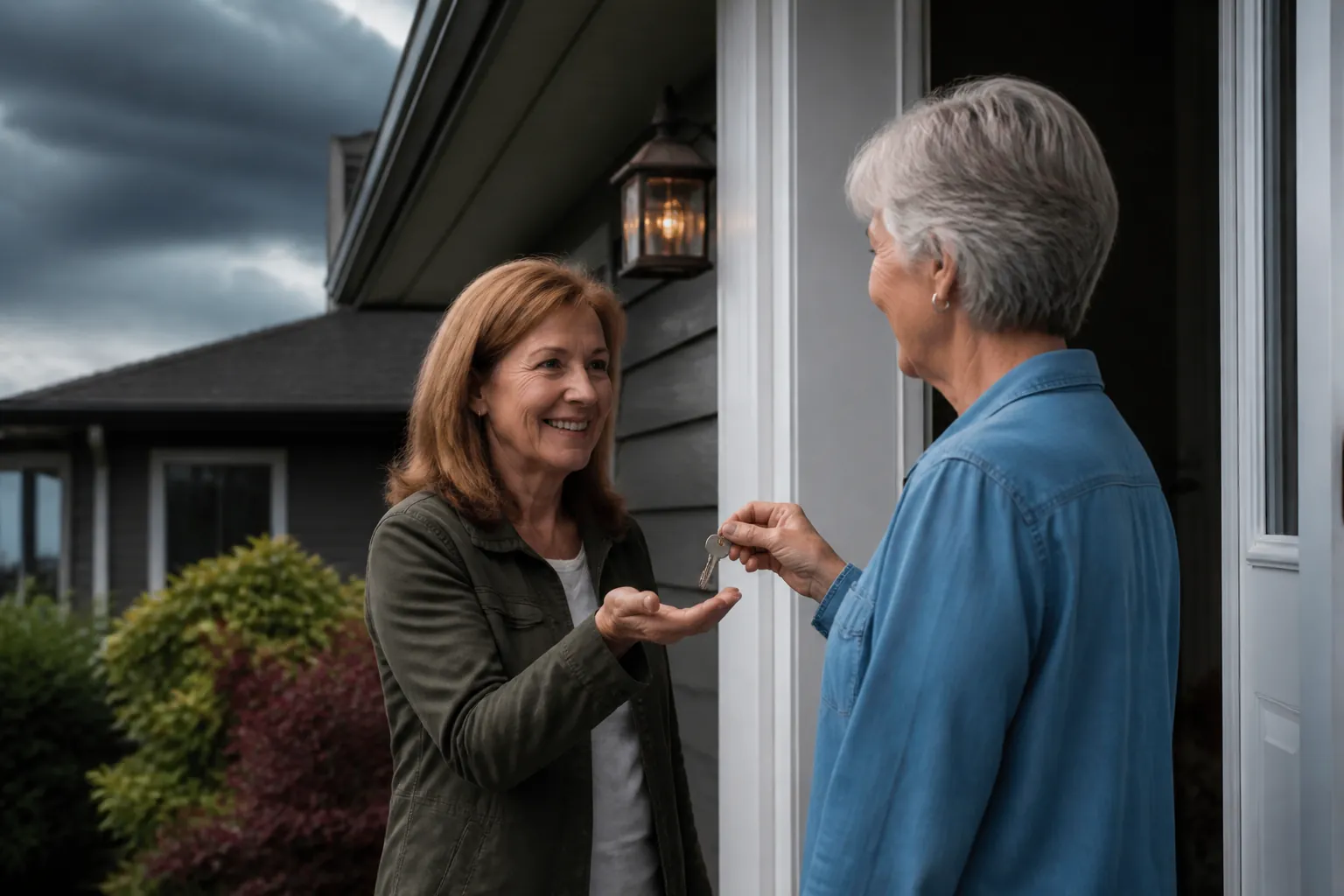
- Pick one primary support contact and one backup.
- Give the primary person a spare key or lockbox code.
- Walk that person through the home once: go-bag, medication list, breaker panel, water shutoff if known, medical equipment, pet supplies, and safest exit.
- Agree on check-in times: for example, before the storm, when power goes out, the next morning, and after the all-clear.
- Write down what the person should do if you do not answer: call again, come over, contact a relative, or request a welfare check.
Independence is easier to protect when the helper has instructions instead of authority. The point is not to hand over control. The point is to make sure someone can open the door and find the right paper if you cannot explain everything at that moment.
If winter storms are possible, prepare heat and vents early
Winter storms add two problems that deserve separate attention: unsafe heat and blocked ventilation. The National Weather Service advises refilling heating fuel before it is empty, using a properly ventilated emergency heat source, keeping carbon monoxide detector vents clear of snow, and having extra prescription medicine before a winter storm.[6]
Do not bring grills, camp stoves, or generators indoors for heat. Do not run a car in an attached garage to warm up. If snow or ice blocks the usual exit, that is not a minor inconvenience for someone using a walker, cane, oxygen tubing, or a wheelchair; it is part of the emergency plan.
During the storm: stay reachable and reduce fall risks
Once the storm is underway, the goal is to keep the routine small and safe. Move the phone, flashlight, water, medications, eyeglasses, hearing aids, cane or walker, and warm clothing within arm’s reach of where you will sit or sleep. If you need to get up at night, use the flashlight before you stand.
- Check in with your support person at the agreed time, even if nothing is wrong.
- Keep the phone plugged in while power is available; after the power fails, lower screen brightness and avoid unnecessary calls or videos.
- Use text messages when they work, because they may go through when voice calls do not.
- Do not walk through standing water, dark rooms, or cluttered paths unless there is an urgent reason.
- Keep pets, cords, throw rugs, and loose blankets out of the main walking path before you settle in.
- If officials tell your area to evacuate and you need help leaving, call your support contact or local emergency number early rather than waiting until the route is harder to use.
If you use medical equipment and the battery is running down, do not spend the last minutes of charge deciding whom to call. Use the equipment list you prepared. Call the support person, equipment supplier, utility, doctor’s office, or emergency services according to the plan written beside that device.
Power-outage rules to tape to the refrigerator
The food and generator rules are worth printing because they are easy to forget when the kitchen is dark and everyone is tired.
| Outage question | Rule |
|---|---|
| How long is food safe in the refrigerator? | A refrigerator keeps food cold for about 4 hours if the door stays closed.[5] |
| How long is food safe in a full freezer? | A full freezer keeps temperature for about 48 hours if the door stays closed.[5] |
| When should food be thrown away? | Discard food that has been held at 40°F or higher for 2 or more hours.[5] |
| Where can a generator run? | Outdoors, at least 20 feet from windows, doors, and attached garages.[5] |
| Where should carbon monoxide detectors be? | Ready.gov advises working carbon monoxide detectors on every level of the home.[5] |
| What about refrigerated medications? | Ready.gov says refrigerated medications should generally be discarded if power is out for more than a day unless the drug’s label says otherwise.[4] |
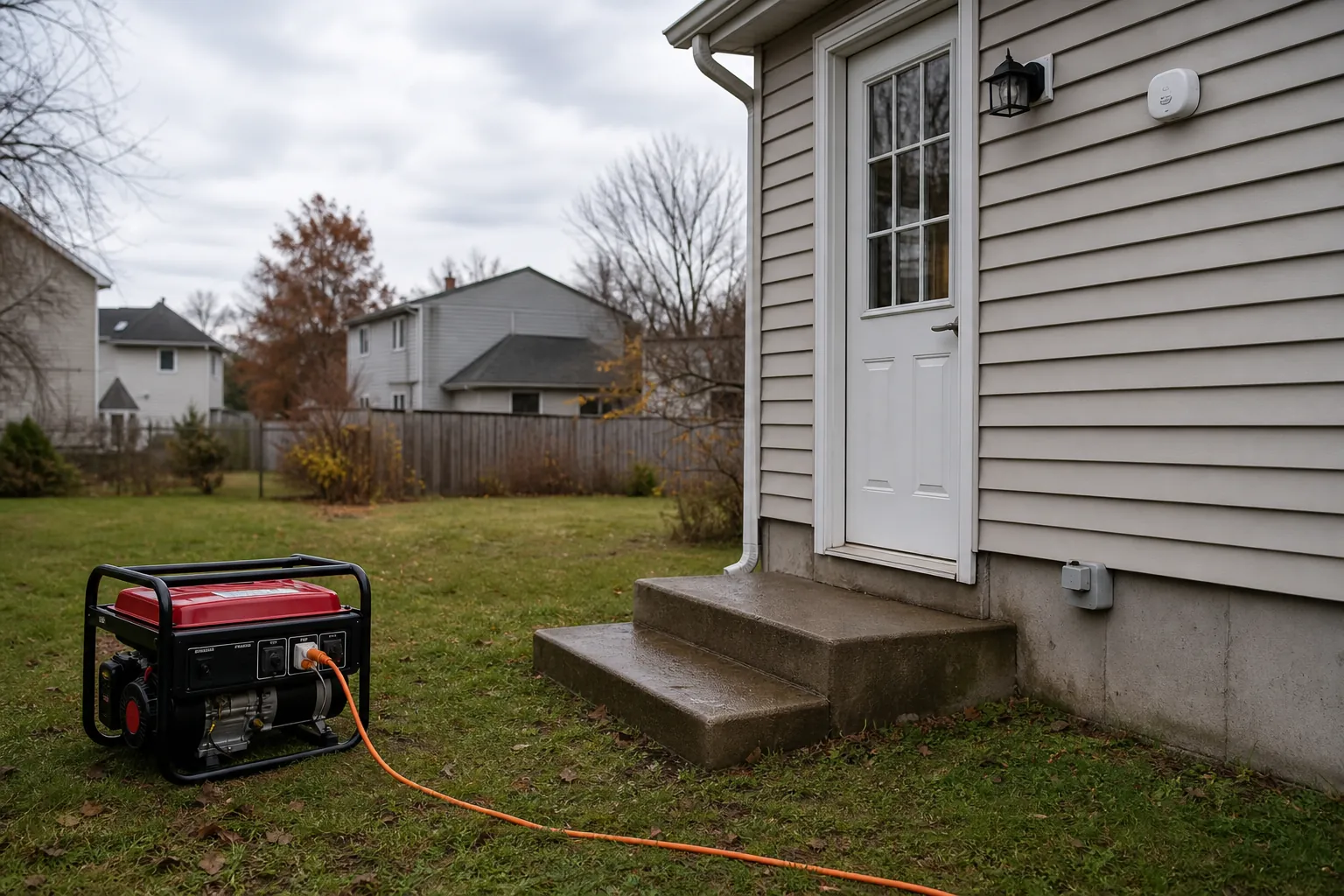
A generator is not safe because it is near an open door, under a porch, in a garage with the door cracked, or beside a window that “doesn’t open much.” The distance matters. The exhaust has to stay outside, and the carbon monoxide alarm has to work before anyone gets sleepy, dizzy, confused, or weak.
For refrigerated medications, the safest step is to plan in advance with the pharmacist. Put the pharmacist’s instructions in writing with the medication list. During an outage, avoid opening the refrigerator unless necessary, and call the pharmacist before using medication you are unsure about.
After the storm: do not let the first clear hour become the dangerous hour
After the storm, people are tempted to hurry. That is when falls happen: stepping over branches, carrying spoiled food, walking into a wet garage, reaching for a breaker panel, or trying to move a generator alone.
- Check in with your support person before you start cleaning up.
- Put on sturdy shoes before walking through any area with water, glass, branches, or debris.
- Use the refrigerator and freezer rules before eating food from an outage.
- Check medication safety, especially anything refrigerated or exposed to heat.
- Look for new fall hazards: wet floors, curled rugs, loose cords, shifted furniture, broken handrails, missing night-lights, and blocked exits.
- Do not move heavy branches, flooded boxes, appliances, or a generator by yourself.
- Restock what you used before putting the go-bag away.
If the storm changed the house—water came in, power cords were moved, rugs were lifted, furniture shifted, or a normal exit is blocked—treat the home as unfamiliar until you walk through it slowly in daylight or with help.
Review the checklist every 6 months
A storm checklist goes stale quietly. Medications change. Batteries expire. A neighbor moves. A walker replaces a cane. A phone number stops working. The backup power plan that was fine last year may not cover this year’s equipment.
- Review the full checklist every 6 months.
- Review it again after any medication change.
- Review it after adding or replacing medical equipment, mobility aids, hearing aids, glasses, oxygen equipment, or a medical alert system.
- Review it after a move, after a support contact changes, and before the storm season most common in your area.
- Replace expired food, water, batteries, and medications according to their labels and your pharmacist’s instructions.
The checklist only works if the paper copy, spare key, charged batteries, medication list, and supplies are still where the plan says they are.
References
- Supporting Health Of Older Adults Before, During, And After Disasters — Health Affairs
- Build A Kit — Ready.gov
- Older Adults Emergency Preparedness — American Red Cross
- Older Adults — Ready.gov
- Power Outages — Ready.gov
- Winter Weather Safety: Before a Winter Storm — National Weather Service
Related reading
Noticed something outdated or inaccurate on this page? Flag a correction. We review every report against CDC, NIA, and AARP HomeFit guidance before updating a page.
Part of the Fall Prevention section.