
STEADI: Intervene
Dust Storm Safety Checklist for Seniors: Lungs and Balance
A dust storm is two emergencies for an older adult: airborne dust threatens the lungs, and the power outage such storms often bring turns a dark home into a fall hazard. This before, during, and after checklist for older adults in the desert Southwest anchors every step to NWS, Ready.gov, CDC, and Mayo Clinic guidance.
For an older adult in the desert Southwest, a dust storm is not just weather outside the window. It can become two emergencies at once: dust in the air that stresses breathing, and a sudden loss of light or visibility that makes ordinary movement through the home more dangerous. That combination matters during the North American monsoon season, which the National Weather Service office in Tucson frames as June 15 through September 30 for Arizona and nearby monsoon-affected areas of the Southwest.[1]
This dust storm safety checklist for older adults is written for that setting: Arizona, New Mexico, West Texas, Southern California, and parts of Utah and Nevada where monsoon outflows and dry soils can turn a normal afternoon into a brown wall of dust. The goal is not to make every senior storm-proof. It is to make the next few decisions easier before the alert arrives, while the dust is moving through, and after the sky looks clear but symptoms may still show up.
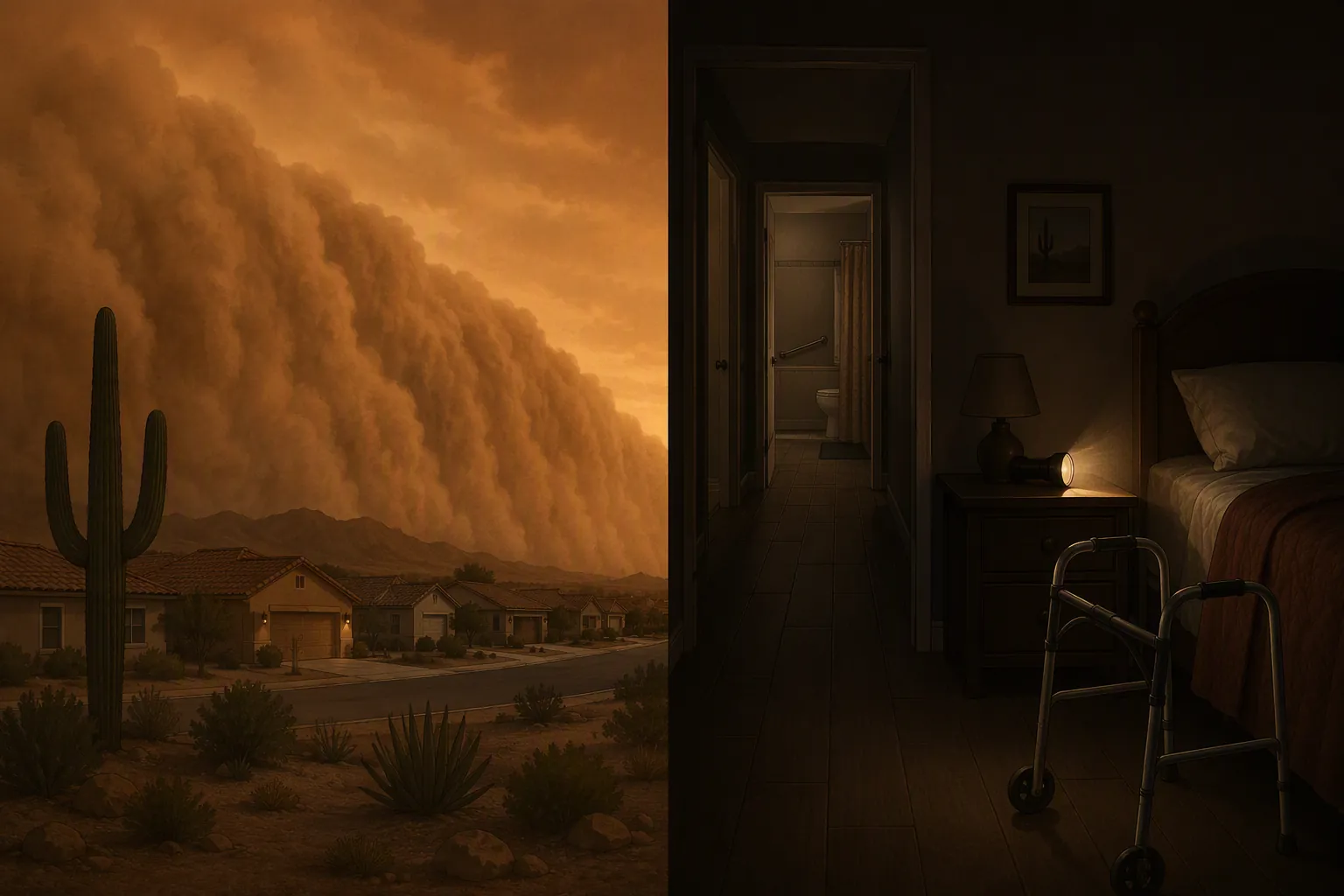
The alert that changes the plan
Caregivers do not need a meteorology lesson, but they do need to know which phone alert should trigger action. The National Weather Service describes a Dust Storm Warning as a sudden visibility drop to one-quarter mile or less, and its dust-storm safety guidance is blunt: if you are driving and encounter a dust storm, get off the road.[2] A Dust Advisory is a lower-threshold alert: visibility of one mile or less, but greater than one-quarter mile.[3]
Inside the home, those alerts should be treated differently too. A Dust Advisory is the time to close windows, confirm the older adult is indoors, and check that lighting, medications, and mobility aids are reachable. A Dust Storm Warning is the time to stop nonessential movement, stay inside, avoid driving, and use the indoor air plan.
Wireless Emergency Alerts for extreme weather are auto-enabled on most devices, and the American Lung Association advises people who are not receiving them to contact their cellular provider.[4] For an older adult who dismisses alerts because “nothing happened last time,” the caregiver’s job is to turn the alert into a simple household routine, not a debate.
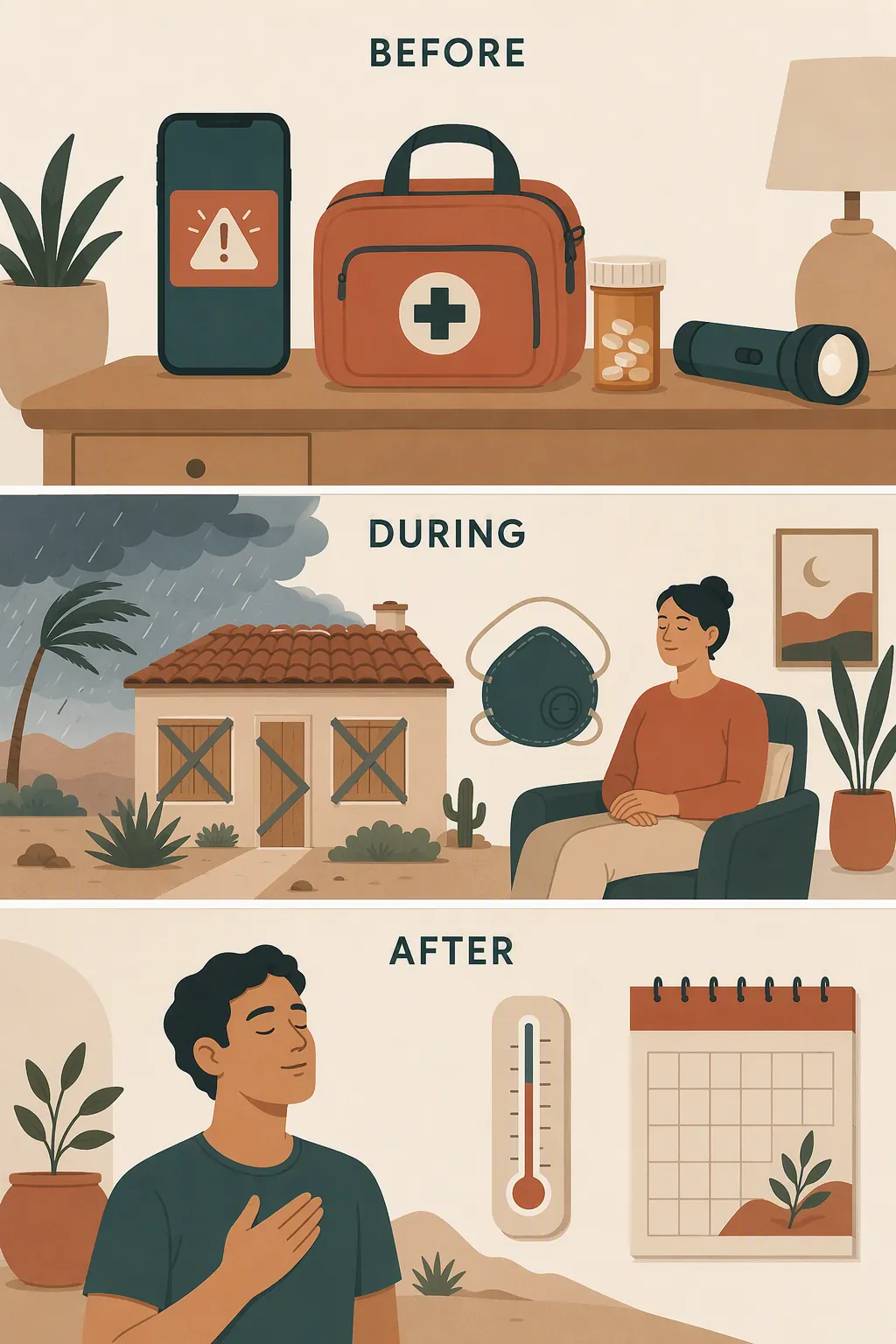
Quick checklist: before, during, and after a dust storm
| Phase | Lungs | Balance and movement | Caregiver check-in |
|---|---|---|---|
| Before | Turn on alerts; prepare an indoor air plan; keep needed respiratory supplies and medications ready. | Clear the bed-to-bathroom route; place flashlight and backup lighting where the older adult can reach them from bed and favorite chair; keep walker, cane, glasses, and shoes in consistent places. | Set a call or text plan for Dust Advisory and Dust Storm Warning days; confirm who checks if power or communication fails. |
| During | Stay indoors; close windows and doors; reduce dust coming inside; avoid outdoor cleanup or errands. | Sit down before the lights fail if possible; do not walk through a dark house unless necessary; use mobility aids, shoes, and a flashlight for any unavoidable trip. | Use short check-ins: indoors, breathing okay, lights on or off, phone charged, next check-in time. |
| After | Keep limiting dust exposure while particles may remain in the air; watch for cough, wheeze, chest discomfort, shortness of breath, or fever-like illness. | Check for dizziness, weakness, new unsteadiness, or near-falls before resuming chores. | Log symptoms and balance changes; seek medical advice for concerning or worsening symptoms. |
The checklist pairs separate evidence streams. The respiratory risk comes from dust and lung-health guidance. The fall risk comes from older-adult fall-prevention guidance. The outage concern comes from monsoon safety guidance noting that monsoon hazards can cause power and communication outages.[1] No single source proves every link in that chain for every household. The practical point is that the same storm can make breathing harder and movement less safe at the same time.
Before the storm: make the safe choice the easy choice
The most useful dust-storm work happens on a clear day. Once a warning arrives, the older adult may be hearing a phone alert, checking the window, looking for a flashlight, and deciding whether to call someone—all while the light outside changes and dust begins pressing into gaps around doors. Preparation should remove choices from that moment.
Set alerts and a check-in rule
- Confirm that Wireless Emergency Alerts are working on the older adult’s phone. If alerts are not coming through, contact the cellular provider, as the American Lung Association advises.[4]
- Agree on what happens at each alert level: Dust Advisory means get indoors and close up the house; Dust Storm Warning means stay put, avoid driving, and limit movement.
- Choose one primary contact and one backup contact. Ready.gov’s older-adult preparedness guidance emphasizes building a support network, especially for people who may need help with transportation, communication, medical equipment, or daily activities during an emergency.[9]
- Make the check-in short enough that it will actually happen: “Are you inside? Are the windows closed? Are you breathing comfortably? Are the lights on? Is your walker or cane beside you?”
For seniors living alone, the plan should not depend on one adult child noticing a radar image from another city. A neighbor, building manager, nearby relative, or friend from church may be the person who can knock on the door if the phone stops working.
Prepare the indoor air plan
Dust storms carry particles that can irritate the eyes, nose, throat, and lungs, and the World Health Organization describes sand and dust storms as events that can affect air quality and human health across large areas.[5] The American Lung Association lists older adults among the people most at risk from lung irritation after dust storms and notes that dust particles may linger in the air from a few hours up to 10 days.[4]
That does not mean every older adult will become ill after every storm. It means the home should be ready for a period when outdoor air is not friendly to older lungs.
- Choose the room where the older adult will wait out a warning. Favor a room with few outside doors, a comfortable chair, a phone charger, water, medications, glasses, and the usual mobility aid.
- Check that windows and exterior doors close fully before storm season.
- Keep prescribed inhalers, oxygen-related supplies, or other respiratory equipment in their normal, reachable place. Do not move medical equipment into a “storm kit” if that makes it harder to find during ordinary use.
- Ask the older adult’s clinician ahead of time what symptoms should trigger a call, urgent visit, or emergency care, especially if the person has asthma, COPD, heart disease, or a history of severe respiratory infections.
Build the 72-hour kit without hiding the daily essentials
Ready.gov recommends a basic emergency kit with enough supplies for several days, including water, food, a battery-powered or hand-crank radio, flashlight, first aid kit, extra batteries, whistle, dust mask, plastic sheeting, duct tape, moist towelettes, garbage bags, wrench or pliers, manual can opener, local maps, and a cell phone with chargers and backup battery.[8] For older adults, Ready.gov also points to needs such as medications, medical equipment, assistive devices, copies of important documents, and a support network.[9]
The American Red Cross likewise urges older adults to plan around medications, mobility, hearing, vision, transportation, and support contacts rather than treating emergency supplies as a one-size-fits-all bag.[10]
For dust storms, the kit should be close enough to reach without crossing the whole house in poor light. A packed bag in the garage is useful for evacuation planning, but it does not help much if the power fails and the older adult’s flashlight is inside that bag, under canned food, on a shelf behind the water heater.
Clear the route before the lights go out
Falls are not a side issue for this checklist. In 2021, falls caused more than 38,000 deaths among adults age 65 and older in the United States and led to nearly 3 million emergency department visits, making falls the leading cause of injury death for that age group.[6] A dust storm does not have to cause a fall directly to raise the danger; it only has to darken the home, interrupt power, make the older adult hurry, or move the walker out of reach.
Mayo Clinic’s fall-prevention guidance includes removing tripping hazards, keeping living spaces well lit, placing night lights in bedrooms, bathrooms, and hallways, and keeping a flashlight within reach in case of power outages.[7] In a desert storm plan, that flashlight belongs where the person’s hand can find it from bed and from the chair where they usually watch TV—not merely somewhere “in the house.”
- Clear the bed-to-bathroom path, including throw rugs, cords, laundry baskets, pet bowls, and low furniture.
- Put shoes or nonskid slippers in a consistent place beside the bed.
- Keep the walker, cane, or rollator within arm’s reach of the bed and favorite chair.
- Place a flashlight or battery lantern at the bedside, near the main sitting area, and near the bathroom route.
- Charge phones and backup batteries before monsoon afternoons when storms are forecast.
For a fuller room-by-room setup, use How to Fall-Proof a Senior's Home Before a Power Outage. For a shorter outage-specific list, keep Power Outage Checklist to Prevent Falls in Older Adults with the storm-season paperwork.
If the older adult already has vision changes, this preparation becomes more important. Dim rooms, glare, and low contrast can make a familiar hallway behave like a new hazard. The warning signs in 10 Signs of Vision Loss in the Elderly are worth reviewing before storm season, not after the first frightening trip to the bathroom in the dark.
Match the plan to summer realities
Dust storms in the Southwest often arrive inside a larger summer problem: heat, medication storage, dehydration risk, and power reliability. If the older adult lives alone, combine the dust-storm check-in with the heat check-in. The routines in In Extreme Heat, Seniors Living Alone Can't Trust Thirst and Which Summer Safety Essentials Matter Most on a Budget can help caregivers decide what to buy first when money, space, or attention is limited.
During the storm: protect air first, then prevent unnecessary movement
When a Dust Storm Warning arrives, the safest plan is often plain and unglamorous: get inside, stay inside, close the house, sit down, and wait. The trouble is that many falls happen during the small exceptions—getting up to look out the front window, going to find the good flashlight, walking to the garage for bottled water, or rushing to move a trash can before the wind takes it.
If the older adult is indoors
- Close windows and exterior doors.
- Move away from door gaps or rooms where dust is visibly entering.
- Stay in the prechosen room with phone, water, medications, glasses, shoes, and mobility aid nearby.
- Avoid sweeping, vacuuming, or outdoor cleanup while dust is still moving; those jobs can wait.
- If breathing symptoms start or worsen, follow the clinician’s existing action plan or seek medical advice promptly.
The older adult does not need to inspect the storm to respect it. Looking through a dusty window from a safe chair is different from walking room to room to see what is happening. The second choice adds fall risk without adding much useful information.
If the power flickers or goes out
A power outage during a dust storm should change movement rules immediately. The older adult should sit before trying to solve the problem. Then: shoes on, glasses on, mobility aid in hand, flashlight on, and only necessary trips.
- Do not walk through the dark house to check every room.
- Do not go outside to inspect the yard, roof, gate, carport, or electrical equipment.
- Do not carry large water containers, heavy lanterns, or emergency bins while using a cane or walker.
- Use the bathroom route that was cleared before storm season.
- If the older adult must move, they should move slowly and deliberately, not by memory alone.
The detailed outage setup belongs in a dedicated plan. Use Power Outage Checklist to Prevent Falls in Older Adults for the lighting and dark-home movement rules. In this dust-storm checklist, the key point is timing: the time to make the route safe is before the warning, not after the hallway has gone black.
If the older adult is driving or away from home
The National Weather Service guidance for drivers in dust storms is to avoid driving into or through a dust storm; if caught in one, pull off the road as far as possible, turn off lights, set the emergency brake, take your foot off the brake, and wait it out.[2] That instruction matters for caregivers too. A Dust Storm Warning is not the moment to ask an older adult to “just drive over before it gets worse.”
If the older adult is at a store, clinic, senior center, or neighbor’s home, the safer call may be to stay there until official conditions improve. Independence includes the right to wait safely rather than prove the trip can be finished.
A caregiver phone script for the warning window
During the storm, long instructions can overwhelm the person who is already managing noise, dust, flickering lights, and worry. Keep the call practical:
- “Are you inside right now?”
- “Are the windows and outside doors closed?”
- “Are you sitting down?”
- “Is your walker, cane, or rollator beside you?”
- “Is your flashlight within reach?”
- “How is your breathing—any new cough, wheeze, chest tightness, or shortness of breath?”
- “I’ll call again at ____. If the phone fails, ____ will check on you.”
That is enough. The call is not a full safety lecture. It is a way to keep the older adult seated, oriented, breathing calmly, and connected.
After the storm: the sky may clear before the risk is gone
After a dust storm, wait for official conditions to improve before resuming errands, driving, outdoor cleanup, or yard checks. The visible wall of dust may be gone, but the American Lung Association notes that particles can remain in the air from a few hours up to 10 days.[4]
This is also when caregivers should pay attention to changes that are easy to dismiss as “just the storm” or “just being tired.” Watch for new or worsening cough, wheeze, chest discomfort, shortness of breath, dizziness, unusual weakness, confusion, or a new wobble when standing. If symptoms are severe, worsening, or unusual for that person, seek medical advice.
Valley fever deserves a longer memory than the dust cloud itself. Mayo Clinic notes that older adults are more likely to get valley fever, lists staying inside during dust storms as a prevention step, and describes symptoms as beginning one to three weeks after exposure.[11] That timing is easy to miss if no one connects a late cough, fever, fatigue, or chest discomfort back to the storm week.
A multi-year study of dust storm days in Arizona, California, and Utah found respiratory emergency department visits were elevated by about 3.7% to 5.0% at one to three days after dust storm days.[12] That finding should not be stretched into a promise about any one city or any one household. It does support a practical habit: keep watching after the storm instead of ending the safety plan when the patio becomes visible again.
For adult children, a dated log helps. Note the storm date, symptoms, medication changes, near-falls, appetite, sleep, dizziness, and any change in walking. The format in How to Monitor Health Changes in Elderly Parents works well here because delayed symptoms are easier to notice when they are written down.
One-page dust storm safety checklist for older adults
Before monsoon storms
- Confirm Wireless Emergency Alerts are working on the older adult’s phone.[4]
- Write down what Dust Advisory and Dust Storm Warning mean for the household: advisory means close up and prepare; warning means stay inside, avoid driving, and limit movement.[2][3]
- Set a primary and backup check-in person.[9][10]
- Keep several days of water, food, flashlight, batteries, radio, first aid supplies, medications, phone chargers, backup battery, and personal medical supplies ready.[8][9]
- Choose the safest indoor room for waiting out a warning.
- Clear the bed-to-bathroom route and the chair-to-bathroom route.
- Place flashlights or battery lanterns where the older adult can reach them from bed and favorite chair.[7]
- Keep walker, cane, rollator, glasses, hearing aids, shoes, and phone in consistent places.
- Ask the clinician what respiratory or heart symptoms should trigger a call or urgent care visit.
During a Dust Advisory or Dust Storm Warning
- Get indoors before visibility worsens.
- Close windows and exterior doors.
- Stay in the prepared room with phone, medications, water, shoes, glasses, and mobility aid.
- Avoid driving; if caught driving in a dust storm, follow NWS pull-off-the-road guidance.[2]
- If the power goes out, sit first; then use shoes, glasses, flashlight, and mobility aid before any necessary movement.
- Do not go outside to inspect damage while dust, wind, or poor visibility continues.
- Use short caregiver check-ins focused on location, breathing, lighting, mobility aid, and next contact time.
After the storm
- Wait for official conditions to improve before driving, errands, or outdoor cleanup.
- Keep limiting dust exposure while particles may remain in the air.[4]
- Watch for new cough, wheeze, chest discomfort, shortness of breath, dizziness, weakness, confusion, or balance changes.
- Remember valley fever symptoms may begin one to three weeks after exposure.[11]
- Record symptoms, near-falls, and unusual fatigue in a dated health log.
- Seek medical advice for severe, worsening, or unusual symptoms. This checklist is educational and does not replace care from the older adult’s clinician.
For seniors in the desert Southwest, dust storm safety is not only “get indoors,” and it is not only “prepare for a power outage.” It is the pairing: protect airways, reduce unnecessary movement, keep light and mobility within reach, and keep watching the person after the sky clears.
References
- Monsoon Safety, National Weather Service Tucson.
- Dust Storms and Haboobs, National Weather Service.
- Watch/Warning/Advisory Definitions, National Weather Service.
- Dust Storms, American Lung Association.
- Sand and dust storms, World Health Organization.
- About Older Adult Fall Prevention, Centers for Disease Control and Prevention.
- Fall prevention: Simple tips, Mayo Clinic.
- Build A Kit, Ready.gov.
- Older Adults, Ready.gov.
- Older Adults Emergency Preparedness, American Red Cross.
- Valley fever, Mayo Clinic.
- Respiratory Morbidity Associated with Dust Storms in the Western United States, PMC, 2024.
Related reading
Noticed something outdated or inaccurate on this page? Flag a correction. We review every report against CDC, NIA, and AARP HomeFit guidance before updating a page.
Part of the Fall Prevention section.