
STEADI: Assess
Your Parent Collapsed on a Walk — Is It a Stroke or a Fall?
When an older adult collapses outdoors, the fall may be the first sign of a stroke. This guide helps you distinguish a stroke-precipitated fall from a mechanical fall, explains why you should not help them stand, and provides step-by-step first aid while waiting for emergency services.
Your parent goes down on a sidewalk, park path, driveway, or trail. The ordinary human move is to reach under an arm and help them stand. In a possible outdoor stroke emergency involving an older adult, that is the move to stop.
Leave them where they are for the moment. Check whether they are awake and breathing. Then check B.E. F.A.S.T. signs before you decide this was “just a fall.” The American Stroke Association puts Balance first in B.E. F.A.S.T. because sudden trouble with balance, coordination, walking, or dizziness can be a stroke warning sign, not only a fall problem [1].
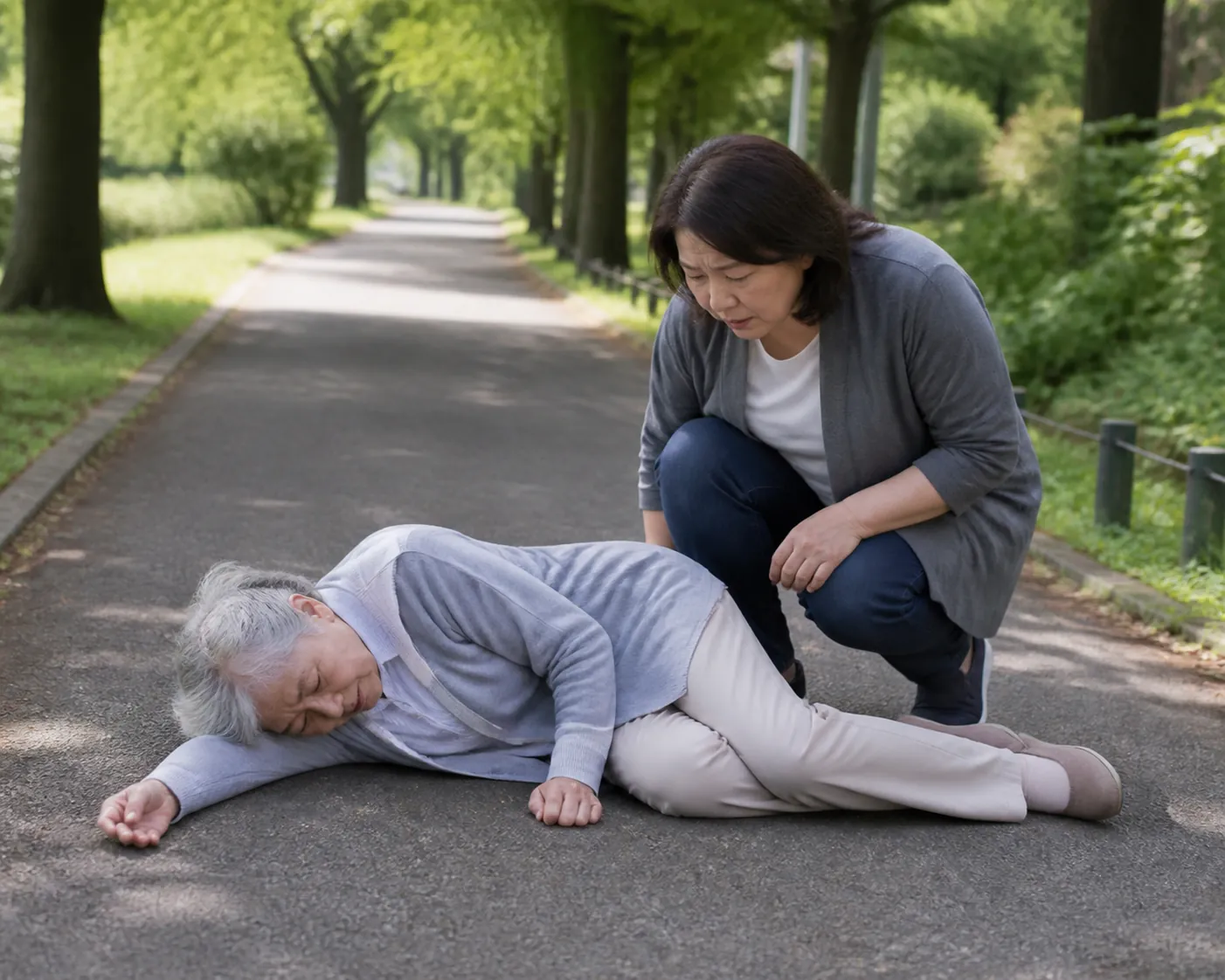
This is emergency-recognition guidance, not a diagnosis. A parent can trip over a curb, faint, become dehydrated, overheat, or have a stroke. You do not need to sort all of that out on the pavement. Your job is to avoid making the scene less safe, notice the stroke clues that are visible, and call 911 when stroke is possible.
The first rule: do not stand them up yet
A mechanical fall usually has a story you can see: a raised pavement edge, a dog leash around the ankles, loose gravel, a missed step. A stroke-precipitated collapse may look different. The person may have been walking normally, then suddenly veered, staggered, grabbed for nothing, became confused, or dropped without a clear trip hazard.
Helping them up can hide the most useful information. If they cannot sit steadily, cannot coordinate one side, cannot explain what happened, or get worse when moved, you want EMS to hear that exactly as it happened. Walking them home or to a car can also turn a time-sensitive emergency into a delay. Stroke urgency is often explained with the clinical benchmark that an untreated ischemic stroke may cost about 1.9 million brain cells per minute, and even a well-meant “let’s get you home first” detour may add a 30-to-90-minute delay before emergency care starts [1].
So make the first minute simple:
- Do not lift, stand, or walk them unless they are in immediate danger from traffic, water, fire, or another direct hazard.
- Check whether they respond when you speak to them.
- Check whether they are breathing normally.
- Look for B.E. F.A.S.T. signs while they remain down.
- Call 911 if any stroke sign is present, if they are confused, if the fall had no clear cause, or if you are unsure.
Run B.E. F.A.S.T. where they lie
B.E. F.A.S.T. is useful outdoors because it starts with the thing you may have just witnessed: balance failure. The CDC also tells laypeople to watch for sudden trouble walking, dizziness, loss of balance, confusion, trouble speaking, weakness, numbness, vision trouble, and severe headache [2].
- B — Balance: Did they suddenly lose balance, stagger, collapse, become very dizzy, or seem unable to coordinate their body?
- E — Eyes: Do they report sudden vision trouble, double vision, or loss of vision?
- F — Face: Ask them to smile if they can. Does one side droop or look uneven?
- A — Arms: Ask them to raise both arms if they can do so safely while lying or seated. Does one drift down, fail to lift, or seem weak?
- S — Speech: Ask a simple question: “What is your name?” or “Where are we?” Listen for slurring, strange words, trouble understanding, or new confusion.
- T — Time: Note the time symptoms began, or the last time you know they were normal.
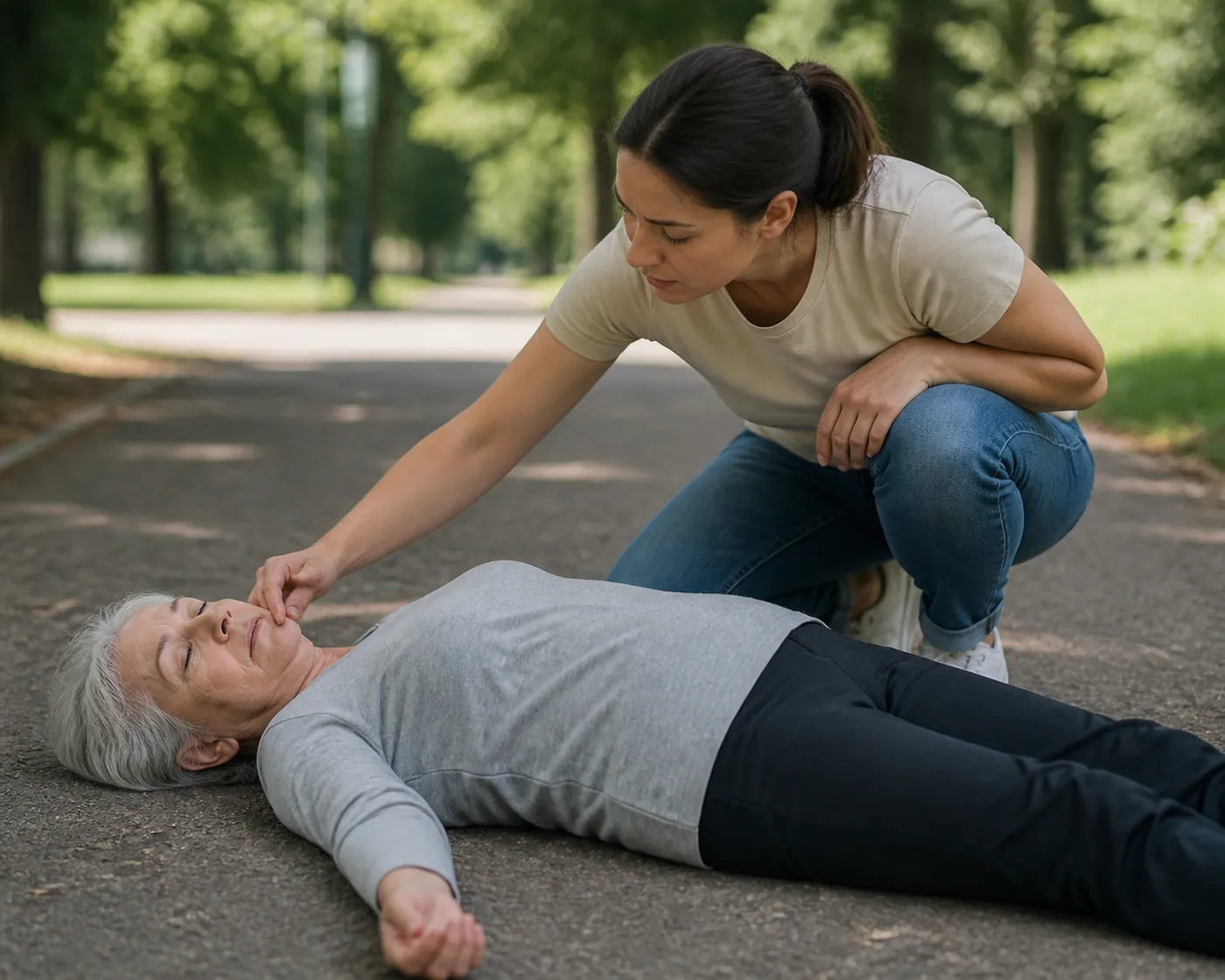
Do not wait for every letter to be positive. A person can have a stroke without dramatic face drooping in the first moment you see them. Sudden balance loss with confusion, dizziness, nausea, weakness, speech change, or vision trouble is enough reason to call.
When the fall itself is the warning sign
The difficult outdoor cases are not the obvious ones. If your parent’s face is drooping and speech is slurred, most people understand that something serious is happening. The harder call is the parent who says, “I’m fine, I just got dizzy,” while lying on the pavement after a sudden collapse.
Stroke belongs on the list of possible medical causes of a fall. Cleveland Clinic lists stroke among medical conditions that can lead to falls in older adults and states that someone who falls from stroke symptoms needs immediate medical care [3]. That does not mean every outdoor fall is a stroke. It means the fall should not be treated as harmless until you have checked for neurological clues and involved emergency help when those clues are present.
Watch especially for a collapse that comes with any of these observable signs:
- Sudden loss of balance in someone who was steady a minute earlier.
- A new staggering gait, leaning to one side, or inability to sit upright without support.
- Vertigo, spinning sensation, nausea, or vomiting that began abruptly.
- Confusion about where they are, what happened, or what day it is.
- Slurred speech, trouble finding words, or trouble understanding you.
- One-sided arm or leg weakness, numbness, or clumsiness.
- Face drooping or a smile that looks uneven.
- Vision changes, double vision, or sudden severe headache.
- No obvious trip hazard, slip surface, or impact explanation.
A mechanical fall can still injure the head, hip, wrist, ribs, or shoulder. A suspected stroke can also produce a fall injury. Do not let one possibility cancel the other. If they hit their head, are on blood thinners, have severe pain, cannot bear weight, are confused, or have any B.E. F.A.S.T. sign, the answer is still emergency evaluation.
Make the 911 call with the facts EMS needs
Call from where the person is. Put the phone on speaker if you need both hands free. If another person is present, point to them and give one job: “You call 911.” Do not ask the group generally. Crowds are poor dispatch systems.
Say the word “stroke” if you suspect it. The CDC’s layperson guidance is direct: call 911 right away if someone shows signs of stroke [2].
- Give the exact location: street address, park name, trail marker, nearest intersection, building entrance, parking lot number, or GPS location if available.
- Say what happened: “My 78-year-old father suddenly lost balance and collapsed while walking.”
- Report what you see: balance loss, dizziness, vomiting, confusion, speech trouble, facial droop, arm weakness, vision trouble, head injury, pain, or loss of consciousness.
- Give the time: when they were last normal and when the collapse or symptoms began.
- Tell the dispatcher whether they are awake and breathing normally.
- Mention major known facts if you know them: blood thinners, diabetes, prior stroke, heart rhythm problems, recent surgery, seizure history, or allergies. Do not delay the call to search for these.
If you do not know an answer, say so. Guessing a symptom time is less useful than saying, “She was normal when we left the house at 8:10, and she collapsed at about 8:25.”
While waiting outdoors, manage the scene
The waiting period feels longer than it is. Give yourself a sequence and follow it.
- Keep them still unless the dispatcher tells you otherwise or the location is immediately dangerous.
- If they are awake, keep them lying down or in the safest comfortable position. Keep their head and shoulders supported without forcing their neck.
- If they are unconscious but breathing, vomiting, or unable to protect their airway, place or maintain them on their side in a recovery position if you can do so safely. Mayo Clinic stroke first-aid guidance includes positioning the person on their side with the head slightly raised when appropriate [4].
- Do not give food, water, pills, or aspirin. Stroke can affect swallowing, and first-aid guidance warns against giving anything to eat or drink while waiting for emergency care [4][5].
- Loosen tight clothing around the neck if needed. Do not remove shoes or clothing unless necessary for safety or weather protection.
- Protect them from sun, rain, wind, or cold. Use a jacket, umbrella, shade, or blanket without overheating them.
- Send one person to meet the ambulance if the location is hard to find. Keep one person with your parent.
- Watch for changes: worsening confusion, new weakness, vomiting, trouble breathing, seizure-like activity, or loss of consciousness. Tell the dispatcher immediately.
- Keep bystanders useful. Ask someone to control pets, flag EMS, move bikes, or hold a light. Do not let people crowd, lift, feed, or question the person repeatedly.
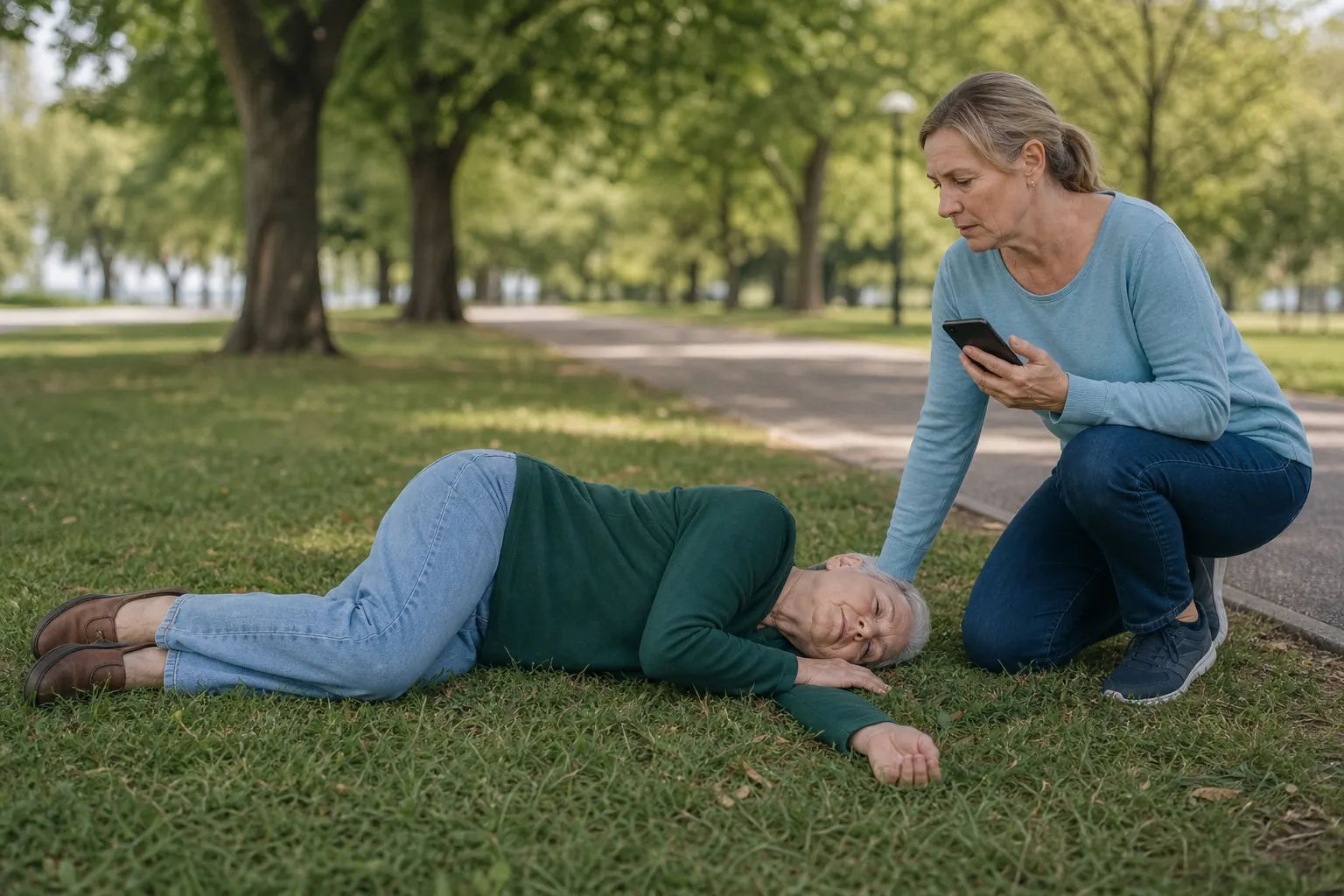
If the person insists on standing, slow the moment down. Say, “We’re going to stay still until the ambulance checks you.” Embarrassment is powerful after a public fall. So is denial. Neither is a safety plan.
Heat, dehydration, and “maybe they just tripped” do not clear the stroke risk
Outdoor walks add noise to the decision. It may be hot. They may have skipped breakfast. The pavement may be uneven. A hat, sunglasses, poor lighting, or rain can make the face and eyes harder to assess. A proud parent may say they are fine because they do not want strangers watching.
Heat illness can also be serious, especially with exertion, dehydration, altered mental status, or very hot skin. But hot weather does not rule out stroke. Dizziness, nausea, confusion, and collapse can overlap. When you cannot tell, call 911 and describe both sets of facts: the weather and exertion, plus any sudden balance loss, speech change, weakness, facial droop, vision trouble, or confusion.
The same rule applies to an apparent trip. If there is a clear curb edge and your parent says, “I caught my toe,” still look at the whole person. Are they speaking normally? Are both arms moving normally? Can they explain what happened? Are they newly dizzy or nauseated? Is their face symmetrical? Did they collapse before the foot hit the obstacle? The trip hazard matters, but it is not the only evidence.
Do not tidy away the evidence
Before EMS arrives, avoid turning the scene into a cleaner but less informative version of itself. Do not move the cane, walker, glasses, hat, or shoes unless they are creating a hazard. Do not erase the path of the fall by dragging the person several feet to make room. Do not coach them into a better-sounding explanation.
Useful observations are plain: “She was walking straight, then suddenly leaned left.” “He said the path was spinning.” “Her words stopped making sense after she fell.” “There was no curb or rock where he went down.” “He tried to sit up and tipped backward.” These are better than a confident amateur diagnosis.
After EMS: the fall-risk work is not over
Once EMS takes over, give the timeline again and hand over any medication list if you have it. The emergency team and hospital clinicians will decide what testing and treatment are appropriate. Your outdoor job ends at a clean handoff: what happened, when it started, what you saw, what changed while waiting, and whether the person was moved.
If the event turns out to be a stroke, possible stroke, TIA, or another medical cause of collapse, do not treat the walking route as the only problem. Fall risk often increases after stroke; the European Stroke Organisation reports that approximately 73% of older adults experience at least one fall within the first year after a stroke [6]. That number belongs after the emergency, not before it. It is a reason to reassess mobility, medications, vision, home hazards, assistive devices, and supervision after medical follow-up.
For that post-event review, use a structured caregiver tool rather than memory. The Fall Prevention FAQ for Seniors and Caregivers can help you review common risk factors after discharge or a medical visit. The Fall Prevention Handout for Seniors: A Caregiver's Action Guide gives you a printable way to turn that review into home and walking-safety changes.
On the pavement, though, prevention waits. The safer default is to treat an elderly outdoor collapse as a possible stroke, check B.E. F.A.S.T. without lifting, call 911, and keep the person still until trained help arrives.
References
- Stroke Symptoms — American Stroke Association
- Stroke Signs and Symptoms — CDC
- Slip and Fall Injury — Cleveland Clinic
- Stroke First Aid — Mayo Clinic
- What to Do While Waiting for an Ambulance — Stroke Foundation Australia
- Falls After a Stroke — European Stroke Organisation
Related reading
Noticed something outdated or inaccurate on this page? Flag a correction. We review every report against CDC, NIA, and AARP HomeFit guidance before updating a page.
Part of the Fall Prevention section.