
STEADI: Intervene
Style Tips for Women Over 90 That Keep You Steady
Style guidance for women over 90 that treats fall-safe dressing as part of personal style, not a loss of it. Covers seated dressing technique, floor-clearing hems, easy closures that still look like regular buttons, and grip-soled shoes she will actually wear.
Getting dressed is one of those ordinary morning rituals that can hide a surprising amount of balancing. A woman may be choosing a cardigan, smoothing a trouser leg, reaching for a button, stepping into a shoe—and at the same time standing on one leg, bending toward the floor, lifting an arm overhead, or trusting a sole that may not hold on a polished surface.
That is why style tips for women over 90 belong in a fall-prevention conversation. The CDC reports that more than 1 in 4 adults age 65 and older falls each year, and it names modifiable risks such as poor footwear, foot pain, and home hazards including clutter.[1] Clothing is not the whole answer, of course. But it is one of the surfaces a woman meets every day before she ever reaches the hallway.
At 90+, the stylish choice is the steady one. That does not mean surrendering to garments that look as if they were designed only to be managed by someone else. It means choosing clothes that let her sit to dress, stand without catching a hem, fasten without strain, and walk in shoes that grip—while still looking like the woman she has always been.
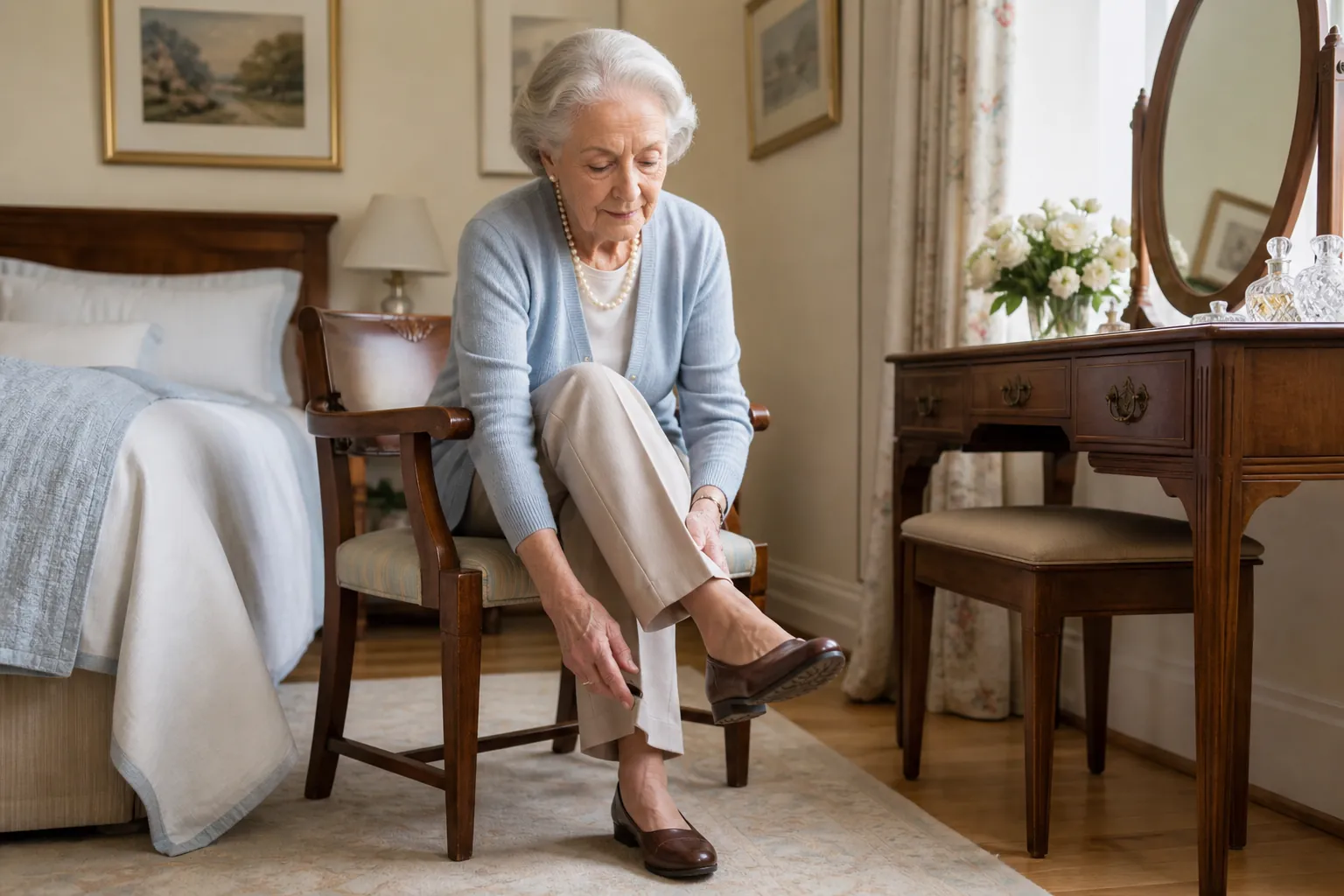
Start with the part of dressing most likely to steal balance
The risky moment is often not the outfit. It is the transition inside the outfit: one foot lifted, both hands busy, eyes looking down, weight shifting sideways. Pants, skirts, stockings, robes, nightgowns, slippers, and shoes all ask for small transfers of balance. Those transfers are easy to underestimate because they happen in a familiar room.
A good dressing plan removes as many of those transfers as possible. The clothes do not need to announce that they are safer. They need to behave better at the exact moments when a fall is most likely to begin.
| Dressing moment | What can go wrong | Style-safe adjustment |
|---|---|---|
| Putting on pants | Standing on one leg or bending too far forward | Sit on a sturdy chair and dress one leg at a time |
| Standing up | Pant cuffs, robe hems, or nightwear drag underfoot | Keep hems and cuffs above the ankle before rising |
| Fastening clothes | Tiny buttons or back closures create long reaching and frustration | Use easier closures that still look like ordinary clothing |
| Walking after dressing | Slippers, slick soles, or stocking feet slide on the floor | Finish with stable, grip-soled shoes she will actually wear |
Sit first, then dress
The chair matters. It should be sturdy, high enough that standing does not require a deep push from the knees, and preferably have arms for controlled sitting and rising. A bed is often too soft and too low; an armless vanity stool can turn the act of dressing into another balance test. The goal is not to make dressing feel clinical. It is to give the body a reliable base before hands and feet get busy.
For pants, the safest rhythm is unglamorous but elegant in its practicality: sit down, gather the trousers, put in one leg, then the other, and keep the pant cuffs above the ankle before standing. The National Council on Aging article by Geri-Fit describes this seated approach and claims it can reduce fall risk “up to 95%”; that figure should be read as the program’s own claim, not as a proven clinical-trial result.[2] The underlying point is still useful: standing while threading a foot through fabric is an unnecessary demand on balance.
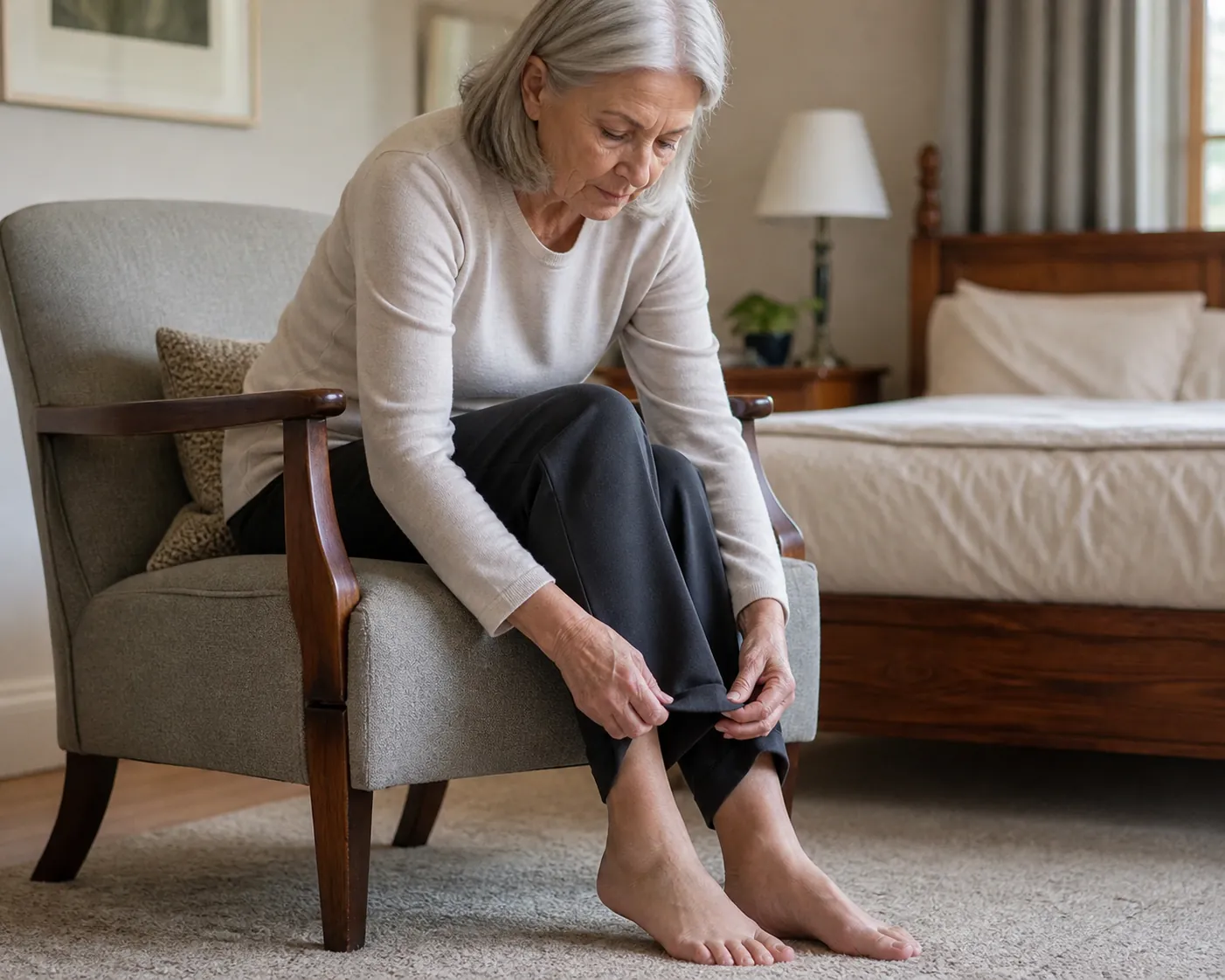
This is where clothing choice and dressing technique meet. A pair of trousers can be beautifully cut and still be a poor choice if the leg opening collapses under the foot or the waistband requires a wrestling match. Soft trousers with enough structure to keep their shape are often kinder than flimsy fabric that puddles. A waistband should be easy to guide over the hips once she is standing, not so loose that it slips and not so tight that it forces tugging.
If someone helps her dress, the same principle still applies: let the chair carry the balance work. Assistance should not turn into a hurried pull while she is half-standing. One leg at a time, cuffs clear, then stand. It is slower than yanking on a garment in the moment; it is faster than recovering from a fall.
Hems should clear the floor without making the outfit look diminished
A dragging hem is not a charming inconvenience at 90+. It is a trip hazard. The rule is simple: trousers, robes, skirts, nightgowns, and house dresses should clear the floor when she is standing in the shoes or indoor footwear she actually uses.
This does not require cropped everything or a wardrobe that looks abruptly practical. A full-length trouser can still be graceful if it breaks cleanly above the shoe and does not slide under the heel. A robe can still feel generous without sweeping the floor. A nightgown can be soft without wrapping around the ankle during a bathroom trip.
The fitting test should happen in motion, not just in front of a mirror. Have her sit, stand, turn, and take a few steps. Watch the back hem. Watch whether a cuff catches as she rises. Watch whether fabric pools when she sits and then follows her underfoot when she stands. These are small observations, but they are more useful than any label promising “easy wear.”
Choose closures that preserve the look of her own clothes
Closures are where dignity is often lost quietly. A woman who wore neat cardigans and tailored blouses may be handed something shapeless because small buttons have become difficult. The better solution is not to erase the garment type she likes. It is to change the mechanics while keeping the appearance familiar.
Magnetic closures, larger hidden snaps, hook-and-loop hidden behind a proper placket, or fabric-covered fasteners can imitate the look of ordinary buttons while reducing the time and finger precision needed to dress. A cardigan can still look like a cardigan. A blouse can still have a clean front. A jacket can still close neatly without requiring a long negotiation with a tiny buttonhole.
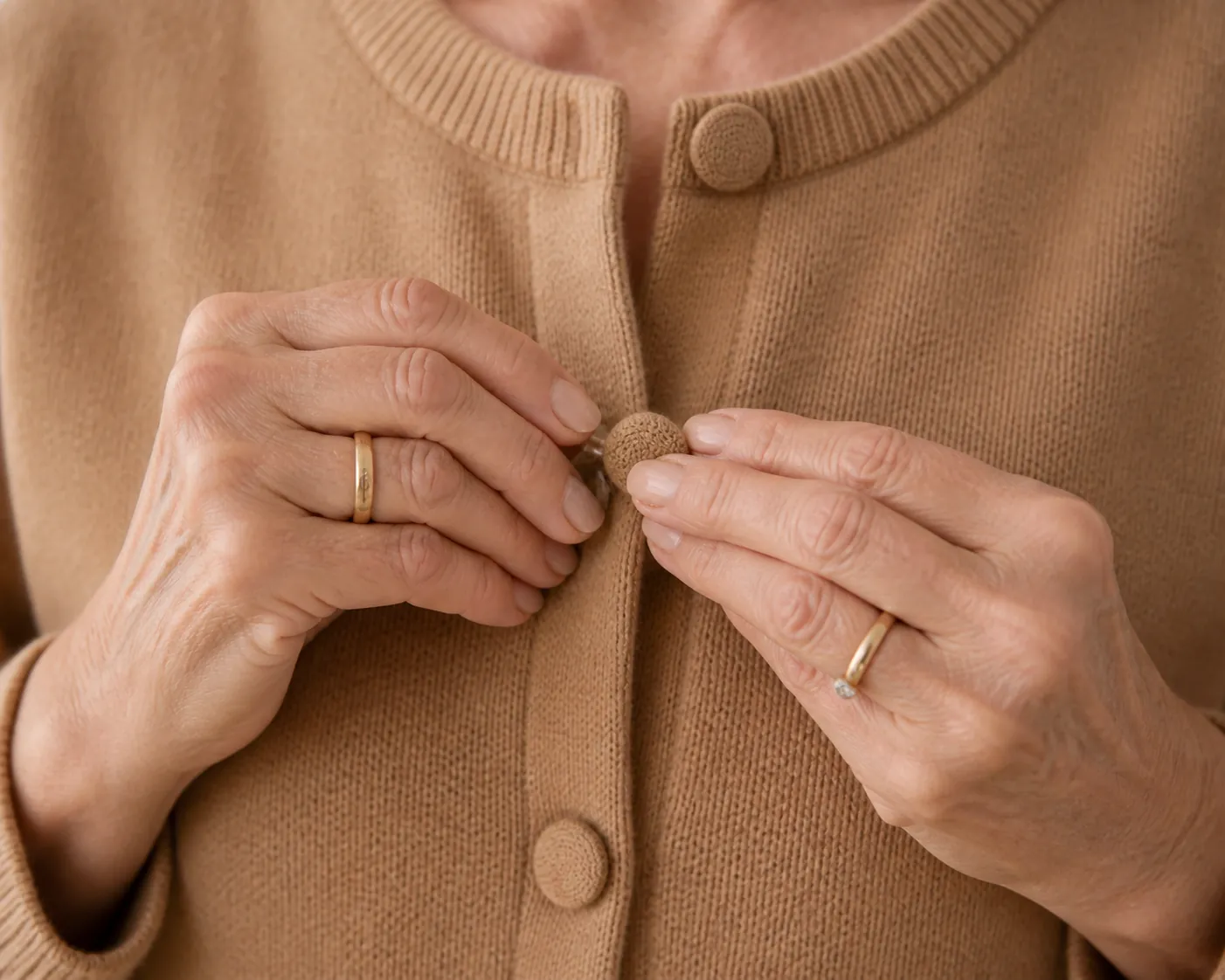
Front closures usually ask less of the shoulders than back closures or garments that must be pulled overhead. That matters when reaching up causes wobbling, pain, or fatigue. A front-opening cardigan, knit jacket, or blouse can keep the same polished outline as a pullover while making the dressing motion more controlled.
The deciding question is not whether a garment belongs to a category called adaptive clothing. The question is whether it passes for her clothing. If she has always liked pearls, soft neutrals, tailored knits, dark trousers, or polished flats, the safer version should borrow from that vocabulary. If it looks like a costume of dependence, it will sit in the drawer.
Footwear is the final safety decision, not an afterthought
Shoes are easy to treat as the last detail of an outfit. For fall prevention, they are the foundation. The CDC includes poor footwear among modifiable fall risk factors, which is a plain way of saying that what is on the foot can change what happens when the floor is slick, uneven, or cluttered.[1]
Avoid high heels, floppy slippers, slick soles, and walking in stocking feet. Each one creates a different kind of problem: a heel narrows the base, a floppy slipper shifts under the foot, a smooth sole can skate across wood or tile, and stocking feet offer little protection or grip. Cozy is not the same as stable.
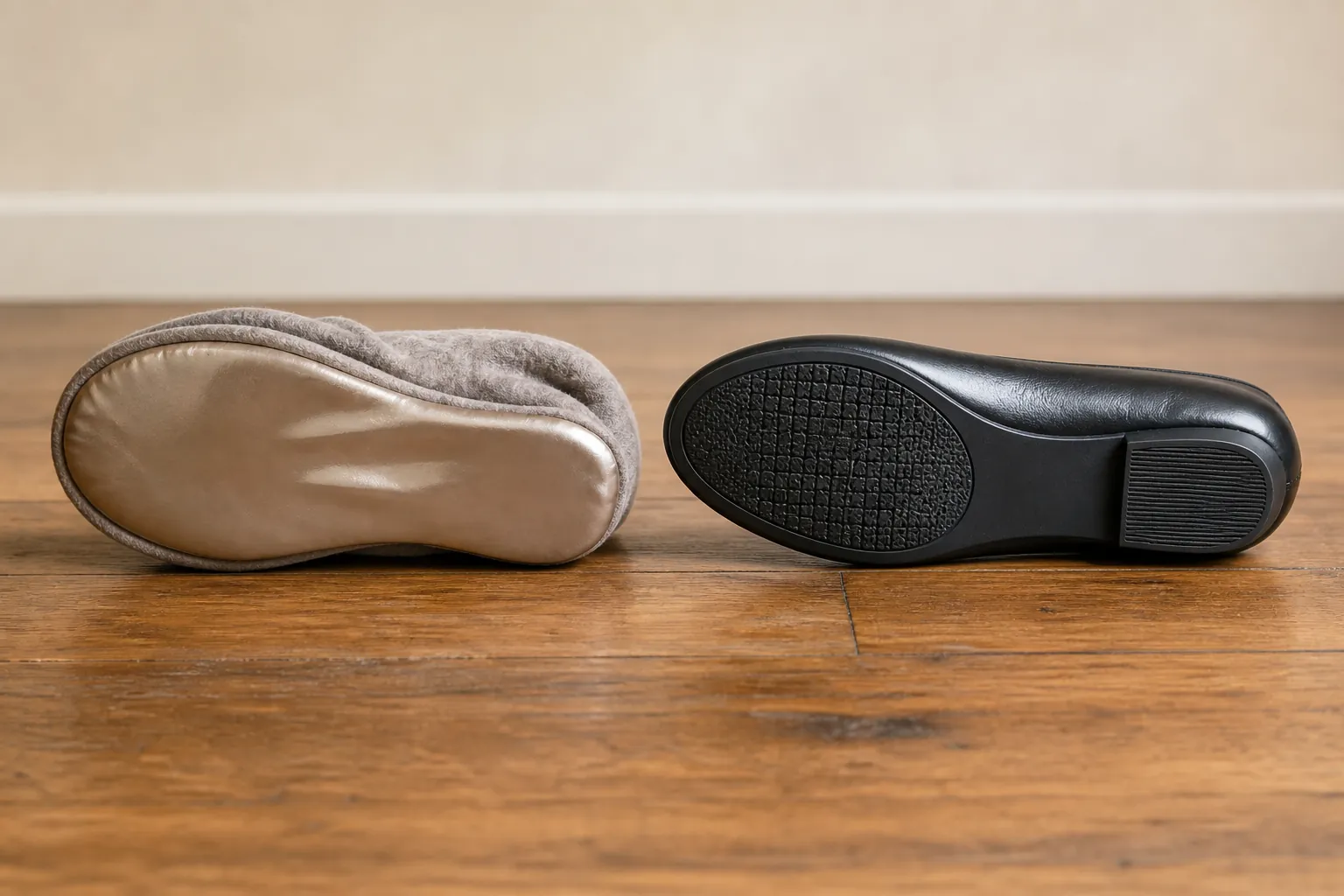
A better shoe has a secure heel, a sole with texture, a low and stable profile, and enough structure that the foot does not slide around inside it. It should be easy to put on while seated, but not so loose that it behaves like a slipper. If laces have become a nuisance, consider a polished flat, walking shoe, or loafer-style shoe with an easy closure that still holds the foot.
The phrase “shoes she will actually wear” is not sentimental. It is operational. A technically safer shoe that she dislikes may be kicked off by noon, replaced with old slippers, or avoided except when someone is watching. The right pair must satisfy both the floor and the mirror.
Build outfits around the woman, not around convenience
The most common mistake in shopping for a woman over 90 is treating ease as the only virtue. Ease matters, but ease without identity can feel like being edited out of one’s own life. A pair of pull-on pants may be useful; a closet full of anonymous pull-on pants may feel like defeat. Velcro may solve one problem and create another if it makes a woman feel as if she has been dressed by a catalog rather than by herself.
Start with the clothes she already reaches for. If she has always liked tailored cardigans, look for cardigans with friendlier fasteners. If she prefers trousers to skirts, refine the trouser fit and hem. If she feels properly dressed only in real shoes, do not replace them with bedroom slippers; find a stable shoe that looks finished. If she likes a soft robe in the morning, shorten the hem before calling it unsafe.
There is no need to chase trends unless she enjoys them. Color, jewelry, and seasonal details can be chosen as they always were: by taste. The safety work is quieter. It sits in the chair height, the hem length, the closure, the sole, the way the garment behaves when she rises.
A practical fitting test
When deciding whether a garment belongs in her closet, do not judge it only on the hanger. Put it through the morning routine.
- Can she begin dressing from a sturdy chair instead of standing on one leg?
- Can pants, skirts, robes, or nightwear stay clear of the floor when she stands and walks?
- Can she fasten the garment without painful reaching, tiny finger work, or visible frustration?
- Do the shoes grip the floor and stay securely on the foot?
- Does the outfit still look like something she would have chosen before safety became part of the conversation?
That last question is not decorative. If she will not wear it, it has failed. The better style tip is the one that keeps her steady without making safety the loudest thing in the room.
References
- Facts About Falls, CDC, https://www.cdc.gov/falls/data-research/facts-stats/index.html
- A Simple Dressing Tip That Could Save You From a Fall, National Council on Aging, https://www.ncoa.org/article/a-simple-dressing-tip-that-could-save-you-from-a-fall/
Related reading
Noticed something outdated or inaccurate on this page? Flag a correction. We review every report against CDC, NIA, and AARP HomeFit guidance before updating a page.
Part of the Fall Prevention section.