
STEADI: intervene
How Seniors Can Avoid Falls During Brush Fire Evacuations
Standard wildfire evacuation advice overlooks the fall risks that make escape dangerous for older adults with limited mobility. This guide provides a step-by-step fall-prevention plan — from pre-season home prep to go-bag placement and safe evacuation routes — so seniors and their caregivers can prepare for brush fire season without adding fall risk to the threat of fire.
The evacuation order is not the first problem. The first problem is the walker parked across the room, the hallway gone dark during a power shutoff, the little rug that was harmless yesterday, and the emergency bag sitting on the floor where a person with stiff knees has to bend for it.
That is where standard advice on how seniors can stay safe during brush fires often comes up short. “Leave early” is good advice, but it does not explain how an older adult using a cane, walker, wheelchair, oxygen equipment, or weak balance gets from bed to door to car without falling. In the January 2025 Los Angeles wildfires, reporting found that many of the 25 confirmed deaths were older adults or people with physical disabilities who could not evacuate in time.[1] That is not a reason to panic. It is a reason to stop pretending the hard part begins at the driveway.
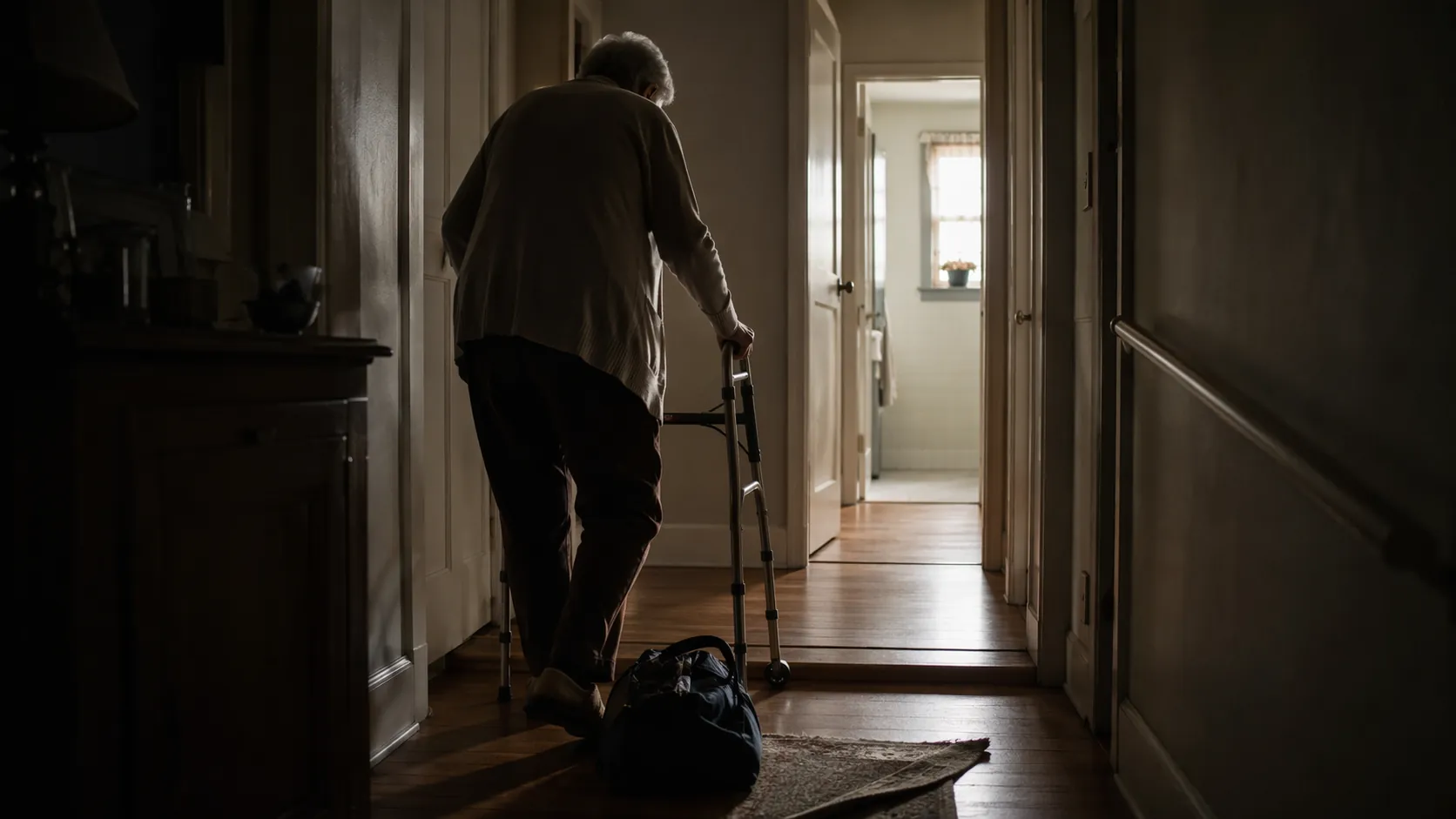
Older adults already face higher fire risk: the U.S. Fire Administration says adults 65 and older have a 2.5 times greater risk of dying in a fire than the general population, a statistic based on fire deaths broadly rather than brush fires alone.[2] Falls are their own emergency; USFA identifies falls as the leading cause of fatal and nonfatal injuries among adults 65 and older.[3] Put those two facts together during a fast-moving brush fire, and the safest plan is not just a bigger emergency kit. It is a route that does not ask a person to rush, bend, carry, balance, and think clearly all at once.
Start With the Route, Not the Bag
Ready.gov tells older adults to make a plan that accounts for medical, mobility, communication, and support needs before an emergency.[4] For a senior with limited mobility, that plan has to begin with one plain test: Can this person move from the place they sleep to the safest exit using the mobility aid they actually use today?
Do not answer that from memory. Walk it. Roll it. Do it at the person’s normal pace, with the walker, cane, wheelchair, rollator, portable oxygen, or brace they use when they are tired. A route that works for a healthy visitor may fail the person who needs two hands on a walker and a pause before every threshold.
| Evacuation Point | What to Check | Fall-Safe Decision |
|---|---|---|
| Bedside | Can the senior stand, reach footwear, reach mobility aid, and reach the go-bag without bending? | Move supplies to waist height and keep the mobility aid within arm’s reach. |
| Bedroom door and hallway | Is the doorway wide enough for the walker or wheelchair? Are there rugs, cords, baskets, pet bowls, or furniture edges? | Clear the path completely; do not depend on stepping around obstacles during smoke or darkness. |
| Main exit | Does the threshold catch wheels, cane tips, or feet? | Use the exit that works with the current mobility aid, not the exit that is closest on paper. |
| Porch, ramp, or walkway | Is the surface uneven, dark, slippery, or blocked by planters, hoses, or stored items? | Treat the outside approach as part of the evacuation route, not as landscaping. |
| Vehicle or pickup point | Can the senior reach it without carrying anything in the hands needed for balance? | Put supplies on the body, on the walker basket, or with the helper — not in the senior’s hands. |
Clear the Pre-Season Path While Everyone Is Calm
Brush fire preparation usually means watching evacuation zones, trimming vegetation, keeping gas in the car, and packing supplies. Those still matter. CDC guidance covers staying safe from wildfire smoke, evacuation, and health hazards, while the Red Cross emphasizes making a wildfire plan and preparing to leave when instructed.[5][6] But inside the home of an older adult, the evacuation lane needs the same seriousness as the defensible space outside.
Start at the bed and move toward the exit. Remove loose area rugs from the route. If the rug is decorative, it can come back after fire season. If it is covering a cold floor or a worn spot, replace it with a safer fix that does not create an edge for a walker wheel or cane tip. Do not leave the decision for evacuation night, when smoke advisories, sirens, and phone calls make small hazards harder to see.
Check doorway width with the actual device. USFA advises older adults who use walkers or wheelchairs to make sure all exits are wide enough for safe escape.[2] In some older homes, including many built before 1990, do not assume a walker can pass straight through just because a person can squeeze through sideways. Sideways is not an evacuation plan. A walker user needs enough room to keep both hands on the frame and move without twisting.
Then look down at thresholds. A small raised strip between the bedroom and hall, the hall and kitchen, or the back door and porch can stop a wheelchair caster or make a walker user lift instead of roll. If the safest exit has a lip, add a beveled threshold ramp or choose another exit that does not require the senior to bump over it under pressure. The right exit is the one the person can use while tired, anxious, and moving slowly.
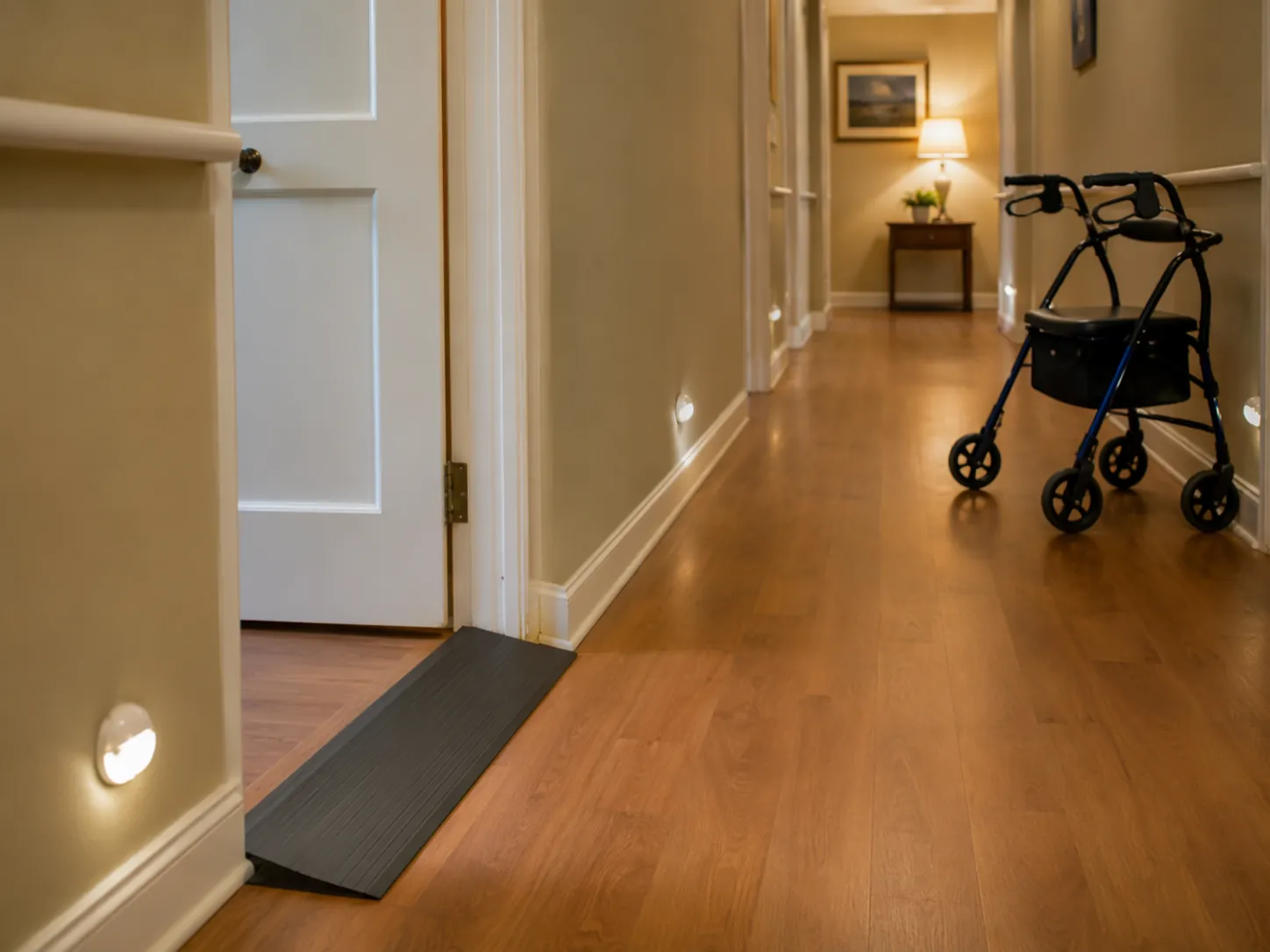
Lighting belongs in the route plan, not on a wish list. Brush fire evacuations can overlap with public safety power shutoffs, and a dark hallway changes how a senior moves. Ready.gov tells older adults to plan for power needs, including medical equipment and assistive devices.[4] Motion-sensor night lights along the bed-to-exit route reduce the chance that someone will fumble for switches or step into a black hallway. Battery-backed lighting matters if the power is already out.
For more detailed blackout preparation, the same route should be checked against a power outage fall prevention checklist for seniors. If the senior depends on powered medical equipment, fold the evacuation route into a 72-hour power outage plan for medically dependent seniors, because losing power can mean losing lights, lift chairs, oxygen concentrators, phone charging, and confidence at the same time.
The Exit Must Match the Person’s Current Mobility
Families often keep an old evacuation idea long after the senior’s body has changed. The back door was once quickest. The garage once made sense. The front steps were fine before the cane. Brush fire season is the time to update the route to the person standing there now, not the person who used that door five years ago.
- If the senior uses a walker, test whether the walker can stay open through every doorway.
- If the senior uses a wheelchair, test turning space at the bed, hallway corner, exit door, and vehicle area.
- If the senior uses a cane, check whether the cane tip catches on rugs, mats, cracked concrete, or threshold strips.
- If the senior uses oxygen, check tubing length, tank placement, and whether a helper must carry backup equipment.
- If the senior has poor vision, mark the route with lighting and high-contrast cues rather than relying on memory.
This is not about making the house perfect. It is about making one route dependable. One clear route beats three theoretical exits blocked by furniture, steps, boxes, rugs, or locked security doors nobody can open quickly.
Put the Go-Bag Where a Fall Will Not Start
A go-bag on the floor is a bad bargain for someone with balance trouble. It may be packed beautifully and still be placed exactly where a senior has to bend, twist, or let go of a walker to reach it.
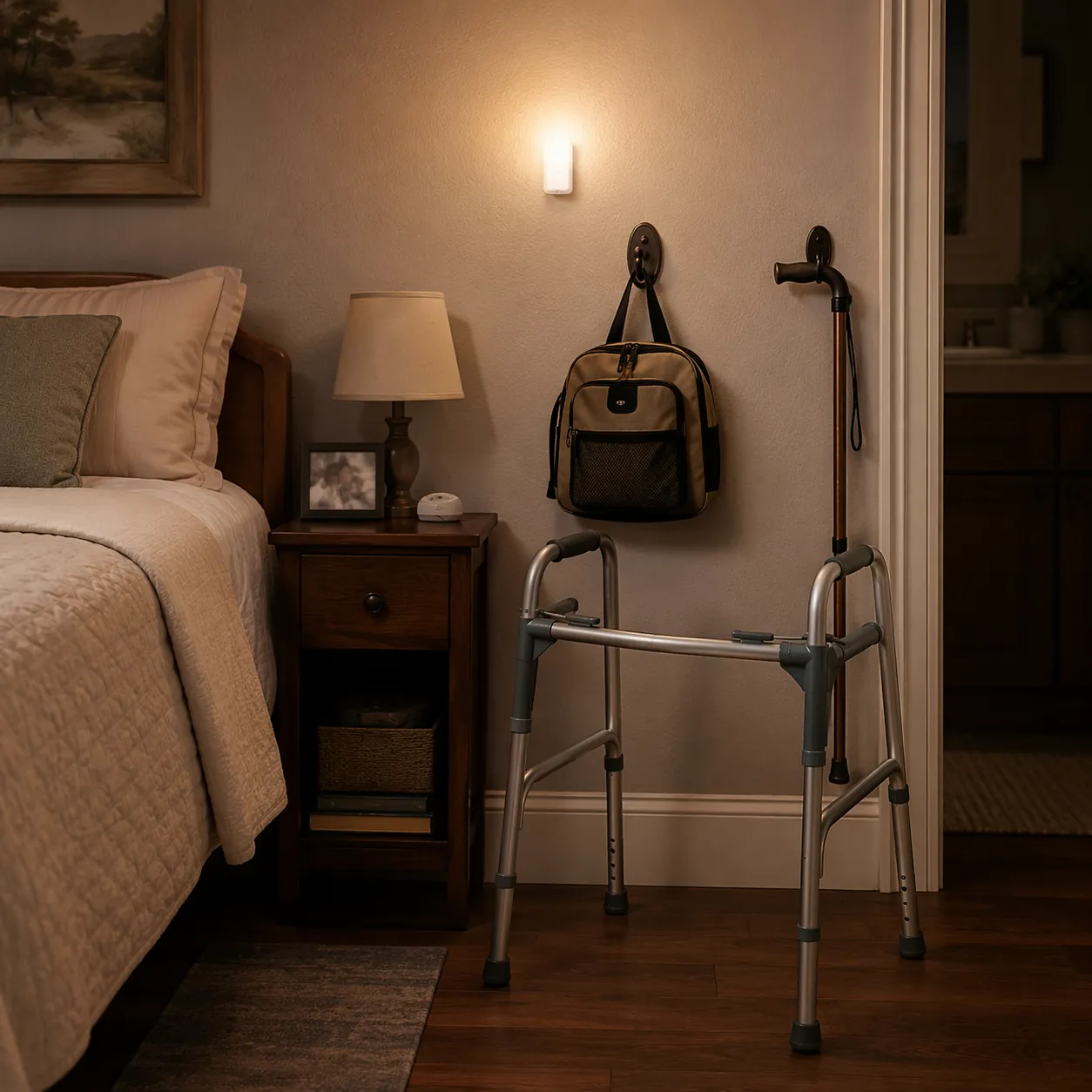
A practical senior wildfire guide from FireHelpCenter recommends placing the go-bag on a wall hook at waist height beside the bed, with a checklist card attached nearby; it also notes that mobility aids are often left behind when they are stored away from the bedside or blocked during rushed evacuations.[7] Treat that as practical supplementary advice, with the main rule kept simple: the senior should not have to choose between balance and supplies.
The bag should be light enough to wear cross-body or attach to a walker basket without changing the senior’s gait. If the adult child wants to pack more, use a second bag for the helper or car. Do not turn the senior’s bag into a suitcase.
- Keep identification, insurance cards, medication list, emergency contacts, and copies of key medical information in the bag.
- Pack essential medications or a current medication plan in the way the senior’s clinician and pharmacist recommend.
- Include glasses, hearing-aid batteries or charger, phone charger, small flashlight, mask if advised for smoke, and a written address list.
- Place heavier water, food, extra clothing, backup batteries, and comfort items in a car kit or caregiver bag when possible.
- Tape a short checklist to the hook: shoes, aid, phone, bag, door, call.
For families building supplies from scratch, a 72-hour senior power outage safety kit can carry the heavier planning load. The evacuation bag beside the bed has a narrower job: get the senior out without occupying the hands needed for balance.
Set the Evacuation-Night Order Before the Night Arrives
On the night of an evacuation, order matters. A senior who grabs the bag first may have no safe hand left for the walker. A senior who steps barefoot into the hallway may slip, stub a toe, or hesitate at the porch. A senior who waits to call because “I can still manage” may lose the window when a neighbor could have come slowly and safely.
Use this sequence during drills and during real evacuation warnings:
- Put on sturdy shoes first. Keep them beside the bed during red-flag weather or evacuation watch periods.
- Stand with the mobility aid already in position. Do not cross the room unsupported to fetch it.
- Put on or attach the go-bag only after balance is secure. Keep hands free for the walker, cane, railing, or wheelchair controls.
- Take the planned route, even if another door looks faster. Faster is not safer if it adds stairs, clutter, darkness, or uneven ground.
- Pause at thresholds. Roll or step deliberately; do not let a caller, alarm, or helper rush the body faster than the feet can go.
- Trigger the support call early. The call is part of the evacuation, not proof that the senior has failed.
Caregivers should practice saying the same calm instruction every time: shoes, walker, bag, route, call. Do not add five new questions while the person is trying to stand. Do not ask them to look for paperwork. Do not ask them to carry keepsakes. The job in that moment is movement without a fall.
Hands Stay for Balance
The rule is strict because the consequences are strict: no purse in one hand and cane in the other if the person needs that hand for a rail. No grocery tote dangling from the walker if it changes the walker’s balance. No oxygen bag slung in a way that pulls the senior sideways. No flashlight carried by a person who needs both hands on a walker; mount light on the route or have the helper carry it.
If a neighbor or adult child arrives, that helper carries extras. The senior carries identity, medical essentials, and only what can be worn or secured without changing balance. Sentimental items should be decided and staged before fire season, not negotiated while embers are moving.
The Threshold Is a Stop Sign
Doorways deserve a pause. A threshold changes texture, height, light, and sometimes slope all at once. That is where a walker wheel catches, a cane tip slips, or a wheelchair caster turns. The pause is not delay; it is how the person leaves still standing.
Helpers should avoid pulling from the front unless trained to assist that person safely. Stand where you can guide, open doors, move obstacles, and keep the route lit. If the senior uses a wheelchair, do not improvise lifting over steps unless emergency responders or trained helpers are required and available. The pre-season plan should have already chosen the exit that avoids that scene whenever possible.
Build the Call Tree Around Real Evacuation Time
Support networks fail when they are polite instead of specific. “Call me if you need anything” is not enough for a senior who may minimize danger, worry about bothering people, or believe they can still manage because they managed last year.
Ready.gov encourages older adults to create a support network and plan for communication, transportation, and assistance before emergencies.[4] For brush fire evacuation, the network needs names, timing, and duties.
| Role | Assignment |
|---|---|
| Primary caller | Calls as soon as evacuation warning or serious fire concern appears, not after the senior is frightened. |
| Pickup person | Knows the driveway, ramp, key location, mobility aid, and safest exit route. |
| Backup pickup person | Takes over if the first helper is blocked by road closures, work, or caregiving duties elsewhere. |
| Medical information holder | Has medication list, equipment needs, pharmacy, physician, and emergency contact details. |
| Check-in closer | Confirms the senior reached the vehicle, shelter, family home, or agreed safe location. |
Write the protocol in ordinary language and post it where the senior can see it. Example: “If evacuation warning is issued, I put on shoes, use walker, put on bag, call Ana, and wait by front door unless smoke or instructions require leaving immediately.” Keep the backup numbers on paper because phones die, power fails, and stress makes contact lists harder to navigate.
California Caregiver Resource Centers also advises older adults and family caregivers to plan ahead for fire season, including emergency contacts, transportation, medication, supplies, and evacuation needs.[8] The useful part is not the existence of a list. It is assigning someone to notice when the list has to become action.
Do Not Let Smoke Plans Create Fall Hazards
Not every brush fire moment is an evacuation moment. Sometimes officials advise people to monitor alerts, reduce smoke exposure, or stay indoors until conditions change. CDC wildfire guidance includes steps for reducing exposure to wildfire smoke and protecting health during wildfire events.[5] For seniors, smoke planning still has to respect fall risk.
A senior who becomes dizzy, short of breath, anxious, or disoriented in smoky conditions may move less steadily. Fans, cords, air purifiers, extension cords, sealed-off rooms, and hastily moved furniture can create new trip points. If the plan is to shelter temporarily, keep the same rule: one clear path from chair or bed to bathroom, phone, medication, and exit. Smoke safety should not turn the living room into an obstacle course.
A companion air-quality alert fall-safety plan can help families handle the days when the senior is not evacuating but is still weaker, less active, or more cautious because the air outside is unsafe.
Practice the First Ten Minutes
A full evacuation drill can feel overwhelming, especially for a parent who does not want to be treated like a project. So practice the first ten minutes. That is where many preventable falls hide.
- Can the senior get shoes on without walking across the room?
- Can they reach the walker, cane, wheelchair, glasses, hearing aids, phone, and go-bag from the bed or usual chair?
- Can they move through the route with lights off and backup lighting on?
- Can they cross the threshold without lifting the walker awkwardly or catching a wheel?
- Can they reach the vehicle or pickup point without carrying anything loose?
- Can they make or answer the support-network call before they are exhausted?
Time the drill only if timing will not cause rushing. The better measure is whether the route stays stable: no grabbing furniture, no stepping around clutter, no bending for a bag, no dark patch where the person freezes, no helper saying, “Just hurry.”
If the senior lives alone, repeat the drill with the person who is most likely to help. If the helper has never folded the wheelchair, opened the ramp, handled the oxygen backup, or guided the walker through the exit, that helper is not ready. If the senior is embarrassed, keep the drill private and practical. Safety work does not need an audience.
When the Plan Needs Outside Help
Some homes cannot be made evacuation-safe with a few cleared rugs and night lights. Stairs may block every exit. A wheelchair may not fit through the best door. A senior may need two-person assistance to transfer. A driveway may be too steep, cracked, or dark. Those are not character flaws; they are facts the plan has to face before the smoke arrives.
In those cases, the support protocol should shift earlier. The senior may need to leave at the first evacuation warning, during red-flag conditions, or when a trusted local contact says the situation is changing nearby. Families should also ask local emergency management, fire departments, paratransit services, senior services, or medical providers what evacuation assistance options exist in their area. Availability varies, so this cannot be left as a vague promise.
For families who want the same fall-prevention structure for other disasters, a hurricane preparedness checklist for seniors living alone can help translate the same principle: the safest emergency plan is the one that fits the person’s body, home, helper network, and first ten minutes.
For seniors with limited mobility, the fall-safe brush fire plan is a rehearsed, obstacle-free, hands-free, well-lit path from bed to exit to help. Inspect that one route today: shoes reachable, mobility aid beside the bed, go-bag at waist height, rugs gone, threshold handled, lights working, caller assigned. When those pieces are in place, the plan matches the older body that has to use it.
References
- Wildfire Evacuations Spell Difficulties for Disabled, Elderly Residents, AJMC
- Fire Safety for Older Adults, U.S. Fire Administration/FEMA
- Fall Prevention, U.S. Fire Administration/FEMA
- Older Adults, Ready.gov
- Wildfire Safety, Centers for Disease Control and Prevention
- Wildfire Safety, American Red Cross
- Wildfire Preparedness Guide for Seniors & Caregivers, FireHelpCenter
- 13 Fire Season Tips for Elderly and Family Caregivers, California Caregiver Resource Centers
Related reading
Noticed something outdated or inaccurate on this page? Flag a correction. We review every report against CDC, NIA, and AARP HomeFit guidance before updating a page.
Part of the Fall Prevention section.