
STEADI: intervene
Three-Phase Tornado Safety Checklist for Older Adults and Their Caregivers
A generic tornado safety plan can be dangerous for seniors. This three-phase checklist adapts evacuation, medication, and fall-prevention steps to the specific risks older adults face — from mobility limitations and sensory impairments to power-dependent medical devices.
“Go to the lowest level” is sound tornado advice until the lowest level is down a narrow stairway, past a loose rug, in the dark, while someone is trying to grab a walker, oxygen tubing, hearing aids, and refrigerated medication. For older adults, a tornado safety checklist has to answer a harder question: can this person get from an ordinary room to a safer place quickly without creating a fall, medication, or medical-device emergency on the way?
That adjustment is not a minor convenience. Older adults face roughly 2 to 4 times higher injury and mortality risk in disasters, according to United Spinal Association’s summary of inclusive disaster-planning research.[1] Tornado deaths also expose a housing problem that generic advice often softens: NOAA data cited by United Spinal found that 43% of tornado deaths over a 21-year period occurred in mobile homes.[1] For a senior who uses a wheelchair, walker, oxygen concentrator, CPAP, or insulin, “home” and “safe shelter” may be two different places.
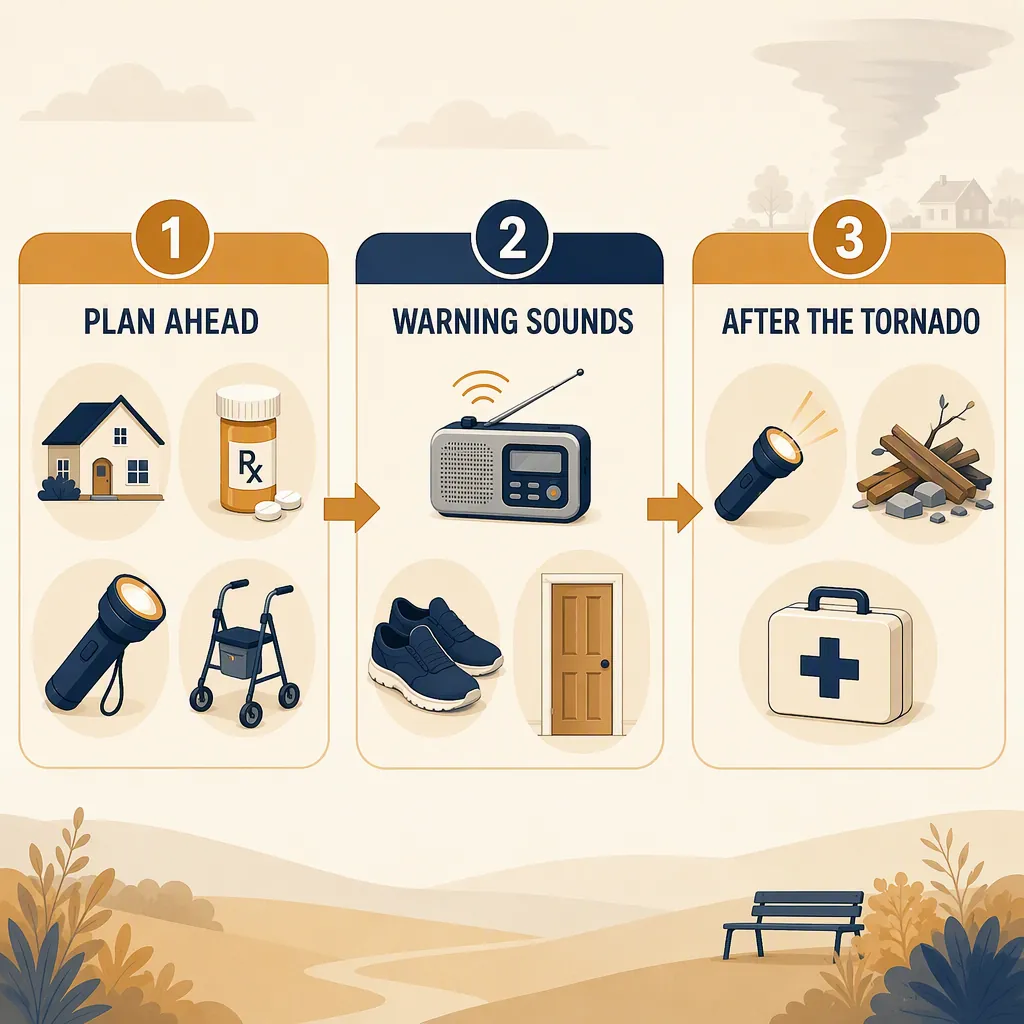
A useful tornado safety checklist for elderly adults works in three phases: what is solved before storm season, what happens when the warning sounds, and what has to be checked before anyone leaves shelter or moves through a damaged home.
| Phase | Main job | Senior-specific risk to solve |
|---|---|---|
| Plan ahead | Choose the shelter route, support network, supplies, and backup power before a warning | Falls, inaccessible basements, sensory impairment, medication gaps, powered medical devices |
| When the warning sounds | Move safely to shelter and adapt the shelter position to the person’s mobility | Rushing, darkness, stairs, walkers, wheelchairs, bedbound status, hearing or vision limits |
| After the tornado | Leave shelter only when it is safe and protect medications, devices, and footing | Debris, darkness, unsafe exits, generator carbon monoxide, spoiled medication, damaged mobility paths |
Phase 1: Plan Ahead Before the Warning Exists
The most important tornado decision for an older adult is usually made on an ordinary day, not during the warning. If the safest room requires a frantic trip down stairs, across a cluttered hallway, or away from a powered medical device without backup, the plan is still unfinished.
Start With the Person, Not the Supply List
Before buying another flashlight, write down what actually affects movement and decision-making in the home:
- Mobility: Can the person walk unaided, use a cane, walker, wheelchair, transfer from bed, or manage stairs without hands-on help?
- Fall history: Has the person fallen in the hallway, bathroom, bedroom, porch, or stairs within the past year?
- Vision: Can they see the shelter route at night, during a power outage, or without glasses?
- Hearing: Will they hear a weather radio, phone alert, siren, caregiver call, or door knock with hearing aids removed?
- Cognition: Can they understand a watch versus a warning, remember the shelter location, and follow the plan under stress?
- Medical dependence: Does safety depend on oxygen, CPAP, dialysis supplies, refrigerated medication, a powered wheelchair, or an electric bed?
This is where many family plans become too optimistic. “Mom knows what to do” is not a plan if Mom cannot hear the alert without charged hearing aids. “Dad can get to the basement” is not a plan if he only does that slowly in daylight with someone beside him. The checklist has to match the worst likely conditions: nighttime, no power, bad footing, loud wind, and very little time.
Choose a Shelter the Person Can Actually Reach
A basement may be the best tornado shelter in many homes, but it is not automatically the best choice for every older adult. If the basement stairs are steep, unlit, narrow, damp, or missing a second handrail, the trip down can become the first injury of the storm.
Look for the safest reachable option, not the safest theoretical option. In a site-built home, that may be a small interior room or hallway on the lowest accessible level, away from windows and exterior walls. In an apartment, it may be an interior hallway, bathroom, closet, or designated community shelter area. In a mobile home, the plan should identify a sturdier shelter location before storm season, because mobile homes account for a large share of tornado deaths.[1]
For older adults in mobile homes, the hard part is often not knowing that another shelter would be safer. It is transportation, timing, and deciding early enough. A caregiver should help answer these questions before the first watch of the season:
- Where is the nearest sturdy shelter the older adult can enter with their mobility aid?
- Who will drive or assist if the person no longer drives at night or in heavy rain?
- How early must the person leave, before walking, transfers, or oxygen setup become rushed?
- Does the shelter allow service animals, oxygen equipment, walkers, wheelchairs, and a caregiver?
- What is the backup location if the first option is locked, full, or unreachable?
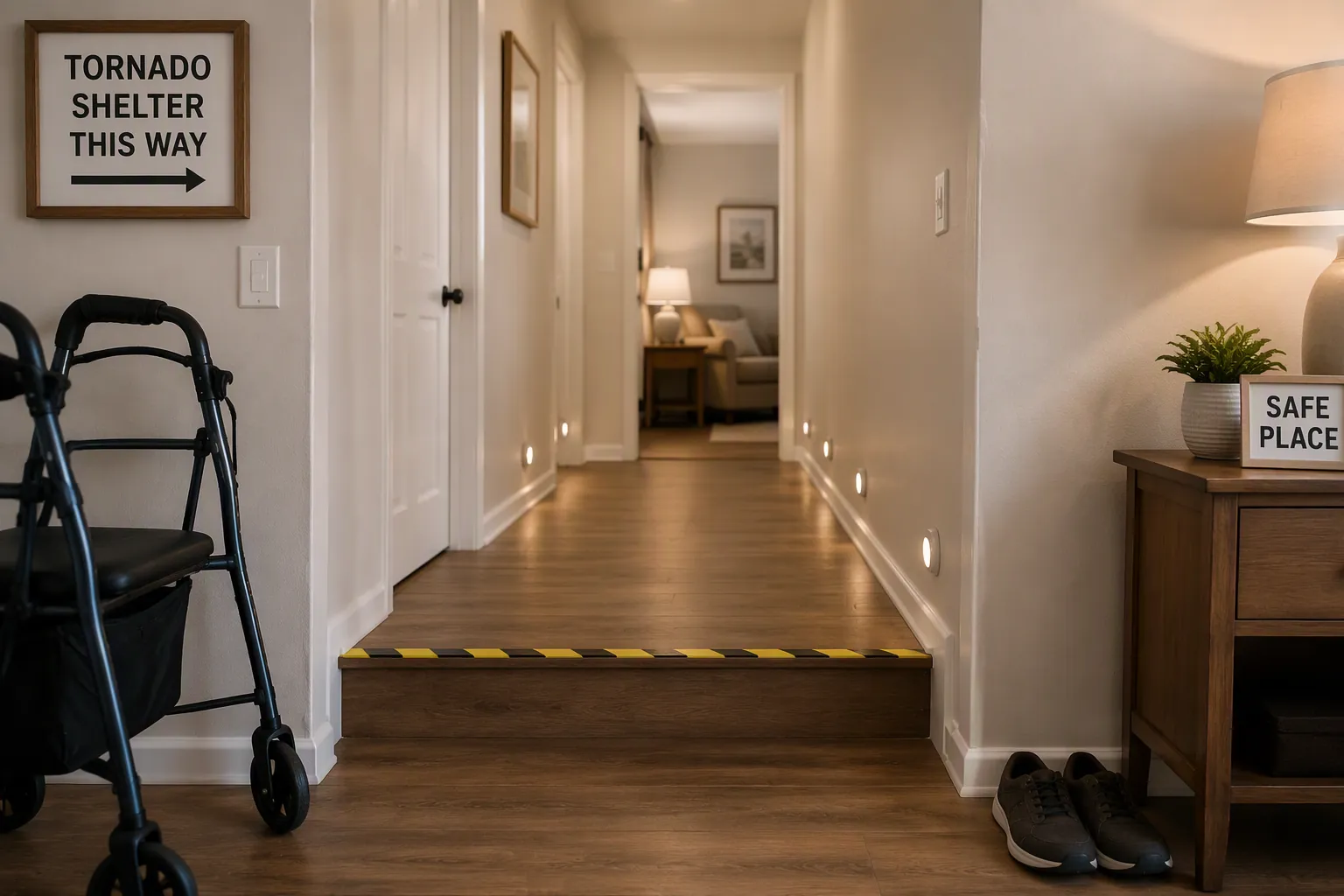
Fall-Proof the Route Before Storm Season
A shelter route for an older adult should be treated like a medical safety path, not a hallway that happens to lead somewhere safer. Walk it at night. Walk it with the same cane, walker, wheelchair, oxygen tubing, slippers, glasses, and lighting the person would likely have during a real warning.
- Remove throw rugs, loose mats, low baskets, pet beds, cords, and decorative items from the bedroom-to-shelter route.
- Place sturdy non-slip shoes beside the bed, not in a closet across the room.
- Install nightlights along the route and use battery-backed or motion-activated lights where power loss is likely.
- Mark step edges with high-contrast tape so a single step does not disappear in low light.
- Add handrails on both sides of stairs if stairs remain part of the route.
- Keep the primary mobility aid within arm’s reach of the bed, chair, or recliner where the person sleeps most often.
- Store a backup cane, walker, transfer board, or wheelchair cushion near the shelter area if the person depends on one.
Do not assume the bedroom is the starting point. Many older adults sleep in recliners, nap in living rooms, or spend evenings in a den far from the planned shelter. The route should be checked from the bed, favorite chair, bathroom, kitchen, and porch entrance.
Build a Two-Person Support Network
One helper is fragile. A phone battery dies, a neighbor is at work, an adult child is across town, or the person who usually helps is also sheltering. Each older adult should have at least two people who know the tornado plan, the shelter location, the medication and device needs, and how to get into the home if the older adult cannot reach the door.
- Name a primary and backup contact for warnings, transportation, and post-storm check-ins.
- Give trusted contacts current medication lists, device requirements, emergency contacts, and preferred hospital information.
- Agree on the exact alert trigger: tornado watch, tornado warning, local siren, weather radio alert, or caregiver call.
- Decide who calls, who comes over, who drives if needed, and who checks after the storm.
- Confirm access: keys, lockbox code, building entry code, garage override, or apartment office procedure.
If the older adult has memory loss, the plan should be written in plain language and placed where the person actually looks: near the recliner, bedside table, refrigerator, or medication station. A large-print card that says “When tornado warning sounds: put on shoes, take walker, go to hall bathroom, sit on shower chair, cover head” is more useful than a thick folder in a drawer.
Make Alerts Redundant
A siren outside is not enough for many older adults. Tornado alerts should reach the person in more than one way, especially overnight and when hearing aids are charging.
- Weather radio with battery backup and loud alert setting
- Phone alerts set to the correct county or location
- Caregiver call or text when severe weather is expected
- Visual or vibrating alert options for people with hearing loss
- A plan for hearing aids: charging routine, spare batteries, and a storage spot that can be reached quickly
Pack the Kit Around Medical Reality
The American Red Cross separates emergency supplies into a Go-Kit for at least 3 days and a Stay-at-Home Kit for up to 2 weeks.[2] That distinction is helpful for older adults because sheltering in a hallway for 30 minutes and being stuck without power for days are different problems. The same household may need both: a small shelter bag within reach and a larger home supply for the outage and recovery period.
For water, CDC emergency guidance uses 1 gallon per person per day and recommends storing at least a 3-day supply when possible.[3] Ready.gov’s emergency kit guidance also advises considering supplies for several days and points households toward longer shelter-in-place planning, including a 2-week supply for home needs.[4] For an older adult, the water plan has to include medication swallowing, hygiene, incontinence care, and any medical equipment cleaning the person must continue.
| Shelter Go-Kit | Stay-at-Home Supply |
|---|---|
| Flashlight or headlamp with easy button | Extra batteries and battery-powered lanterns |
| Current medication list and emergency contacts in large print | At least 30-day medication supply when prescriptions and insurance allow |
| One dose cycle of essential medications if medically appropriate and approved | Cooling plan for insulin or other temperature-sensitive medication |
| Spare hearing aid batteries or charger | A longer hearing aid battery supply, such as 3 months when feasible |
| Backup glasses and magnifier | Copies of prescriptions and device settings |
| Small first aid items and gloves | Incontinence supplies, wipes, trash bags, and skin-care items |
| Light blanket, helmet or hard hat if available, and sturdy shoes | Backup power plan for CPAP, oxygen, powered wheelchair, communication device, or medical bed |
Do not let the kit become a substitute for the route. A beautifully packed bin in the garage will not help someone who cannot safely cross the house when the warning sounds. Keep the immediate shelter items where the person shelters, then store the larger outage supplies where a caregiver can retrieve them safely after the storm.
For a deeper supply-by-supply setup, use How to Build a 72-Hour Senior Power Outage Safety Kit. The tornado version should stay focused on what must move with the person, what must stay powered, and what cannot be replaced quickly after damage.
Solve Backup Power Before It Is Needed
For someone who uses CPAP, oxygen, a powered wheelchair, a lift chair, a stair lift, or an electric hospital bed, backup power is not a comfort item. It decides whether the person can breathe, transfer, communicate, or leave a room.
- List every device that needs electricity and how long it must operate without grid power.
- Ask the medical equipment supplier what backup battery options are compatible with the exact device.
- Keep wheelchair, scooter, phone, hearing aid, and medical-device batteries charged when severe weather is forecast.
- Store charging cords and adapters in a labeled pouch near the shelter or medical station.
- If a generator is part of the plan, decide who can operate it safely and where it will be placed outside.
The caregiver question is blunt: if power fails at 2 a.m., can this person still get out of bed, breathe safely, hear instructions, call for help, and keep essential medication usable? If the answer depends on someone improvising, the plan needs more work.
Phase 2: When the Tornado Warning Sounds
A warning is not the time to debate the best room or search for shoes. The plan should already have narrowed the action to a short sequence the older adult can perform under stress.
Use a Fall-Safe Movement Sequence
- Turn on the bedside flashlight, headlamp, or one-touch lamp before standing.
- Put on the non-slip shoes stored beside the bed, chair, or recliner.
- Use the cane, walker, wheelchair, transfer aid, or caregiver assist exactly as practiced.
- Take the shelter Go-Kit only if it is within easy reach and does not delay movement.
- Move to the chosen interior shelter location without stopping for valuables, paperwork, or extra household tasks.
- Sit, lock brakes if using a wheelchair or rollator, protect the head and neck, and wait for confirmed all-clear information.
Caregivers should resist the urge to rush physically. Pulling an older adult by the arm, hurrying a walker, or trying to carry someone without training can injure both people. The safer version is practiced movement: clear commands, light first, shoes on, mobility aid stable, short route, no last-minute detours.
If the Person Uses a Wheelchair
The shelter location must be reachable without stairs unless there is a reliable, practiced, powered-and-manual transfer plan. A small interior windowless room on the lowest accessible level is often more realistic than a basement the person cannot enter safely.
- Keep the path wide enough for the chair, including turns into the shelter room.
- Lock wheelchair brakes once in position.
- Move away from windows, mirrors, tall furniture, and unsecured shelves.
- Use a blanket, pillow, cushion, or helmet to protect the head and neck if available.
- Keep the chair’s charger, manual backup instructions, and transfer supplies known to caregivers.
If the Person Uses a Walker or Cane
A walker helps only if the route has enough clearance and the person does not abandon it in panic. The shelter area should have a stable chair, shower chair, bench, or low seat available so the person does not have to lower to the floor and then struggle to get up.
- Do not ask a walker user to hurry beyond their normal safe pace.
- Avoid stairs during the warning unless they are already part of a practiced, safe route.
- Have the person sit once in shelter, then cover the head and neck.
- If a rollator is used as a seat, lock the brakes before the person sits.
- Keep oxygen tubing, long cords, and pet movement out of the walking path as much as possible.
If the Person Is Bedbound or Cannot Reach the Shelter
Some older adults will not be able to reach a hallway, bathroom, or basement during a warning. Pretending otherwise makes the plan look cleaner and the person less safe. The backup plan should reduce exposure where they are.
- Move the bed or primary sleeping location away from windows before storm season if possible.
- Keep heavy blankets, pillows, or a protective cushion within caregiver reach.
- Lower adjustable beds before severe weather if the person can safely tolerate that position.
- Protect the head and neck with pillows, blankets, or a helmet if one is available.
- Keep essential medical tubing and power cords arranged so they do not become strangulation, tripping, or disconnection hazards.
If the older adult lives alone and cannot self-transfer, this limitation should trigger a higher level of planning before storm season: earlier relocation during tornado watches, a neighbor response agreement, or a care plan that does not depend on a last-minute rescue.
Shelter Position Matters, but So Does Getting Up Later
Standard tornado guidance often tells people to get low and cover their head. For many older adults, getting to the floor is easy only in one direction. If they cannot rise without help, they may be safer seated on a stable chair, shower chair, wheelchair, or rollator with brakes locked while using pillows, blankets, a mattress, or a helmet for head and neck protection.
The goal is not a perfect textbook posture. The goal is the safest protective position the person can enter quickly and leave safely after the danger passes.
Phase 3: After the Tornado
The storm passing does not make the house safe. For an older adult, the first post-tornado danger may be a familiar hallway turned into a dark obstacle course: broken glass, wet flooring, insulation, splintered wood, shifted furniture, loose cords, and a missing handrail.
Do Not Rush Out of Shelter
- Wait for an all-clear from a trusted weather source or local authority when possible.
- Use a flashlight before standing or transferring.
- Check whether glasses, hearing aids, shoes, cane, walker, oxygen tubing, and phone are in place before moving.
- Look for water, glass, nails, insulation, and shifted furniture before taking the first step.
- If the exit route is blocked or unstable, call for help rather than climbing over debris.
A caregiver arriving after the storm should not start by moving the older adult through damage unless there is an immediate hazard. First check for injuries, breathing issues, medication needs, device power, gas smell, smoke, structural damage, and safe footing.
Protect Medication and Medical Devices
Power loss changes the medication plan quickly for people who use refrigerated drugs such as insulin. If the refrigerator is out, the caregiver should check the medication’s storage instructions, avoid guessing about safety, and contact a pharmacist, prescriber, or health department guidance when temperature exposure is uncertain.
Medical devices need the same attention. Confirm whether oxygen equipment, CPAP, wheelchair batteries, communication devices, and chargers still work. If the person depends on powered equipment and backup power is running low, the support network should escalate early rather than waiting until the device fails.
Use Generators Without Bringing Carbon Monoxide Inside
Generators can keep essential devices running, but they can also create carbon monoxide danger if used in or near living areas. CDC warns that generators should be used outside and kept away from doors, windows, and vents because carbon monoxide can build up indoors and poison people who cannot see or smell it.[5]
This matters for older adults because “just put the generator in the garage” can sound practical after a storm and still be dangerous. If no one in the home can move and operate the generator safely, the generator is not a complete backup-power plan.
Re-Entry Is a Mobility Decision
If the older adult evacuated to a neighbor’s house, community shelter, or interior building, returning home should wait until the route, entrance, lighting, and interior walking paths are safe. A home with a damaged porch, wet threshold, buckled flooring, or blocked bathroom may be technically standing and still unsafe for someone with balance problems or a wheelchair.
A good tornado safety checklist for elderly adults is not a longer version of the standard list. It is a fall-aware, power-aware, medication-aware route from ordinary home routines to shelter and back out again without turning the safety plan into another emergency.
References
- Emergency Preparedness for People with Disabilities, United Spinal Association
- Emergency Preparedness for Older Adults, American Red Cross
- Creating and Storing an Emergency Water Supply, Centers for Disease Control and Prevention
- Build A Kit, Ready.gov
- Prevent Carbon Monoxide Poisoning, Centers for Disease Control and Prevention
Related reading
Noticed something outdated or inaccurate on this page? Flag a correction. We review every report against CDC, NIA, and AARP HomeFit guidance before updating a page.
Part of the Fall Prevention section.