
STEADI: intervene
How to Get an Elderly Parent to Tornado Shelter Without Falling
Rushing to shelter during a tornado warning is a high fall-risk moment for seniors. This guide provides a pre-planned, fall-safe protocol to get an elderly parent to safety without injury, covering path preparation, mobility aids, and shelter alternatives.
A tornado warning is a terrible time to discover that the walker is across the room, the basement light switch is at the bottom of the stairs, and your parent’s slippers slide on the hallway floor. The standard advice—get to the lowest level, in an interior room—may still be the right weather advice. But for an elderly parent with poor balance, shoulder pain, neuropathy, a walker, a wheelchair, or a history of falls, the trip to that “safe place” can become its own emergency.
The real question behind tornado safety tips for elderly parents is not only where the safest shelter is on paper. It is whether your parent can reach that place in the actual house, at night, under stress, without falling on the way.
That distinction matters. More than 1 in 4 adults age 65 and older falls each year, so a rushed shelter trip is not a small side concern for many families.[1] An educational tornado-fatality analysis reports that adults 75 and older have roughly three times the tornado death rate of adults ages 25 to 64; treat that as directional evidence rather than an official NOAA table, but the pattern is consistent with the vulnerability emergency planners worry about.[2] United Spinal Association, citing the Partnership for Inclusive Disaster Strategies, notes that people with disabilities are 2 to 4 times more likely to die or be injured in a disaster than nondisabled people.[3] And tornado injury risk is not limited to direct wind exposure; falls and debris are part of the injury picture too.[2]
This article is general safety education, not medical, legal, construction, or emergency-management advice. If your parent has medical restrictions, cognitive impairment, oxygen equipment, a wheelchair-transfer risk, or a home with structural concerns, use this as a planning framework and confirm the details with the appropriate clinician, local emergency-management office, building professional, or emergency services provider.
The shelter route is part of the shelter
For a steady adult, “go to the basement” may sound simple. For a parent who uses a walker, that sentence hides a dozen tasks: stand up from the recliner, find the walker, turn toward the hall, avoid the rug edge, reach the stairwell, grip the railing, manage each step, and land safely at the bottom—possibly while sirens are sounding and someone is saying, “Hurry.”
KCUR/NPR reporting in 2020 made this problem plain for residents with disabilities in Tornado Alley: steep basement stairs and underground storm cellars are effectively unusable for many people who rely on walkers or wheelchairs.[4] A shelter plan that depends on stairs your parent cannot safely use is not a plan. It is a hope that a frightening moment will temporarily erase the limitations you already know are there.
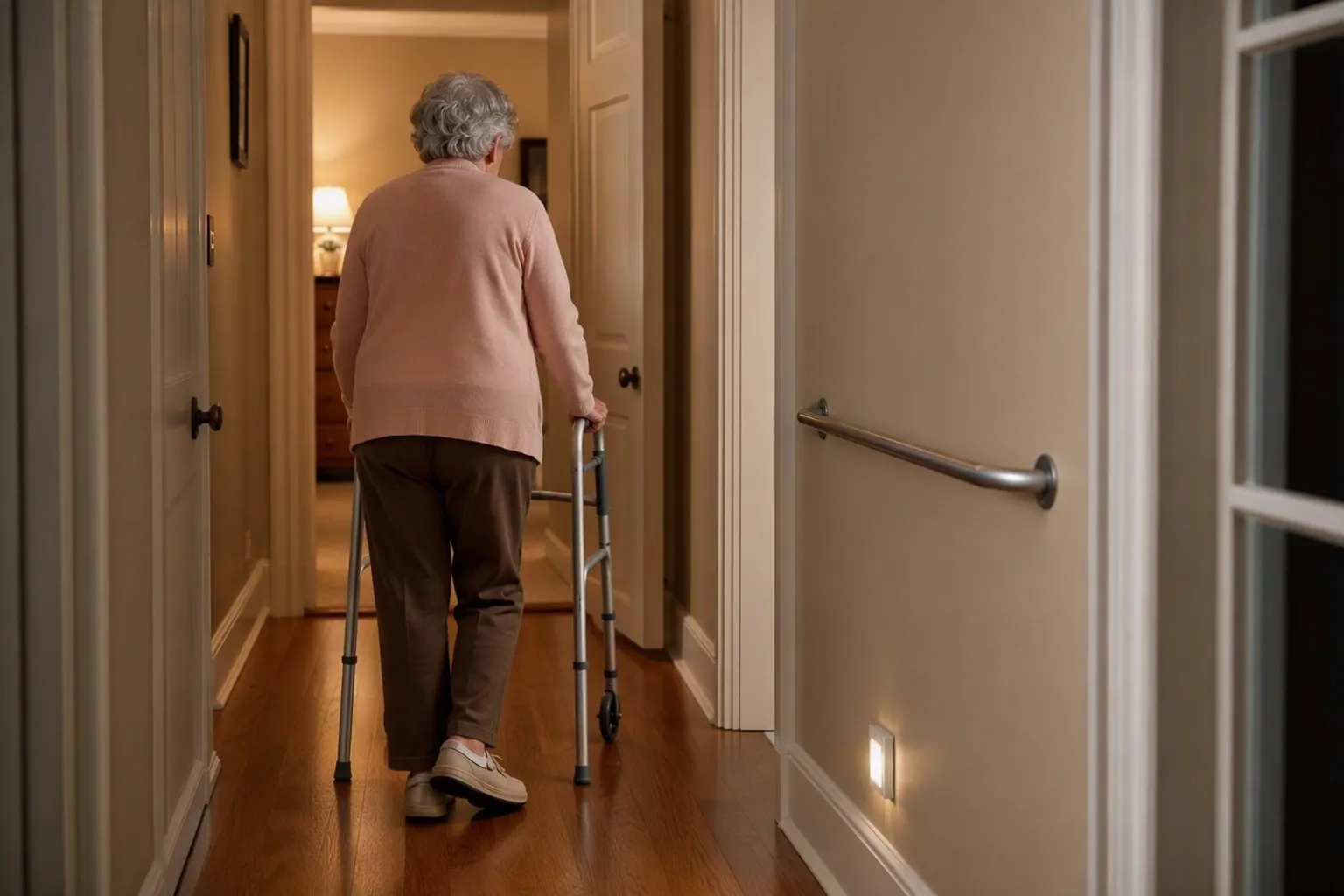
So start by judging the whole route, not just the destination. A basement may offer stronger tornado protection than a hallway closet, but if getting there means a likely fall on dark stairs, the family has to decide on the safest reachable shelter instead of the theoretically safest unreachable one.
Before storm season: walk the route slowly, then fix what failed
Do this before a warning, in ordinary light, with your parent using the same cane, walker, wheelchair, shoes, glasses, and hearing aids they would actually need during a storm. Begin at the places where your parent spends time: the recliner, bed, bathroom, kitchen chair, porch, or garage entry. Then walk to the chosen shelter location at your parent’s real pace.
Do not time the route first. Watch it first. The timing will not mean much if the first pass reveals that the walker catches on a rug, the parent reaches for a towel bar that cannot hold weight, or the hall light is controlled from the wrong end of the hallway.
| What to inspect | What to change before the next warning |
|---|---|
| Floor path | Remove throw rugs, cords, laundry baskets, pet bowls, loose shoes, low stools, and decorative items from the shelter route. |
| Footwear | Stage closed-back, slip-resistant shoes where your parent can put them on quickly, especially near the bed and main chair. |
| Mobility aid | Keep the walker, cane, wheelchair, or rollator on the parent’s side of the room, not parked across the furniture. |
| Lighting | Add nightlights, motion lights, reachable lamps, and flashlights with working batteries along the route. |
| Stairs | Check whether railings are on the usable side, whether steps are even and dry, and whether your parent can descend without rushing. |
| Doorways and thresholds | Clear narrow turns and consider threshold changes if a walker or wheelchair catches. |
| Shelter supplies | Store supplies at reachable height inside or next to the shelter area, not on a high shelf or in the garage. |
| Human help | Decide who will call, who will drive over if safe, who has a key, and who checks back after the warning. |
This is where home modification stops being a someday project and becomes part of the tornado plan. Grab bars, stair lighting, better railings, lever handles, threshold ramps, and clearer furniture placement are not cosmetic changes when they sit between your parent and shelter. If you need a broader way to rank those fixes, use a room-by-room aging plan like How to Prioritize Home Modifications for Aging in Place and apply it specifically to the route from bed, chair, and bathroom to shelter.
If cost is the obstacle, price the route changes before buying extra gear. A sturdy grab point at the exact place your parent reaches, a reliable light at the stairwell, or a small threshold fix may matter more than a larger emergency kit stored where no one can reach it. For budgeting, compare likely projects with Home Modification Costs for Aging in Place and, for the broader one-time-modification logic, What Aging in Place Modifications Actually Cost and Save.
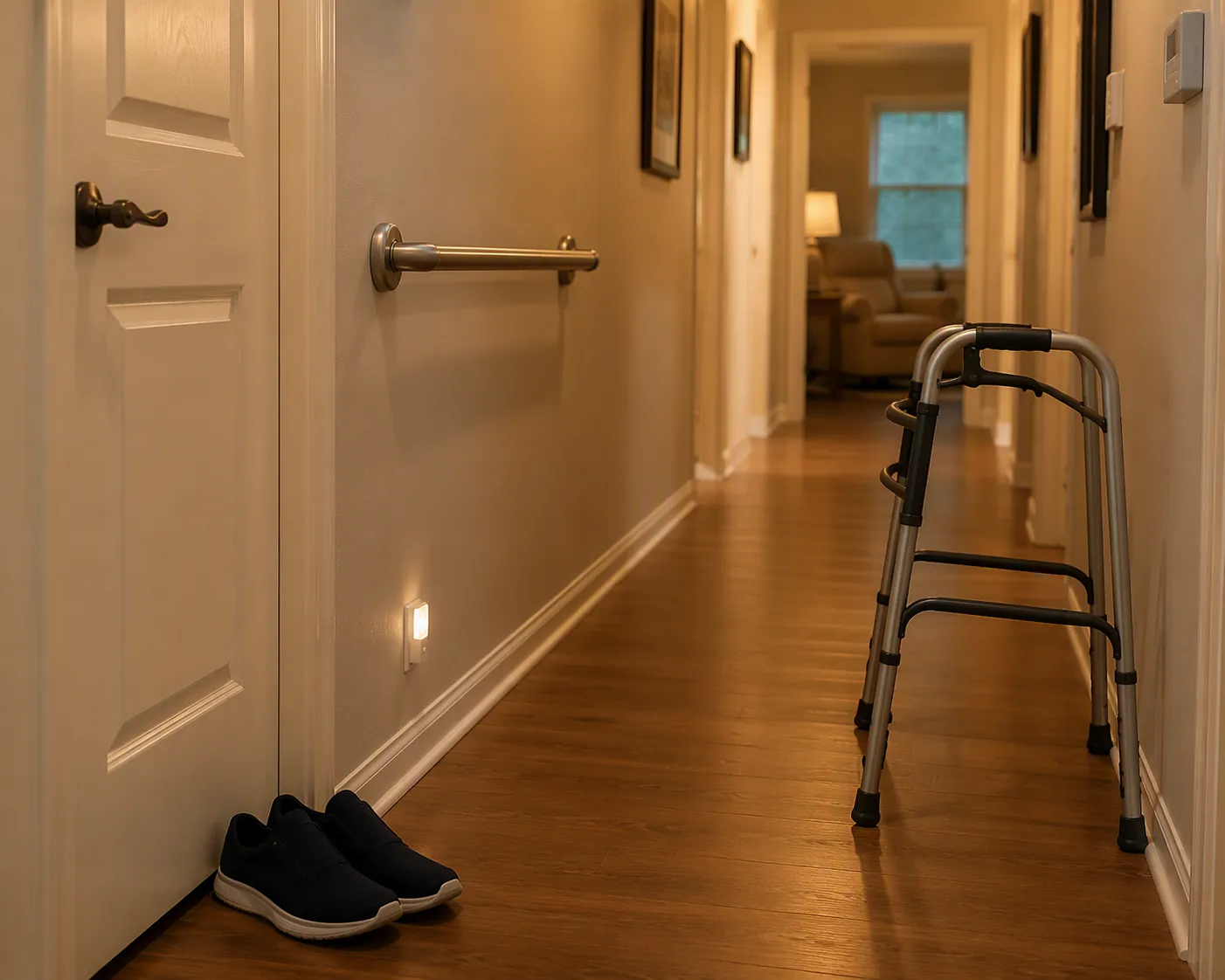
Put supplies where the body can reach them
Emergency supplies do not help if they are in a basement cabinet your parent cannot open, on a high laundry-room shelf, or in a tote too heavy to move. Oklahoma State University Extension recommends a two-kit system for older adults: one kit for sheltering at home and a lighter bag for evacuation, stored in an easy-access spot rather than somewhere high or awkward.[5]
For the shelter-at-home kit, think about what your parent may need while sitting in place after the warning: shoes, a flashlight, spare batteries, a phone charger or power bank, water, medication information, a medication dose if appropriate and approved by their care plan, glasses, hearing-aid batteries, incontinence supplies, a small blanket, and a written contact list. Keep it low enough to reach without shoulder strain and close enough that no one has to cross the house to retrieve it.
The lighter evacuation bag is different. It is for leaving the home if damage, fire, flooding, or official instruction makes that necessary after the tornado threat has passed. Do not make the warning-time shelter trip depend on carrying a heavy bag. A parent gripping a walker should not also be balancing a loaded tote.
Name the people before you need them
The American Red Cross recommends that older adults establish a support network of at least three people who have keys and know where emergency supplies are kept.[6] That is a practical number. One neighbor may be at work, one adult child may be stuck across town, and one friend may not hear the phone. The plan should not depend on the one person who is least reachable during bad weather.
- Give the support people the shelter location, not just the address.
- Tell them whether your parent uses a walker, cane, wheelchair, oxygen, hearing aids, or a lift chair.
- Make sure they know whether basement stairs are allowed, questionable, or off-limits.
- Place a key where the agreed helpers can legally and safely access it, or give keys directly.
- Decide who calls first, who checks after the warning, and who contacts emergency services if no one can reach your parent.
During a tornado warning: use the slow plan, not the panic plan
Once the warning is active, the job changes. You are no longer redesigning the house. You are executing the safest route that already exists. If the route has not been prepared, choose the safest reachable option you can without creating a fall you can see coming.
- Turn on lights first if the switch is reachable. Use lamps, phone light, flashlight, or nightlights rather than moving through a dark hall.
- Put supportive shoes on if they are close and the delay is brief. Do not send a parent down stairs in loose slippers if a safer option is available.
- Put the mobility aid in hand before standing. The walker or cane should move with your parent from the first step, not be fetched after they are already unsteady.
- Give one cue at a time: “Stand up,” then “Hold the walker,” then “Turn toward the hall.” Too many instructions at once can make a frightened person move faster than their balance allows.
- Use the pre-cleared route. Do not improvise a shortcut through the laundry room, garage, or cluttered storage area because it looks faster.
- Avoid carrying your parent unless trained help or emergency services are involved and the danger requires it. An untrained lift can injure both people and can drop the parent in the worst possible moment.
- If the stairs are not safe today, use the above-ground alternative you chose in advance.
The hard part is refusing the false urgency of a dangerous route. A fall on the stairs can immobilize your parent before they reach any shelter at all. Moving deliberately is not the same as ignoring the warning; it is how you keep the shelter trip from becoming the first injury.
When the basement is not the right answer
If your parent cannot use the basement safely in normal conditions, assume they will not use it safely during a warning. That means the family needs an above-ground option, chosen before the siren.
In many homes, the practical fallback is a small, windowless interior room on the lowest reachable level: a bathroom, closet, hallway, or interior room away from windows. It should have enough clear floor space for the walker or wheelchair to enter, a stable chair if sitting is safer than standing, and supplies stored where your parent can reach them. If the door swings awkwardly, the threshold catches the walker, or the room is packed with storage bins, it is not ready.
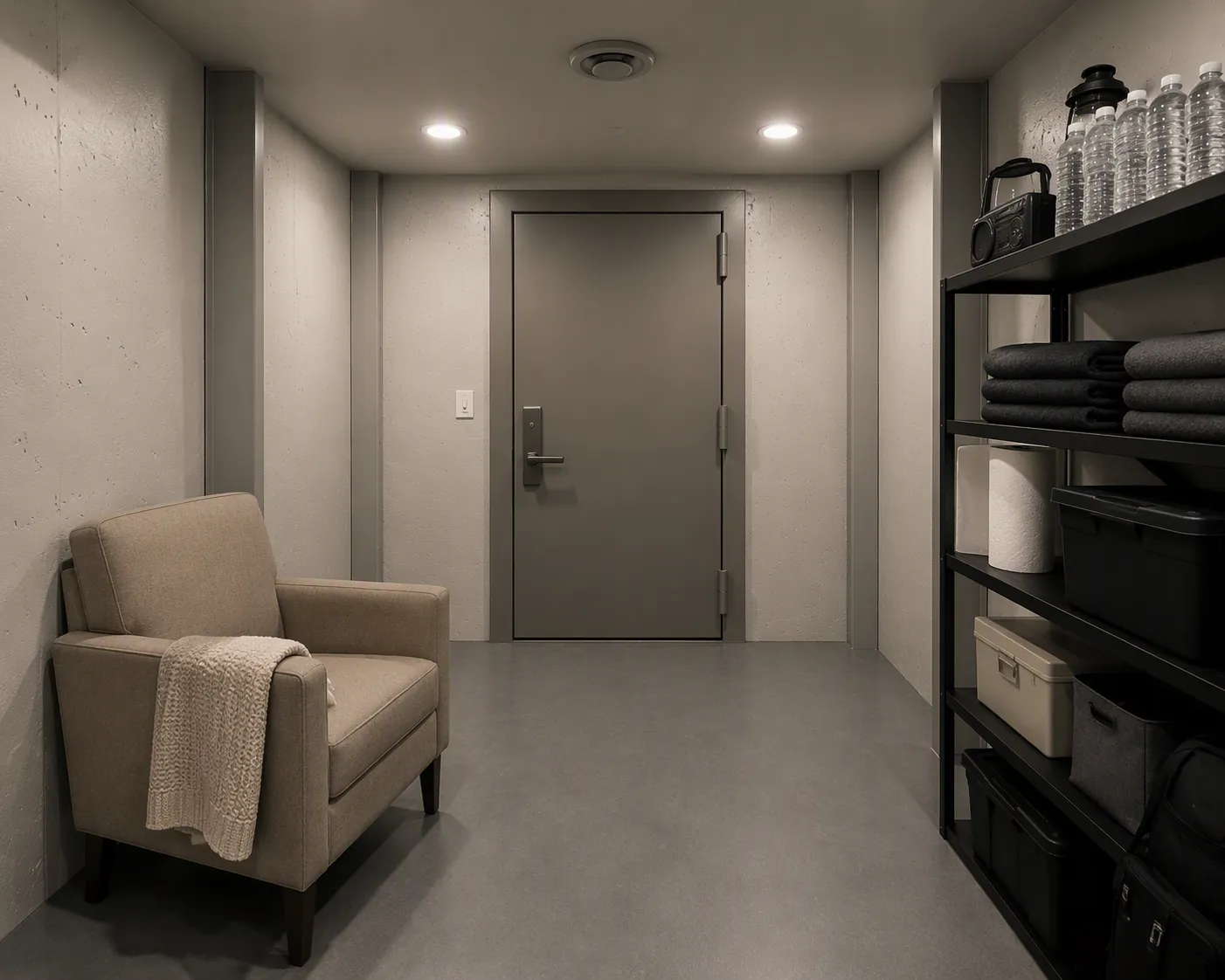
For some families, a FEMA-compliant above-ground safe room may be worth investigating, especially when wheelchair access or stair avoidance is central to the plan. Use FEMA P-320 and P-361 as educational design references to discuss requirements with a qualified builder or local emergency-management office; do not rely on a vendor’s brochure alone. The phrase “above-ground” is not enough by itself. The room’s construction, anchoring, door, accessibility, and usable interior space all matter.
Be cautious with rebate assumptions. KCUR’s 2020 reporting described an Oklahoma rebate of about $2,000 per household that was limited to homeowners and allocated by lottery to about 50 households a year.[4] That is useful as an example of how limited such programs can be, not proof that every state or county has the same help available in 2026. Check your own local emergency-management agency before building a plan around a subsidy.
Night warnings need their own small plan
Nighttime is when a neat daytime plan often falls apart. Your parent may be asleep without hearing aids, the walker may be parked near the bathroom instead of the bed, and the route may be lit only by a switch across the room. TornadoSimulator.net reports that about 40% of tornadoes occur at night but account for about 65% of fatalities, another directional sign that sleeping through or stumbling through a warning is a serious problem.[2]
- Use more than one warning method: weather radio, phone alerts, local alerts, and a support-person call if your parent sleeps deeply.
- Keep shoes, glasses, phone, flashlight, and mobility aid in the same reachable place every night.
- Add nightlights from bed to shelter, including the bathroom route if your parent often wakes at night.
- If your parent has hearing loss or cognitive impairment, decide who is responsible for confirming they are awake and moving.
- If stairs are part of the plan, test them at night with the actual lighting. Daytime confidence does not prove nighttime safety.
A simple decision rule for the warning itself
When the warning comes, do not debate every possible shelter location from scratch. Use a rule you have already agreed on:
- If the basement route is clear, lit, dry, and your parent can use the stairs safely today, go to the basement using the mobility aid and railings.
- If the basement requires rushing, carrying, unsupported stair descent, or a route through clutter or darkness, use the chosen above-ground interior shelter.
- If your parent is already in the safest reachable interior room and moving would create a high fall risk, improve protection there: stay away from windows, sit low if possible, cover with a blanket or cushion if available, and keep the phone nearby.
- If your parent falls, is trapped, has chest pain, severe shortness of breath, head injury signs, or cannot be moved safely, call emergency services when it is possible to do so.
The best tornado plan for an elderly parent is not simply the lowest place in the house. It is the safest reachable place, chosen before the warning, with the route made as boring as possible: clear floor, good light, real shoes, the walker on the correct side of the chair, supplies within reach, and people who know exactly what help they are expected to provide.
Walk the route today in normal conditions. Decide whether the stairs are truly usable. Move the emergency supplies to reachable storage. Put the shoes and mobility aid where your parent can actually get them. Name the three support people and make sure they know the plan.
References
- Facts About Falls, CDC
- Tornado Fatality Statistics, TornadoSimulator.net
- Tornado Preparedness for the Disability Community, United Spinal Association
- Many Tornado Alley Residents With Disabilities Lack Safe Options In A Storm, KCUR/NPR, 2020-02-18
- Older Adults and Planning Ahead for Severe Weather, Oklahoma State University Extension
- Older Adults, American Red Cross
Related reading
Noticed something outdated or inaccurate on this page? Flag a correction. We review every report against CDC, NIA, and AARP HomeFit guidance before updating a page.
Part of the Fall Prevention section.