
STEADI: Intervene
Tornado Shelter Choices for Seniors With Limited Mobility
When a basement is not an option, the right tornado shelter for a senior with limited mobility is an accessible above-ground safe room or a small interior windowless room adapted in advance — not the room with the strongest wind rating. This decision guide covers how to choose and prepare that space when stairs are not safe, including basement-route fall hazards and the mobile-home rule.
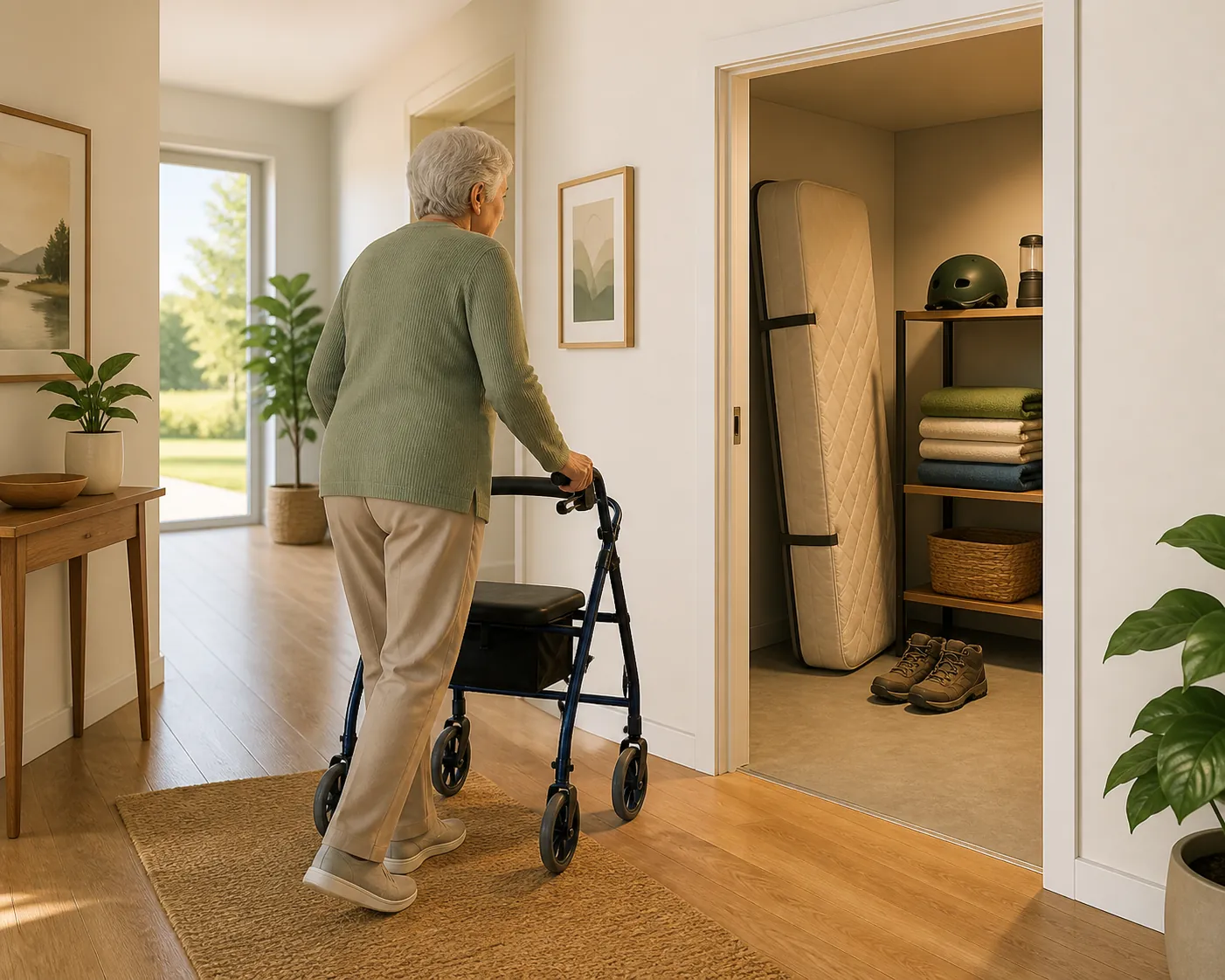
“Go to the basement” is useful tornado advice only if the person can get to the basement without falling, freezing on the stairs, or arriving without the walker, oxygen tubing, shoes, or caregiver they need. For a senior with limited mobility, the shelter decision starts with a more practical question: which protected space can they actually reach and remain in for the duration?
CDC and Ready.gov both point people toward a storm cellar, basement, or small interior windowless room on the lowest floor of a sturdy building during a tornado.[1][2] That safety frame matters. So does the route. In the CDC review of the April 25–28, 2011 tornado outbreak across five southeastern states, 338 deaths were identified, and 32.5% of decedents were age 65 or older; older age was listed among the risk factors for death.[3] The point is not that older adults cannot shelter safely. It is that a plan that requires fast stair use, tight turns, or last-minute improvisation is not a plan.
This article stays on the shelter-choice decision. For the surrounding watch-and-warning routine — when to charge devices, move shoes, call helpers, and stop waiting — use the Tornado Warning Checklist for Seniors and Caregivers. If there is immediate danger, follow local emergency instructions. This is planning guidance, not a substitute for emergency services, building-code review, medical advice, or local emergency management direction.
The shelter decision has to eliminate unsafe routes first
A basement may be the strongest available space in many houses. It can also be the wrong answer for a person who cannot safely use stairs. The same is true of a garage shelter reached through a step-down, a cramped closet that cannot fit a wheelchair, or a bathroom where the door cannot close once a walker is inside.
| Decision point | What to do |
|---|---|
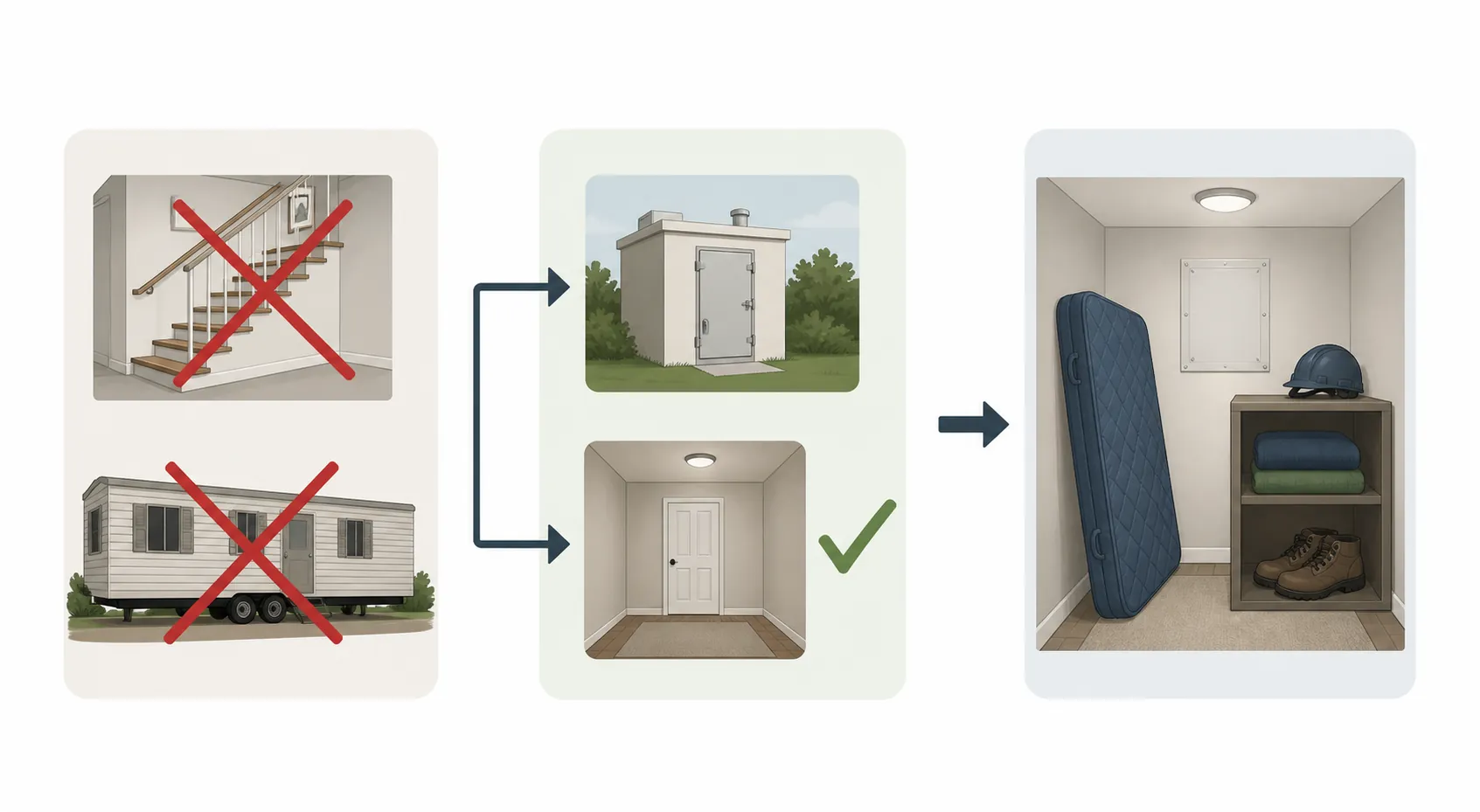
| 1. Remove false options | Cross off mobile homes during tornado warnings, stair routes the senior cannot use safely, rooms with windows, rooms against exterior walls when a better interior option exists, and spaces too small for the mobility device or caregiver. |
| 2. Choose the best reachable shelter | Prefer an accessible above-ground safe room if one exists. If not, choose a small interior windowless room on the lowest floor of a sturdy building. |
| 3. Make the space stay-able | Add seating or transfer support, head and body protection, sturdy shoes, lighting, communication, and enough clear floor space for the actual mobility device. |
| 4. Write the helper-and-route plan | Name who calls, who drives or walks over, which door they use, where the key is, and what happens if that person cannot come. |
Do not rank shelters only by wind resistance. Rank them by the best protection the person can reach without creating a second emergency on the way there.
Test the basement route as a fall-risk route, not as a weather idea
A basement is still a good shelter if the senior can get there reliably. The test should happen on an ordinary day, with the same walker, cane, shoes, glasses, lighting, and caregiver arrangement that would exist during a storm. If the person needs to rush to make the route work, the route does not work.
Walk the route slowly and notice the small failures: a walker left at the top of the stairs, a narrow turn at the landing, laundry stored on the steps, a basement light switch that is hard to reach, a handrail on only one side, a door that swings into the path, or a chair that is too low to rise from after sheltering. These are not minor details during a warning. They decide whether the person arrives safely.
A basement route is usually not a good primary plan when the senior cannot descend stairs without hands-on help, becomes dizzy or breathless on stairs, cannot carry needed equipment, or would be trapped below grade if the caregiver cannot get there. In that case, stop treating the basement as the plan and choose the safest reachable above-ground option.
If an accessible above-ground safe room exists, judge the doorway before the label
An above-ground safe room can be the strongest practical choice for a senior who cannot use stairs, but only when the room is truly accessible. FEMA’s safe-room guidance points to FEMA P-361 and ICC 500 for safe-room criteria, and FEMA also states that it does not certify or endorse safe-room products, designs, or installers.[4] That matters when families are comparing shelters online. A sales page is not the same thing as a verified safe-room standard.
For a limited-mobility plan, the first inspection is physical. Can the senior enter without stairs? Is the threshold low enough for the walker or wheelchair? Is the door wide enough in real use, not just on paper? Can the person turn around inside? Can a caregiver fit beside them without blocking the door? Is there a place to sit for the duration? Are the floor, lighting, and door hardware usable when the power is out or the person is anxious?
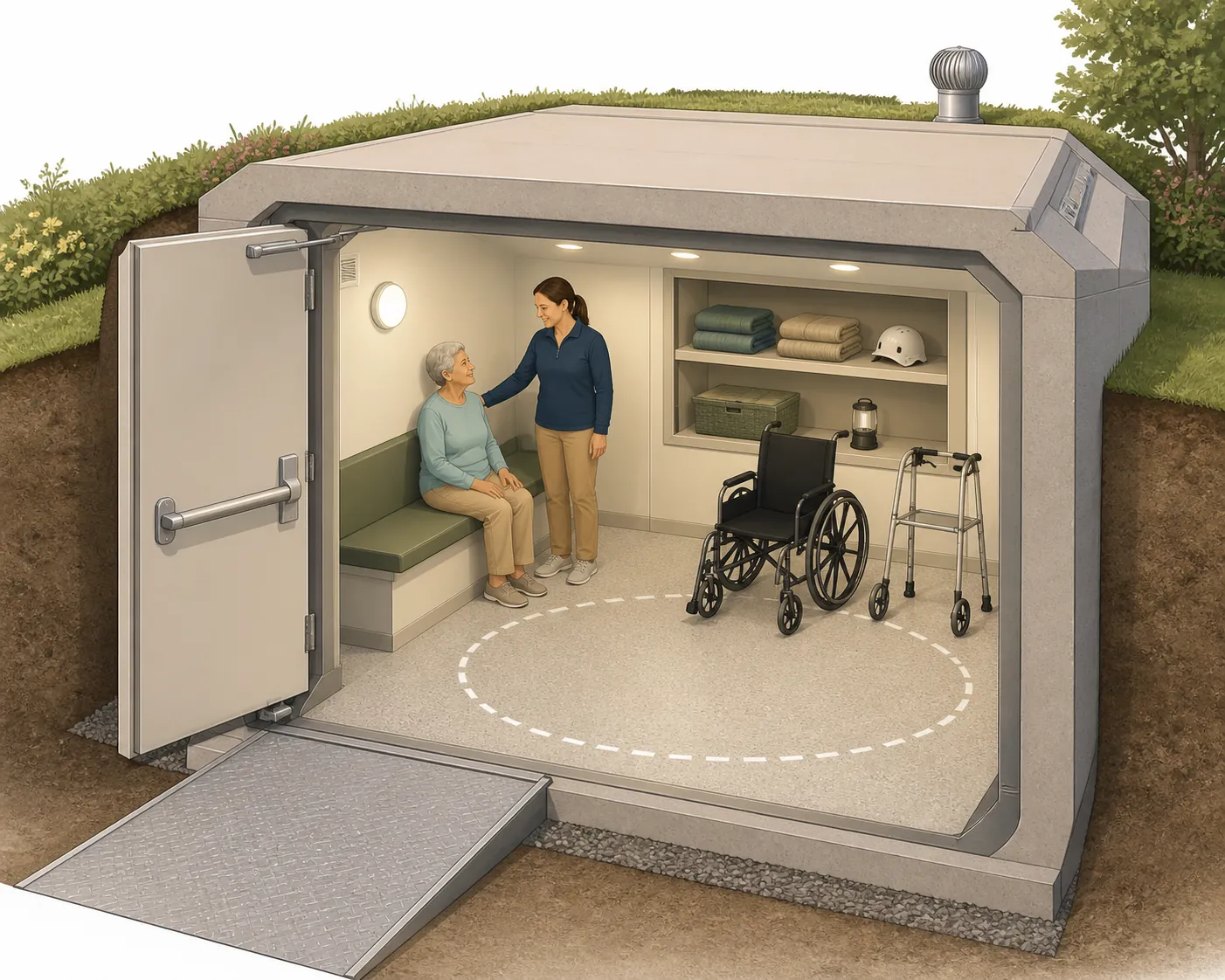
Shelter-industry accessibility guidance commonly emphasizes wider entries, turning space for mobility devices, caregiver room, slip-resistant flooring, seating, and lighting; use that kind of information as a practical checklist, not as proof that a product is certified or effective.[8] If a permanent safe room is being considered, the accessibility review belongs in the same conversation as the structural review.
FEMA notes that hazard-mitigation grant funding is administered through state and local emergency management agencies, not by a family applying directly to FEMA for a product purchase.[4] If cost, contractor selection, or remodeling scope is the next barrier, step out to a full project-planning resource instead of trying to solve that inside a storm warning. The CareWise guides to aging-in-place modification costs and payment options and choosing between a CAPS specialist and a general contractor are better places for that decision.
When there is no safe room or usable basement, choose the best small interior room
The fallback is not “any room downstairs.” It is a small interior windowless room on the lowest floor of a sturdy building, as close to the center of the structure as the home allows.[1][2] The room should be away from windows and, when there is a choice, away from exterior walls.
A bathroom may be a strong candidate when it is small, windowless, interior, and reachable. FOX Weather’s tornado-safety reporting notes that bathrooms can be favorable because plumbing inside the walls may add strength, and it also identifies interior closets and hallways as possible options when they are windowless and away from outside walls.[7] That does not make every bathroom safe. A bathroom with a window, an exterior wall, a narrow doorway, or a tight turn that traps a walker may lose to an interior closet or center hallway.
The room also has to close. A hallway that keeps the person away from glass may be better than a bathroom where the wheelchair blocks the door. A closet that looks protected may be unusable if the person cannot enter without backing in, folding the walker, or stepping over stored boxes. During planning season, clear the candidate room until the actual person and actual device fit.
A quick ranking for common interior-room choices
| Possible shelter | Use it when | Reject it when |
|---|---|---|
| Interior bathroom | It is windowless, on the lowest floor, reachable without stairs, large enough for the mobility device, and the door can close. | It has a window, sits on an exterior wall when a better interior option exists, has a tight doorway, or cannot fit the caregiver and device. |
| Interior closet | It is windowless, cleared out, central, and large enough for the person to enter without unsafe turning or transfers. | Stored items block entry, the floor is cluttered, the person would have to stand the whole time, or the door cannot close. |
| Center hallway | It is away from windows and exterior doors and is the only space that can fit a wheelchair, walker, or caregiver safely. | It exposes the person to glass, heavy loose objects, or traffic through exterior rooms. |
Make the chosen room stay-able before storm season
The shelter room should not become usable only after someone runs around the house collecting supplies. Prepare it as if the warning will come while the caregiver is across town and the senior is already tired.
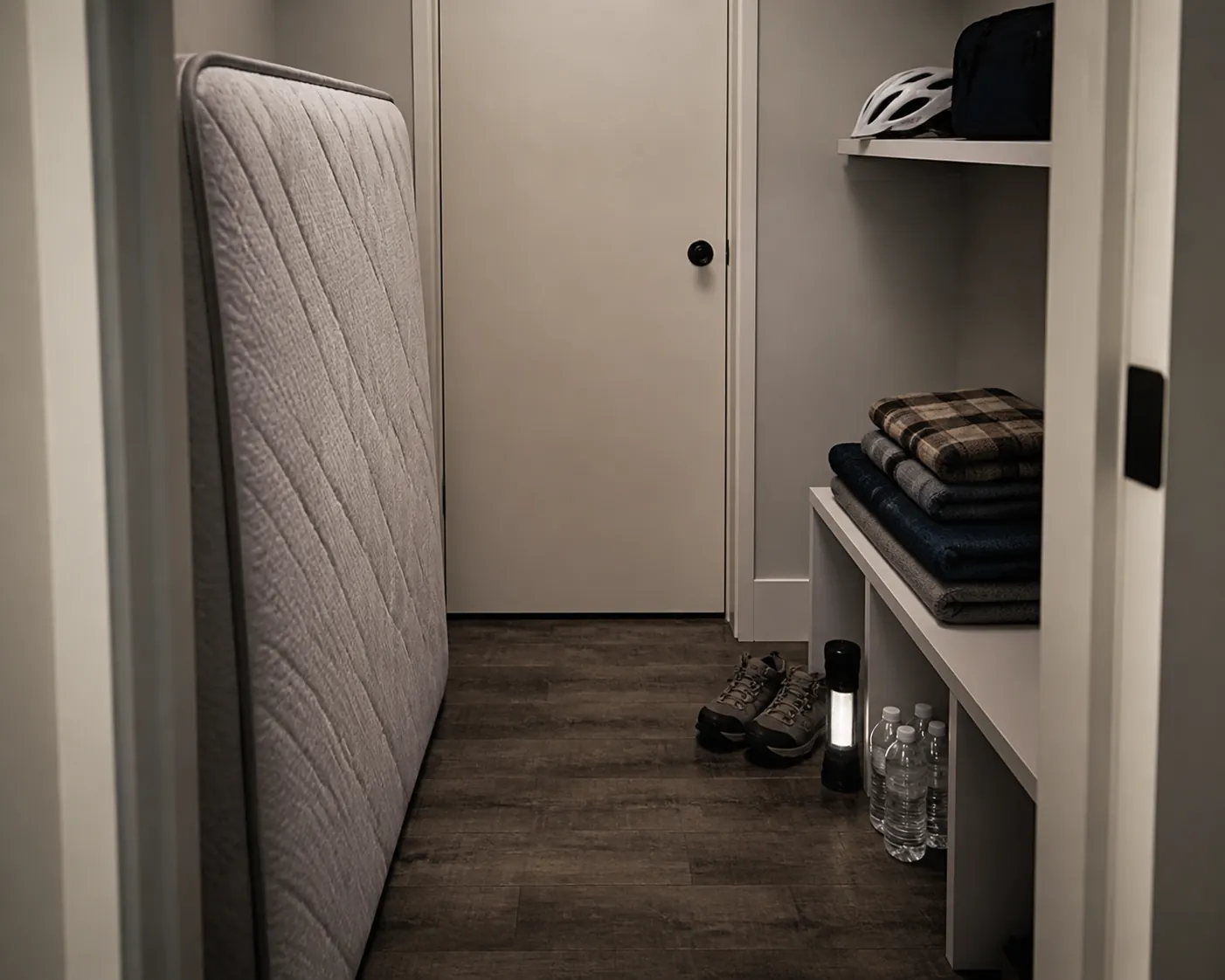
- Keep sturdy shoes in or next to the shelter space. Bare feet and post-storm debris are a bad combination.
- Store head and body protection there: a bicycle helmet, heavy blankets, pillows, or a small mattress that can be pulled over or against the person.
- Add a stable chair or bench if the person cannot sit on the floor and rise safely.
- Keep a flashlight or battery lantern within reach, not buried in a kitchen drawer.
- Leave the floor clear enough for the walker, wheelchair, commode chair, or caregiver stance the plan actually requires.
- Keep a charged phone, written emergency contacts, and essential communication instructions where the senior can reach them.
If the room is also a bathroom or closet, the tornado supplies need a permanent place. A helmet on a high shelf that the senior cannot reach is decoration. Shoes behind a hamper will not be found quickly. A mattress stored in another room may as well not exist if the person shelters alone.
Use home-modification planning to remove route hazards before adding new equipment. The room-by-room home modification priority guide and home-modification prioritization guide can help sort the boring but important fixes: clear hallway width, lighting, thresholds, loose rugs, bathroom door swing, and seating height.
Walker, wheelchair, and bed-bound plans are not the same plan
For a walker user
The route needs continuous clear width, good lighting, and no last-minute object moving. The shelter room should have a place to park the walker without blocking the door. If the person must sit, choose the chair now and test whether they can rise from it. A low stool or soft ottoman may create a fall risk after the storm passes.
For a wheelchair user
Do not assume a transfer. If the person normally remains in the wheelchair, the shelter must fit the wheelchair, the door must close, and a caregiver must be able to stand or sit without trapping the chair. Check the threshold, door swing, turning space, and whether the person can reach communication devices from the sheltered position.
For a bed-bound senior
A bed-bound plan usually has to happen earlier than a warning. If the person cannot be moved quickly and safely, the family should work with caregivers, clinicians as appropriate, building management if relevant, and local emergency management to decide whether relocation before severe weather is realistic. The written plan should name who has the authority and access to move the person, what equipment is required, and what the backup is if that helper is unavailable.
For all three scenarios, write the plan in plain language. “Go to interior bathroom” is not enough. Better: “When a tornado warning is issued, use the hall route from the recliner to the windowless hall bathroom. Put on the shoes already beside the bathroom door. Sit on the shower chair facing the interior wall. Pull the folded blanket over shoulders and use the helmet on the shelf. Daughter calls; neighbor has key code if no answer.”
Mobile homes need a different rule: leave before the warning
A mobile home should not be treated as another shelter option to adapt. The American Red Cross says mobile homes are not safe during tornadoes and advises identifying a safe place in a sturdy building ahead of time.[5] For a senior with limited mobility, that means the plan cannot depend on deciding where to go after the warning arrives.
United Spinal Association states that over roughly the past 21 years, 43% of U.S. tornado deaths occurred among people in mobile homes; that figure should be read as their reported statistic, not as a finding independently verified here.[6] It is still enough to underline the practical rule: if the home is mobile or manufactured and the person has limited mobility, identify the sturdy destination, transportation, helper, keys, and timing in advance.
The destination might be a neighbor’s site-built home, a community shelter, an accessible public building, or another location named by local emergency management. The plan should include the exact route from bed or chair to vehicle, where mobility equipment fits, who drives, and how early the person leaves when severe weather is possible. Use the Emergency Evacuation Plan Checklist for Elderly Parents to turn that into a named-helper handoff.
What the written shelter plan should say
A useful tornado emergency plan for seniors with limited mobility is short enough to follow and specific enough to survive stress. Put it on paper and keep a copy in the shelter space, near the usual chair or bed, and with the out-of-town caregiver.
- Primary shelter: the exact room or safe room, not a vague phrase like “inside room.”
- Backup shelter: what to do if the primary room is blocked, occupied, locked, or unreachable.
- Route: the path from the most common starting places — bed, recliner, bathroom, kitchen — to the shelter.
- Mobility equipment: walker, wheelchair, cane, transfer belt, portable oxygen, hearing aids, glasses, or other items the person actually uses.
- Helper: who calls, who comes in person, who has keys or codes, and who is backup.
- Shelter position: where the person sits or parks the wheelchair, how the door closes, and where head protection is stored.
- After-storm contact: who checks for injury, blocked exits, medication access, power loss, and water.
Out-of-state caregivers should not rely on memory or reassurance. Ask for a phone video of the route. Watch whether the walker turns easily, whether the bathroom door closes, whether the chair is already there, and whether the shoes and helmet are reachable. The person who lives in the home may be used to working around hazards. A tornado plan cannot depend on those workarounds.
Once the shelter choice is settled, connect it to the rest of the severe-weather plan: the tornado-warning checklist for watch-stage actions, the evacuation checklist for named helpers, and what seniors should do in the first 72 hours after a tornado for the recovery side.
Choose the best shelter the senior can genuinely reach. Prepare that space before storm season. Write down the route, helper, equipment, and backup. A perfect shelter that requires an unsafe staircase is not the plan; it is an obstacle.
References
- Preparing for a Tornado, CDC
- Tornadoes, Ready.gov
- Tornado-Related Fatalities — Five States, Southeastern United States, April 25–28, 2011, CDC MMWR
- Safe Rooms, FEMA
- Tornado Safety Tips, American Red Cross
- Tornado Preparedness for the Disability Community, United Spinal Association
- Tornado safety: How to identify the safest places inside your home, FOX Weather
- Storm Shelter Accessibility Features for Seniors & People With Disabilities, OKC Shelters
Related reading
Noticed something outdated or inaccurate on this page? Flag a correction. We review every report against CDC, NIA, and AARP HomeFit guidance before updating a page.
Part of the Fall Prevention section.