
STEADI: Intervene
Dust Storm Safety Checklist for Seniors with Lung Disease
A three-phase dust storm safety checklist for seniors with lung disease and the caregivers who plan for them: what to stock, arrange, and do before, during, and after a storm, with medication supply, indoor air, and symptom rules at the center. It fills the gap left by generic dust-storm guidance written for drivers and the general public rather than for older adults with COPD, asthma, or other respiratory conditions.
A dust storm plan has to start before the alert
A dust storm safety checklist for seniors with respiratory issues cannot stop at “stay indoors.” For an older adult with COPD, asthma, emphysema, chronic bronchitis, oxygen equipment, CPAP, or a rescue inhaler that is somehow always almost empty, the real plan begins days or months before the sky turns brown.
The visible wall of dust is only one part of the danger. The American Lung Association says dust can remain in the air from a few hours up to 10 days, and that older adults and people with lung disease are among those most at risk for lung irritation after a dust storm.[1] Serious storms can also drive PM10, the larger inhalable particle pollution used in dust-storm research, far above the World Health Organization’s 24-hour guidance level; one systematic review reported PM10 levels exceeding 6,000 µg/m3 in severe storms.[2]
Dust storms are most common in the U.S. Southwest, so this checklist is written with places like Arizona, New Mexico, West Texas, inland Southern California, and Southern Colorado in mind.[3] It is not a substitute for medical advice. It is a practical synthesis of dust-storm guidance, Valley fever prevention advice, respirator safety guidance, chronic-condition emergency planning, and power-outage preparation. The senior’s own clinician-approved action plan should overrule any generic checklist.

Printable three-phase checklist
Use this as the working copy: print it, put the clinician’s instructions in the blank spaces, and keep it where the person who answers the phone during an alert can actually find it.
| Phase | Caregiver action | Why it matters for a senior with lung disease |
|---|---|---|
| Before dust season | Turn on Wireless Emergency Alerts and local weather alerts. Write down which alert means “seal the house now.” | Generic dust-storm guidance is often aimed at drivers. A homebound or medically fragile senior needs warning early enough to close the house, start filtration, and contact a caregiver. |
| Before dust season | Ask the clinician for a written respiratory action plan: usual medication schedule, rescue medication rule, oxygen or CPAP instructions, symptom thresholds, and when to call 911. | The decision about “wait and watch” versus “call now” should not be made for the first time while someone is wheezing. |
| Before dust season | Arrange at least a 7–10 day prescription supply if the clinician and insurer allow it; note refill dates on the checklist. | CDC chronic-condition emergency guidance for wildfire smoke uses a 7–10 day prescription supply as a preparedness step, and dust storms create similar access and air-quality problems for people with lung disease.[4] |
| Before dust season | Ask whether an N95 respirator is appropriate. If yes, buy NIOSH-approved N95s in the correct size and practice putting one on. | NIOSH advises people with heart or lung conditions to ask a doctor before using a respirator, and to remove it if they feel dizzy, lightheaded, or have trouble breathing.[5] |
| Before dust season | Prepare indoor-air control: working HVAC, clean filters, portable HEPA air purifier if available, and a room that can be kept closed. | The American Lung Association recommends staying inside, closing doors and windows, and setting air conditioning to recirculate during a dust storm.[1] |
| Before dust season | For oxygen, CPAP, nebulizer, or other powered equipment, confirm backup power and emergency contacts. If appropriate, register medical equipment with the utility company and local emergency services. | Power and equipment planning is a separate safety layer; the American Lung Association advises registering home medical equipment, arranging backup oxygen that does not require electricity, and never changing oxygen flow without provider approval.[6] |
| Before dust season | Write the support network: nearby caregiver, out-of-town contact, pharmacy, clinician, oxygen supplier, equipment company, utility, and transportation backup. | A plan that lives only in one person’s head fails as soon as that person is at work, driving, sick, or unreachable. |
| During the storm | Shelter indoors. Close windows and doors. Keep outdoor air out. Run AC on recirculate if using AC. | This is the core dust-storm instruction from lung-health guidance, and it matters more for someone whose lungs are already working hard.[1] |
| During the storm | Avoid outdoor errands, yard checks, mailbox trips, and “quick” walks to the car. If exposure is unavoidable and the clinician has cleared respirator use, wear a fitted NIOSH-approved N95. | CDC Valley fever prevention guidance recommends staying inside during dust storms and using a properly fitted N95 when dusty exposure cannot be avoided.[7] |
| After the visible dust passes | Keep filtration and closed-window habits in place until local air quality and symptoms are back to the person’s usual baseline. | Dust can linger for hours to 10 days, so the after phase is not optional.[1] |
| After the visible dust passes | Monitor breathing, cough, wheeze, chest tightness, oxygen levels if the clinician uses them, medication use, fatigue, and confusion. Follow the action-plan rule for new or worsening symptoms. | The American Lung Association advises contacting a healthcare provider for new or worsening respiratory symptoms after dust exposure.[1] |
Before: do the boring work while breathing is stable
The before phase deserves the most attention because it is where caregivers can remove the miserable little failures that make a bad-air day worse: the empty inhaler, the missing oxygen supplier number, the HVAC setting no one remembers, the mask bought in the wrong size, the CPAP battery question that nobody wanted to deal with.
AARP’s emergency-preparedness reporting found that about 1 in 3 adults age 50 and older had no extra prescription medicine, even though about 60% felt prepared for an emergency.[8] That gap is exactly where a caregiver checklist earns its place on the refrigerator. Feeling prepared does not help much when the pharmacy is across town, the air is unhealthy, and the person who needs the refill should not be walking through dust to get it.
Put the clinician’s action plan at the center
The action plan should be specific enough that a different caregiver could use it. “Call if breathing gets worse” is too vague. A useful plan says what the senior normally takes, what rescue medication is allowed, what symptoms change the plan, whether oxygen saturation is being tracked, and when to call the clinician, urgent care, or 911.
For a senior with COPD or asthma, this conversation should include the dust-storm scenario directly: “If there is a dust alert and she starts using her rescue inhaler more often, what is the rule?” “If he is coughing more the next morning, do we call that day?” “If the power goes out and the concentrator stops, what is the backup oxygen plan?” The goal is not to turn the caregiver into a clinician. It is to stop asking medical questions for the first time during the emergency.
If the household is also reviewing broader chronic-condition home planning, it can help to keep the dust-storm sheet with other caregiver safety notes, the same way you would keep medication lists and home-risk notes together when planning safety for a parent with a chronic condition.
Medication supply is not a footnote
For dust-storm planning, the most practical medication target is a 7–10 day supply of prescriptions, rescue inhalers, nebulizer medication if prescribed, and other clinician-directed respiratory supplies. CDC guidance for people with chronic conditions during wildfire smoke recommends having a 7–10 day supply of prescription medicines; this is an analog, not a dust-storm-specific rule, but the access problem is familiar: bad air can make a trip to the pharmacy unsafe.[4]
The American Red Cross recommends that older adults prepare at least a 30-day supply of medications for emergencies, which is a broader emergency baseline.[9] Insurance limits, controlled medications, refill timing, and mail-order delays can complicate that. The caregiver’s job is to ask early, not to discover the limit after the alert arrives.
- Check the expiration date and remaining doses on rescue inhalers.
- Keep a current medication list with dose, schedule, pharmacy, prescriber, and refill date.
- Ask the pharmacy what early-refill or emergency-refill options exist before dust season.
- Keep spacer devices, nebulizer cups, tubing, batteries, and cleaning supplies with the medication plan if the clinician has prescribed or recommended them.
- Write down which medication change, if any, is allowed during worsening symptoms. Do not improvise dose changes.

Be careful with N95 advice
A well-fitted N95 can reduce inhaled dust when exposure cannot be avoided, and CDC Valley fever prevention guidance includes wearing a properly fitted N95 during unavoidable dusty activities.[7] That does not mean every senior with lung disease should casually put one on and walk outside.
CDC NIOSH guidance is the piece people skip: anyone with a heart or lung condition should ask a doctor before using a respirator, and a respirator should be removed if the person becomes dizzy, lightheaded, or has trouble breathing.[5] For someone who already gets short of breath crossing the room, “wear a mask” is not complete advice.
| Respirator question | What to decide before a storm |
|---|---|
| Is an N95 medically appropriate? | Ask the clinician specifically. Note the answer on the checklist. |
| Which respirator? | Use NIOSH-approved N95 respirators, not a loose cloth mask or decorative face covering for dust protection. |
| Can the senior get a seal? | Facial hair, face shape, straps, dexterity, and confusion can all interfere with fit. |
| When should it be used? | Only for unavoidable exposure, such as getting into a vehicle for urgent care, unless the clinician gives different instructions. |
| When should it come off? | If the person feels dizzy, lightheaded, or has more trouble breathing. |
Choose the cleanest room, not the prettiest one
The cleanest room is usually the one with the fewest leaks to the outside, the door that closes well, and the air purifier or HVAC supply that can run reliably. It may not be the favorite chair room. Decide that now, because nobody wants to negotiate room choice while the sky is dark and a parent is already anxious.
- Replace or check HVAC filters before dust season according to the system’s instructions.
- Know how to set the system to recirculate, if that option exists.
- If using a portable HEPA air purifier, place it in the room where the senior will shelter and keep replacement filters available.
- Keep windows and exterior doors closed; avoid using fans that pull outdoor air inside.
- Avoid indoor particle sources during the event, such as smoking, burning candles, or frying food.
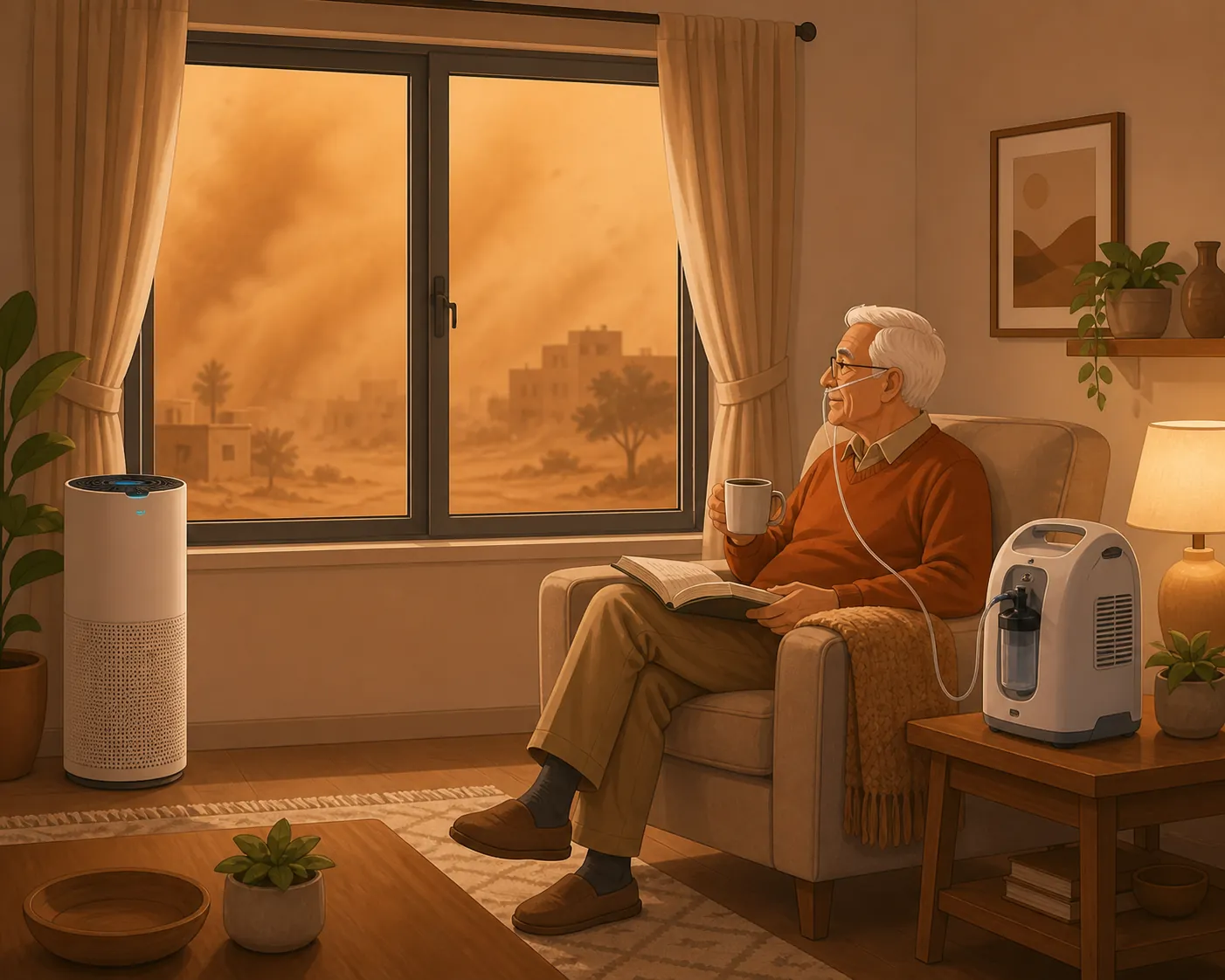
Oxygen, CPAP, and power need their own line on the checklist
Respiratory equipment turns a dust-storm plan into a logistics plan. The American Lung Association advises people who use home medical equipment to register with the electric company and local fire or police departments where appropriate, arrange backup oxygen that does not require electricity, and never reduce oxygen flow rate without the provider’s approval.[6]
If the senior uses CPAP for sleep apnea, the dust-storm plan should include the same power and cleaning questions as the oxygen plan: what happens if power fails, where are filters and tubing kept, who calls the equipment company, and whether the machine should be used differently during congestion or worsening breathing. Older adults using PAP therapy already face enough missed diagnoses and equipment confusion, especially women whose symptoms may not match the stereotype; keep dust-storm equipment instructions with the rest of the sleep apnea and CPAP planning notes.
Generators belong outdoors only. The American Lung Association warns that generators, camp stoves, and grills can create carbon monoxide risk and should not be run inside, including in a garage.[6] A backup-power plan that creates a carbon monoxide emergency is not a backup plan.
During: protect indoor air and do less
During the storm, the plan should become blunt. Get inside. Keep the senior inside. Close windows and doors. Set air conditioning to recirculate if the system allows it. Run the prepared air purifier in the shelter room. Do not send anyone outside for the mail, trash bins, patio cushions, or a quick look at the sky.
If the senior is away from home when an alert arrives, the safest next step depends on location, symptoms, transportation, and the clinician’s plan. The general principle is still the same: reduce dust exposure quickly. Get into a building or vehicle with windows closed and outside air limited. If a respirator has been cleared by the clinician and exposure is unavoidable, use the NIOSH-approved N95 as practiced.
| Do during the storm | Avoid during the storm |
|---|---|
| Move to the cleanest prepared room. | Opening doors repeatedly to check conditions. |
| Keep medications, phone, water, and action plan within reach. | Outdoor chores, errands, or walking to a neighbor’s house unless urgent. |
| Use prescribed oxygen, inhalers, CPAP, or nebulizer exactly as directed. | Changing oxygen flow or medication dose without the provider’s instruction. |
| Call for help according to the written symptom rule. | Waiting for the sky to clear if breathing is clearly getting worse. |
This is also when the support network matters. A caregiver who lives across town can still call to make sure the HVAC is on recirculate, the rescue inhaler is nearby, the oxygen backup is where it should be, and the senior has not decided to “just step outside for a minute.” The person inside the house should not have to remember every detail alone.
After: the brown wall may be gone, but the lungs are still keeping score
The after phase is where generic dust-storm advice often gets too thin. Visibility improves, traffic moves again, and everyone wants to open the windows. For a senior with lung disease, that may be too early. Dust can linger in the air for hours to 10 days, so the household should keep treating the event as an air-quality problem after the dramatic part has passed.[1]
Keep the clean-room setup going until local air quality information, visible conditions, and the senior’s symptoms have returned to their usual baseline. Continue medications as prescribed. Replace or check filters if the storm loaded them with dust. Wipe surfaces with methods that do not send dust back into the air. If cleanup has to happen outside, do not assign it to the person with lung disease.
Watch for symptoms that are new, worse, or unusual for that person
The American Lung Association advises contacting a healthcare provider for any new or worsening respiratory symptoms after dust exposure.[1] That instruction is simple, but caregivers need to translate it into the senior’s real baseline. Some people cough every morning. Some are always a little short of breath. The question is what changed after the dust.
- More shortness of breath than usual.
- New or worsening wheeze, cough, chest tightness, or chest discomfort.
- Need for rescue medication more often than the written plan allows.
- Lower oxygen readings, if the clinician has told the household to monitor them.
- Unusual fatigue, confusion, bluish lips or fingers, fainting, or severe distress.
- Fever, persistent cough, or symptoms that do not follow the person’s usual pattern.
The last point deserves care in the Southwest. CDC Valley fever prevention guidance is one reason dust avoidance matters; the agency notes that adults over 60 are at higher risk for severe Valley fever, and it recommends staying inside during dust storms, closing windows, using indoor air filtration, and wearing a fitted N95 when dust exposure is unavoidable.[7] That does not mean every cough after a dust storm is Valley fever. It means persistent or concerning symptoms should be handled through the clinician’s rule, not shrugged off as “just dust.”
Reset the kit before the next alert
After the storm, the caregiver job is not finished until the supplies are reset. Refill what was used. Replace a respirator that was worn or damaged. Check whether the air purifier filter needs attention. Put the action plan back in its place. Add a note if anything failed: the alert did not wake anyone, the concentrator cord did not reach the clean room, the pharmacy number was wrong, or the senior could not tolerate the N95.
The American Red Cross recommends reviewing emergency plans every six months.[9] For a household managing lung disease in dust country, that review should also happen after any storm that exposed a weak spot.
What to write on the one-page plan
A one-page dust-storm plan is more useful than a perfect binder nobody opens. Keep it plain. If the senior has more than one caregiver, use the same sheet in every home, car folder, and medication notebook.
| Line on the plan | Fill in |
|---|---|
| Main diagnosis and baseline | COPD, asthma, emphysema, chronic bronchitis, oxygen use, CPAP use, usual symptoms, usual oxygen reading if monitored. |
| Daily respiratory medications | Medication name, dose, timing, prescriber, pharmacy. |
| Rescue medication rule | Exactly when to use it, maximum use allowed, and when to call. |
| Dust alert action | Who calls, who closes the house, who checks equipment, who confirms medications. |
| Cleanest room | Room name, purifier location, HVAC setting, supplies stored there. |
| Respirator decision | Clinician says yes or no; type and size; when to use; when to remove. |
| Oxygen or CPAP plan | Backup power, backup oxygen, supplier number, utility registration, emergency instructions. |
| After-storm symptom rule | Which symptoms mean call clinician, urgent care, or 911. |
| Support network | Nearby caregiver, backup caregiver, out-of-town contact, transportation help, neighbors if trusted. |
| Last reviewed | Date, changes made, next review date. |
For seniors with lung disease, dust-storm safety is a loop: supplies and support before, indoor-air protection during, and symptom rules afterward. The next useful step is small and concrete: ask the clinician for the written respiratory action rule, then build the rest of the checklist around it.
References
- Dust Storms, American Lung Association, updated July 25, 2025.
- The effects of dust storms on human health: A systematic review and meta-analysis, Aghababaeian et al., 2021.
- Dust Storm Safety, National Weather Service.
- Wildfire Smoke and People with Chronic Conditions, CDC.
- Community Respirators and Masks, CDC NIOSH.
- Power Outages and Lung Health, American Lung Association, July 2025.
- Valley Fever Prevention, CDC, April 2024.
- Preparing for an Emergency, AARP, 2023.
- Emergency Preparedness for Older Adults, American Red Cross.
Related reading
Noticed something outdated or inaccurate on this page? Flag a correction. We review every report against CDC, NIA, and AARP HomeFit guidance before updating a page.
Part of the Fall Prevention section.