
STEADI: intervene
Make Your Typhoon Plan Fall-Safe for Seniors Living Alone
A typhoon preparedness checklist for seniors living alone must go beyond standard supplies—it needs to address the fall hazards that appear when power fails, paths are cluttered, and no one is home to help. This guide focuses on preventing those post-storm falls with a room-by-room plan.
The lights go out, and the house changes immediately. The bed is in the same place. The bathroom is in the same place. But the rug edge near the doorway has curled, the chair that was moved “just for now” is still half in the path, the flashlight is across the room, and the walker is not where the hand reaches for it.
That is where a typhoon preparedness checklist for elderly people living alone has to begin: not with a neat pile of supplies, but with the first dark walk after power fails. For an older adult living alone, the storm danger often turns into fall danger—darkness, wet floors, displaced furniture, debris, and the small impulse to hurry before something gets worse. Preparedness that ignores those details is not finished.
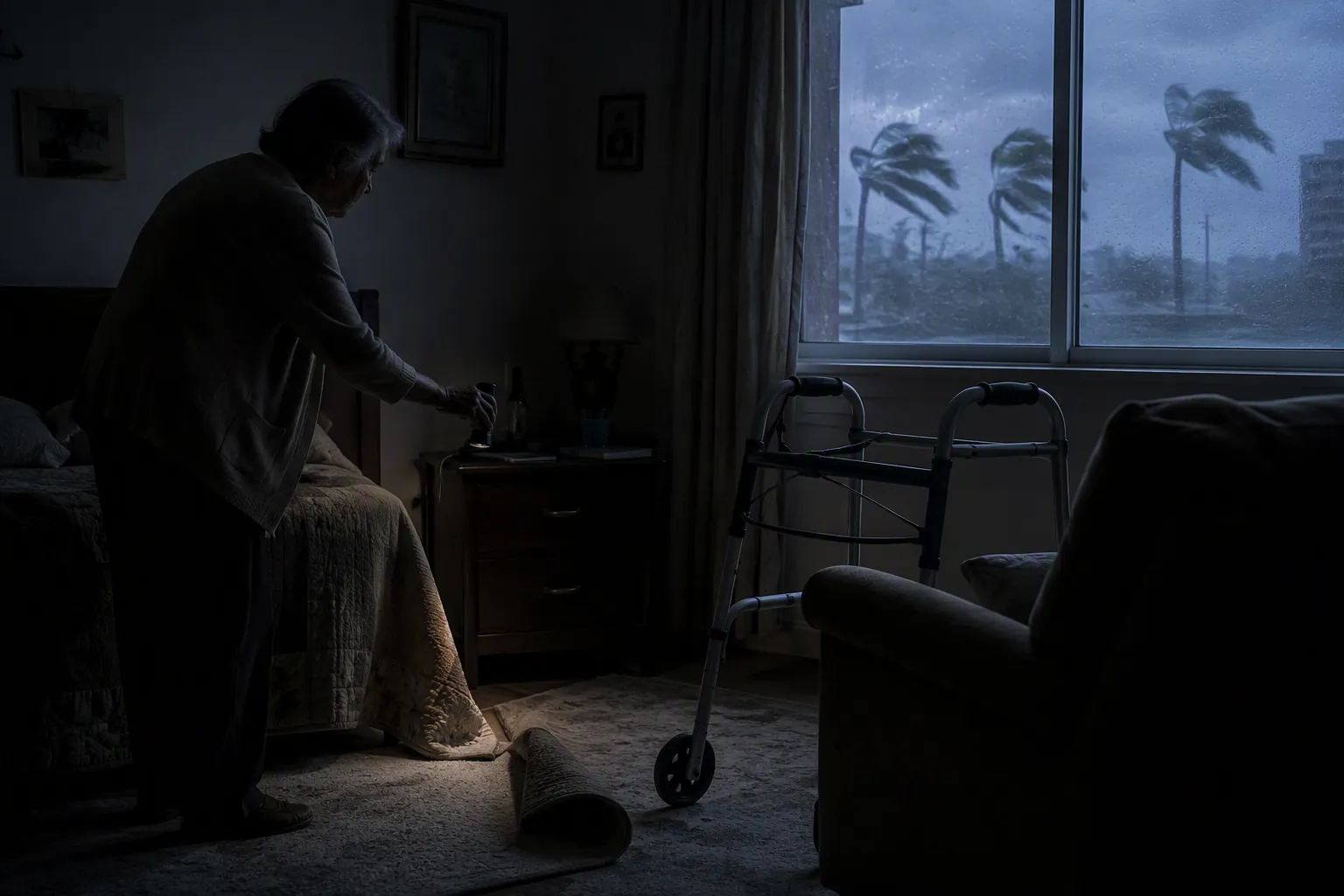
Many U.S. preparedness sources use “hurricane” rather than “typhoon.” The storm basin changes the word, not the household problem. If a powerful tropical storm can cut power, flood an entryway, block roads, or force an evacuation decision, the home plan needs to make walking, reaching, calling, and using the bathroom safer before the weather arrives.
This article is educational, not medical, legal, or evacuation advice. Medication plans, oxygen or powered-equipment needs, evacuation timing, and medical-priority power programs should be confirmed with clinicians, local emergency management, utility providers, and official storm instructions.
Start with the walking route, then add the supplies
A standard emergency kit still matters. Water, shelf-stable food, batteries, a radio, copies of documents, chargers, pet supplies, and basic first aid should not be skipped. But for a senior living alone, the question is not only “Do you have it?” It is “Can you reach it safely when the room is dark, humid, noisy, and you are tired?”
Keystone Health recommends pre-storm steps such as placing flashlights in every room and removing or taping down rugs, specifically because simple household features become fall hazards when storms disrupt normal movement.[1] Happier at Home also points to post-storm conditions—debris, downed power lines, darkness, and wet surfaces—as fall-risk situations, with special concern for the first 72 hours after the storm.[2]
| When | Main fall-safety job | What must be reachable without stretching, climbing, or searching |
|---|---|---|
| Before the storm | Clear and test the routes used most often: bed to bathroom, chair to kitchen, bedroom to exit | Flashlights, phone, medication, water, mobility aid, shoes, glasses, emergency contacts |
| During the storm | Stay positioned in the safest practical room with a clear bathroom route | Call device or landline, medication, water, mobility aid, flashlight, radio or alerts |
| First 72 hours after | Treat the home as newly hazardous until light, floors, doors, and paths are checked | Flashlight, sturdy footwear, phone, spare key contact, cleanup help, official instructions |
The table is short because the work is physical. The plan has to be walked, not just written.
The pre-storm walkthrough: do it in the rooms that actually get used
Do the walkthrough before the wind starts, while there is still daylight and patience. If an adult child, neighbor, aide, or friend is helping, the older adult should lead the route. The helper may notice clutter, but the person who lives there knows the real routine: which side of the bed they stand on, where the hand goes first, which chair they use to put on shoes, and which doorway they brush against when they are half-awake.
Walk the home as if it is 2 a.m. and the power is out. No stepping over laundry baskets. No squeezing between a chair and a table. No “I’ll remember that box is there.” If something would require a sidestep in the dark, it needs to move.
Bedroom: make the first stand-up safer
The bed area deserves more attention than most checklists give it. Many storm injuries at home do not begin with dramatic damage; they begin with standing up without light, shoes, glasses, or the usual support.
- Put a flashlight on the nightstand, not in a drawer across the room. If grip strength is limited, choose one with a large switch.
- Place glasses, hearing aids, phone, charger or power bank, water, and needed nighttime medication within easy reach.
- Position the walker, cane, or rollator on the side of the bed where the person actually gets up. Do not park it at the foot of the bed where it can become an obstacle.
- Remove loose slippers that slide. Put sturdy, closed-back shoes where feet can find them without bending far.
- Clear the line from bed to door. A laundry hamper, fan, oxygen tubing, extension cord, pet bed, or spare dining chair can become the thing that changes the night.
If the home uses night-lights, assume they may fail when power fails. Battery-operated or rechargeable motion lights can help, but they still need to be placed where they illuminate the floor, not just the wall.
Bathroom route: remove the little hazards that wait for bare feet
The path from bed to bathroom should be treated as an emergency route. It is used when the person is sleepy, rushed, or worried about leaks and storm noise. That is not the time to discover a throw rug has bunched up.
- Remove small rugs where possible. If a rug must stay, tape it flat on all edges before the storm.
- Move trash cans, scales, hampers, and decorative stands out of the walking line.
- Keep toilet paper, hygiene items, wipes, and towels at waist height. No reaching into high cabinets during a power outage.
- Place a flashlight or battery light where it can be reached before entering the bathroom, not after crossing a wet tile floor.
- Check that grab bars, raised toilet seats, shower chairs, and nonslip mats are secure if they are already part of the person’s routine.
This is also the right place to think about water. If a toilet must be flushed with stored water or if washing water is set aside in buckets, do not put heavy containers where they have to be lifted, dragged, or stepped around at night.
Kitchen and eating area: supplies should not turn into clutter
FEMA’s basic emergency guidance uses a minimum three-day supply of essentials as a starting point.[3] For an older adult living alone, that short kit should be stored like a fall-prevention tool: visible, reachable, and not blocking the route to the sink, refrigerator, bathroom, or exit.
Put the most-used storm supplies between knee and shoulder height, with the heaviest items closer to waist level. A case of water on the floor can be a tripping hazard. A case of water on a high shelf can invite unsafe reaching. Split heavy supplies into smaller containers if that makes them easier to handle.
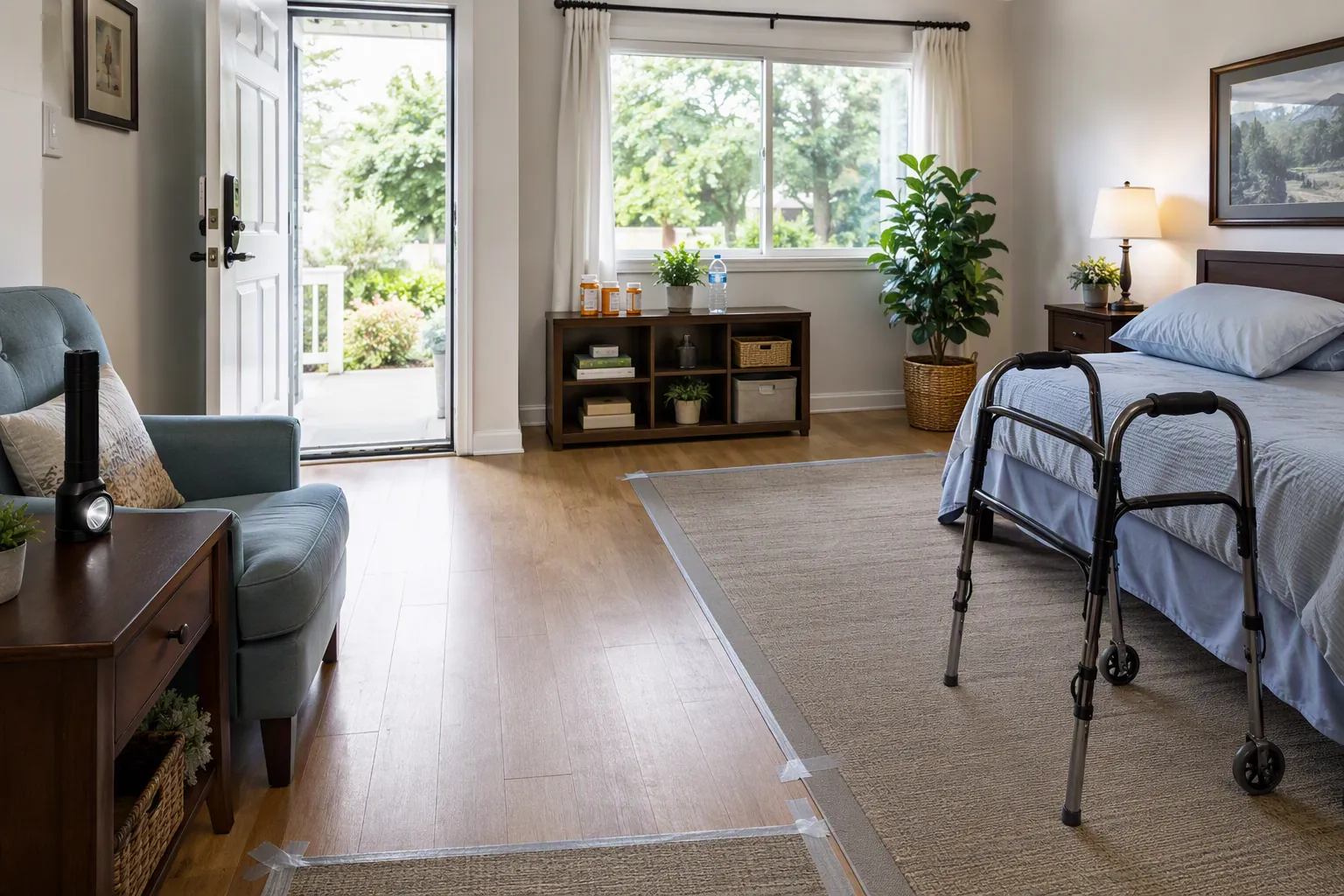
- Keep shelf-stable food where it can be opened without climbing on a step stool.
- Put a manual can opener with the food, not in a crowded drawer.
- Store water in several reachable places rather than one heavy stack.
- Keep a flashlight in the kitchen even if there is one in the bedroom.
- Leave the main kitchen walkway empty. Storm supplies lined along the floor are not ready; they are obstacles.
The Red Cross advises older adults to plan for a 30-day supply of medications and at least two weeks of staying home, which is a much more realistic continuity plan for someone who may not be able to drive, stand in a long pharmacy line, or restock immediately after a storm.[4] That does not mean every bottle belongs on the counter. It means medication storage should be reviewed before storm season with the prescriber and pharmacist, then placed where the older adult can reach it safely.
Living room: anchor the ordinary things
The living room often becomes the storm room because it has a favorite chair, a television, a side table, and room for a walker. It also collects the hazards people stop seeing: cords, ottomans, magazine baskets, low tables, plant stands, and rugs.
Before the storm, tape down or remove loose rugs, secure cords against the wall, and move low furniture out of the route between the chair, bathroom, bedroom, and exit. Keystone Health includes removing or securing area rugs and placing flashlights in every room among low-cost pre-storm interventions for seniors.[1]
If the older adult uses a recliner, check whether it can be operated safely during an outage. A power recliner that traps someone in a difficult position is not a comfort item during a storm. Keep a straight-backed chair available if that is safer for standing.
Entryway and exit path: assume water will find the floor
The entryway needs two jobs: it has to support evacuation if officials instruct it, and it has to keep the person from slipping if wind-driven rain, tracked-in water, or minor leaks reach the floor. A mat that slides is worse than no mat. Umbrellas, shoes, and bags should not sit in the walking line.
- Place sturdy shoes, identification, keys, emergency contact list, and needed assistive items near the exit but not on the floor in the path.
- Keep a towel within reach for small indoor wet spots, but do not expect the older adult to manage large leaks alone.
- Make sure the door can open fully without hitting stored supplies.
- If a walker or wheelchair is used, test the turn at the door with the storm supplies in place.
A packed evacuation bag that blocks the door is not preparedness. Put it on a chair, shelf, or stable surface where it can be reached without bending low or stepping around it.
The support network is part of the safety equipment
“Call your daughter” is not a complete plan if the daughter loses power, cannot get through, or lives beyond flooded roads. The Red Cross and Ready.gov both emphasize a support network for older adults, including family, neighbors, friends, and caregivers, with someone who has access to the home and knows where emergency supplies are stored.[4][5]
Redundancy is not overreacting. The Conversation’s 2025 guidance for seniors living alone recommends a multi-person check-in system rather than depending on only one caregiver.[6] That matters most when the first contact is also dealing with the storm.
Write the check-in plan in plain language and put copies where they will be seen: near the main phone, inside the emergency kit, and with the person who holds the spare key.
- Name at least two people who will check in before, during, and after the storm if communication is available.
- Name one person nearby, if possible, who can physically check the home when it is safe to do so.
- Give a spare key or access instructions to a trusted person, not to “whoever can come.”
- Share the location of medication, mobility aids, emergency supplies, shutoff information, and medical equipment.
- Decide what happens after a missed check-in: who calls next, who contacts emergency services, and who does not attempt unsafe travel.
For older adults who use powered medical equipment, mobility equipment, oxygen, refrigerated medication, or other time-sensitive supports, the network should also know which clinician, pharmacy, equipment supplier, utility program, or local emergency office to contact. Keystone Health notes pre-registration for medical priority power restoration as one preparedness step for eligible seniors.[1]
During the storm, shrink the home
Once conditions worsen, the goal is not to keep using the whole house. The goal is to make the safest practical area small, clear, and well supplied. Local officials should guide evacuation and sheltering decisions. The National Council on Aging recommends that older adults prepare for both sheltering in place and evacuation, and practice both plans before a disaster.[7]
If sheltering in place is the official and practical choice, set up the main sitting or resting area before the storm peaks. The bathroom route should already be clear. The phone should not be charging across the room. The walker should not be parked near the door “out of the way.” Out of the way often means out of reach.
- Keep a call device, charged phone, or landline within arm’s reach of the main seat or bed.
- Keep medication, water, glasses, hearing aids, flashlight, and emergency contacts at the same reachable station.
- Place the cane, walker, or rollator where the person can stand and take hold of it without twisting.
- Do not move furniture into the bathroom route to protect windows or store supplies.
- Use official alerts by radio, phone, or local emergency channels, but do not cross a dark room repeatedly just to check updates.
A good during-storm setup looks almost boring: light, phone, water, medication, bathroom path, mobility aid. Boring is fine. Boring is what lets someone get through the night without improvising.
For more detail on the power-loss side of this problem, see the Power Outage Fall Prevention Checklist for Seniors. The same dark-room hazards show up in typhoon preparation, only with water, debris, and delayed help added.
After the wind passes, do not let cleanup become the emergency
The house can feel safer once the loudest weather has moved on. That feeling is not proof that the floor is safe, the porch is clear, or the street is passable. Happier at Home identifies the first 72 hours after a hurricane as a particularly dangerous window for seniors because debris, downed power lines, wet surfaces, and darkness can increase fall risk.[2]
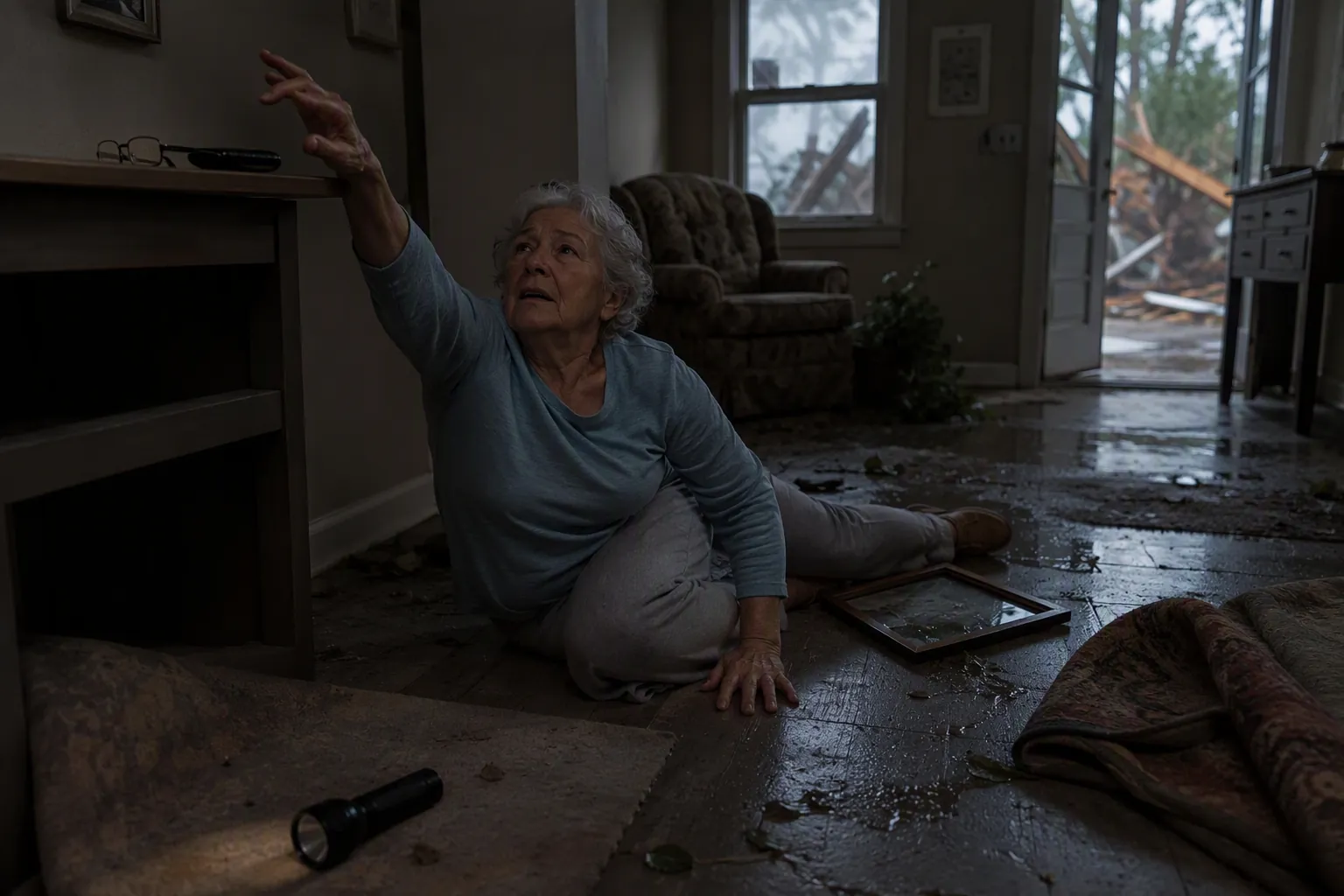
This is the part of the plan that too many lists rush past. The storm kit may have been perfect, and the fall can still happen when someone sees a branch against the door, a puddle near the entry, or a picture frame on the floor and thinks, “I’ll just move that.”
The first post-storm rule is to pause long enough to see. Use a flashlight even in daytime if the room is dim. Put on sturdy shoes before walking through any area where glass, wet flooring, splinters, or displaced objects may be present. Use the mobility aid even for “just a few steps.” Short trips are where people cheat their own safety rules.
Check the inside before the outside
The older adult living alone should not be the first cleanup crew. Before opening doors, lifting objects, or stepping onto a porch, check the indoor routes that are needed for basic living.
- From the bed or main chair, check the floor for shifted rugs, cords, fallen items, and water.
- Check the bathroom route next. If it is blocked or wet, call a support person before trying to fix it alone.
- Check that medication, water, phone, glasses, and mobility aid are still reachable.
- Check the kitchen only as far as needed for safe food, water, and medication access.
- Check the entryway last, and do not go outside until official guidance and visible conditions make it safe.
Downed power lines, unstable branches, loose railings, broken steps, and standing water are not household chores for a tired person with a flashlight. They are reasons to wait, call, and use the support network.
Wet floors need a plan before they need a mop
A small towel near the entry can help with minor dampness. A spreading leak, soaked rug, or slippery tile is different. The older adult should not have to drag wet rugs, wring towels, carry buckets, or bend repeatedly while alone after a typhoon.
If water is present in a walking path, the next action should be based on safety, not pride. Sit down in a safe spot, call a named contact, and wait if waiting is the safer choice. If the bathroom route is affected, that is urgent enough for the support plan to activate.
Do not reorganize the home in the dark
After a storm, people move things. A neighbor may bring in a cooler. A family member may shift a walker while checking a window. A caregiver may stack towels by the hall. Every moved object should be put back with the older adult’s walking pattern in mind.
That means the walker returns to the side of the bed or chair. The flashlight returns to the reachable table. Medication does not get placed on a high shelf “so it won’t get wet” unless the person can still reach it safely. Supplies should be restocked without narrowing the path.
What belongs on the checklist
A useful checklist for seniors living alone should be organized around what the person must do in the home, not around what a store sells in the emergency aisle.
| Checklist item | Fall-safe placement or action |
|---|---|
| Flashlights | One in every room used during the storm; reachable from bed, bathroom route, kitchen, and main chair |
| Medication | Reviewed with clinician or pharmacist; stored at reachable height; enough continuity planning for delayed restocking |
| Water and food | Split into manageable containers; stored off the walking path and not on high shelves |
| Phone, landline, chargers, power bank | Within arm’s reach of resting area; emergency contacts printed nearby |
| Walker, cane, rollator, wheelchair | Parked where the person stands up; never moved to make room for supplies |
| Rugs and mats | Removed or taped flat before the storm; wet rugs treated as hazards after the storm |
| Bathroom route | Cleared, lit, and tested from the bed in low light |
| Entry and exit path | Clear enough for mobility equipment; bag and shoes reachable without blocking the door |
| Support network | Multiple contacts, spare key holder, shared supply locations, missed-check-in plan |
| Evacuation and shelter-in-place plans | Based on local official instructions; practiced before storm season |
The checklist should be printed in large enough type to read without hunting for glasses, though the glasses should still be reachable. Keep one copy near the phone, one in the emergency supply area, and one with the spare-key contact.
The final walk-through test
Before calling the plan finished, test it once in daylight and once in low light if that can be done safely. Start from the bed. Reach for the flashlight. Stand with the usual support. Find the walker or cane. Walk to the bathroom. Return to the main chair. Reach the phone, medication, water, glasses, shoes, and emergency contacts. Check the path to the exit.
Nothing should require stepping over a cord, moving a chair, bending around a box, climbing for a bottle, or searching a dark drawer. If the person cannot reach light, phone, medication, water, bathroom, mobility aid, and exit path without improvising, the checklist is not finished.
A typhoon plan for an older adult living alone is only as good as the first dark walk it makes safer.
References
- Emergency Preparedness for Seniors — Keystone Health, 2025
- Hurricane Preparedness for Seniors — Happier at Home, 2024
- Build A Kit — Ready.gov
- Older Adults Emergency Preparedness — American Red Cross
- Older Adults — Ready.gov
- Multi-person check-in system with redundancy for seniors living alone — The Conversation, Williams, 2025
- Emergency Preparedness 101 — National Council on Aging
Related reading
Noticed something outdated or inaccurate on this page? Flag a correction. We review every report against CDC, NIA, and AARP HomeFit guidance before updating a page.
Part of the Fall Prevention section.