
STEADI: Intervene
Typhoon Safety Checklist for Seniors Living Alone
A generic storm checklist misses what a senior living alone depends on most: medications, mobility aids and powered devices, and a support network with a spare key. This printable before-during-after typhoon checklist covers those gaps plus fall-prevention steps for power-outage darkness and post-storm cleanup.
A senior living alone can have canned food, flashlights, and a full tank of gas and still be unsafe in a typhoon. The missing pieces are usually quieter: the blood pressure medication that runs out before pharmacies reopen, the walker parked in the wrong room, the oxygen concentrator with no backup-power plan, or the neighbor who is willing to help but cannot get through the locked door.
For U.S. Pacific families, “typhoon” is the right word. NOAA explains that hurricanes and typhoons are the same type of storm, with sustained winds of 74 mph or higher; the name changes by ocean basin, not by the basic safety problem.[1] That means hurricane preparedness guidance still applies in typhoon regions, but the checklist below is written for the older adult who may have to use it alone.
Safety note: this is not medical advice. Local emergency instructions, evacuation orders, and clinician guidance come first. If the person uses oxygen, dialysis supplies, insulin, refrigerated medication, a hospital bed, a lift, or any other powered medical equipment, confirm the plan with the prescribing clinician, pharmacist, equipment supplier, or local emergency management office before storm season.
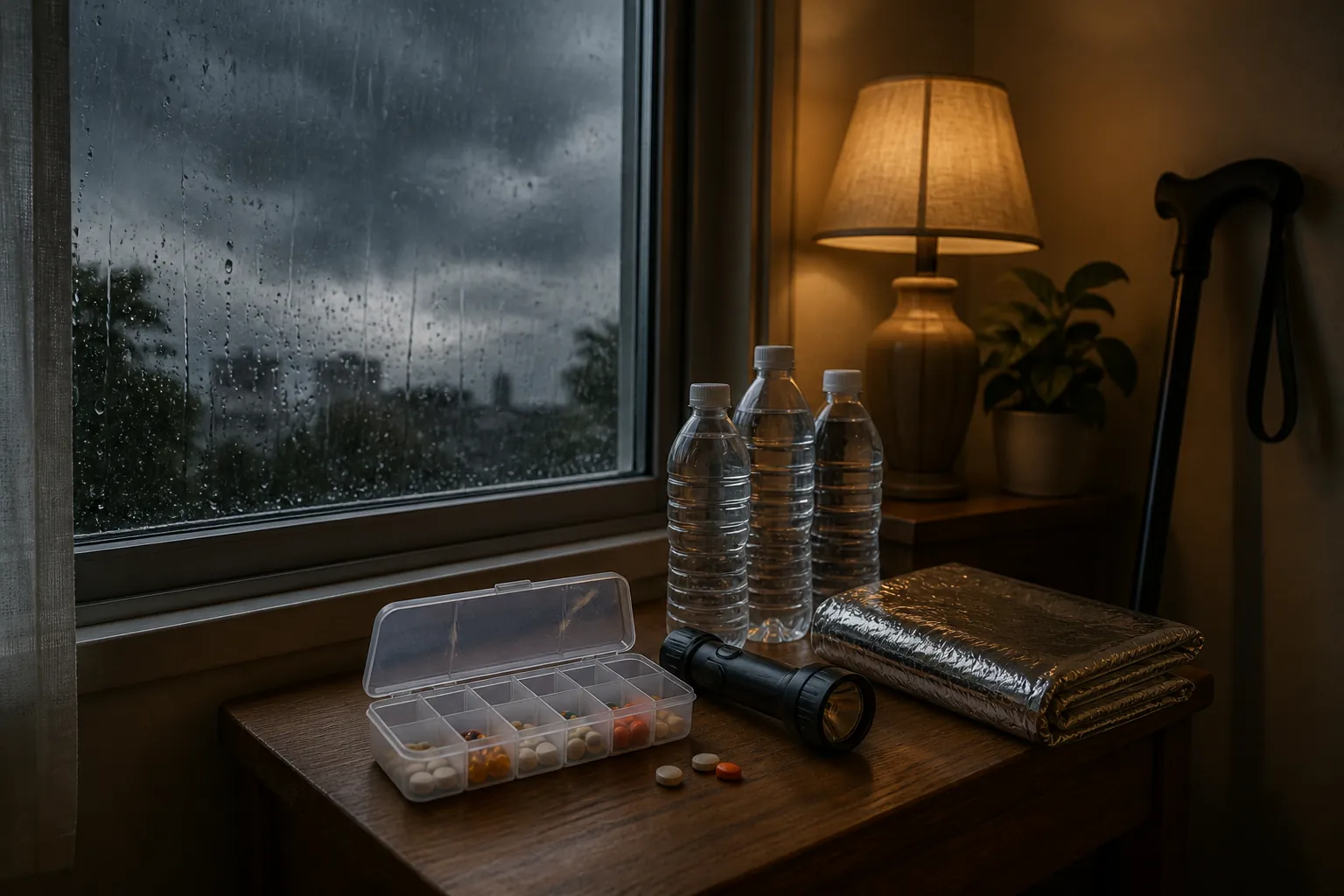
Printable typhoon safety checklist for seniors living alone
Print this page and write names, phone numbers, storage locations, and backup plans in the right-hand column. A checked box is not enough if nobody knows where the item is or who can reach it when roads are closed.
| When | Check | Write the answer before the storm |
|---|---|---|
| Before typhoon season | Ask the pharmacy and clinician how to maintain at least a 30-day medication supply, including prescriptions, over-the-counter medicines used regularly, and medical supplies such as test strips or incontinence products. Red Cross older-adult guidance recommends keeping at least 30 days of medication and extra assistive items.[2] | Medication refill date: ____ / Pharmacy phone: ____ / Who can pick up refills: ____ |
| Before typhoon season | Create two kits: a Go-Kit that can be carried for at least 3 days away from home, and a Stay-at-Home Kit with supplies for at least 2 weeks. The Red Cross uses this Go-Kit and Stay-at-Home Kit split for older adults.[2] | Go-Kit location: ____ / Stay-at-Home Kit location: ____ |
| Before typhoon season | Put a written medication and medical-equipment list in both kits. Include drug names, doses, allergies, diagnoses, prescriber names, pharmacy, insurance information, equipment model numbers, and emergency contacts. | List printed on: ____ / Copy given to: ____ |
| Before typhoon season | For powered medical equipment, write the backup-power plan. Include battery runtime, charging schedule, backup battery location, supplier emergency number, and what to do if power is out longer than the battery lasts. | Equipment: ____ / Battery lasts: ____ / Supplier phone: ____ / Backup location: ____ |
| Before typhoon season | Pack or stage extra assistive items: eyeglasses, hearing-aid batteries or charger, cane tips, walker glides, denture supplies, compression garments, braces, and a labeled spare cane if one is used. Red Cross guidance specifically calls out extra assistive items such as a cane and eyeglasses.[2] | Assistive-item storage spot: ____ |
| Before typhoon season | Choose one accessible shelter room inside the home. The path from bed to bathroom to shelter room must fit the walker, cane, wheelchair, or other mobility aid that will actually be used during the outage. | Shelter room: ____ / Route checked with walker or cane: yes / no |
| Before typhoon season | Clear the walking route. Remove throw rugs, cords, low stools, loose mats, stacked supplies, and anything that could shift in wind or darkness. CDC identifies throw rugs and clutter as fall hazards for older adults.[6] | Route cleared on: ____ / Who rechecks it: ____ |
| Before typhoon season | Place light where hands will be. Put a flashlight or battery lantern at the bed, bathroom door, shelter-room entrance, medication station, and next to the mobility aid. Do not rely on a phone flashlight as the only light source. | Flashlight locations: ____ |
| Before typhoon season | Name one support-network member who has real access. Ready.gov says at least one person in the support network should have an extra key, know where emergency supplies are stored, and know how to use lifesaving equipment or administer medicine.[3] | Name: ____ / Phone: ____ / Has key: yes / no / Knows supplies: yes / no |
| Before typhoon season | Choose backup contacts in case the first person is off-island, unreachable, ill, or blocked by unsafe roads. | Backup 1: ____ / Backup 2: ____ |
| Before typhoon season | Decide early what would trigger evacuation or shelter use: loss of power needed for medical equipment, flooding risk, inability to keep medication safe, unsafe stairs, or local instructions. | Trigger for leaving home: ____ / Transportation contact: ____ / Shelter destination: ____ |
| Before typhoon season | Charge phones, power banks, hearing aids, medical-device batteries, mobility-scooter batteries, and rechargeable lights. Label the chargers and keep them in one place. | Charging station: ____ / Last full charge: ____ |
| Before typhoon season | Store water, ready-to-eat food, manual can opener, hygiene supplies, continence supplies, trash bags, gloves, masks for cleanup dust, and pet or service-animal supplies if needed. | Food/water location: ____ / Special diet needs: ____ |
| When a typhoon watch or local condition is announced | Follow local alert levels, not family guesses. Guam’s typhoon-condition system moves from Condition IV, when damaging winds are possible within 72 hours, to Condition I, when damaging winds are expected within 12 hours and only emergency traffic should be on the roads.[4] | Current local condition: ____ / Last official update time: ____ |
| When conditions worsen | Move medications, mobility aid, eyeglasses, phone, charger, water, snacks, radio, flashlight, and emergency documents into the shelter room before walking becomes unsafe. | Moved by: ____ / Time: ____ |
| During the typhoon | Stay inside and remain in the chosen shelter area until local officials give the all-clear. Guam GHS/OCD tells residents to stay sheltered until the all-clear is announced.[4] | Radio station/app/contact for all-clear: ____ |
| During the typhoon | Conserve battery power. Use phone calls and texts carefully, keep medical equipment on its prescribed schedule, and avoid using battery-powered mobility equipment for unnecessary movement. | Battery check times: ____ |
| During the typhoon | Do not walk through dark rooms unless it is necessary. Use the mobility aid every time, turn on the placed light first, and sit down if dizzy, short of breath, or unsure of the route. | Nearest seated rest spot: ____ |
| After the typhoon | Wait for the all-clear and obey road restrictions. If local officials say emergency traffic only, do not ask an older adult, neighbor, or relative to drive out for a non-emergency errand.[4] | All-clear time: ____ / Roads open? yes / no |
| After the typhoon | Check the walking path before the older adult walks it. Look for glass, wet floors, shifted furniture, branches, loose cords, broken tiles, and supplies that fell into the route. | Who checks the route: ____ |
| After the typhoon | Stay away from dangling or downed wires. Guam GHS/OCD warns residents to avoid dangling wires after a typhoon.[4] | Hazards reported to: ____ |
| After the typhoon | Do not run a generator indoors, in a garage, or near open windows. Red Cross hurricane guidance warns against unsafe generator use because of carbon monoxide risk.[5] | Generator location if used: ____ / Who operates it: ____ |
| After the typhoon | Check refrigerated food and temperature-sensitive medication. Guam GHS/OCD tells residents to check refrigerated food after a typhoon; for medication, call the pharmacist or prescriber if temperature safety is uncertain.[4] | Pharmacy called if needed: ____ / Food discarded: ____ |
| After the typhoon | If water may be contaminated, follow local instructions. Guam GHS/OCD advises boiling possibly contaminated water for 3 to 5 minutes.[4] | Water advisory status: ____ |
| After the typhoon | Avoid river banks and flooded areas. Guam GHS/OCD specifically warns residents to stay off river banks until all potential flooding has passed.[4] | Flood-prone areas near home: ____ |
| After the typhoon | Delay heavy cleanup. Carrying wet branches, pushing soaked rugs, climbing ladders, and moving debris can turn recovery into a fall or injury event. | Cleanup helper: ____ / Tasks the older adult will not do: ____ |
| After the typhoon | Ask the support person to make an in-person check if phones are down or if the older adult uses powered medical equipment, has fallen recently, is low on medication, or cannot safely inspect the home. | Check-in deadline: ____ / If no contact, go to: ____ |
Why this checklist starts with medicine, equipment, mobility, and a key
Storm planning for an older adult living alone is not mainly a pantry project. Food matters, but food is rarely the only failure point. The plan has to protect the routines that keep the person safe on an ordinary day: taking medication on time, seeing clearly, hearing instructions, getting to the bathroom, transferring safely, powering prescribed equipment, and letting a trusted person in if the door is locked.
Ready.gov’s older-adult framework is useful because it does not stop at “make a kit.” It tells older adults to assess needs, make a plan, and engage a support network. The most important sentence for a person living alone is the one that gives the network real responsibility: at least one person should have an extra key, know where supplies are stored, and know how to use lifesaving equipment or administer medicine.[3]
That instruction is where many family plans are weakest. A daughter may know her father has a generator but not where the extension cords are. A neighbor may have promised to check in but may not know that the walker has to be brought into the shelter room before the wind rises. A nephew may have the phone number but not the house key. None of those are character flaws. They are planning gaps.
Make the pre-storm plan specific enough for someone else to use
The best test of a typhoon plan is simple: could a trusted person walk into the home, in bad light, and find the medication, assistive devices, documents, chargers, and backup supplies without a tour? If the answer is no, the plan is still inside one person’s head.
Medication should not depend on one open pharmacy
A 30-day medication supply sounds generous until roads are closed, clinics are limited, phone service is spotty, or refrigeration is uncertain. Red Cross older-adult guidance recommends keeping at least 30 days of medication, and that should include the unglamorous supplies that make the medication usable: syringes, glucose strips, inhaler spacers, pill cutters, alcohol wipes, and written instructions.[2]
Keep the list boring and legible. Use the medication name, dose, time taken, reason for taking it if known, prescriber, pharmacy, allergies, and what should not be skipped. Put one copy in the Go-Kit, one in the Stay-at-Home Kit, one on the refrigerator or inside a clearly labeled folder, and one with the support person. If anything changes, replace the old copies instead of adding sticky notes that will be missed during an emergency.
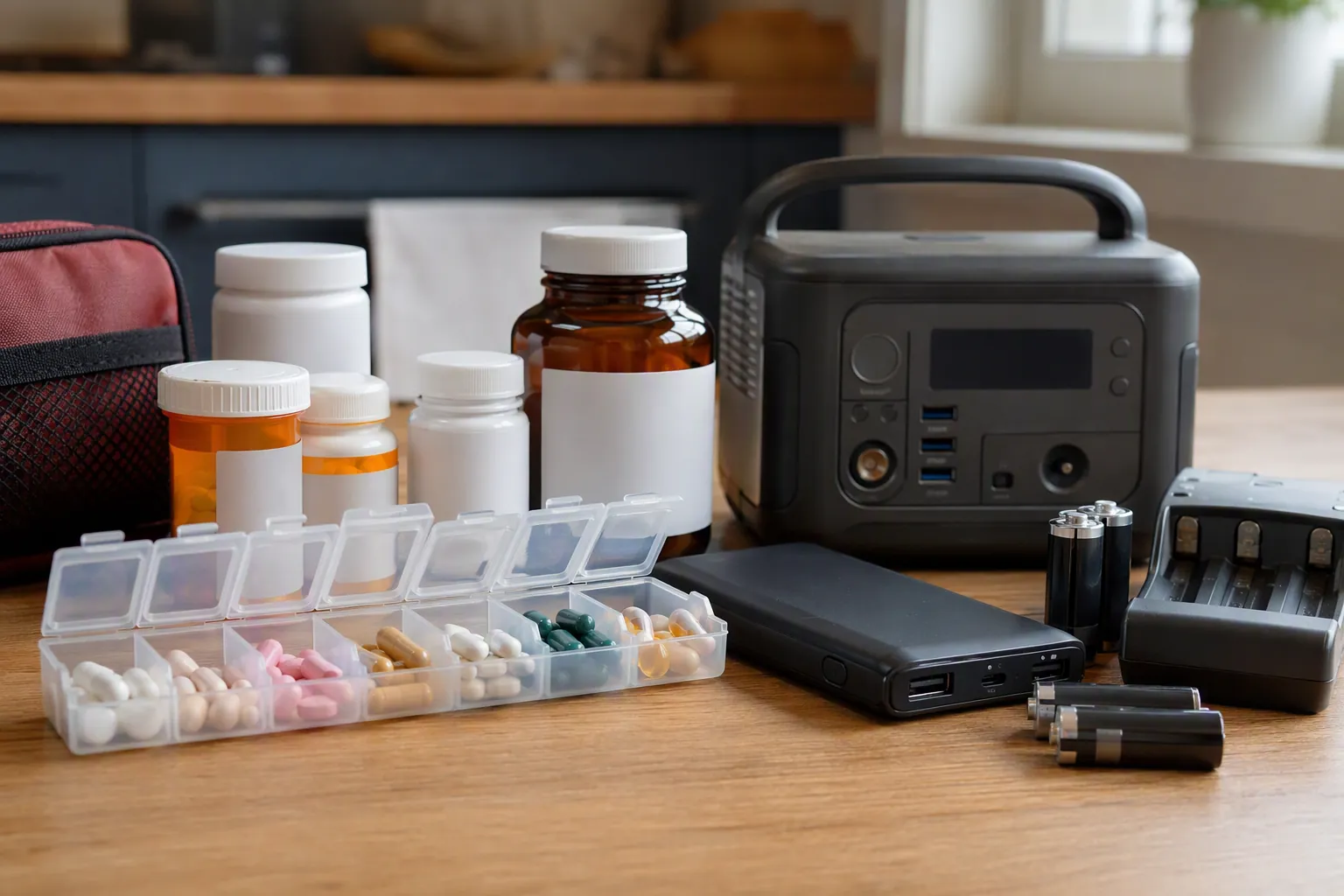
Powered equipment needs a written failure plan
If electricity fails, “we have batteries” is not a plan. Write down which device needs power, how long the battery lasts, how long it takes to recharge, whether it can be charged from a vehicle or power station, and who has been shown how to connect it. If the device is lifesaving or time-sensitive, ask the equipment supplier and clinician what to do when the outage lasts longer than expected.
Keep chargers together, labeled, and reachable without bending behind furniture. The support person should know the difference between the phone charger, hearing-aid charger, mobility-scooter charger, oxygen-equipment power cord, and backup battery. If that sounds too detailed, imagine trying to sort unlabeled black cords by flashlight while the person who needs the device is tired, hot, and worried.
Mobility aids belong in the storm route, not the closet
A cane or walker only helps if it is where the person is when the lights go out. Before the storm, walk the exact route from bed to bathroom to shelter room using the real device. If the walker catches on a rug, cannot turn through a doorway, or is blocked by stacked water cases, fix that before the first serious alert.
Duplicate small items when possible: eyeglasses, hearing-aid batteries, cane tips, denture supplies, and a spare flashlight. Red Cross guidance names extra assistive items because they are not optional conveniences for an older adult; they are how the person receives instructions, avoids obstacles, and moves safely.[2]
Use local typhoon conditions to stop errands early
A senior-specific checklist should not encourage last-minute errands. In Guam’s system, Condition IV means damaging winds are possible within 72 hours, and Condition I means damaging winds are expected within 12 hours, with only emergency traffic allowed on the roads.[4] By the time the roads are restricted, the medication, water, documents, mobility aid, lights, and charger should already be in place.
Use the earliest alert to make phone calls, not the final one. Confirm who is checking in, who has the key, where the person will shelter, what equipment needs power, and what would trigger evacuation. If the older adult insists they are “fine,” ask concrete questions instead of arguing about readiness: Where is the spare key? How many days of medication are in the house? Can the walker fit into the shelter room? What happens if the refrigerator is warm tomorrow?
The support person needs access, instructions, and permission to act
A support network is not the same as a contact list. A contact list is names. A support network is a neighbor, relative, friend, building manager, caregiver, faith-community member, or nearby family member who has agreed to a specific job and can do it under storm conditions.
- Give one trusted person a spare key or an approved way to enter.
- Show that person where the Go-Kit, Stay-at-Home Kit, medications, equipment instructions, mobility aid, and documents are kept.
- Write down what counts as urgent: no answer after a set time, medical equipment without power, a missed critical medication, a fall, confusion, chest pain, breathing trouble, flooding, or unsafe heat.
- Choose backups in case the first person cannot travel or cannot be reached.
- Decide how the support person should communicate with off-island relatives: call, text, group message, radio contact through local channels, or a prearranged check-in time.
This is also where the family has to respect independence without pretending independence means no help. The older adult can choose the support person, the storage location, the shelter room, and the evacuation preference. But the plan still has to work if they are tired, in pain, without power, or unable to answer the phone.
Do not treat “after the typhoon” as safe
The period after the wind drops is when a careful person can get hurt doing ordinary things: stepping into a hallway without light, checking the yard, opening the refrigerator, moving wet rugs, or trying to clear a branch before help arrives. For older adults, that matters. CDC reports that more than one in four older adults falls each year, about 3 million older adults visit emergency departments for falls annually, and a first fall doubles the chance of falling again.[6]
That is why darkness, throw rugs, clutter, and debris are not side notes. They are fall hazards added to stress, heat, poor sleep, disrupted meals, and possible medication changes. Before anyone asks an older adult to “just check outside,” someone should check the floor, the porch, the stairs, the bathroom, and the route to the refrigerator.
Post-storm walking rules
- Use a flashlight or lantern before taking the first step, not after entering a dark room.
- Use the cane, walker, or wheelchair every time, even for a short trip to the bathroom.
- Keep one hand free. Do not carry water jugs, debris, or heavy bags while using a cane or walker.
- Sit down before sorting supplies, making calls, or taking medication if dizzy, overheated, short of breath, or shaky.
- Ask the support person to clear the route before cleanup begins.
Food, water, wires, and generators
Guam GHS/OCD tells residents to avoid dangling wires, check refrigerated food, stay away from river banks until potential flooding has passed, and boil possibly contaminated water for 3 to 5 minutes.[4] Those instructions are not just for the person who plans to go outside. A wire near the entrance, a wet walkway, or questionable water can decide whether the older adult should stay put, call the support person, or wait for official help.
Refrigerated medication needs the same caution as refrigerated food, with one important difference: do not guess. If insulin or another temperature-sensitive medication may have been too warm, call the pharmacist, prescriber, or manufacturer’s medical information line if available. Put that number on the printed medication list before storm season.
Generator decisions should also be made before the outage, not during it. Red Cross hurricane guidance warns that generators should not be used indoors because of carbon monoxide risk.[5] For a senior living alone, the safest generator plan may be that someone else operates it, places it correctly, checks fuel safely, and confirms that cords do not create a trip hazard across the walking route.
Why families should talk before the warning is urgent
Preparedness gaps are common enough that families should not assume the plan exists. A University of Iowa report on research using 2010 Health and Retirement Study data said fewer than 25% of adults age 50 and older had an emergency plan, about 25% lived alone, about half would not know where to shelter, about 25% lacked transportation access, and 15% relied on electrically powered medical devices.[7] Those numbers are dated and should not be treated as a current local forecast, but they describe exactly the kinds of gaps this checklist is meant to expose.
A University of Michigan National Poll on Healthy Aging finding is just as practical for family conversations: only 40% of older adults had discussed evacuation with family or friends.[8] Evacuation is hard to discuss when the sky is already dark and everyone is trying to preserve phone battery. The calmer time to decide is when the support person can still drive over, test the key, walk the shelter route, and read the medication list.
Fill these blanks before you put the checklist away
| Question | Answer |
|---|---|
| Who has the spare key? | Name: ____ / Phone: ____ |
| Where are the medications and printed medication list? | Location: ____ |
| Which device fails first if power is out? | Device: ____ / Battery time: ____ / Backup plan: ____ |
| Can the walker, cane, or wheelchair move from bed to bathroom to shelter room? | Yes / No / Fix needed: ____ |
| What is the evacuation trigger? | Trigger: ____ |
| Who checks the home after the all-clear? | Name: ____ / Time: ____ |
| What will the older adult not do during cleanup? | No ladders / no debris lifting / no outdoor walking alone / other: ____ |
The checklist is ready when those blanks have names, places, and decisions in them. If the plan still depends on memory, good luck, or someone finding the right key after the phones stop working, keep going.
References
- What is the difference between a hurricane and a typhoon? | NOAA Ocean Service, NOAA Ocean Service.
- Older Adults Emergency Preparedness | American Red Cross, American Red Cross.
- Older Adults | Ready.gov, Ready.gov.
- Typhoons | Guam Homeland Security / Office of Civil Defense, Guam Homeland Security / Office of Civil Defense.
- Hurricane Preparedness | American Red Cross, American Red Cross.
- Facts About Falls | Older Adult Fall Prevention | CDC, Centers for Disease Control and Prevention.
- UI study: Older adults in U.S. not prepared for natural disasters, Iowa Now, March 2014.
- Emergency Planning Among Older Adults, University of Michigan National Poll on Healthy Aging.
Related reading
Noticed something outdated or inaccurate on this page? Flag a correction. We review every report against CDC, NIA, and AARP HomeFit guidance before updating a page.
Part of the Fall Prevention section.