
STEADI: Intervene
Hurricane & Flood Safety Checklist for Seniors Living Alone
For an older adult living alone, a standard emergency kit is not enough to survive a multi-day hurricane or flood outage. This checklist covers the essentials that generic lists omit — a 30-day medication supply, backup power for medical devices, a go-bag with waterproofed documents, and a support network with spare keys — plus flood hazards, exact quantities, cited sources, and a twice-a-year refresh plan.
A hurricane and flood safety checklist for seniors living alone has to do more than count flashlights and cans of soup. The weak point is usually continuity: medication, power for medical equipment, safe movement through a dark house, a door someone else can open, and papers that are still readable after water gets in.
Use this as a print-and-mark checklist before hurricane season, again when a storm watch is issued, and once more after the house is safe to re-enter. For older adults with complex medical needs, confirm the plan with the prescribing clinician, oxygen supplier, home health agency, or local emergency management office.
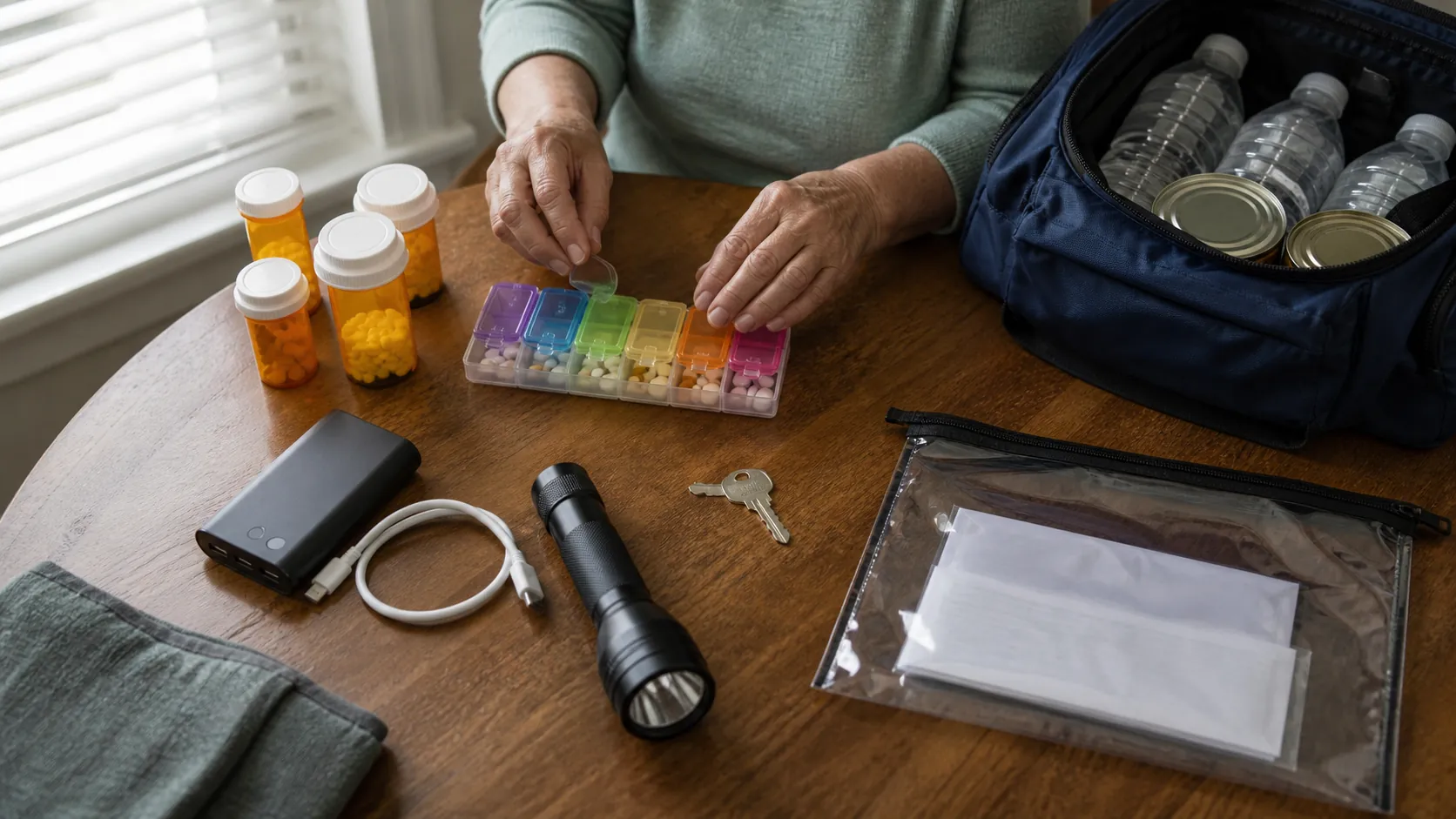
Printable hurricane and flood checklist for a senior living alone
| Area | What to set up before the storm | Who owns it |
|---|---|---|
| Medication | Ask prescribers and insurers how to maintain an emergency supply. The Red Cross older-adult guidance says to keep at least 30 days of medications, while NCOA separately recommends a two-week prescription supply; do not treat those as the same standard. Keep an updated medication list with doses, prescribers, pharmacy, allergies, and emergency contacts. [1][2] | Senior, adult child, prescriber, pharmacist |
| Water and food | Store at least 1 gallon of water per person per day for 3 or more days as a baseline, plus nonperishable food the person can open and eat without power. [3] | Senior or nearby helper |
| Medical-device power | Write down every device that needs electricity: oxygen concentrator, CPAP or BiPAP, nebulizer, power recliner used for transfers, phone, hearing-aid charger, glucose monitor, refrigerator for medication. Match each device to a backup battery, power station, generator plan, or relocation plan. | Senior, equipment supplier, support-network lead |
| Assistive items | Pack extras where possible: eyeglasses, hearing-aid batteries or charger, cane tips, walker accessories, incontinence supplies, wound supplies, and copies of device settings. The Red Cross specifically calls out extra assistive items such as a cane or eyeglasses. [1] | Senior and caregiver |
| Go-bag and documents | Pack ID, insurance cards, medication list, emergency contacts, medical-device information, advance directives if used, spare glasses, chargers, flashlight, small first-aid supplies, and cash. Keep paper documents in a waterproof pouch. | Senior or document helper |
| Support network | Name at least one nearby person who knows where supplies are kept and has a spare key; Ready.gov specifically recommends that a support-network member hold a spare key and know where emergency supplies are stored. [4] | Senior, neighbor, friend, adult child |
| Local registry or profile | If family or neighbors are thin on the ground, check local emergency-management registries, medical-needs registries, transportation assistance, or Smart911-style profiles. In New Orleans, for example, NOLA Ready says Smart911 can flag medical needs and evacuation-assistance eligibility. [5] | Senior, caregiver, local emergency management |
| Home preparation | Clear tripping hazards from evacuation paths, charge phones and batteries, bring in outdoor items, protect documents, set flashlights at bed, bathroom, kitchen, and exit routes, and keep mobility aids where they can be reached in the dark. | Senior and helper |
| Storm timing | Use the watch and warning window. CDC says hurricane or tropical storm watches are generally issued about 48 hours before tropical-storm-force winds are possible, and warnings about 36 hours before those winds are expected. [6] | Support-network lead |
| Shelter or evacuate | Have both plans written: one for staying home for an extended outage and one for leaving early with medications, mobility equipment, pets or service animals, and documents. The Red Cross says older adults should plan to stay home for two weeks or evacuate; NCOA also emphasizes practicing both shelter-in-place and evacuation plans with family. [1][2] | Senior, caregiver, evacuation driver |
| Floodwater and generator safety | Do not walk or drive through moving water. Keep generators outside and at least 20 feet from the house with a working carbon monoxide detector. Treat floodwater as contaminated. [7] | Everyone involved |
| Review cycle | Review, practice, and refresh the plan, supplies, and important documents now and every six months, as Red Cross guidance says. [1] | Senior and support network |
What makes the living-alone version different
A three-day household kit assumes someone can improvise. A senior living alone may not have that margin. If the pill organizer runs out on day four, if the oxygen company cannot deliver, if the walker is in the garage behind a swollen door, or if the only house key is inside with the person who fell, the problem is no longer “storm preparedness.” It is access, medication continuity, and rescue logistics.
That is why the senior-safe checklist starts with the items that interrupt care first: prescriptions, device power, mobility, documents, and another human being who can get through the door. Standard kit items still matter. They just should not be allowed to crowd out the details that keep an older adult medically stable through a long outage.
If you also prepare for tornadoes, the same household logic applies: medications, mobility equipment, communication, and post-storm fall hazards need their own plan. CareWise’s fall-safe tornado preparedness checklist for seniors can be used as the inland storm companion to this hurricane-and-flood plan.
Medication, medical devices, and the supplies generic kits miss
Start with medication because it has the least forgiveness. The Red Cross advises older adults to keep at least 30 days of medications, while NCOA’s disaster guidance recommends a two-week prescription supply. Those are distinct recommendations from distinct organizations, and a real plan should respect the higher-risk reality: some prescriptions cannot be refilled quickly after roads flood, pharmacies close, or a caregiver cannot reach the house. [1][2]
The medication supply is only half the job. The list matters just as much. Keep one printed medication list in the go-bag, one with the emergency documents, and one with the person most likely to speak to a shelter nurse, paramedic, emergency department, or temporary caregiver. The list should include drug names, doses, timing, prescribing clinicians, pharmacy phone number, allergies, diagnoses that affect care, and any medication that must be refrigerated.
For a more detailed way to build that list and prevent missed or duplicated doses during a transfer of care, use CareWise’s guide to preventing medication errors at every hospital handoff. A storm evacuation is a handoff, even when it begins in the driveway.
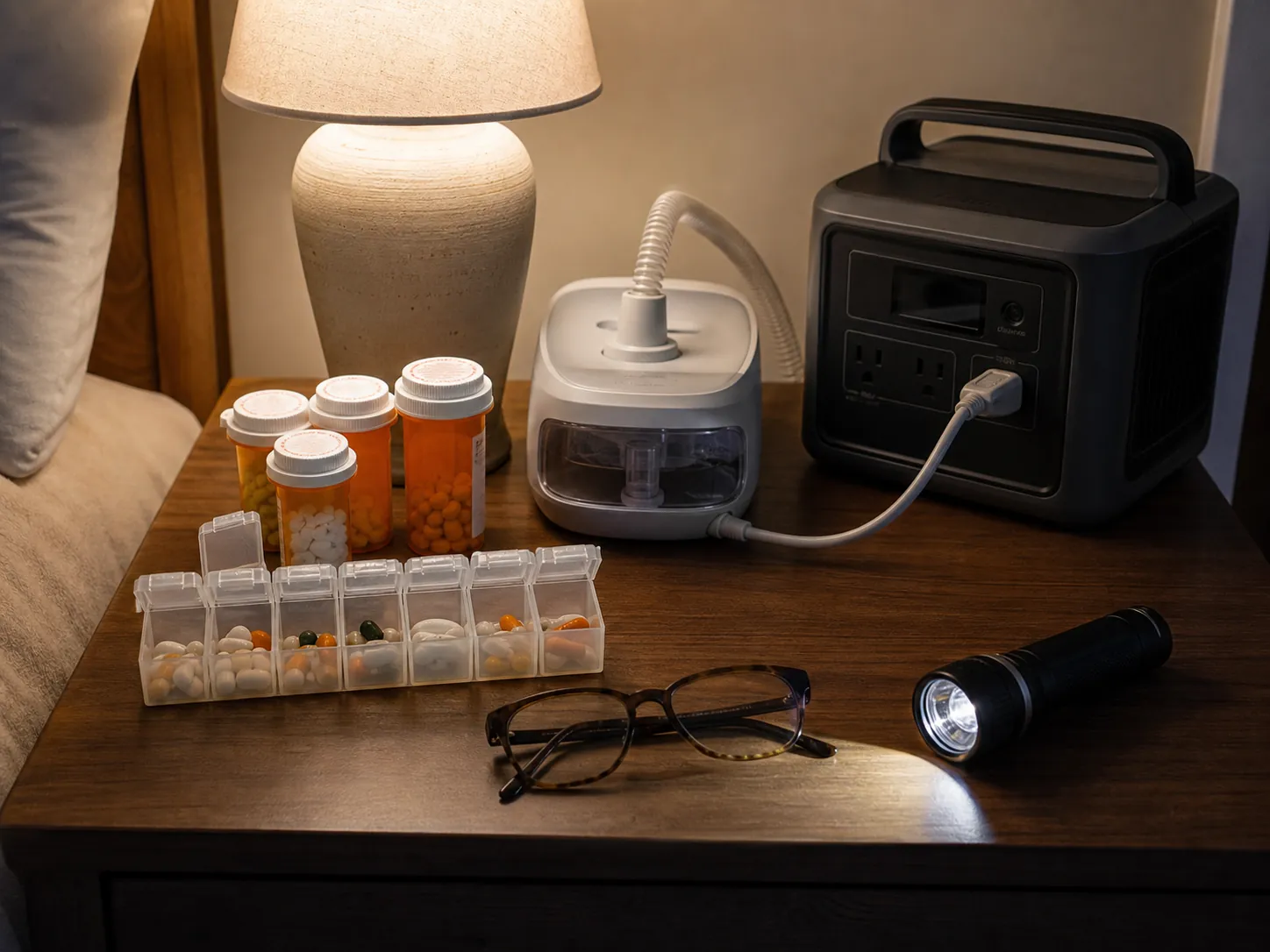
Make a power plan for every device, not just the phone
Walk through the home and write down what fails when the power fails. A phone battery is obvious. Less obvious are a powered bed, lift chair, oxygen concentrator, CPAP machine, nebulizer, stair lift, electric wheelchair, hearing-aid charger, medication refrigerator, well pump, and garage door opener.
- For oxygen: call the oxygen supplier before storm season and ask exactly what backup tanks, battery equipment, delivery limits, and emergency procedures apply during a hurricane or flood.
- For CPAP, BiPAP, or nebulizers: record model numbers, settings, battery compatibility, and how many hours the backup power actually supports.
- For refrigerated medication: ask the pharmacist what temperature range matters, how long the medication can safely remain out of range, and what to do if the refrigerator loses power.
- For mobility: keep the walker, cane, wheelchair, transfer belt, braces, and shoes in a path that remains reachable if the house is dark or one room floods.
Multi-day outage planning overlaps with heat risk, especially in late summer and early fall. If air conditioning loss is part of the plan, pair this checklist with CareWise’s guide on keeping seniors safe in a heat-wave power outage.
Pack backup assistive items like they are medical supplies
A spare cane tip, eyeglasses, hearing-aid batteries, incontinence supplies, wound dressings, denture supplies, and a backup pair of sturdy shoes do not look dramatic in a storm kit. They decide whether someone can stand, hear instructions, read a label, sleep, toilet safely, and walk out without falling. Red Cross guidance for older adults specifically includes extra assistive items such as a cane or eyeglasses. [1]
Water, food, light, radio, and first aid
The baseline supplies still belong in the house. AAGP disaster guidance for older adults gives the familiar water starting point: 1 gallon per person per day for 3 or more days. [3] For a senior living alone, that water has to be reachable, liftable, and openable. A case of bottles in the garage is not much help if the garage floods or the person cannot carry it.
- Water: at least 1 gallon per person per day for 3 or more days as a baseline; store some in smaller containers if lifting is an issue. [3]
- Food: shelf-stable foods that match the person’s diet and can be opened without an electric can opener.
- Lighting: flashlights or lanterns at the bed, bathroom, kitchen, and exit route; avoid relying on candles.
- Communication: charged cell phone, backup battery, wall charger, car charger if appropriate, and a battery-powered or hand-crank radio.
- First aid and hygiene: basic first-aid kit, hand sanitizer, wipes, masks if used, gloves, trash bags, toilet paper, and continence supplies.
- Pet or service-animal supplies: food, water, leash, carrier, medications, vaccination records, and waste bags.
The support network needs names, keys, and permission
A support network is not a vague promise that “someone will check.” Ready.gov tells older adults to engage a support network, and specifically says a network member should keep a spare key and know where emergency supplies are stored. [4] AAGP guidance goes further by recommending a personal support network of at least three family members, friends, or neighbors who exchange keys. [3]
Three people is not always realistic. Families may live states away. Neighbors may be elderly themselves. A senior may not want to hand out keys, and that wish deserves respect. The answer is not to pretend help is guaranteed; it is to write down the backup layers while the weather is quiet.
| Role | What this person or service must be able to do |
|---|---|
| Primary local contact | Has a key or lockbox code, knows where supplies and documents are, can reach the home before roads flood, and knows whether the senior is sheltering or evacuating. |
| Medication contact | Has the medication list, pharmacy information, prescriber names, and permission to help with refill questions when possible. |
| Device or oxygen contact | Knows the supplier phone number, device settings if relevant, and where backup batteries, tanks, cords, or chargers are stored. |
| Out-of-area contact | Receives check-in calls or texts and can coordinate if local lines are busy or local contacts cannot reach the home. |
| Local registry or emergency profile | Used when personal support is limited or medical needs require advance notice to local responders. |
For the spare key, choose one method and write it down: a trusted neighbor, a lockbox, a building manager, or another local arrangement the senior accepts. The important part is that the person expected to help at 2 a.m. is not left standing outside a locked door while water rises or the power is out.
If your city or parish uses a medical-needs registry, evacuation-assistance registry, or Smart911-style emergency profile, treat it as part of the plan rather than a last-minute form. NOLA Ready, for example, says Smart911 can flag medical needs and evacuation-assistance eligibility, and notes that shelters are the last option for older adults with medical needs. [5]
Documents and the go-bag
Important papers do not belong loose in a kitchen drawer during storm season. Put copies in a waterproof pouch or sealed plastic bag inside the go-bag, then keep a second set where the support-network lead can find it. If originals must stay home, raise them off the floor and away from windows, washing machines, water heaters, and low cabinets.
- Photo ID, Medicare or insurance cards, and pharmacy card
- Medication list, allergy list, diagnoses, and clinician contacts
- Emergency contacts, including out-of-area contact
- Medical-device information, oxygen supplier, equipment settings, and serial or model numbers if useful
- Copies of advance directives, health care proxy, or power of attorney if the person uses them
- Small amount of cash, spare keys, charger cords, and written passwords or access instructions only if stored securely
- Pet or service-animal records
Use the 48-hour and 36-hour storm window
CDC hurricane guidance gives two useful timing markers: watches are generally issued about 48 hours before tropical-storm-force winds are possible, and warnings about 36 hours before those winds are expected. [6] For a senior living alone, the 48-hour mark is not early. It is the point when loose plans need to become assigned tasks.
| When | What should happen |
|---|---|
| Before hurricane season | Build the medication supply plan, confirm device backup power, register for local alerts or assistance if needed, waterproof documents, place spare key or lockbox, and schedule the six-month review. |
| At a watch, about 48 hours before possible tropical-storm-force winds | Call the support-network lead, confirm shelter-or-evacuate plan, refill fuel or charge batteries if safely possible, move water and supplies within reach, bring mobility aids inside, and check prescriptions. |
| At a warning, about 36 hours before expected tropical-storm-force winds | Stop errands that can wait, complete evacuation if that is the plan, move away from windows, confirm check-in times, and keep shoes, flashlight, phone, medications, and mobility aid at bedside. |
| During the storm | Stay out of floodwater, avoid candles, conserve phone battery, use generators only outdoors and far from the house, and keep the support network updated when possible. |
| After the storm | Do not drive or walk through floodwater, check for carbon monoxide risks, avoid wet electrical hazards, document damage if safe, and ask for help before moving heavy debris or wet rugs. |
Sheltering in place and evacuating are two separate plans
The Red Cross tells older adults to plan either to stay home for two weeks or to evacuate. [1] Those plans use different supplies. Sheltering needs water, food, medication continuity, power backup, safe toileting, and a way to communicate. Evacuating needs a destination, transportation, documents, medication, mobility equipment, device power, pet or service-animal plans, and a person who can help load and leave early.
Do not wait until the warning window to find out that the wheelchair does not fit in the neighbor’s car, the oxygen tanks cannot be transported upright, the shelter does not meet the person’s medical needs, or the pet cannot come to the planned destination. NCOA advises older adults to have both shelter-in-place and evacuation plans and to practice them with family. [2]
Post-storm structural damage can also turn a sheltering plan into an evacuation. If a tree falls on the home, blocks the exit, or damages the room where mobility equipment is stored, use the response steps in CareWise’s guide on what to do when a tree falls on an elderly parent’s home.
Floodwater is its own hazard, not just wet weather
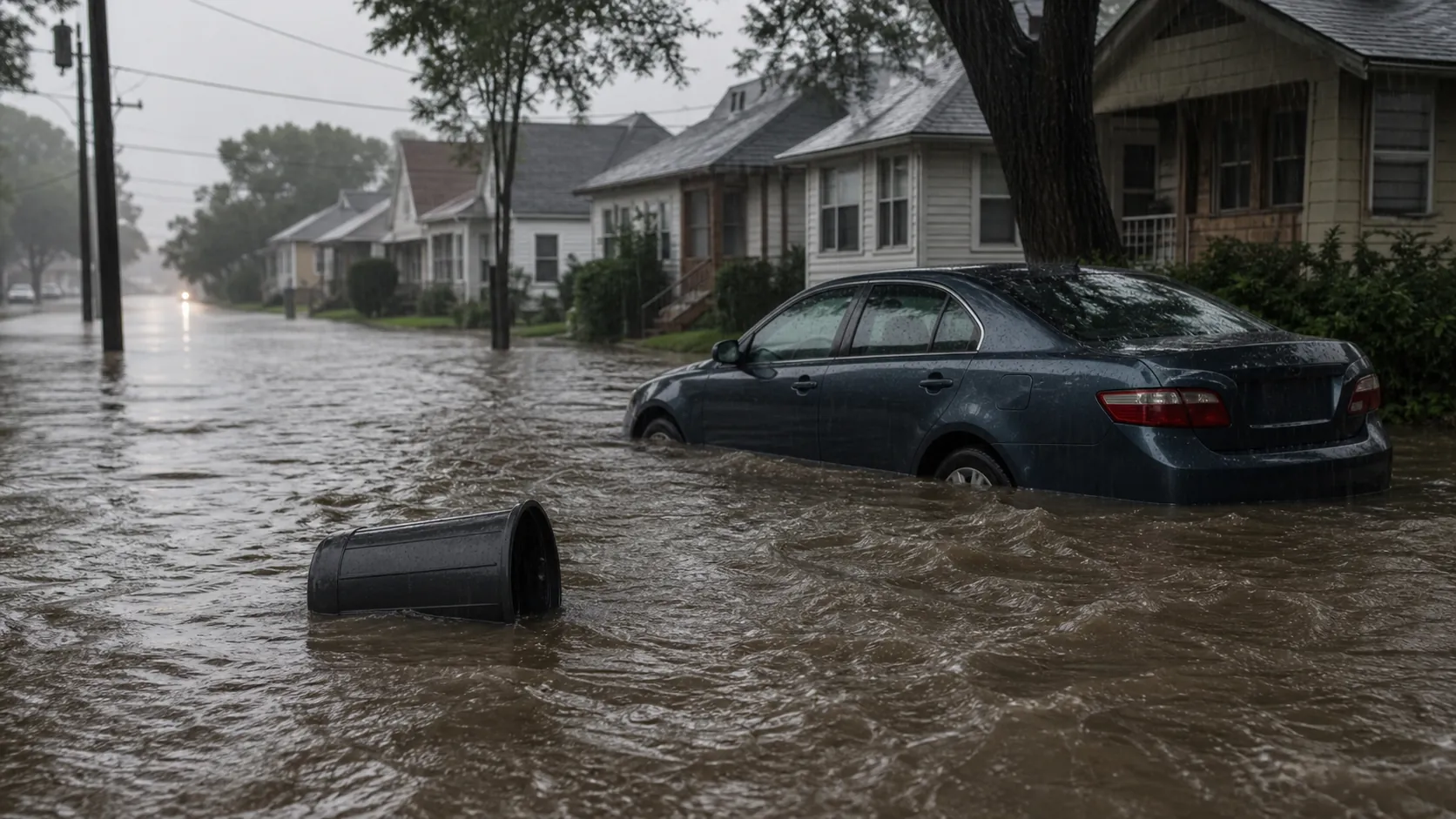
Floodwater changes the rules for a senior living alone. It hides curbs, holes, downed wires, broken glass, snakes, sewage, chemicals, and uneven pavement. It also turns a familiar front walk into a fall hazard for someone using a cane, walker, oxygen tubing, or poor night vision.
The water-depth rules are blunt for a reason. CDC hurricane guidance says 6 inches of moving water can stall or sweep away a car. [6] The National Weather Service says 6 inches of fast-moving floodwater can knock over an adult, 12 inches can carry away most cars, and 2 feet of rushing water can carry away most SUVs and trucks. [8]
- Do not walk through moving water to check a mailbox, reach a car, or meet a ride.
- Do not drive through flooded streets, even if the road is familiar.
- Do not assume shallow water is safe; depth, current, road washout, and hidden debris are hard to judge from a porch or car window.
- If water is entering the home, move to higher safe ground inside only if it does not require stepping into floodwater or using wet electrical equipment.
CDC floodwater guidance says floodwater can contain downed power lines, human and livestock waste, household, medical, and industrial hazardous waste, coal ash waste, chemicals, and germs that can cause wound infections, gastrointestinal illness, tetanus, and other diseases. [7] For an older adult with diabetes, fragile skin, neuropathy, poor circulation, or an open wound, “just a few steps” through dirty water can create a medical problem after the storm has passed.
Generator safety: 20 feet, outdoors, never the garage
A generator can keep medical equipment running, but carbon monoxide is the danger that does not announce itself. CDC floodwater guidance says to use generators at least 20 feet from the house and to use a working carbon monoxide detector. [7] Red Cross flood safety guidance also warns never to use gasoline, propane, natural gas, or charcoal-burning devices inside a home, basement, garage, tent, or camper. [9]
AAGP notes that unintentional carbon monoxide poisoning causes roughly 500 deaths and 15,000 emergency room visits per year, with adults 65 and older especially vulnerable. [3] That statistic is not an argument against generators. It is an argument for putting the generator plan in writing before someone is tired, hot, worried about oxygen, and tempted to crack the garage door “just this once.”
After flooding: wet floors, mold, and fall hazards
The fall risk rises after the water leaves. Wet rugs, warped flooring, loose thresholds, extension cords, fans, debris piles, and displaced furniture can make a safe home unsafe overnight. If an older adult uses a walker, the cleanup path has to be wide, dry, and well lit before they are expected to move through it.
Red Cross flood guidance says to dry a flooded home within 24 to 48 hours if possible, and if that cannot be done, assume there is mold growth. [9] That timeline matters when deciding whether a senior with asthma, COPD, allergies, immune compromise, or oxygen needs can safely remain in the home while cleanup is still underway.
Home setup before storm season
Aging in place during storm season is partly a home-modification issue. The goal is not to make the home stormproof; it is to remove the avoidable failures that trap someone inside, make them fall, or keep helpers from finding what they need.
- Clear the route from bed to bathroom, bathroom to kitchen, and living area to exit.
- Place flashlights where the person actually walks at night, not in a junk drawer.
- Keep shoes with backs or sturdy slippers at bedside; bare feet and flood debris do not mix.
- Move medications, documents, chargers, and backup glasses above likely water level.
- Bring in outdoor furniture, hoses, planters, and decorations that can block paths after wind.
- Label the main water shutoff, breaker panel, oxygen supplies, and emergency kit location for helpers.
- Test smoke and carbon monoxide alarms before storm season and replace batteries if needed.
For broader aging-in-place upgrades that make emergency movement easier year-round, see CareWise’s overview of why seniors are choosing home modifications over downsizing.
Review, practice, and refresh every six months
The Red Cross tells older adults to review, practice, and refresh the plan, supplies, and important documents now and every six months. [1] Put two dates on the calendar: one before hurricane season and one six months later. CDC identifies the Atlantic hurricane season as June 1 through November 30, so a spring review gives enough time to fix medication, power, key, and registry problems before watches and warnings start arriving. [6]
| Every six months, confirm | What to check |
|---|---|
| Medication | Medication list is current; emergency supply plan still works; pharmacy and prescriber information is correct. |
| Power | Backup batteries charge; generator plan is safe; carbon monoxide detectors work; device supplier numbers are current. |
| Documents | Insurance cards, ID copies, emergency contacts, medical-device information, and legal documents are current and waterproofed. |
| Support network | Names, phone numbers, spare key or lockbox code, check-in times, and evacuation driver are still valid. |
| Supplies | Water, food, first-aid supplies, hygiene supplies, batteries, chargers, and pet supplies are not expired, leaking, missing, or stored out of reach. |
| Mobility and exits | Walker, cane, wheelchair, shoes, flashlight, and exit route are reachable in the dark. |
| Local registration | Emergency alerts, medical-needs registry, evacuation-assistance registry, or Smart911-style profile are updated if available. |
The review is finished only when the medication list has been printed, the backup power has been tested, the spare key is where the plan says it is, the documents are waterproofed, the support-network names have answered, and everyone involved understands the flood rules: do not walk through moving water, do not drive through floodwater, and do not run a generator in the garage.
References
- Older Adults Emergency Preparedness, Red Cross
- Emergency Preparedness 101: What to Do Before, During, and After Disaster, NCOA
- Older Adults and Disaster Preparedness and Response, AAGP
- Older Adults, Ready.gov
- Seniors & People with Medical Needs, NOLA Ready
- Preparing for Hurricanes or Other Tropical Storms, CDC
- Floodwater After a Disaster or Emergency, CDC
- Turn Around Don't Drown, National Weather Service
- Flood Safety, Red Cross
Related reading
Noticed something outdated or inaccurate on this page? Flag a correction. We review every report against CDC, NIA, and AARP HomeFit guidance before updating a page.
Part of the Fall Prevention section.