
STEADI: intervene
Weather-Themed Gifts That Prevent Nighttime Falls
Automated motion-sensor lights and LED guiding strips are the most evidence-backed weather-themed gift for older adults, reducing nighttime fall risk by addressing the seasonal hazard of early darkness. This article reviews the research and key features to look for in a product-neutral guide for caregivers.
A weather-themed gift does not have to be a storm glass, a barometer, or a mug printed with clouds. In winter, weather also changes the house. The evening arrives earlier, the hallway stays dark longer, and the half-awake trip from bed to bathroom becomes less forgiving. For an older adult who gets up at night to toilet, that dark route is not a decorative problem. It is a fall-prevention problem.
That is why the most useful weather-themed gifts for older adults are often the least showy ones: motion-sensor plug-in night lights, LED guiding strips, and other automated lights that turn on before a foot lands on the floor. They do not ask someone to remember a switch. They do not depend on a phone being nearby. They simply make the winter night less treacherous.
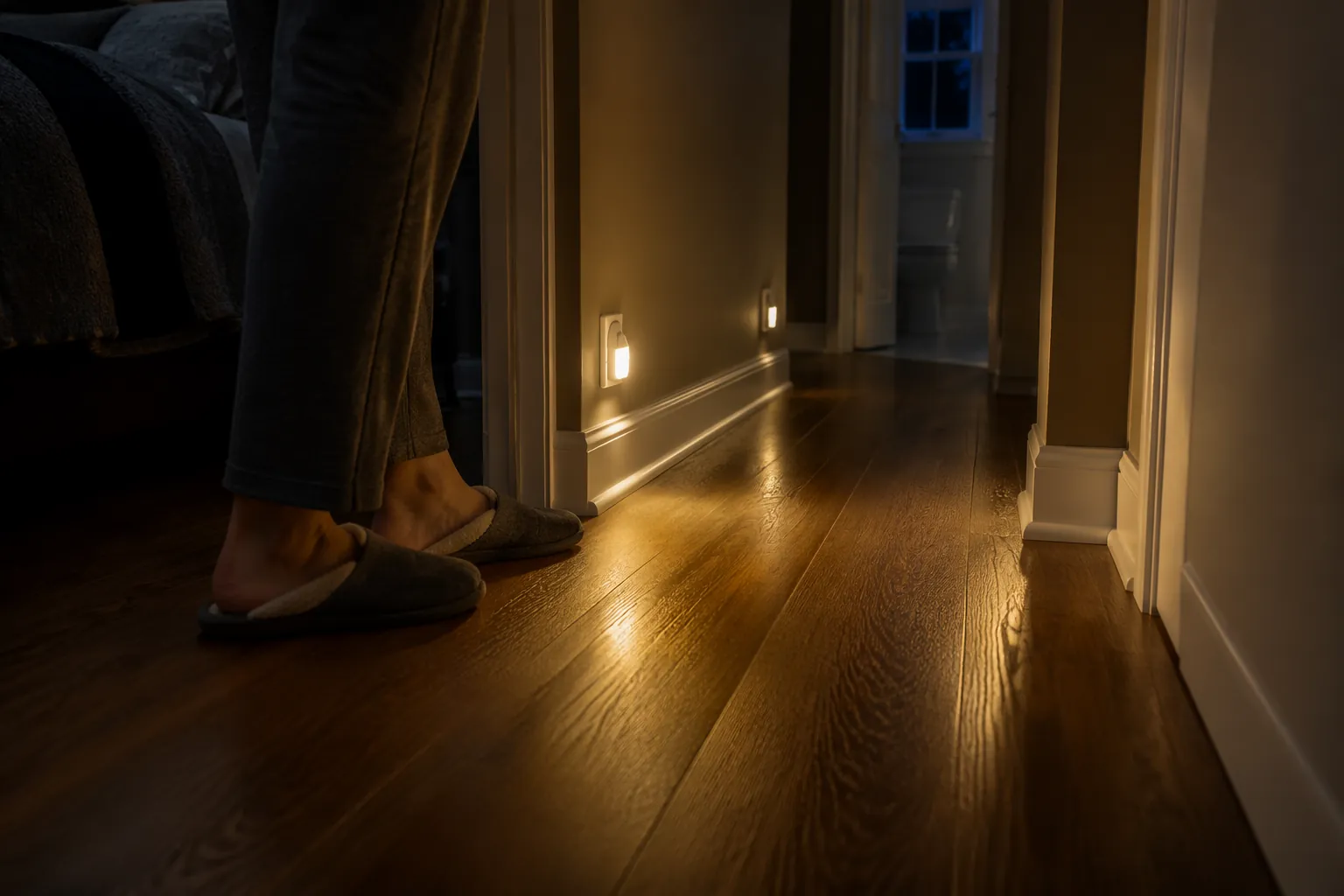
The winter hazard is the route, not the weather theme
Falls are common enough that they should not be treated as a distant possibility. The CDC reports that more than one in four older adults falls each year in the United States, and falls are the leading cause of injury death among adults 65 and older; in 2021, more than 38,000 older adults died from falls, with the age-adjusted fall death rate up 21% from 2012 to 2021.[1]
The nighttime part matters because the bed-to-bathroom trip is repeated, sleepy, and easy to underestimate. Nocturia is common in later life: Bosch and Weiss reported that about 60% of older adults toilet at least twice nightly.[2] A person who makes that trip most nights does not need a dramatic accident scenario to be at risk. They need one slipper catching on a rug edge, one missed doorway, one reach for a wall that is not where they thought it was.
A cozy gift may still be welcome. A robe, a heated throw, or a puzzle book can make winter feel kinder. But those gifts do not change the dark path from the bed to the toilet. Automated lighting does.
What the LED guiding-strip study actually found
The strongest evidence for this gift category comes from a Radboud University Medical Center study of automated LED guiding strips in older adults. The study included 64 participants with a mean age of 80.8 years. Researchers installed a lighting system that automatically marked the walking route at night, then measured outcomes before and after installation.[3]
The most recognizable result was not a fall count. It was fear during overnight movement. Participants’ fear of falling at night decreased from 5.5 to 3.8, a statistically significant change, and 57% reported a subjective reduction in fear of falling.[3] That is not a small emotional detail. Fear can make someone move stiffly, rush, freeze, or avoid getting up until the urge is urgent. A lighted route cannot make knees stronger, but it can make the next few steps feel less uncertain.
Sleep quality also improved, rising from 6.7 to 7.4 in the study, and participants rated the lighting system 8.4 out of 10.[3] That matters for gift-giving because a safety device that annoys the person who has to live with it will be unplugged, ignored, or moved to a drawer. The Radboud system was not merely tolerated. Participants rated it highly.
| What changed in the study | Reported result | What it means for a gift decision |
|---|---|---|
| Fear of falling at night | Decreased from 5.5 to 3.8 | The lighted route addressed a feeling older adults actually notice during overnight movement |
| Subjective fear reduction | 57% reported improvement | Not everyone benefits equally, but more than half perceived less fear |
| Sleep quality | Improved from 6.7 to 7.4 | The system did not appear to make nights feel more disruptive overall |
| User rating | 8.4 out of 10 | Acceptability is a real advantage for a device meant to stay in the home |
The caveat is important. This was an uncontrolled before-after study in a Dutch population with 64 participants. It does not prove that LED guiding strips reduce actual fall rates. It supports the more modest claim that automated guiding lights can reduce fear of falling at night and improve self-reported sleep quality in the group studied.[3]
That narrower claim is still useful. A caregiver choosing a winter gift does not need miracle language. A device that makes a repeated nighttime route easier to see, less frightening, and acceptable to the person using it has already cleared a meaningful bar.
The best gift is usually automatic path lighting
For most homes, start with the path itself: bed, doorway, hallway, bathroom entrance, and toilet area. A single decorative night light in the hall may glow prettily while still leaving the first step out of bed dark. The more useful gift is a small system of lights that covers the route in sequence.
Ohio State Wexner Medical Center specifically recommends fall-prevention gifts such as plug-in motion-sensor lights, motion-sensing light bulbs, and LED pathway strips.[4] Lifeline also describes motion detector lights as a tool that can help older adults avoid falls by lighting areas automatically when movement is detected.[5] The shared point is simple: the light should come on without the older adult having to find a switch.
Motion-sensor plug-in night lights
Plug-in motion-sensor night lights are the easiest first purchase. They are modest, familiar, and do not require installation beyond choosing the right outlets. The plug-in part matters because batteries create a maintenance chore. If the battery dies in February and no one notices, the gift has quietly stopped doing its job.
Look for warm, low-glare light rather than a cold bright beam. The goal is not to flood the room like a garage. It is to show floor edges, doorframes, rugs, thresholds, and the direction of travel without startling someone fully awake. A light that feels harsh may be turned away, covered, or unplugged.
- Place one light where feet first touch the floor, if an outlet allows it.
- Place another near the bedroom doorway or hallway turn.
- Add one at the bathroom entrance if the toilet is not visible from the hall.
- Test the sensor from the actual walking angle, not just by waving a hand in front of it.
- Check that the light does not shine directly into the sleeper’s eyes from the pillow.
LED guiding strips
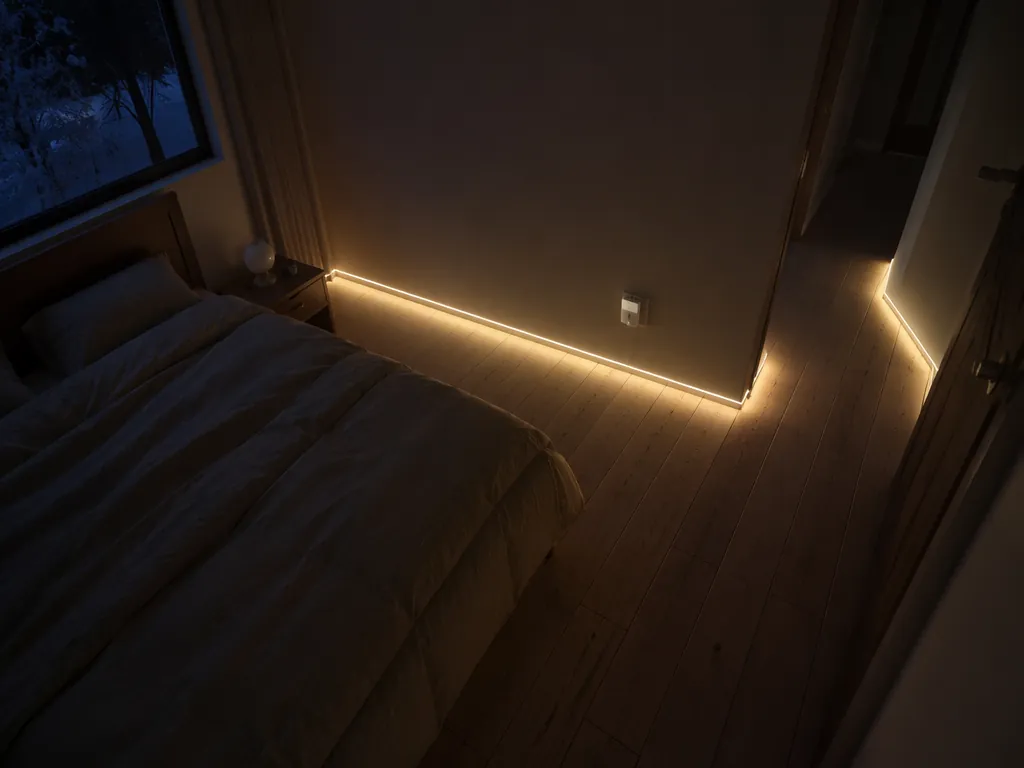
LED guiding strips are more specific than a night light. They mark the path itself, often along a baseboard or floor edge, which can be especially helpful when the bed-to-bathroom route includes a turn, a narrow hallway, or a threshold. This is the category closest to the Radboud intervention: a guide rather than a glow.[3]
A strip can also make the gift feel less like a hospital device if it is installed neatly and kept low. It does not have to announce itself during the day. At night, it gives just enough orientation: here is the floor line, here is the turn, here is the doorway.
The main caution is installation quality. A strip that peels up, creates a loose cord, or crosses a walking surface can introduce the very problem it is meant to reduce. Choose designs that keep cords out of the path, adhere securely, and can be removed without damaging the home if the older adult dislikes the placement.
Voice-activated and smart lights
Voice-activated lights can help in some homes, especially when an older adult already uses a smart speaker comfortably. They are less ideal as the only nighttime solution because they require the person to wake enough to speak clearly and remember the command. Motion is more reliable for the first step out of bed.
If smart lights are already part of the house, set them up as backup rather than theater. A simple command such as “bathroom light” is better than a complicated scene. The useful feature is not novelty. It is reducing the number of things someone has to do while sleepy.
How to choose without turning the house into a clinic
Safety gifts can land badly. A night light may be small, but the message can feel large: I am worried you will fall. That does not mean the gift is wrong. It means the delivery matters.
The least patronizing approach is to frame the gift around the house and the season, not the person’s decline. Winter makes the hallway darker. The bathroom route is awkward. The switch is in the wrong place. The light is there so no one has to think about it at 2 a.m.
- Choose plug-in lights when outlets are available, because they reduce battery maintenance.
- Choose motion activation for the first step out of bed, before hands are free or eyes are fully adjusted.
- Choose warm, low-glare illumination that marks edges without flooding the room.
- Choose coverage for the whole route rather than one attractive light in the middle of the hall.
- Choose removable or low-profile options if the older adult is sensitive to visible safety equipment.
It also helps to install the lights with permission, not as a surprise home inspection. Ask where the nighttime path actually goes. Some people do not use the nearest bathroom. Some avoid a hall rug. Some steady themselves on a dresser before they reach the doorway. The right placement is based on the route they really take, not the route that looks obvious in daylight.
Where traditional weather gifts fit
A barometer can be charming. A storm glass can be pretty on a windowsill. Weather radios have their own purpose in emergency preparedness. But if the gift question is about winter safety inside the home, those are not the first tools to reach for.
The better weather-themed gift addresses the condition winter creates indoors: earlier darkness and longer nights. Automated path lighting is not a complete fall-prevention plan. It will not replace medication review, vision care, strength work, footwear, grab bars, or removing trip hazards. And the Radboud study does not prove fewer falls.[3] It does show that older adults using automated guiding lights reported less fear of falling at night and better sleep quality, which is a practical and meaningful place for a gift to work.
For an older adult who gets up in the dark, that is a better winter present than another object meant only to make the season feel cozy. It changes the route.
References
- Facts About Older Adult Falls, CDC, https://www.cdc.gov/falls/data-research/facts-stats/index.html
- The Prevalence and Causes of Nocturia, Bosch & Weiss, 2010
- Automatic Lighting for Preventing Falls in Older Adults: A Pilot Study, Gerontology, 2020, https://pmc.ncbi.nlm.nih.gov/articles/PMC7949218/
- Gift ideas for older adults that promote safety and independence, Ohio State Health & Discovery, https://health.osu.edu/wellness/prevention/gift-ideas-for-older-adults
- How Motion Detector Lights Can Help Seniors Avoid Falls, Lifeline, https://www.lifeline.com/blog/how-motion-detector-lights-can-help-seniors-avoid-falls/
Related reading
Noticed something outdated or inaccurate on this page? Flag a correction. We review every report against CDC, NIA, and AARP HomeFit guidance before updating a page.
Part of the Fall Prevention section.