
When Falls Signal the Need for 24/7 Home Care: A Decision Framework for Families
Recurrent falls are a clear signal that part-time help may no longer be enough. This article provides a three-level decision grid linking fall frequency to the right care model — from home modifications and part-time care to live-in or 24-hour shift care.
Recurrence Is the Real Signal
Every 11 seconds a senior lands in an emergency room for a fall. More than 800,000 hospitalizations a year. Twenty-seven thousand deaths. Those are the numbers from the National Council on Aging, and they are meant to alarm.
They do alarm. But they do not tell you what to do about your own parent.
The number that should get your attention is not the 1 in 4. It is the second fall.
A single fall is bad. A second fall within weeks tells you the current setup is not containing the risk. That is the moment to stop thinking about modifications and start thinking about supervision.
The Fall Cascade
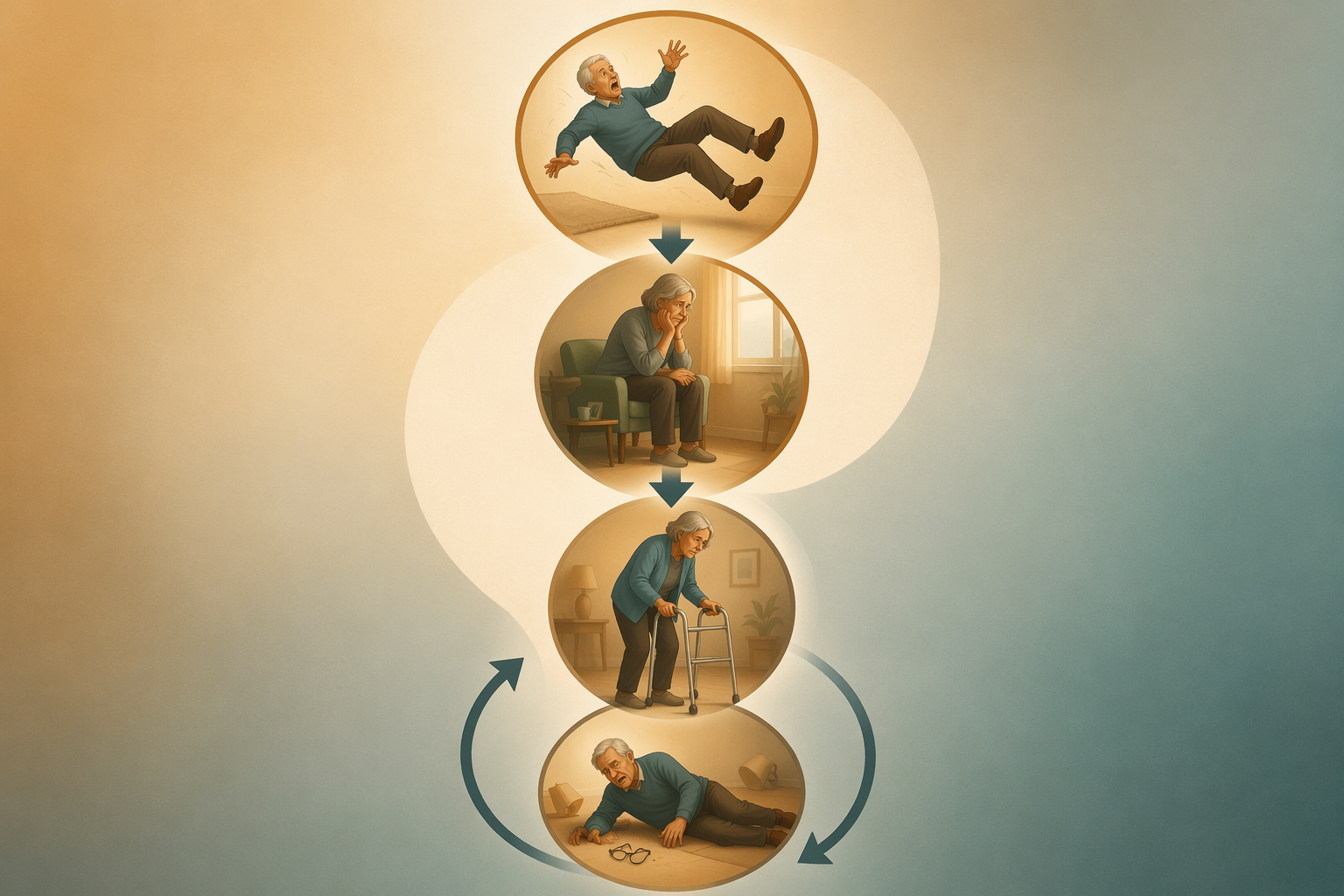
A fall does not end when the bruise heals. The real damage begins afterward. Fear of moving sets in. The senior starts avoiding stairs, stops walking to the mailbox, stays in the chair longer. Muscles weaken. Balance deteriorates. The next fall becomes more likely.
This is the fall cascade: injury → fear → deconditioning → repeat fall. It is well documented. And it means a single fall is never isolated — it resets the risk baseline higher.
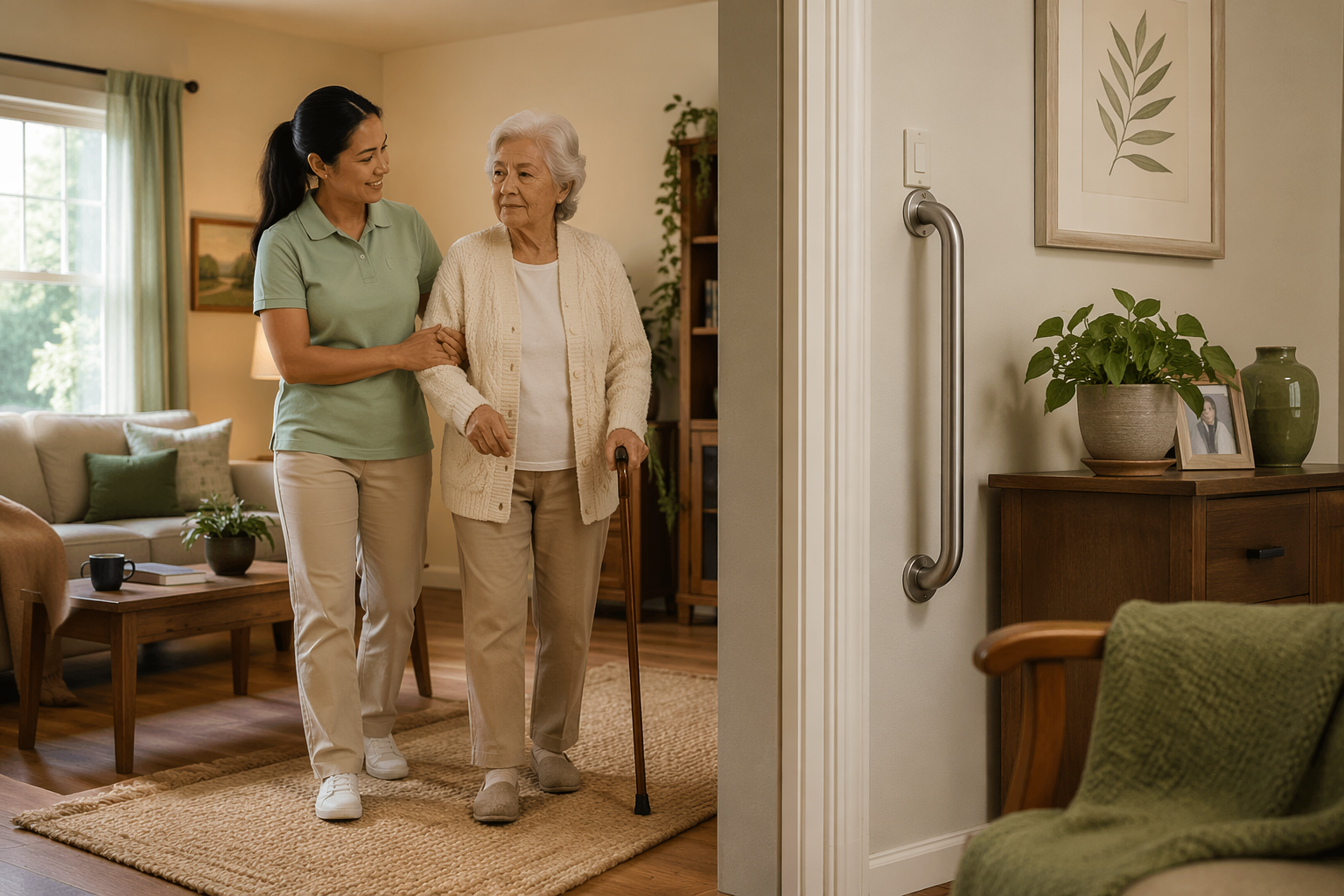
Home modifications will help. Non-slip rugs, grab bars, better lighting — they are necessary. But if your parent is getting up at night without calling for help, modifications alone will not stop the cascade.
Matching Staff to Fall Frequency
Here is the framework I wish every family had before they called an agency. It matches fall frequency and context to the staffing model that actually fits.
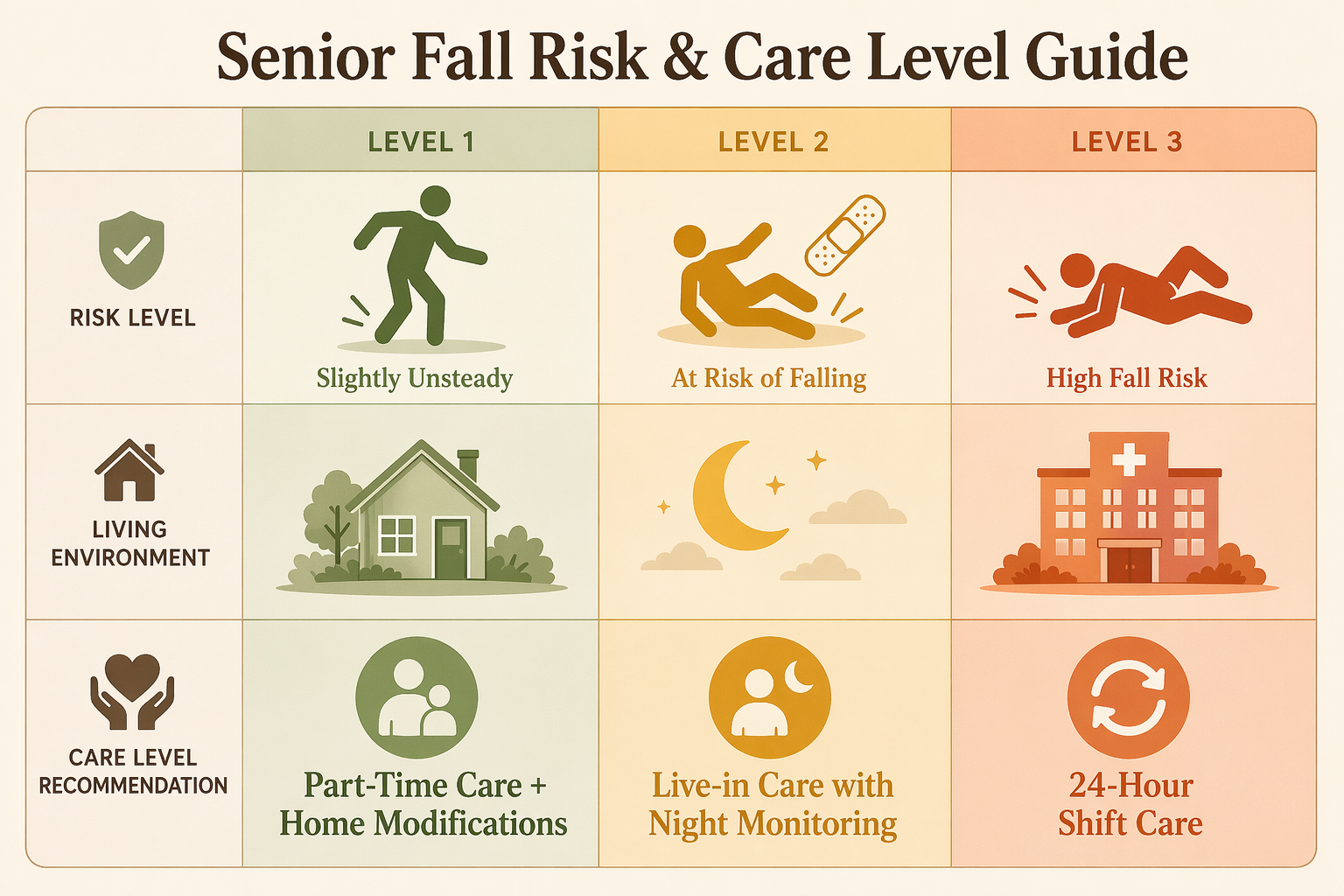
| Level | Fall Pattern | Staffing Model | Critical Caveat |
|---|---|---|---|
| Level 1 | Occasional stumbles, no injury | Part-time care (4–8 hrs/day) + home modifications | Works only if no nighttime attempts to get up. |
| Level 2 | Monthly falls with minor injury (bruise, cut) | Live-in care (1 caregiver, 24-hr shift with 8-hr sleep break) | Senior must sleep through the night with minimal assistance. Nighttime wakefulness or sundowning breaks this model. |
| Level 3 | Weekly falls, ER visits, post-hospital recovery | 24-hour shift care (2–3 caregivers, rotating awake shifts) | No sleep gap. Someone is awake and alert at all times. |
Level 1: Occasional Stumbles
Your parent has tripped once or twice in the past six months. No broken bones. They get up on their own or with minimal help. Part-time care — a home health aide for a few hours to assist with bathing, meals, and mobility — plus a thorough home safety assessment is often sufficient.
This is the moment to fall-proof the home and start monitoring fall patterns. Keep a simple log: date, time, what happened, whether help was needed. If a second stumble occurs within a month, escalate.
Level 2: Monthly Falls with Minor Injury
Now you are seeing bruises, cuts, a sprained wrist. The senior is afraid to walk alone but still tries. This is the most common entry point for live-in care — one caregiver lives in the home and provides supervision around the clock.
But here is the detail most families miss: live-in care includes an eight-hour break for the caregiver to sleep. Senioridy puts the typical cost at $5,500–$9,000 per month, but the key question is not cost — it is whether the senior sleeps through the night. If they wake up, become confused, and try to get out of bed, the live-in caregiver may not be awake to prevent the fall.
Homewatch CareGivers explicitly notes that nighttime wakefulness or sundowning indicates live-in care is usually not sufficient. I would say it bluntly: if your parent is getting up at night, skip live-in and go straight to shift care.
Level 3: Weekly Falls or ER Visits
A fall every week. A hospitalization. A hip fracture that requires rehab. At this frequency, you need 24-hour shift care — two or three caregivers working overlapping shifts so someone is always awake and alert.
TheKey explains that 24-hour care uses two 12-hour shifts or three 8-hour shifts. No sleep break. The caregiver is there to respond immediately when the senior tries to get up. Cost ranges from $10,000 to $20,000+ per month, depending on location and agency.
This level is also the one most often triggered by a hospital discharge. If your parent was hospitalized for a fall-related injury, Medicare home health may cover short-term skilled nursing, but it will not cover the 24/7 supervision needed to prevent the next fall.
The Nighttime Question Changes Everything
I have yet to meet a family who asked the agency, “Is the caregiver allowed to sleep?” before signing a contract. They assume 24-hour means awake. It does not.
Live-in care means one person stays in the home for 24 hours but is legally entitled to eight hours of uninterrupted sleep and several hours of personal break time. If the senior tries to get up at night, the response time depends on whether the caregiver wakes up. That is a gamble I would not take with a recurrent faller.
Twenty-four-hour shift care eliminates the gamble. Someone is always awake. That is the only model that guarantees immediate assistance, every time.
Home Modifications Help, but They Are Not Enough
No matter which staffing model you choose, the home environment matters. A cluttered hallway, a loose rug, a bathtub without grab bars — these multiply fall risk.
But here is the boundary: home modifications prevent falls that would happen anyway. They do not prevent the cascade once the senior is already in a fall cycle. A grab bar does not stop someone from trying to walk to the bathroom at 3 a.m. when they are confused. That is what supervision is for.
For a thorough room-by-room guide, see our fall prevention guide with a CAPS specialist. For the layered system of modifications, monitoring, and services, read the full fall prevention system guide.
Also, not all falls are caused by the same thing. Medication side effects, vision changes, vestibular disorders, undiagnosed neuropathy — any of these can trigger a fall. A geriatric care manager can help you sort through the medical, environmental, and social factors. The senior health services guide can help you match services to your parent’s actual needs.
Questions to Ask Every Agency
You are not just hiring someone to be in the house. You are hiring someone to prevent the next fall. These are the questions that separate a well-prepared agency from one that just sends a warm body.
- Is the caregiver trained in fall prevention and safe transfer techniques? Ask for specifics, not a promise.
- Is the caregiver awake during night hours, or is this a live-in arrangement with a sleep break?
- If live-in: What happens if the senior tries to get up at night? Is the caregiver expected to wake and assist, or is that considered a break interruption?
- What is the protocol after a fall? Does the caregiver call 911 immediately? Who notifies the family?
- How do you document falls and near-falls? Is there a written log shared with the family weekly?
- Do you have a fall risk assessment tool you use during intake? Can I see it?
- Can you provide references from families who transitioned from part-time to 24-hour care due to falls?
The decision is hard. The cost is high. But the question is not whether you can afford 24-hour care. It is whether you can afford another fall.
Related reading
Noticed something outdated or inaccurate on this page? Flag a correction. We review every report against CDC, NIA, and AARP HomeFit guidance before updating a page.
Part of the Fall Prevention section.